Short answer: Ubuntu’s current Canonical option is Myna, an optional technology preview for local speech-to-text. It inserts dictated words into the focused application, but it is not a voice assistant and cannot operate the desktop by voice. “GNOME Voice Control” is not established by the available GNOME evidence as a built-in product; the phrase currently points to a GNOME proposal and separate third-party applications whose capabilities must be checked individually.
What this comparison is—and is not
The wording matters because it joins two different ideas. Dictation turns speech into text in the field where your cursor is active. Voice control interprets spoken commands to activate buttons, switch windows, scroll, launch applications, or otherwise operate a desktop. A dictation engine can be excellent at one job without doing the other.
As an Amazon Associate I earn from qualifying purchases.
Canonical’s Ubuntu project is called Myna. It was announced as a technology preview on 12 October 2026, not as a finished feature that is universally installed on Ubuntu. The GNOME material available for this comparison is a 26 June 2026 community discussion proposing a desktop-wide offline speech-to-text service. That discussion names independent projects, rather than documenting an official GNOME component named “GNOME Voice Control.”
Consequently, there is no evidence-based product benchmark between Myna and one standard GNOME voice-control package. The useful comparison is between Myna’s documented behavior and the range of third-party approaches associated with GNOME. Their current support, command vocabulary, language coverage, and maturity can differ substantially.
#1 Best Overall

- 360 Degree Position Adjustable Gooseneck Design --Plug and play USB microphone Pick up the sound from 360-degree with high sensitivity, in the best possible location for sound to your PC gaming, dragon voice dictation, and talk to Cortana
- Mute Button & LED Indicator --One-click to mute/unmute your microphone for pc, Build-in LED indicator tells you the working status at any time
- Intelligent Noise-Canceling Tech --Premium omnidirectional condenser microphone with noise-canceling technology can pick up your clear voice and reduce background noise and echo
- USB Plug&Play(1.8/6ft USB Cable) -- No driver required. Just need to plug & play for the microphone to start recording, well compatible with Windows(7, 8, 10 and 11) and macOS. (NOT compatible with Xbox/Raspberry Pi/Android)
- Solid Construction--Adopting premium metal pipe and heavy-duty ABS stand to make sure that you will be satisfied with our computer mic quality
Canonical’s primary announcement is the best place to verify changes before installing: Myna speech-to-text is now available as a technology preview.
Ubuntu Myna: current status and scope
A technology preview, not a default Ubuntu capability
Myna is optional. Canonical describes it as an Ubuntu 26.10 feature preview and publishes installation coverage for Ubuntu 24.04 LTS, Ubuntu 26.04 LTS, and Ubuntu 26.10. The supported combination is narrower than the Ubuntu brand name suggests: the announcement specifies amd64 and amd64v3 systems running GNOME on Wayland.
That status has practical consequences. Preview software can change its setup, shortcut behavior, supported applications, and model requirements. Canonical is actively asking users to report transcription quality, responsiveness, language and accent behavior, application compatibility, setup issues, and results across different computers and microphones. Those requests identify areas under evaluation; they are not published guarantees or measured weaknesses.
Do these 3 things before closing this tab:
1Fix the driver behind crashes, sound loss and screen glitches2Repair Windows errors before they cause bigger problems3Scan for outdated or missing drivers - takes under a minuteWhat Myna is designed to do
Myna’s basic interaction is deliberately simple:
- Place the cursor in a text field in the application you want to use.
- Press the shortcut configured for Myna.
- Speak while Myna displays real-time recognition feedback.
- Stop or toggle the configured interaction and let the recognized text be inserted into the focused application.
The target is text entry, not a conversational assistant. Canonical explicitly says Myna is “deliberately focused on dictation” and “is not a voice assistant and does not control the desktop through voice commands.” It therefore should not be evaluated as a hands-free replacement for keyboard navigation, accessibility command software, or an application automation system.
Eligibility and installation
Check the conditions first
Before changing software sources, verify all of the conditions in the published preview announcement:
- Ubuntu 24.04 LTS, Ubuntu 26.04 LTS, or Ubuntu 26.10.
- An amd64 or amd64v3 machine.
- A GNOME desktop session running on Wayland.
- A microphone that your Ubuntu audio system can expose to applications.
- Sufficient disk space for the recognition model you choose to download.
The announcement does not provide a complete language matrix, a universal application-compatibility list, or numeric CPU, memory, storage, accuracy, or latency requirements. A machine can meet the platform labels and still produce a poor experience with a weak microphone, an unsupported language, a busy processor, or an application that does not accept the insertion method.
Rank #2

- 【Crystal Clear Audio Quality】Our Omnidirectional pattern condenser microphone accurately captures your voice, making it perfect for dictation, online classrooms, and more.
- 【Active Noise-Cancelling】Come in CMTECK CCS2.0 SMART CHIP with Omnidirectional Polar Pattern, which can effectively block the background noise. The pop filter prevents plosives from overloading the microphone, ensuring only your voice is heard.7
- 【Convenient Mute Button with LED Indicator】You can quickly mute/un-mute the microphone with the Mute Button and the built-in LED light lets you know the working status(Greenlight: Connected; Red light: Mute mode).
- 【Easy to use】 No drivers needed, just plug and record without external power supply, directly connect the microphone to a USB compatible device, well compatible with Windows(7, 8 and 10), Mac OS and PS4 (NOT compatible with Raspberry Pi/Linux/Android)
- 【Mini size with Adjustable Gooseneck】Adopted flexible and adjustable gooseneck metal pipe, easily adjust position 360 degrees to suit user comfort. The compact and stable base maximizes your desktop space.
Install the preview from Canonical’s published instructions
Canonical’s setup uses a personal package archive (PPA). Because preview instructions and package names can change, check the current announcement immediately before installation.
What’s actually slowing this PC down?
Pick the symptom - the matching free tool is one click away.
- Open a terminal and add Canonical’s Myna PPA:
sudo add-apt-repository ppa:canonical-desktop-team/myna - Refresh package metadata:
sudo apt update - Install the configuration package:
sudo apt install myna-config - Open Activities and launch the Myna configuration entry. Use its setup flow to download a recognition model, choose the available engine, select an input microphone, and configure the shortcut.
- Test in a plain text field first. Put the cursor in the field, press the configured shortcut, speak a short sentence, and confirm that text appears before trying a complex editor or a remote desktop session.
If the package manager reports that your release, architecture, or session is unsupported, do not force-install a package from another Ubuntu release. The preview’s stated support boundaries are part of its technology-preview status.
Recognition engines, models, and hardware
Engine choices
Canonical says that Myna can use Parakeet, Whisper, and FunASR recognition engines. The announcement does not publish a head-to-head score, word-error rate, latency chart, or complete list of model variants. Choosing an engine is therefore a practical experiment based on your language, accent, computer, and microphone rather than a documented ranking.
Model downloads are a one-time prerequisite for each selected model. After a model is installed, Canonical says transcription runs on the machine and does not need an internet connection. Downloading or changing models still requires the normal network access needed to obtain the files.
GPU acceleration
A supported NVIDIA GPU can enable a GPU-accelerated engine. Support for other accelerators is described as planned, not current. If no supported GPU path is available, Myna can use the computer’s CPU, but the published material supplies no performance number to predict responsiveness on a particular processor.
For a fair personal test, keep the model, microphone, speaking distance, and sample text constant when switching engines. Record whether words appear promptly, whether punctuation needs correction, and whether the system remains responsive while another application is busy. These observations are useful for your machine, but they are not a general benchmark.
Rank #3

- HIGH SENSITIVITY for CLEAR CALL - This portable USB microphone adpots a 6*10mm high sensitivity condensor microphone to capture clear voice, the audio signal processed by multi levels of audio gain amplifier and advanced ADC module, it provides crystal clear voice, reliable compatibility and noise cancelling. It's able to capture voice in 10ft distance clearly -it's very small, but powerful. Plug it into the computer, you'll experience better con-call immediately.
- PLUG-and-PLAY - The USB 2.0 interface is widely compatible with the most computer devices (Windows, Mac, Raspberry Pi, Linux, Chromebook & etc ) and softwares (Google Meetings, Zoom, Team, Skype & etc). Just plug it into the USB port and done. No extra driver or settings are required.
- COMPACT & PORTABLE - Like a flash disk, you can put it in the pocket with ease. Carry it with your laptop, and plug it in when you need it. No more tangled cords or bulky bases hogging your desk space, This mic is on a mission to keep your workspace sleek and organized.
- IDEAL REPLACEMENT - If you are looking for a quality microphone for work at home, online conferencing, online class, live streaming and webinar, this is a great choice. It's not a recording studio grade microphone, but the sound quality is better than most of laptop built-in microphones, and it's completely enough to meet your general demand.
- WHAT YOU GET - Packed in a metal carrying box, and comes with 12 months waranty. For any concern, you can send us messages and we will respond in 24 hours.
What “GNOME Voice Control” currently refers to
The GNOME discussion is a proposal
The GNOME Discourse thread dated 26 June 2026 is titled “Proposal: Desktop-wide offline speech-to-text / dictation support.” Its author describes a prototype with a local Whisper backend in a Podman container, a Python D-Bus service, and a keyboard shortcut, then asks whether GNOME should provide a standard service. That is a design discussion, not release documentation for a GNOME product.
The thread does not establish that GNOME ships a built-in application named GNOME Voice Control. It also does not establish one shared installation method, command vocabulary, privacy policy, language list, or Wayland behavior for every project mentioned in the discussion.
Third-party projects named in the discussion
Participants point to projects including Speed of Sound and EasySpeak. The EasySpeak developer describes it as a GNOME- and Wayland-first application covering both voice control and dictation, and identifies it as alpha at that date. The thread also contains claims about project features such as portal support and X11/Wayland operation for Speed of Sound. These are statements in a community conversation, not independent compatibility tests.
Outdated Drivers Are Slowing You Down
One free scan finds every outdated or missing driver and matches the right update for your exact hardware.Free scan · exact hardware matchWindows Errors? Fix Them Before They Spread
Repair common Windows errors and clear accumulated junk for a smoother, more stable PC - no reinstall needed.Free scan · no reinstallIf you investigate one of these tools, read its own current documentation for installation, supported desktop sessions, permissions, model downloads, command scope, language support, and maintenance status. Do not substitute a third-party project’s behavior for GNOME’s platform guarantees.
The source discussion is available at GNOME Discourse: Proposal: Desktop-wide offline speech-to-text / dictation support.
Feature comparison
| Question | Ubuntu Myna | GNOME-associated tools |
|---|---|---|
| What is it? | Canonical’s optional technology preview, announced 12 October 2026. | The cited GNOME item is a proposal thread that names separate projects; it is not a built-in product specification. |
| Primary job | Dictate text into the focused application. | Depends on the selected project. EasySpeak’s developer describes both voice control and dictation. |
| How it starts | A configured keyboard shortcut, followed by speech. | Tool-specific; the thread does not establish a shared GNOME workflow. |
| Where recognition runs | Canonical says it runs locally after the model download and works offline for transcription. | The proposal mentions local models, but local processing is not a universal guarantee for every GNOME-associated tool. |
| Stated platform coverage | Ubuntu 24.04 LTS, 26.04 LTS, and 26.10 on amd64/amd64v3 with GNOME on Wayland. | Tool-specific. The discussion mentions differing project claims without independently validating them. |
| Voice commands | Explicitly outside Myna’s initial scope. | May be available in a particular voice-control application; verify its current command set. |
| Published accuracy or speed benchmark | Not stated in Canonical’s cited announcements. | Not stated in the cited GNOME discussion. |
| Language and accent coverage | Canonical requests feedback; a complete matrix is not stated. | Not established for GNOME as a whole; check the selected project. |
The table compares what the cited sources actually establish. “Not stated” is more informative than assigning a winner from unrelated Whisper, Parakeet, or FunASR tests, because model versions, hardware, audio quality, and decoding settings can change the result.
Rank #4

- Crystal-Clear Sound: This computer microphone features exceptional 360-degree omni-directional audio pickup, capturing your voice with clarity and natural tone within the optimal 6-12 inch range. And with windproof fluffy caps, the microphone can reduce the breaking noise generated by the spray and wind. You can create professional, authentic recordings effortlessly – without requiring specialized software or sound cards.
- Plug-and-Play, Easy To Use: No drivers or software, simply plug this usb microphone into your PC to be game-ready in seconds for gaming, streaming, or chatting. microphone for computer desktop for video recording is for windows and mac compatible. ( not a speaker.)
- Mute Button & LED Indicator: The gaming microphone features a touch-sensitive mute button, which allows you to instantly mute/unmute your computer microphone for desktop. This mute function effectively prevents audio mishaps during chats or recordings, ensuring your peace of mind. The built-in LED indicator shows the microphone status in real time (green: connected/working; red: mute mode).
- Multifunction Use: The microphone for podcast can be automatically recognized on your computer or pc. The desktop microphone for pc is versatile, not only it can be used for gaming, singing, home studio, Yahoo recording, YouTube recording, but also can use it for court reporting, remote training, business negotiation, video chatting and so on.
- Premium Materials & User-Friendly Design: This streaming microphone features a metal gooseneck tube and ABS shockproof base for durability, and a non-slip silicone pad that won't budge even if you tap the desktop hard during a passionate live broadcast. The small and compact design allows you to carry this gaming microphone pc in your backpack to the office, conference room or home without taking up a lot of space.
Dictation versus desktop control
When Myna is the better fit
Investigate Myna when your main task is writing: email, notes, form fields, issue descriptions, or other text-entry work. Its focused-application model is easy to understand, and its local operation may suit users who do not want audio sent to an online transcription service. You still need to proofread, because no accuracy guarantee or universal language list is published for the preview.
Quick wins for a faster PC:
Scan for outdated or missing drivers - takes under a minuteDriver Scan →Repair Windows errors before they cause bigger problemsFix Now →Fix the driver behind crashes, sound loss and screen glitchesFind Drivers →When Myna is the wrong tool
Myna does not satisfy requirements such as “open the browser,” “switch to the next window,” “click the Save button,” “scroll,” or “run this command.” Canonical places voice assistants, desktop voice commands, translation, and automatic language detection outside the initial project scope. A separate voice-control application is required for those jobs, and its command grammar and safety behavior must be evaluated independently.
When you need both
A user may combine a dictation utility with a voice-control tool, but running two audio-triggered programs can create shortcut conflicts, competing microphone access, duplicated speech recognition, or unexpected command activation. Configure one push-to-talk path at a time, test which application receives focus, and disable overlapping hotkeys before relying on the setup for work.
Independent reader supportYour contribution helps us test, update, and keep practical guides available for everyone.Privacy and offline operation
Canonical states that Myna’s recognition engines run on the user’s machine and that, once the model is downloaded, transcription needs no internet connection. Its June 2026 project announcement says, “No audio recordings are uploaded to external services.” That is Canonical’s description of the initial implementation, not an independent privacy audit or a guarantee covering every future engine, diagnostic feature, or third-party integration.
Local processing reduces dependence on a cloud transcription account, but it does not eliminate ordinary desktop privacy considerations. Microphone permissions, other applications with audio access, crash reports, logs, and model-download traffic should be reviewed under your organization’s policies. A GNOME-associated tool may have a different architecture, so do not infer its privacy behavior from Myna or from the GNOME proposal.
Free tools Windows power users keep installed
One-click scans. No signup required.
Read Canonical’s project announcement for the design context: Introducing Myna: Speech to Text for Ubuntu Desktop.
Best Value
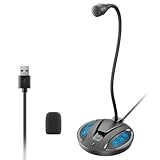
- Studio-Quality Sound: This desktop microphone for pc features an omnidirectional pickup pattern, focusing on your voice to capture every detail for loud, powerful audio. Its intelligent noise reduction effectively filters out keyboard clicks, fan humming, and background noise, delivering crystal-clear, distortion-free sound. Experience exceptional audio quality with this must-have computer microphone for desktop.
- Plug & Play USB Microphone for PC with Wide Compatibility: No drivers or complex setup! Connect directly to Windows/Mac via USB and be ready in seconds. Works flawlessly as a streaming microphone or podcast microphone with native support for Zoom, Teams, Skype, YouTube, Twitch and more. ( not a speaker.)
- One-Tap LED Mute & Ambient Lighting: This essential desktop microphone features an eye-catching mute button with instant tap control – mute/unmute effortlessly during calling or streaming. Customizable breathing lights (on/off switch) enhance your gaming microphone setup with sleek tech aesthetics, elevating any workstation or gaming mic with premium ambiance.
- Flexible Gooseneck Wired Desktop Microphone: Designed for pc gaming, this microphone for computer features a fully adjustable 360-degree metal gooseneck for effortless positioning and optimal sound capture. The flexible 5.7-inch gooseneck offers superior convenience, allowing you to easily orient it horizontally or vertically to suit the speaker's comfort. Perfect for online meetings and capturing studio-quality audio during live recordings.
- Durable: Built with a high-grade metal gooseneck and a weighted, shock-resistant ABS base featuring non-slip silicone pads, this podcast mic remains steadfastly anchored, resisting displacement even during enthusiastic live streaming sessions. Compact and remarkably lightweight, its design enables easy portability, effortlessly stow this versatile usb microphone in your bag for immediate use in offices, meeting rooms, or home studio setups.
How to evaluate transcription on your own system
- Confirm the session. Check that you are using the stated GNOME-on-Wayland environment and a supported Ubuntu release before troubleshooting recognition quality.
- Use a repeatable sample. Dictate the same paragraph containing names, numbers, punctuation, and technical terms with each engine you want to compare.
- Keep audio conditions stable. Use the same microphone position, room, speaking volume, and background-noise level.
- Measure the work, not a headline score. Note correction time, missed words, punctuation errors, delay before text appears, and whether another application makes the interface lag.
- Test target applications. Try a simple text editor, a browser form, and your main writing application. Focused-field insertion can behave differently in each program.
- Test your language and accent. Canonical is collecting feedback in this area, and no complete support matrix is published. Treat successful English dictation as insufficient evidence for another language.
- Test recovery. Confirm that you can cancel recognition, reclaim the microphone, and return to keyboard input if the preview stops responding.
Keep these notes separate from claims about general accuracy. They describe your hardware, model, application, and speaking conditions, not a universal ranking.
Troubleshooting common failures
The shortcut does nothing
- Open Myna’s configuration from Activities and verify that a shortcut is assigned.
- Check for a collision with the desktop, window manager, accessibility utility, or another speech application.
- Confirm that the Myna process is running and that the microphone is available to the logged-in session.
- Try a basic text field rather than a terminal, sandboxed application, remote desktop, or elevated window.
The model will not download or install
- Confirm network access for the initial download; offline operation begins only after the model is present.
- Check free disk space and retry the model selection in Myna’s configuration.
- Recheck your Ubuntu release and amd64/amd64v3 architecture against the preview announcement.
- Do not mix packages from another Ubuntu release to bypass an eligibility error.
Text appears slowly or recognition stops
- Try a smaller or different supported engine if Myna offers one for your language.
- Close heavy workloads and compare CPU behavior with and without a supported NVIDIA GPU path.
- Move the microphone closer, reduce background noise, and repeat the same sample.
- Record the model, machine, microphone, and application when reporting the problem; Canonical specifically requests feedback on responsiveness and hardware.
Words are accurate in one application but not another
Myna inserts into the focused application, so the receiving program matters. Verify that the cursor is active, test a plain text editor, and then test the target application. A failure in one program does not establish that the recognition engine itself is inaccurate.
Microphones and accessibility considerations
Canonical invites preview feedback across different microphones, which makes the microphone an important test variable. An optional USB microphone may help if your built-in mic produces low volume or captures fan noise, but the published material does not identify a best model, promise an accuracy improvement, or require a purchase. First test positioning, input-level settings, and background noise with hardware you already have.
The Tool Desk
Outbyte PC Repair FREERepair Windows errors before they cause bigger problemsFix Now →Outbyte Driver Updater FREEFix the driver behind crashes, sound loss and screen glitchesFind Drivers →Push-to-talk is often easier to reason about than an always-listening trigger: you know when audio is being captured and can prevent accidental dictation. Myna’s documented workflow is shortcut-based, but the exact key is configured by the user. Users who need continuous hands-free operation, spoken navigation, or switch-access commands should treat those as separate requirements and evaluate a dedicated voice-control or accessibility tool.
What the available evidence does not prove
- It does not provide a numeric word-error rate, latency measurement, language count, or controlled comparison between Myna and a GNOME-associated application.
- It does not establish perfect transcription, universal application compatibility, continuous hands-free control, translation, or automatic language detection for Myna.
- It does not establish that every GNOME desktop includes a built-in feature named GNOME Voice Control.
- It does not make third-party projects mentioned in the GNOME thread equivalent in maturity, privacy, command coverage, or Wayland support.
- It does not establish support for non-NVIDIA accelerators today; Canonical describes that support as planned.
Which route should you choose?
- Choose Myna first if you run an eligible Ubuntu release with GNOME on Wayland, want local text dictation, and accept preview software.
- Investigate a separate GNOME-associated tool if your requirement includes spoken desktop commands, but verify that project’s current documentation rather than relying on the phrase “GNOME Voice Control.”
- Use a staged trial if you need both: test dictation and commands separately, assign non-conflicting shortcuts, and verify microphone ownership and application focus.
- Wait or avoid a preview deployment for a regulated or mission-critical workflow that requires published accuracy, latency, language, or support guarantees; the cited sources do not provide those figures.
As of October 2026, Myna is the clearest Canonical path for Ubuntu speech-to-text, while GNOME voice control remains a broader category of proposals and third-party applications. The deciding questions are not which label sounds more capable, but whether your release and session are eligible, whether local dictation meets your language and accent needs, and whether you actually need text insertion or spoken control of the desktop.
Quick Recap
Product prices and availability are accurate as of the date/time indicated and are subject to change. Any price and availability information displayed on Amazon at the time of purchase will apply.

