Recommended Free Tools
TimeTeller is a circadian-medicine technology that uses molecular data and machine learning to estimate an individual’s internal biological time. A 2024 peer-reviewed methods paper shows the underlying algorithm can infer clock timing and dysfunction from a transcriptome. The company’s saliva-based service turns that concept into a home-collection workflow, but its clinical value for choosing treatments remains under investigation rather than established standard care.
What TimeTeller is
TimeTeller is designed to measure circadian-clock function at the molecular level. The core method, described in a 2024 paper in PLOS Computational Biology, treats the circadian clock as a noisy dynamical system involving many genes. A machine-learning model analyzes one transcriptome and produces a likelihood curve that can estimate internal timing, visualize clock structure and identify patterns consistent with clock dysfunction.
As an Amazon Associate I earn from qualifying purchases.
The method was demonstrated with mouse, baboon and human microarray or RNA-sequencing data. That is important evidence that the computational approach can work across species and data types, but it is not the same as proving that every commercial test gives a clinically actionable result for every person.
The company’s saliva workflow
TimeTeller says customers collect saliva at home, mail the sample to a laboratory and receive a report containing an individual circadian profile and recommendations. Saliva is a practical, less-invasive source of biological material, while the algorithmic research is about transcriptomic measurement in general. Product workflow and performance claims should therefore be distinguished from the peer-reviewed methods paper.
#1 Best Overall
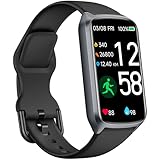
- 【24H Accurate Health Monitoring】Measure your Heart Rate, Blood Oxygen, Blood Pressure and Stress with this Fitness Tracker. Understand your physical state, especially for high-intensity or outdoor work such as high temperature, brainstorming, stay-up and get professional analysis on how to relax in a healthier and better way. Amzhero Fitness Tracker also analyzes sleep quality and score your sleep quality to help you adjust your sleep habits more tools
- 【25 Sports Modes & Fitness Tracker】Amzhero Fitness Tracker supports 14 sports such as walking, running, mountaineering, swimming, yoga, hiking, cycling, treadmill, etc . Accurately record all-day activities like steps, distance, calories burned, miles walked, active minutes and give professional analysis on improving your sports and daily habit
- 【Smart Life Partner with You】Check daily workout clearly on a 1.47'' HD bright color display. Create customized fitness schedules and goals, Get vibration alerts for all notifications, including phone calls, texts, and social media app alerts. Never miss a message with smart notifications delivered right to your wrist. You also can check real-time weather and change your music on the smartwatch
- 【15 Day Battery Life& 5ATM Waterproof】Fully charge for 2 hours, support 15 days standby time. Large capacity and low power consumption design offers longer endurance. Amzhero fitness watch is designed with 5ATM waterproof, you can wear it when washing hands, in the rain and swimming
- 【1-Year Warranty Promised & Wide Compatibility】Compatible with iPhone, Samsung etc., built-in BLE5.0 and 300mAh lithium-ion battery. Our free APP "Gloryfit" supports iOS 9.0 / Android 6.0 or above smartphones. If you have any questions, please don’t hesitate to contact us with any problem
Why an internal clock matters
Circadian rhythms coordinate behavioral, physiological and cellular processes over roughly 24-hour cycles. A 2023 review in Frontiers, alongside a related PubMed-indexed review, describes links between circadian disruption and sleep disorders, depression, diabetes, cardiovascular disease, obesity and cancer. Circadian medicine aims to align daily behavior and treatment with biological time rather than relying only on the clock on the wall.
Clock time is not necessarily biological time
Two people who go to bed at 11 p.m. can have different molecular phases because of genetics, light exposure, work schedules, illness, travel or medication. A questionnaire-based chronotype labels a person as an early or late type; a molecular profile attempts to estimate where the person’s clock is currently operating and whether its signals appear coherent. The PLOS model’s likelihood curve is intended to contain information about both phase and dysfunction, not just a preference for mornings or evenings.
How a TimeTeller-style profile is produced
- Collect a biological sample. The company describes an at-home saliva collection that is then shipped to its laboratory.
- Measure molecular signals. Laboratory analysis generates transcriptomic data from the sample. The published algorithm was developed for transcriptome data; the company’s product-specific laboratory details are not fully established by that paper.
- Run the clock model. Machine learning estimates the most likely internal timing and produces measures that can indicate altered or weakened clock structure.
- Return a report. TimeTeller says its report can include guidance on sleep, physical activity, nutrition, daylight exposure and treatment timing.
- Interpret with a clinician. A profile is not a diagnosis and should not be used to change a prescription, dosing time or cancer regimen without the treating professional.
Potential use in personalized treatment
The principal medical idea is chronotherapy: scheduling an intervention when a patient’s biology may improve benefit or reduce toxicity. TimeTeller lists possible applications in chemotherapy, radiotherapy, immunotherapy, hormone therapy, targeted therapy and combinations. These are intended applications, not evidence that the service has established an optimal schedule for each treatment.
What oncology research is testing
The UK Health Research Authority lists ITTACA, a study in people with advanced lung cancer receiving immunotherapy. It is investigating hair and buccal-mucosa samples as practical, non-invasive ways to determine internal-clock time and monitor individual circadian rhythms. ITTACA is evidence of clinical-translation work; it does not show that TimeTeller has become routine care or that a clock estimate improves survival.
The company’s press material also presents personalized timing recommendations for sleep, exercise, food, light exposure and treatment. Lifestyle scheduling may be lower risk than changing a drug schedule, but even behavioral advice should account for a person’s medical conditions, work obligations and clinician guidance.
Rank #2
![SAMSUNG Galaxy FIT 3 [2025, 40MM] 1.6' AMOLED Display | IP68 Water Resistant | 14 Days Battery Life | 100+ Watchfaces | 100+ Exercise Modes | International Model (Fast Charger Bundle, Black)](https://m.media-amazon.com/images/I/418RlYE+wfL._SL160_.jpg)
- Vibrant 1.6” AMOLED Display – Large, high-res screen with smooth touch for easy navigation
- 5ATM & IP68 Water Resistance – Swim-ready and dust-resistant for active lifestyles
- Up to 14 Days Battery Life – Powerful 208mAh battery for long-lasting performance
- 101+ Workout Modes with Auto Detection – Automatically tracks common workouts for seamless fitness tracking. Advanced Health Tracking – Includes sleep coaching, SpO2, heart rate, and snore detection
- International Model No Warranty in the US. ONLY compatible with Android devices. Samsung Pay - Not Supported. NOT compatible with iPhone or iOS devices.
What is—and is not—clinically validated
The strongest independent evidence is the peer-reviewed computational method and the broader circadian-medicine literature. The available material does not establish regulatory approval, universal treatment benefit or a validated rule that a TimeTeller result can safely determine when medication should be taken.
| Evidence or claim | What it supports | What it does not prove |
|---|---|---|
| 2024 PLOS Computational Biology paper | A machine-learning approach can estimate clock timing and dysfunction from transcriptomic data in mouse, baboon and human datasets. | That every commercial saliva report has the same accuracy or clinical usefulness. |
| Company saliva workflow | Home collection, laboratory analysis and a personalized report are the intended product experience. | Independent validation of diagnostic accuracy, treatment outcomes or regulatory status. |
| ITTACA study listing | Researchers are testing non-invasive samples for internal-clock measurement in advanced lung-cancer immunotherapy. | Proof that clock-guided immunotherapy is already standard practice. |
TimeTeller compared with common alternatives
| Approach | Measurement | Invasiveness | Typical output | Clinical maturity and action |
|---|---|---|---|---|
| TimeTeller-style molecular profile | Transcriptomic or other molecular signals | Saliva or another biological sample | Estimated internal phase plus clock-function metrics | Research and translation stage; treatment decisions require clinical oversight |
| Chronotype questionnaire | Self-reported sleep and activity preferences | None | Usual or preferred sleep timing | Useful for behavior planning, but it does not measure molecular phase |
| Wearable sleep tracking | Movement, heart rate and inferred sleep timing | Non-invasive device | Sleep duration, regularity and timing estimates | Can support lifestyle changes; it does not by itself establish a treatment schedule |
How to interpret the company’s headline figures
On its research page, TimeTeller says around 50% of human genes show rhythmic activity in at least one tissue. The same page says 90–95% of cancer drugs fail during development and attributes about 30% of those failures to excessive or uncontrollable toxicity. Those figures are company-presented context, not measurements of TimeTeller’s own performance.
The company also cites claims of up to fivefold better tolerability and almost double effectiveness for time-optimized treatment schedules. They should be treated as company-reported claims until the underlying studies, patient populations, therapies and endpoints are examined; no independent, general result establishing those gains across patients is provided here.
What readers should do with a result
- Use the report, if obtained, as one data point alongside symptoms, sleep history, laboratory findings and medical advice.
- Ask which sample type, assay, reference population and uncertainty range were used to generate the estimated phase.
- Do not delay cancer treatment or move a dose to a different time solely because a report suggests a circadian preference.
- For sleep or lifestyle changes, make one change at a time and consider shift work, light exposure, travel and existing conditions.
- Check whether the service is available and clinically supervised in your country; availability and regulatory status can differ by jurisdiction.
Why the launch matters
At launch, co-founder and CEO Prof. Dr. Angela Relógio said, “We are thrilled to launch TimeTeller, and are one step closer to bring time-based medicine solutions that are tailored to each patient’s individual needs.” The significance is the attempt to move circadian medicine from population averages toward an individual molecular profile. The unresolved question is whether that profile consistently changes outcomes in well-controlled clinical studies.
Bottom line
TimeTeller offers a credible research direction: infer an internal clock from molecular data, then use that information to personalize daily routines or, eventually, treatment timing. The algorithm has peer-reviewed methodological support, while the saliva product and oncology recommendations remain a developing clinical-translation effort. It should be viewed as an investigational measurement and discussion tool—not a diagnosis or an autonomous medication scheduler.
Quick Recap
Product prices and availability are accurate as of the date/time indicated and are subject to change. Any price and availability information displayed on Amazon at the time of purchase will apply.
Do these 3 things before closing this tab:
1Clear out junk files and repair common Windows errors2Scan for outdated or missing drivers - takes under a minute3Repair Windows errors before they cause bigger problems
