Nickel-metal hydride (NiMH) batteries are best at one job: powering devices you use often, in common cell sizes such as AA and AAA, without buying disposables each time. Their advantages are real, but so are the trade-offs: a 1.2 V nominal voltage, charge loss in storage, lower energy density than lithium-ion, and sensitivity to how they are charged. This guide covers the benefits first, then the limits, then how to decide.
The main advantages of NiMH batteries
1. They are rechargeable and sold in everyday sizes
NiMH cells are made in standard consumer formats, including AA and AAA, as Battery University’s NiMH overview documents. Where a device accepts the cell size and voltage, you can recharge the same cells instead of replacing them. National Instruments’ battery-selection guidance notes that rechargeable cells can be more economical over the long term when they are the primary power source. It also says single-use alkaline may suit infrequent backup use.
As an Amazon Associate I earn from qualifying purchases.
No independent, market-wide study of lifetime cost for NiMH versus alkaline turned up in the sources reviewed. Any savings figure depends on how often you use the device, how many cycles the cells last, and what you pay for a charger. Treat claims of a specific dollar saving with caution.
Crashes, No Sound, or Screen Glitches?
Random freezes, missing sound and display glitches usually trace back to one bad driver. Find and replace yours safely.Free scan · under a minuteWindows Errors? Fix Them Before They Spread
Repair common Windows errors and clear accumulated junk for a smoother, more stable PC - no reinstall needed.Free scan · no reinstall2. Voltage stays relatively steady through discharge
National Instruments states: “The advantage of NiMH over alkaline (in addition to reuse) is a more constant voltage level over the life of the battery.” This is a qualitative point, not a promise that every device will run longer or better on NiMH. It does mean the supply does not sag as gradually as it does with alkaline cells, which can matter to equipment sensitive to voltage.
#1 Best Overall

- RELIABLE PERFORMANCE: 8-pack of AA rechargeable NiMH batteries (2,000 mAh)
- DEVICE COMPATIBLE: Ideal for remote controls, flashlights, clocks, and more
- LONG LASTING: Can be recharged up to 1000 times with minimal power loss
- LOW SELF DISCHARGE: Maintains 80% capacity for 2 years
- EASY USE & STORAGE: Shelf-life up to 5 years; great for everyday or emergency use; arrives pre-charged and ready to use
3. They offer more energy than standard NiCd
Battery University’s technical overview says NiMH provides 40% higher specific energy than standard nickel-cadmium (NiCd). That figure is a comparison against standard NiCd, as stated in the 2021 article. It does not extend to lithium-ion, and it will not hold for every NiCd or NiMH model.
4. Low-self-discharge versions exist
Conventional NiMH loses charge on the shelf, which is the chemistry’s best-known weakness. Some manufacturers sell low-self-discharge cells to address it. ANSMANN, for example, describes its maxE AA cell (1.2 V nominal, 2100 mAh) as having self-discharge ten times lower than regular NiMH, and says the cells ship pre-charged: “Since the batteries are supplied pre-charged, they can be used directly.” These are manufacturer claims about one product, not independent test results. The same page gives two different one-year capacity-retention figures (around 80% in one place, up to 95% in another), so neither number is quoted here as reliable.
Rank #2

- RELIABLE PERFORMANCE: 16-pack of AA rechargeable NiMH batteries (2,000 mAh)
- DEVICE COMPATIBLE: Ideal for remote controls, flashlights, clocks, and more
- LONG LASTING: Can be recharged up to 1000 times with minimal power loss
- LOW SELF DISCHARGE: Maintains 80% capacity for 2 years
- EASY USE & STORAGE: Has a shelf-life up to 5 years for everyday or emergency use; arrives pre-charged and ready to use
The limitations that decide whether NiMH suits you
Self-discharge
The published estimates differ, and they are not interchangeable:
- National Instruments gives an approximate NiMH room-temperature rate of 1–2% per day, against about 2% per year for alkaline. Its page is guidance for CompactDAQ devices, not a universal laboratory constant.
- Battery University gives a general nickel-based estimate of 10–15% lost in the first 24 hours after charging, then 10–15% per month. It adds that self-discharge rises with temperature, age and cycling.
The practical conclusion is that a conventional NiMH cell left in a drawer for months may be well below full when you need it. Low-self-discharge cells are a separate category, and their real performance has to be judged by model.
Rank #3

- LONG LASTING PERFORMANCE: Recharge eneloop AA rechargeable batteries up to 2100 times
- POWERFUL NiMH RECHARGEABLE BATTERIES: eneloop AA Ni-MH pre-charged rechargeable battery deliver up to 2100mAh typical, 2000mAh minimum
- PRE-CHARGED AND READY TO USE: eneloop AA rechargeable batteries are pre-charged at the factory using solar power and maintain up to 70% of their charge after 10 years (when not it use)
- SECURE, PROTECTIVE PACKAGING: This package contains 8 eneloop AA rechargeable batteries
- EXTREME TEMPERATURES: eneloop rechargeable batteries can used in extreme temperatures, down to -4 deg Fahrenheit
Nominal voltage
NiMH cells are rated 1.2 V nominal, both in National Instruments’ comparison and on the ANSMANN listing. Alkaline AA cells start higher when fresh. Fitting physically is not enough: the device has to be designed to work with the chemistry and voltage. Check the manual for whether rechargeable cells are permitted.
Energy density against lithium-ion
National Instruments describes lithium-ion as higher in energy density and lower in self-discharge, with higher per-cell voltage. That favors weight-sensitive products. Lithium-ion is usually built into purpose-designed packs, and a bare lithium-ion cell is not a drop-in replacement for an AA NiMH cell.
Rank #4
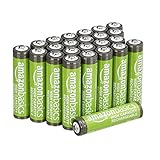
- IN THE BOX: 24-pack AAA rechargeable high-capacity batteries; 850 mAh
- DEVICE COMPATIBILITY: Ideal battery for a wide range of high- and low-drain devices
- RECHARGEABLE: Delivered pre-charged and ready to use; can be recharged up to 500 times with minimal power loss
- LOW SELF DISCHARGE: Maintains 80% capacity for 24 months
- EASY USE & STORAGE: Ships in Certified Frustration-Free Packaging
Charging and deep discharge
Battery University describes NiMH as trickier to charge than NiCd, sensitive to overcharge, and prone to shorter service life with deep discharge. Use a charger intended for NiMH and follow the instructions from the cell and charger makers. No single charging mode or cycling routine applies to all cells, so none is prescribed here.
Recommended Free Tools
NiMH compared with the alternatives
| Factor | Conventional NiMH | Low-self-discharge NiMH | Alkaline | Lithium-ion |
|---|---|---|---|---|
| Reusable | Yes | Yes | No (single-use) | Yes |
| Nominal voltage | 1.2 V (NI; ANSMANN) | 1.2 V (ANSMANN maxE AA) | Not stated in the sources | Higher per cell than NiMH (NI) |
| Storage retention | About 1–2% per day (NI); 10–15% per month after day one (Battery University) | Manufacturer claims 10× lower than regular NiMH; one-year figures inconsistent | About 2% per year (NI) | Lower self-discharge than NiMH (NI) |
| Voltage over discharge | More constant than alkaline (NI) | Not separately stated | Less constant than NiMH (NI) | Not stated in the sources |
| Energy density / weight | Below lithium-ion (NI) | Not stated | Not stated | Higher; lighter for equivalent capacity (NI) |
| Best fit | Frequent use, charger on hand | Frequent use with idle gaps | Infrequent or backup use | Purpose-built packs, weight-sensitive designs |
Compared with NiCd, NiMH offers the 40% higher specific energy noted above (standard NiCd, per Battery University).
How to decide: a practical framework
- Device used weekly or daily (game controllers, toys, camera flashes, flashlights you use often): NiMH fits well, because you recharge often enough that storage loss matters little.
- Device used often but with long idle gaps: low-self-discharge NiMH is the more sensible kind of rechargeable, because it should hold more charge between uses.
- Emergency or standby device (a smoke detector, a drawer flashlight, a rarely used remote): alkaline’s low self-discharge makes it the better default. Check the device manual first, since some equipment may specify a chemistry.
- Weight is the priority or the device is built around a battery pack: follow the maker’s chemistry, which is often lithium-ion.
- Voltage-sensitive equipment: confirm in the manual that 1.2 V cells are supported before swapping.
Buying AA NiMH for frequently used devices
If you are replacing disposable AAs in a compatible, regularly used device, the category to look for is AA low-self-discharge NiMH rechargeable batteries. ANSMANN’s product page lists flashlights, toys, game consoles, cameras and flash equipment as uses for its 1.2 V, 2100 mAh AA cells. That page is manufacturer material, not independent testing. Whichever brand you choose, check the packaging to see whether it is low-self-discharge or conventional, and pair the cells with a charger designed for NiMH.
Storage and aging
Because self-discharge rises with heat, age and cycling (Battery University), store charged cells somewhere cool and expect older cells to hold less over time. Top up cells that have sat unused before relying on them, and avoid running them completely flat repeatedly, since deep discharge can shorten service life.
Quick Recap
Product prices and availability are accurate as of the date/time indicated and are subject to change. Any price and availability information displayed on Amazon at the time of purchase will apply.
The Tool Desk
Outbyte Driver Updater FREEFix the driver behind crashes, sound loss and screen glitchesFind Drivers →Outbyte PC Repair FREEClear out junk files and repair common Windows errorsFree Scan →
