Free tools Windows power users keep installed
One-click scans. No signup required.
The aim of Taskmaster is to finish with the highest cumulative score after an agreed number of tasks. A Taskmaster judges every task, the wording of the task controls any special bonuses or penalties, and the Taskmaster’s decision is final. A descending system—four points for first place, three for second and so on in a four-player game—is a useful default, but it is not an unbreakable 5–1 rule. The judge may award points arbitrarily when the group agrees to play in the spirit of the show.
What is the objective in Taskmaster?
Players compete in a series of unusual challenges. After each task, the Taskmaster awards points, and those points accumulate across the game. The winner is the player with the highest total when the agreed number of tasks has been completed. If a prize task is included, the winner may also receive the prize selected for that task; the official home-game rules specify a Taskmaster trophy and prizes for prize tasks.


As an Amazon Associate I earn from qualifying purchases.
There is no single universal score sheet for every television episode. Some tasks use ordinary rank order, while others award a stated number of points for a particular achievement, add a bonus, impose a penalty or disqualify a player. Read the complete task before anyone starts, because its wording is the rule for that challenge.
Who is the Taskmaster?
The judge’s authority
The Taskmaster watches or reviews the attempts, interprets the instructions and assigns the points. In the official home-game rules, “THE TASKMASTER’S WORD IS FINAL.” Players can explain what they did, but they do not get a vote on the result. This authority is what allows the format to reward ingenuity, literal interpretations and entertaining failures rather than only speed or technical perfection.
#1 Best Overall
Rotating the role at home
The official board-game rules are designed for three to five players. The tallest player is Taskmaster for the first task, then the role passes to the player on that person’s left. The rules recommend giving everyone an equal number of turns where possible. A player who is Taskmaster for a location task does not compete in or score points for that task.
Before starting a homemade game, write down the rotation. If the number of tasks is not divisible by the number of players, decide who receives the extra judging turn before play begins. You can also appoint one permanent judge, but that changes the balance: the judge can no longer compete and must remain consistent about the same standards for every player.
Core rules every player should know
- Read the task aloud immediately and clearly. The official rules require the instructions to be read out clearly and immediately. Do not paraphrase away a condition, time limit or exception.
- Do not discuss the task with fellow competitors. Players should not collaborate, exchange strategies or reveal a secret task while the challenge is in progress unless the task explicitly allows it.
- Obey the law and basic safety requirements. The rules state that players must not break the law. Add sensible house limits for dangerous tools, traffic, heights, fire, animals, personal data and property that does not belong to the group.
- Follow the task’s own conditions. A task can create teams, specify a live performance, award a bonus, impose a penalty or disqualify a contestant. Those conditions override the default rank-based scoring.
- Accept the Taskmaster’s ruling. Appeals can be funny, but the final decision belongs to the judge. If you want formal appeals, agree on that house rule before the first task rather than arguing after every score.
How Taskmaster scoring works
The descending rank convention
For a straightforward task, rank the completed attempts and assign descending points. The official rules give a four-player example: first place receives four points, second receives three, third receives two and fourth receives one. With five players, many groups use five through one; with three players, three through one. This is a convention, not a mandatory scoring table for every task.
| Players in the task | Common descending allocation | Important qualification |
|---|---|---|
| 3 | 3, 2, 1 | Use only when the task is being scored by rank. |
| 4 | 4, 3, 2, 1 | This is the example in the official home-game rules. |
| 5 | 5, 4, 3, 2, 1 | A sensible extension, not an invariable television rule. |
Decide how to handle ties before scoring. The simplest option is to give tied players the same points and then skip the next rank—for example, two players tied for first both receive four points and the next player receives two. Another option is to split the points for the tied places. Neither method is required by the core rules; consistency matters more than the choice.
Rank #2
Arbitrary judging is part of the format
The official rules expressly say that the Taskmaster has the right to be arbitrary and may dish out points as they see fit. That discretion is not a loophole to ignore the task. It is permission to reward a clever interpretation, a particularly elegant solution, dramatic commitment or an amusing technicality when the judge believes it deserves recognition.
Groups should choose their preferred style at the start:
- Strict ranking: award points according to speed, accuracy or the stated success condition, with little subjective adjustment.
- Show-style judging: use the ranking as a guide, then allow the Taskmaster’s personal verdict to decide close calls and creative bonuses.
- Task-defined scoring: ignore a general table when the card or script specifies exact points, a bonus, a penalty or disqualification.
Why the task wording controls the score
Televised tasks can be individual, team, prize or live challenges. Official task pages include examples in which a sole successful player receives five points while other players are penalized, and examples that disqualify a contestant after a stated condition is broken. Those outcomes cannot be inferred from a generic 5–1 table; they come from the words of that particular task.
Do these 3 things before closing this tab:
1Clear out junk files and repair common Windows errors2Fix the driver behind crashes, sound loss and screen glitches3Repair Windows errors before they cause bigger problemsBonuses
A bonus can reward an extra achievement, such as completing an optional part, using a specified object or being the only player to satisfy a hidden condition. Record the bonus separately on the score sheet so the base ranking remains understandable.
Penalties
A penalty subtracts points or assigns fewer points for a stated failure. Apply it only when the task says what the penalty is. Do not invent a deduction because an attempt looked untidy unless the Taskmaster is deliberately using the arbitrary-judging rule and has explained that approach to the group.
Disqualification
Disqualification normally means the attempt does not qualify for the task’s ordinary points. Whether the player receives zero, a negative score or a consolation point depends on the wording. Announce the consequence before revealing the points, and write down the reason so the result is not disputed later.
Teams and live tasks
Team tasks require a decision about whether every team member receives the same score or whether the team’s points are divided. State that rule before play. Live tasks happen in front of the Taskmaster, often with immediate consequences; timing, order and spoken instructions become part of the challenge, so the judge should read them once without interruption and repeat only a genuine clarification.
Task types and how to run them
Prize tasks
Each player supplies or chooses an item matching the prompt, then the Taskmaster ranks the entries. The highest-scoring entry wins the prize for that round. Make the prize rule explicit: it may be a physical object brought to the game, a promised experience or another agreed reward.
Rank #4
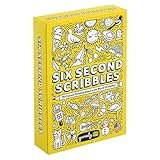
- CAN YOU DOODLE 10 MASTERPIECES IN A MINUTE? Six Second Scribbles challenges you to draw 10 things from a given category in 60 seconds. It’s as tricky as it sounds and leads to some brilliant, hilarious and often questionable art!
- 1000+ ITEMS TO DRAW ACROSS 100+ CATEGORIES! We’ve crammed a lot of content into a small box with categories ranging from nice and easy (food, animals, body parts) to almost impossible (tourist attractions, animated films, cheeses!)
- DRAW, DECIPHER, SCORE! All players draw their items at the same time, and when the minute is up you pass your scribbles to another player. They have to figure out what you’ve drawn and if they guess correctly, you both score points!
- THE ART OF SIMPLICITY! Six Second Scribbles is all about finding the perfect balance between quality and quantity. It’s amazing how fast a minute vanishes and how much can be conveyed with a rapid scrawl of a pencil… or how little!
- TEENY TINY PAPER! Six Second Scribbles comes in a small box, the size of four packs of cards, which contains small pencils and paper too. We love making small games. They are just as good for taking on the go as playing at home, and they use less of the world's natural resources!
Location tasks
Kitchen, living-room, laboratory or garden tasks use available space and props. Inspect the area first, remove hazards and decide which objects are available. The player acting as Taskmaster for that task sits out and does not earn points.
Secret tasks
A secret task is discovered privately, often through a hidden note or envelope. Keep it secret from other competitors and from the person judging if the format allows that. The judge should prepare a way to verify completion without exposing the task prematurely.
Final tasks and video tasks
A final task can close the game or serve as a last high-value challenge. The official rules describe a one-minute self-portrait, a covert secret task and a final video task. For recorded submissions, set a deadline, file format and viewing method before anyone starts; otherwise editing and late delivery can become an accidental advantage.
Quick wins for a faster PC:
Clear out junk files and repair common Windows errorsFree Scan →Fix the driver behind crashes, sound loss and screen glitchesFind Drivers →How to play Taskmaster at home without the board game
You need three to five participants for the official player range, a judge for each task, a score sheet, a timer and safe household materials. A phone can supply timing and recording, but it should not become an unannounced source of outside answers.
Best Value
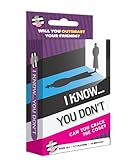
- Crack the Code in a Unique Deduction Card Game: "I Know... You Don’t" challenges players to unravel a secret rule based on clues provided by each card played. It's a deduction card game where observation, logic, and pattern recognition turn every round into a thrilling code breaking game, perfect for those who love a mental challenge.
- Engaging and Interactive for Groups: Designed for 3 to 7 players ages 10 and up, this family card game is ideal for game night, a party, or classroom brain-training activities. The interactive format and rotating gameplay make it a great thinking and icebreaker game for teens, adults, and families alike.
- Strategic Play with Three Ways to Win: Players choose between playing a card, playing multiple cards, or trading in their hand, with each decision being a critical piece of the puzzle. This strategy card game tests your ability to identify hidden patterns while outsmarting your friends.
- Five Levels of Difficulty for All Skill Levels: With secret rules ranging from simple to advanced, this puzzle card game is built for replayability and scalability. Whether you're introducing younger players or challenging seasoned code-breakers, this cognitive game adapts to the moment for consistent, engaging fun.
- Perfect for Travel, Parties, and Quick Play: Compact and fast-paced, "I Know... You Don’t" is a 10 minute game that’s perfect as a travel game, party game, or just a fun brain game for any occasion. Whether you're at a gathering or on the go, it's one of the best hidden information games for keeping minds sharp and players entertained.
- Set the format. Choose the number of tasks, the judging rotation, whether the game is solo or team-based and whether you will use strict ranking or discretionary judging.
- Prepare tasks. Write each instruction so that the objective, time limit, permitted materials, submission method and scoring condition are unambiguous. Mark any bonus, penalty or disqualification in a separate line.
- Read one task. Read it aloud immediately and clearly. Start the timer only when the task says to start, and keep secret information hidden from players who should not see it.
- Run the challenge. Enforce the same deadline and available resources for everyone. Stop an attempt if it becomes unsafe or illegal.
- Judge and explain. The Taskmaster ranks or scores the attempts, applies the written exceptions and gives a short reason for unusual decisions. The ruling is final.
- Record cumulative points. Add the new score to each player’s running total before moving to the next task. Keep the sheet visible so a scoring error can be corrected immediately.
- Rotate the judge. Pass the role to the next player according to the agreed order. At the end, total all tasks and award the trophy or final prize to the highest scorer.
What comes in the official Taskmaster board game?
The official board game is a ready-made option for home play. Its listed contents are a game board, rules sheet, scoreboard playing pieces, a wipe-clean pen, a Taskmaster trophy and 200 task cards, including video tasks from Alex Horne. The rules and components remove much of the preparation work, while the rotating judge keeps the central format intact.
| Component | How it helps |
|---|---|
| 200 task cards | Provides a large supply of prepared challenges, including video tasks. |
| Game board and scoreboard pieces | Shows running totals during the game. |
| Wipe-clean pen | Allows scores to be reused across sessions. |
| Taskmaster trophy | Creates a physical end-of-game prize. |
| Rules sheet | Sets the official player range, role rotation and core conduct rules. |
The official site also lists a Board Game Expansion Pack containing 40 new task cards, final video tasks, prize selector cards and paper refills. Treat the contents and regional availability as edition-specific: check the current product listing before buying, especially if you are replacing an older set or importing it.
Television format, boxed game and homemade play compared
| Feature | Television format | Official boxed game | Homemade version |
|---|---|---|---|
| Taskmaster | A designated host judges every contestant. | Players rotate the judging role; the tallest player starts under the official rules. | Rotate players or appoint one permanent judge by agreement. |
| Scoring | Task wording may set points, bonuses, penalties or disqualification; no universal 5–1 table applies to every task. | Descending rank scoring is suggested, with arbitrary judging allowed. | Choose rank scoring, discretionary scoring or task-specific values before play. |
| Task types | Individual, team, prize and live challenges, plus secret and final tasks. | Prepared location, secret, prize and video-style tasks. | Any safe combination that your space and equipment support. |
| Rounds | Determined by the episode or series format. | Set by the group using the cards and rules. | Agreed in advance; use enough tasks for every judge to receive a fair turn. |
| Props and presentation | Production staff provide locations, props and edited video. | Cards, board, trophy and pen are supplied; household props may still be needed. | Players supply materials, recording equipment and prizes. |
Common mistakes and how to prevent them
- Assuming every task is 5–1: read the task for its actual allocation and exceptions.
- Changing instructions after play begins: write clarifications before the timer starts; otherwise give every player the same revised condition.
- Letting the judge compete: the judging player should sit out of that location task unless your house rules explicitly use a different arrangement.
- Revealing a secret task: distribute hidden instructions privately and collect them after judging.
- Arguing every subjective decision: allow a brief explanation, then enforce the final-ruling rule.
- Leaving totals until the end: update the cumulative scoreboard after each task and have another player check the arithmetic.
- Ignoring safety or legality: replace a risky task with a safe equivalent; entertaining rules never override the requirement not to break the law.
How many tasks should a home game use?
There is no mandatory number of tasks in the core rules. Pick a length that gives each player a comparable judging opportunity and leaves time to complete the challenges. A short session can use one prize task, several location tasks and a final task. A longer session can add secret, team and live rounds. Decide whether the final task carries ordinary points or a special value before anyone sees the results; changing its weight at the end can make the earlier scoreboard meaningless.
What’s actually slowing this PC down?
Pick the symptom - the matching free tool is one click away.
How to determine the winner
After the last task, add every awarded bonus and penalty to the running totals, check for arithmetic errors and apply the tie rule you selected at the beginning. If two players finish level, use a pre-agreed tie-breaker such as one sudden live task, a final ranking by the Taskmaster or a shared victory. Do not create a new scoring principle only after seeing who would benefit from it.
Quick Recap
Product prices and availability are accurate as of the date/time indicated and are subject to change. Any price and availability information displayed on Amazon at the time of purchase will apply.

