The Tool Desk
Outbyte PC Repair FREERepair Windows errors before they cause bigger problemsFix Now →Outbyte Driver Updater FREEFix the driver behind crashes, sound loss and screen glitchesFind Drivers →Choose linear switches if you want a consistently smooth keypress; choose tactile switches if you want a noticeable bump to signal actuation. Neither type is universally faster, quieter, or more comfortable. The right choice depends on the feedback, force, travel, sound, and keyboard compatibility you prefer. CHERRY’s MX Red and MX Brown illustrate the basic difference, while models such as MX Petal and MX Honey show why the category label alone is not enough.
What the two switch types actually mean
A mechanical switch sits beneath each keycap and registers a keypress as its internal stem moves. The terms linear and tactile describe what you feel during that movement, especially around the point where the switch actuates.
As an Amazon Associate I earn from qualifying purchases.
Linear switches: smooth travel from top to bottom
A linear switch is designed to move through its press without a distinct tactile event at actuation. Resistance can still change through the stroke, and the switch can still make sound when the keycap bottoms out or returns, but your finger does not encounter a pronounced bump that announces the electrical actuation point.
CHERRY describes MX Red as a linear example with 45 centinewtons (cN) of actuation force and 2 mm of pre-travel. Those numbers describe MX Red specifically, not every linear switch. A different linear model can use a lighter or heavier spring, a different travel distance, or damping material.
#1 Best Overall
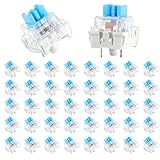
- 【Package Content】The package contains 50 pre-lubricated 3-pin onboard tactile switches, providing smooth actuation and crisp rebound, making it ideal for custom keyboards or upgrades
- 【Clear Housing Design】Featuring a transparent blue casing that perfectly complements the LED backlight, these key switches provide excellent tactile feedback, giving you a pleasant typing experience
- 【Quality Material】Made of plastic housing, copper washers, and high-quality springs, these blue switches are waterproof and dustproof, durable, and have a service life of up to 50 million cycles
- 【Wide Compatibility】Compatible with most keyboards, these keyboard clickers are ideal for users who value feel and performance, making them ideal for typists and gamers
- 【Factory-Precision Lubrication】Each keyboard switch is machine-lubricated to reduce friction and noise, ensuring smooth, consistent keystrokes and plug-and-play reliability for a superior typing experience
Tactile switches: a bump at actuation
A tactile switch gives your finger a noticeable actuation point. The bump may be subtle and rounded or sharp and prominent, depending on the switch design. It is feedback, not a separate electrical feature: the switch can register the key while you feel the resistance change.
CHERRY lists MX Brown as tactile without the classic audible click. Its published specification is 55 cN actuation force and 2 mm pre-travel. Like the MX Red figures, these are model-specific specifications rather than requirements for the tactile category.
Tactile feedback and click noise are different properties
A tactile switch does not have to click. CHERRY’s MX Brown is a non-clicky tactile example, and the company also describes MX Honey as a silent tactile switch. Conversely, a linear switch is not automatically silent: keycap impact, bottom-out, spring noise, and the keyboard case can all be audible. The available manufacturer material does not provide controlled, whole-keyboard loudness measurements, so a category label cannot establish how loud a completed keyboard will be.
What’s actually slowing this PC down?
Pick the symptom - the matching free tool is one click away.
The specifications that matter beyond the label
When comparing two specific switches, evaluate the same characteristics for both. The word “tactile” or “linear” tells you about the basic feel, but it does not tell you the whole force curve, travel, sound treatment, or fit.
| Criterion | What to check | Why it changes the experience |
|---|---|---|
| Actuation feel | Whether a bump exists and how pronounced it is | A sharp bump gives a clear event; a mild bump may feel closer to a smooth press. |
| Actuation force | Force listed for the exact model, usually in cN | Lower figures generally require less force at the stated point; higher figures feel more resistant. The number does not describe every part of the stroke. |
| Pre-travel | Distance before the switch actuates | Shorter pre-travel can make the actuation event occur earlier in the press; it does not by itself determine total key travel. |
| Total travel | Full distance available before the switch reaches the end of its stroke | Two switches can actuate at similar distances yet provide different overall travel. |
| Acoustic treatment | Whether the model is described as clicky, non-clicky, or silent | Damping can reduce switch noise, but the keycap, plate, case, and typing technique still affect the finished keyboard. |
| Mechanical compatibility | Format, mounting, housing and keycap fit, layout, and hot-swap support | A switch that feels right may still be unusable if it does not physically or electrically fit the keyboard. |
Vendor specifications are useful for narrowing choices, but they are not independent comparative measurements. Force values can describe a particular point in the switch’s movement, while the perceived bump and smoothness depend on the complete force curve and on your finger pressure.
Rank #2

- Package Includes: You will get 50 Pcs blue keyboard switches in one bag! Each set of our mechanical switches comes with a switch puller and a convenient cleaning brush. This complete kit makes switch installation and future keyboard cleaning effortless
- Enhanced Durability: Engineered with dust-proof and waterproof construction, these switches provide superior protection. This defense significantly boosts your keyboard's longevity, ensuring consistent performance in any environment
- Authentic Tactile: Experience the satisfying rhythm of typing with a clear tactile bump and a crisp, audible click sound. The driving force offers powerful two-stage feedback, making it the perfect keystroke experience for typists and gamers
- Strong Visual: The transparent housing maximizes the brilliance of lighting for stunning visual effects. Featuring a standard 3-pin MX design, they are plug-and-play compatible with most hot-swappable keyboards and support profile keycaps
- Premium Materials: These clicky switches utilize a high-quality POM stem and a robust copper alloy spring. This premium material combination ensures consistent and satisfying keystrokes over an impressive lifespan of enough clicks
CHERRY examples show why “tactile” is not one fixed feel
The following figures come from CHERRY’s product descriptions. “Not stated” means the cited product information does not provide that value; it is not an estimate.
| Model | Type and sound description | Actuation force | Pre-travel | Total travel |
|---|---|---|---|---|
| MX Red | Linear | 45 cN | 2 mm | Not stated in the cited overview |
| MX Brown | Tactile, without the classic audible click | 55 cN | 2 mm | Not stated in the cited overview |
| MX Petal | Tactile | 30 cN | 2.0 mm | 4.0 mm |
| MX Honey | Tactile and silent | 45 cN | 1.9 mm | 3.7 mm |
MX Petal’s listed 30 cN actuation force demonstrates that a tactile switch can be lighter than MX Red, while MX Honey’s 45 cN figure matches MX Red’s listed force but adds a tactile, silent design and different travel specifications. These examples do not establish that one model is better; they show why you should compare the exact switch you intend to buy.
How the choice changes everyday use
Typing and writing
Some typists prefer a tactile bump because it provides a physical cue during the press. That cue can help you decide when to release a key instead of pressing all the way down, particularly if you develop a light-touch technique. Other typists find any interruption in the stroke distracting and prefer the uninterrupted movement of a linear switch.
Neither preference proves a universal typing advantage. The available manufacturer information does not establish that tactile or linear switches make all users faster, more accurate, or more comfortable. Hand size, posture, keycap profile, layout, spring weight, and personal technique all interact with switch feel.
Games and rapid key presses
Linear switches are often considered when a player wants the same smooth resistance on repeated presses. Tactile switches are often considered when a player wants a clear event under the finger. Those are preference-based reasons, not evidence of an objective gaming winner. The cited material contains no controlled statistic showing that either category improves game performance for a population of players.
Rank #3
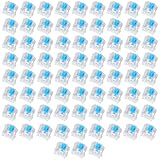
- Value Pack: You'll receive 72pcs blue mechanical keyboard switches, ready for installation. The blue and white color scheme adds a stylish touch to your custom keyboard, making it a perfect gift for family and friends who love mechanical keyboards.
- Durable Construction: The mechanical keyboard switches are made of high-quality acrylic and zinc alloy, making them waterproof and dustproof for durability. The transparent housing perfectly matches the LED backlight and provides excellent tactile feedback and a pleasant click.
- Precise Performance: These 3-pin keyboard keys are compatible with most mechanical keyboards. Their precise actuation and comfortable feedback ensure every keystroke registers perfectly, ensuring a smoother, more stable, and more responsive typing experience even during long typing sessions.
- Enhanced Typing: Our blue key switch are ideal for everyday office document writing. The classic crisp click and tactile feedback, strong paragraph feel, and smooth performance enhance your typing rhythm, providing a comfortable and enjoyable experience.
- Perfect Gift: Our blue switch mechanical keyboard easily replace the original keyboard switches without complex tools or skills. They adapt to most standard keyboards on the market, making them an ideal choice for typists who value feel and accuracy.
For keys that you hold, such as movement or a modifier, compare the force and travel of the exact models. A switch that feels comfortable during a brief tap may feel tiring during long holds if its resistance is not suitable for you.
Outdated Drivers Are Slowing You Down
One free scan finds every outdated or missing driver and matches the right update for your exact hardware.Free scan · exact hardware matchPC Slower Than It Used to Be?
A free scan shows the junk files, broken settings and background clutter dragging Windows down - then fixes them in one click.Free scan · Windows 10 & 11Shared rooms, offices, and recordings
If sound matters, start by avoiding assumptions: tactile does not mean loud, and linear does not mean quiet. Select a model explicitly described as silent or otherwise acoustically damped when available, then consider the rest of the keyboard. Bottom-out noise, return noise, keycap material, mounting, case construction, and desk resonance can dominate what people nearby hear.
There is no reliable whole-keyboard loudness ranking in the cited material. A switch tester can tell you how the mechanism sounds in isolation, but it cannot perfectly predict a finished keyboard in your room.
Heavy or light key preferences
Use the manufacturer’s actuation-force figure as a comparison point, not as a complete description of effort. MX Petal’s listed 30 cN and MX Brown’s 55 cN are both tactile examples with very different published forces. MX Red and MX Honey are each listed at 45 cN, yet one is linear and the other is tactile and silent. If you are sensitive to force, test the exact model rather than choosing solely by category.
A practical decision path
- Decide whether you want a bump. If a smooth, uninterrupted stroke is your priority, begin with linear candidates. If you want a physical actuation cue, begin with tactile candidates.
- Separate feel from sound. If you want feedback but not a click, look at non-clicky tactile or silent tactile models. If you want a quiet linear press, verify that the specific linear model has damping; the category alone does not promise it.
- Set a force range. Compare the exact actuation-force figures and consider how the switch feels through the entire stroke. Do not treat a single cN number as a universal measure of fatigue or comfort.
- Compare travel. Check pre-travel and total travel together. MX Honey, for example, is listed with 1.9 mm pre-travel and 3.7 mm total travel, while MX Petal is listed with 2.0 mm pre-travel and 4.0 mm total travel.
- Test before committing. Use a switch tester or sample pack containing both types, ideally including the exact models you are considering. Press slowly, tap repeatedly, and hold keys so you notice the bump, return, sound, and force in more than one motion.
- Confirm the keyboard fit. Before ordering replacements, verify the switch format, mounting arrangement, compatible housing and keycaps, layout, and whether the keyboard is hot-swappable. CHERRY says its MX Standard switches fit a wide variety of housings, keycaps, and layouts; that is not a guarantee of universal compatibility.
How to test switches without fooling yourself
A short showroom press can hide differences that become obvious after an hour. Use a repeatable comparison:
Rank #4

- This blue key switch has a transparent housing, suitable for LED backlighting, offers excellent tactile feedback, smoother, and will satisfy you with the classic crisp click sound.
- The mechanical keyboard switch is made of plastic shell, copper gasket, high-quality spring, the shaft core material is POM, waterproof, approximate lifespan of 50 million times of keystrokes, durable.
- Total stroke of blue switch: 4 mm; working stroke: 2.2±0.6 mm. Tip: Pins may be bent during shipment, but will not be affected the use after correction.
- Good compatibility, great for most mechanical keyboards, a strong sense of paragraphing, suitable for users pursuing feel and performance, and suitable for typists, enjoy the rhythm of work and games.
- Packaging: 10 PCS 3 pin keyboard dustproof switches.
- Place the tester beside your keyboard and use the same finger for each switch.
- Press each switch slowly from the top, noting when resistance changes and whether the bump feels rounded, sharp, or barely present.
- Tap each one at a normal typing rhythm. Listen for the switch, the keycap hitting the bottom, and the return stroke separately.
- Press halfway and release without bottoming out when possible. This reveals whether the switch gives useful feedback before the end of travel.
- Hold a key for several seconds, then repeat the test on a frequently used key. A force that feels pleasant for one press may not suit your sustained use.
- Repeat the test after you have adapted to the first switch. Familiarity can change your perception, so write down observations instead of relying on an immediate first impression.
Testing cannot produce an objective winner. It gives you information about your own preference, which is the relevant decision variable when no independent evidence establishes a universal performance or comfort advantage.
Independent reader supportYour contribution helps us test, update, and keep practical guides available for everyone.Replacing switches in an existing keyboard
Buying the preferred category is only half the task when you already own a keyboard. A replacement switch must match the keyboard’s mechanical and electrical design.
Check the exact keyboard model
- Identify the switch format specified by the keyboard maker or the existing switch.
- Confirm how the switch mounts to the plate or printed circuit board.
- Determine whether the PCB is hot-swappable. If it is not, replacement normally involves desoldering and soldering rather than simply pulling switches out.
- Verify that the replacement’s housing and stem accept your keycaps and that the switch suits the keyboard’s layout.
- Check whether the keyboard’s lighting system requires a particular switch housing or illumination arrangement.
Do not infer compatibility from the word “MX” alone. MX-style dimensions, mounting details, and keyboard construction can differ, and a switch may fit a keycap while still failing to fit the PCB or plate.
Match the replacement process to your tools
A hot-swap board may allow removal with a switch puller after the keycaps are removed, but the board still has to support the replacement format. A soldered board requires the appropriate desoldering and soldering equipment and the skill to avoid lifting pads or damaging the PCB. If the manufacturer does not document replacement support, treat compatibility as unconfirmed rather than assuming it.
Recommended Free Tools
Common mistakes and how to avoid them
“Tactile means clicky”
It does not. MX Brown is a cited non-clicky tactile example, and MX Honey is described as silent tactile. Choose based on the sound description of the exact model.
Best Value

- Value Set: Receive 50 pcs blue keyboard switches and 1 pc switch puller for a complete custom build or replacement. This generous keyboard switches is a perfect gift for mechanical keyboard enthusiasts
- Durable Construction: Built with high-quality acrylic, zinc alloy, and precision steel springs for long-lasting durability. These waterproof keyboard clicker modules provide stable performance over time
- Crisp Clicky & Tactile: Delivers satisfying clicky sound and tactile feedback for precise, accurate keystrokes. These mechanical keyboard switches offer a responsive typing experience ideal for office work
- Easy 3-Pin Installation: Features standard 3-pin MX-style compatibility for quick installation without complex tools. These versatile keyboard clickers upgrades fit most mechanical keyboard PCBs easily
- Enhanced LED Backlighting: Transparent housing perfectly matches and enhances LED backlit keyboard setups. These backlit-compatible keyboard switches allow vibrant light to shine through clearly
“Linear means silent”
It does not. A linear switch can produce substantial bottom-out or return noise, while a case and keycap set can amplify it. Look for an explicit acoustic treatment and evaluate the completed keyboard.
Choosing by color alone
Color names are product identifiers, not category-wide standards. Even within one manufacturer’s range, force and travel vary. Read the model’s specifications and description rather than assuming that every switch with a familiar color behaves identically.
Assuming the actuation number is the whole feel
Actuation force does not tell you how the switch feels before or after actuation, how pronounced the bump is, or how much force is needed at bottom-out. Use the figure alongside pre-travel, total travel, and a physical test.
Replacing switches without checking the board
A preferred switch can be incompatible with the keyboard’s mounting or PCB. Confirm format, mounting, housing and keycap fit, layout, and hot-swap status before purchasing a set.
Expecting a universal speed or comfort verdict
No cited independent study establishes that tactile or linear switches make everyone faster, more comfortable, or better at gaming. Treat recommendations as preference guidance, not a performance guarantee.
Quick choice guide
| If your priority is… | Start by trying… | What to verify next |
|---|---|---|
| A smooth press with no pronounced event | Linear switches such as MX Red | Exact force, travel, damping, and bottom-out sound |
| A physical actuation cue without a classic click | Non-clicky tactile switches such as MX Brown | Bump strength, force, and acoustic treatment |
| A light tactile specification | A model such as MX Petal, listed at 30 cN | Whether its particular bump and 4.0 mm total travel suit you |
| Tactile feedback with a silent design | A model such as MX Honey | Its 45 cN force, 1.9 mm pre-travel, 3.7 mm total travel, and the sound of the finished keyboard |
| Confidence before buying a full set | A switch tester or sample pack with both categories | That the samples match the format and models you can install |
The bottom line for your decision
Start with the sensation you want under your fingers, not a claim about who should use which switch. Linear is the straightforward choice for uninterrupted travel; tactile is the straightforward choice for a noticeable actuation cue. Then narrow the decision using the exact model’s force, pre-travel, total travel, sound treatment, and compatibility. If you are uncertain, testing representative switches is more reliable than choosing from a category label or an alleged universal performance ranking.
Quick Recap
Product prices and availability are accurate as of the date/time indicated and are subject to change. Any price and availability information displayed on Amazon at the time of purchase will apply.

