The Tool Desk
Outbyte Driver Updater FREEFix the driver behind crashes, sound loss and screen glitchesFind Drivers →Outbyte PC Repair FREERepair Windows errors before they cause bigger problemsFix Now →A small synthetic host–guest system offers a clear molecular picture of a central enzyme idea. In the system described by Chemistry World on 25 February 2014, the rectangular cyclophane ExBox acts as an active-site analogue and bowl-shaped corannulene acts as a substrate analogue. When corannulene enters ExBox, both molecules adjust their shapes: the guest becomes slightly flatter and the host cavity expands. That mutually adapted arrangement favors the geometry corannulene adopts while its bowl inverts, so the inversion is reported to occur ten times faster.
The demonstration is best understood as a deliberately simplified model of selected catalytic principles—not as a protein enzyme, a cell-like catalyst, or a complete artificial replacement for biology. Its value is visual and mechanistic: it shows how molecular recognition, induced fit and transition-state stabilization can be connected in one tractable chemical example.
As an Amazon Associate I earn from qualifying purchases.
What the synthetic catalyst model contains
The system has two principal molecular parts and one shape-changing event. ExBox is the host. Corannulene is the guest. Corannulene’s bowl inversion is the process whose rate changes when the guest is held inside the host.
| Part of the model | Role in the analogy | What happens chemically |
|---|---|---|
| ExBox | Analogue of an enzyme active site | The rectangular cyclophane provides a confined cavity that recognizes and holds corannulene. |
| Corannulene | Analogue of a substrate | The bowl-shaped molecule binds inside the cavity and changes toward a flatter geometry. |
| Bowl inversion | Analogue of a catalyzed reaction | Corannulene passes through a flatter, transition-state-like shape as its curvature reverses. |
Calling the pieces analogues is important. ExBox is not a folded polypeptide with the many side chains, water networks, electrostatic fields and moving domains found in a biological active site. Corannulene is not a metabolic substrate in a living organism. The analogy isolates a few principles so they can be examined without the complexity of a complete enzyme.
#1 Best Overall
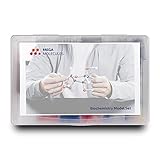
- Perfect for Visual Learners - This hands-on Biochemistry Model Kit is a tool that doesn’t just show you molecular structures; it lets you explore the magic of bonding, resonance, and chemical interactions like never before. It’s your key to understanding how molecular 3D structures influence chemical properties, such as in nucleotides and their base pairs, or in lipids and their hydrophobic behavior. You'll connect the dots between a compound's physical and chemical properties and its three-dimensional structure, deepening your understanding and making complex concepts intuitive.
- Versatile & Suitable for All Learning Levels - Whether you're a biochemistry student, an educator, or just passionate about molecular science, this model set will elevate your learning experience. It’s a powerful way to transform abstract molecular diagrams into tangible, interactive models you can touch, build, and explore. Get ready to turn curiosity into mastery—because biochemistry isn't just a subject, it's the science of life itself. With the Biochemistry Model Set, the possibilities are endless. Don’t just learn it—build it, see it, and truly understand it!
- High-Quality, Durable Components - Components are color-coded to international standards, with scaled bond lengths for accuracy. Rigid bonds allow easy single-bond rotation, while flexible bonds are ideal for double and triple bonds. Lost parts? No problem—Mega Molecules offers replacement atoms and bonds to keep your kit complete and long-lasting.
- Easy Assembly & Disassembly - Unlike many competitor kits that require special tools and make loud popping sounds during assembly or disassembly, Mega Molecules Model Sets offer a quiet, hassle-free experience. Atoms and bonds connect with a gentle push-and-twist motion and easily disconnect with a pull-and-twist—no noise, no tools needed. This thoughtful design minimizes distractions, making it perfect for classrooms, study sessions, and testing environments, ensuring a smooth, focused learning experience.
- Satisfaction Guarantee - Backed by a refund or replacement policy, this biochemistry building set offers a risk-free investment in chemistry education. Whether you're studying the protein structure, the base pairing in DNA, or the intricacies of a glycosidic linkage, this set brings your biochemistry lessons to life. Use it to model the relationships between carbon, hydrogen, oxygen, nitrogen, phosphorus, and sulfur as they form covalent bonds. With every build, you’ll gain deeper insights into the connections between molecular structure and function.
How ExBox changes the rate of bowl inversion
1. Corannulene enters the cavity
The first event is molecular recognition. Corannulene nests inside the cavity of ExBox. Shape complementarity gives the host a way to bind the guest rather than leaving it freely solvated. The fit is not perfectly rigid: the report describes structural adjustments in both partners once the complex forms.
2. Binding produces an induced fit
Free corannulene has a pronounced bowl shape. On binding, the bowl becomes slightly flatter. At the same time, the ExBox cavity expands. The host and guest therefore do not behave like an unchanging lock and key. Binding is a negotiated structural adjustment in which the complex adopts a geometry that neither isolated molecule has to maintain on its own.
3. The guest approaches the inversion geometry
For corannulene to invert its bowl, it must move through a less-curved arrangement. The flatter geometry is higher in energy than the resting bowl-shaped form, so only a fraction of free molecules occupy it at any instant. Inside ExBox, the cavity is described as stabilizing this transition-state-like shape. Holding the guest in a geometry closer to the barrier-crossing arrangement reduces the structural work required to reach it.
4. The inversion proceeds more rapidly
The 2014 Chemistry World account reports a tenfold acceleration of corannulene bowl inversion when ExBox is present. That figure should be attributed to the report: it is not a newly measured value established here, and the detailed experimental conditions and full qualifications of the original investigators are not supplied in the account.
Rank #2
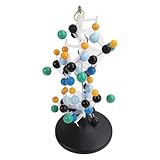
- [VIBRANT COLORS & SAFE DESIGN] The protein molecular model features bright and standardized atomic colors making it visually appealing and easy to identify. The high quality plastic construction ensures durability and safety for classroom use. The colorful balls and connecting are well made providing a tactile learning experience for students.
- [3D MOLECULAR VISUALIZATION] This model offers a comprehensive 3D representation of protein structures allowing students to study molecular and angles from all directions. The detailed design helps in understanding complex protein configurations making it an excellent tool for biochemistry and biology education.
- [HANDS ON LEARNING TOOL] Perfect for building both common and slightly complex protein structures this kit enhances interactive learning in classrooms and laboratories. The easy to assemble and disassemble design with included disconnect tool encourages student participation and engagement.
- [PORTABLE & USER FRIENDLY] Designed for convenience this molecular model is lightweight and easy to store or transport. The tightly held atoms and ensure stability during use while still allowing for effortless disassembly making it ideal for repeated classroom demonstrations.
- [EDUCATIONAL ENHANCEMENT] Specifically tailored for the QH3212 2 protein molecule this model aligns with textbook structures to boost student interest and comprehension. Teachers can leverage this visual aid to deliver more intuitive and effective lessons in molecular biology.
Why transition-state stabilization matters
A catalyst does not need to make the final products more stable than the starting materials. Its defining kinetic effect is to lower the activation barrier between them. In a simplified energy picture, the reactant and product may remain essentially the same while the transition state is selectively stabilized. More molecules can then cross the barrier per unit time.
The ExBox example makes that idea concrete. The host does not merely hold corannulene; it favors a guest geometry associated with the difficult part of the inversion. A cavity that is complementary to the transition-state-like shape can provide a larger rate effect than one that is complementary only to the resting substrate. This is why the example goes beyond a simple “the substrate fits” explanation.
The reported mechanism also illustrates preorganization. By constraining corannulene in a confined environment, ExBox limits the range of shapes the guest can explore. If the bound ensemble already contains more of the flattened geometry needed for inversion, the molecule has less conformational distance to travel before crossing the barrier. The account presents the host’s expansion and the guest’s flattening as parts of this adaptive process rather than as evidence of a permanently rigid cavity.
Induced fit versus a rigid lock-and-key picture
The classic lock-and-key model is useful as a first introduction: an enzyme has a site whose shape complements a substrate, allowing selective binding. A general NCBI Bookshelf chapter on biological catalysts presents this as a basic model of enzyme–substrate interaction. Real catalysis is more dynamic, however, and the ExBox system helps show why.
Rank #3

- FOR BASIC TEACHING TO ADVANCED SCIENCE: 444 pieces molecular model kit, including 136 atoms, 158 bonds and 150 parts for Carbon-60(Fullerene), provides to students from Grade 7 to Graduate level.
- TWO CHEMICAL STRUCTURE MODELS: The ball-and-stick models use spheres to represent atoms and sticks to represent chemical bonds. In the space-filling model, the spheres are drawn to scale and are next to one another as atoms are in real molecules.
- CHEMISTRY EDUCATIONAL MOLECULE MODEL IN 3D: It can display chemical structure, molecular bond, and bond angle in all directions. Demonstrate fundamental molecular geometry, chemical molecular structure, stereochemistry with 3D modeling studies.
- EASY TO LEARN: The universal standard adopted for each atom's color makes it easier for you to use and learn. Atoms and chemical bonds combine tightly and firmly and can be easily disassembled by disconnecting tools.
- If you’re not in love with it for whatever reason, we’ll give you a full replacement or refund—no questions asked. If you have any doubt, please tell us. With nothing to worry about, or even to share with your friends, try it now.
| Question | Rigid lock-and-key picture | ExBox–corannulene model | Biological enzyme |
|---|---|---|---|
| Does the host or enzyme change shape on binding? | Usually treated as little or no change. | Yes. The cavity expands and the corannulene bowl flattens. | Often yes, through side-chain, loop or domain motions; the extent depends on the enzyme. |
| What geometry is favored? | Mainly the substrate’s resting shape. | A flatter geometry associated with bowl inversion. | Efficient enzymes commonly complement key intermediates and transition states as well as substrates. |
| Is catalysis demonstrated? | The analogy alone does not establish it. | The report describes accelerated inversion in the host. | Biological catalytic activity is normally established through kinetic and mechanistic measurements. |
| Is repeated turnover established? | Not part of the simple picture. | Not established by the account summarized here. | Turnover—many catalytic cycles per enzyme molecule—is a defining practical feature of enzymes. |
The dynamic view does not make binding unimportant. Binding is the first step that places the guest in the environment where the rate-enhancing interactions can occur. The key distinction is that a useful catalyst must organize the pathway to the transition state, not simply grip the starting molecule tightly.
Is ExBox an enzyme mimic or an artificial enzyme?
Terminology depends on how much enzyme-like behavior has been demonstrated. The Royal Society of Chemistry chapter From Models Through Mimics to Artificial Enzymes offers a useful progression.
Model
A model is designed to illuminate a selected feature of enzyme chemistry. ExBox–corannulene fits comfortably in this category because it makes molecular recognition, conformational adaptation and transition-state-like stabilization easier to visualize.
Do these 3 things before closing this tab:
1Repair Windows errors before they cause bigger problems2Fix the driver behind crashes, sound loss and screen glitches3Clear out junk files and repair common Windows errorsEnzyme mimic
The chapter uses “enzyme mimic” more specifically for systems that combine substrate binding and catalysis with evidence that the mechanism is enzyme-like. If a primary study establishes those points for ExBox under defined conditions, the term may be justified in that context. The short secondary account alone does not provide enough detail to extend the label beyond the demonstrated features.
Rank #4
- Build common and slightly complex protein structures with this molecular model kit, perfect for teaching and lab use.
- Brightly colored balls and connectors follow standard color coding, making it easy to identify and use.
- Ideal for demonstrating protein molecular features from textbooks, boosting student interest and helping teachers explain clearly.
- 3D modeling shows basic molecular structure from all angles, helping visualize molecular and angles.
- Easy to learn, store, and carry; atoms and connectors fit tightly yet can be easily disassembled with a disconnect tool.
Artificial enzyme
Some definitions reserve “artificial enzyme” for systems that reproduce a broader set of enzyme properties. Catalytic turnover is an important additional criterion: one host molecule should be able to process successive substrate molecules rather than participate in only a single stoichiometric event. The account summarized here does not establish turnover, product release behavior or the full kinetic profile needed for that stronger description.
Using the cautious label “synthetic analogue of selected enzyme principles” avoids both extremes. It recognizes the catalytic effect while making no claim that a rectangular cyclophane reproduces the architecture or function of a natural protein.
Independent reader supportYour contribution helps us test, update, and keep practical guides available for everyone.What the tenfold figure does—and does not—mean
A tenfold rate increase means that, under the conditions used for the reported comparison, the observed bowl inversion proceeded at roughly ten times the rate measured without the host or under the relevant reference condition. It does not mean that ExBox is ten times as efficient as an arbitrary biological enzyme, nor that every corannulene molecule in the cavity inverts ten times during a fixed time interval.
What’s actually slowing this PC down?
Pick the symptom - the matching free tool is one click away.
Rate enhancements are conditional measurements. Solvent, temperature, concentrations, binding equilibrium and the method used to follow inversion all affect the numerical value. Because the available account does not reproduce those experimental details or the primary paper’s precise qualifications, the figure should be used as a reported result of that 2014 article, not as a universal constant for ExBox chemistry.
Best Value

- Model the molecular mechanics of gene expression — from DNA to protein. The Protein Synthesis Molecular Model Set from Mega Molecules is a hands-on educational tool designed to guide students through the complete process of protein synthesis: transcription and translation. Using color-coded components, this set allows learners to construct and manipulate accurate physical models of DNA, mRNA, tRNA, and amino acids—making the molecular biology behind gene expression tangible and engaging.
- This model set supports an active learning experience in which students construct DNA nucleotides using phosphoric acid, deoxyribose, and the four nitrogenous bases: adenine, thymine, cytosine, and guanine.
- Users build a DNA strand from a gene sequence (e.g., T-A-C-C-T-G-C-A-G-A-C-T), physically connecting the nucleotides via gray bonding links to represent covalent bonds.
- Users transcribe mRNA by pairing RNA nucleotides (adenine, uracil, cytosine, guanine) to the DNA template, demonstrating base pairing rules (e.g., A–U, C–G).
- Users model tRNA molecules with built-in anticodons and specific amino acid attachments—highlighting how tRNA ensures accurate translation at the ribosome.
What this model teaches about enzyme design
Recognition and reactivity are different design problems
A host can bind a guest strongly yet have little effect on its reaction rate. Conversely, a modestly binding environment can be highly catalytic if it places the substrate in a productive orientation and stabilizes the rate-limiting geometry. ExBox is instructive because the reported effect connects binding to a specific shape change and then to faster inversion.
Complementarity should be dynamic
Designing a cavity that exactly matches a stable substrate can trap the molecule in the wrong state. A catalyst may work better when its cavity can adjust during binding and when its strongest complementarity appears as the substrate approaches the transition state. The host’s expansion is therefore part of the lesson, not an imperfection to be ignored.
Confinement can simplify a complex motion
In free solution, corannulene samples many orientations and conformations. A host cavity restricts that motion and can increase the population of geometries relevant to inversion. This principle appears in many discussions of supramolecular catalysis, but the bowl-shaped guest provides an unusually intuitive visual example: a curved object is held in a space that helps it flatten before it flips.
A model has boundaries
Natural enzymes operate in water-rich, crowded cellular environments and coordinate binding, chemical transformation, product release and regulation. They may use multiple catalytic groups, long-range electrostatics, flexible loops and conformational states that are absent from a two-component host–guest system. ExBox can clarify one slice of that behavior without representing the whole biological process.
What is established and what remains open
- Established in the cited account: ExBox is presented as the host or active-site analogue; corannulene is the bowl-shaped guest or substrate analogue; binding changes the shapes of both; bowl inversion is the modeled reaction; and a tenfold acceleration is reported.
- Not established by the account: a complete set of experimental conditions, the original paper’s full mechanistic analysis, long-term catalyst lifetime, turnover number, product-release kinetics, cellular compatibility or comparison with a particular natural enzyme.
- Practical implication: explanations can safely use the system to teach induced fit and transition-state stabilization, but claims about artificial-enzyme status should wait for primary evidence that addresses mechanism and turnover.
This separation is especially important when the example is used in teaching. Students should learn that a measured rate enhancement is meaningful evidence of catalysis under stated conditions, while the broader category “enzyme” carries structural and functional expectations that a small synthetic host may not meet.
How to explain the system in one diagram or demonstration
- Draw the free molecules: show ExBox as a rectangular cavity and corannulene as a curved bowl outside it.
- Show binding: place the bowl inside the cavity and indicate that the cavity widens slightly.
- Show induced fit: flatten the bowl partway rather than drawing an unchanged guest in an unchanged host.
- Mark the transition-state-like geometry: identify the flatter arrangement as the shape stabilized by the confined cavity during inversion.
- Separate analogy from identity: label ExBox “active-site analogue” and corannulene “substrate analogue,” not “enzyme” and “biological substrate.”
- State the measured claim carefully: identify the tenfold acceleration as the result reported by the 2014 Chemistry World article.
This sequence prevents a common teaching error: treating binding alone as the cause of catalysis. The explanatory chain is binding, mutual structural adjustment, stabilization of a difficult geometry, and a faster chemical process.
Further reading
Readers who want a broader treatment can consult the Royal Society of Chemistry’s professional reference From Enzyme Models to Model Enzymes by Anthony J. Kirby and Florian Hollfelder. The publisher describes the 273-page book, published on 1 October 2009, as covering enzyme properties, mechanisms, models, artificial enzymes and kinetic interpretation for students and researchers. It provides terminology and mechanistic context for deciding when a synthetic system is a model, a mimic or something closer to an artificial enzyme.
Recommended Free Tools
Quick Recap
Product prices and availability are accurate as of the date/time indicated and are subject to change. Any price and availability information displayed on Amazon at the time of purchase will apply.

