Yes—designed protein modules can self-assemble into precise three-dimensional cages with stability and folding kinetics similar to natural proteins, but they are not synthetic enzymes. In a 2017 study, Ljubetič and colleagues built more than 20 single-chain cages from coiled-coil protein dimers, spanning tetrahedra, four-sided pyramids and triangular prisms. The largest design exceeded 700 amino-acid residues and measured 11 nanometres across. A separate DNA-origami platform has since used nanoscale compartments to organize real enzyme reactions, showing how molecular “origami” can control chemistry without making the protein cages themselves catalytic.
What “synthetic origami” means in protein design
Synthetic origami is a useful shorthand for designing molecules that fold or assemble into a planned shape rather than discovering a shape only after making a natural sequence. In the protein version, researchers choose modular protein parts, encode how those parts should connect, and produce a polypeptide or set of polypeptides that assembles into a defined three-dimensional object.
As an Amazon Associate I earn from qualifying purchases.
The “paper folding” comparison describes the design logic, not the chemistry. Proteins are chains of amino acids joined by peptide bonds. Their final structures are stabilized by hydrophobic packing, hydrogen bonds, electrostatic interactions, van der Waals forces and, in some proteins, disulfide bonds or bound cofactors. A sheet of paper has none of that chemistry. Protein origami therefore means programmable molecular architecture, not literal folding along creases.
The goal can be a hollow cage, a container, a scaffold for other molecules or a component in a larger nanodevice. The design can start with a desired geometry and work backward to sequences that should produce it. That reverses the usual natural-protein problem, in which a sequence exists first and scientists determine what structure it adopts.
#1 Best Overall
- Perfect for Visual Learners - This hands-on Biochemistry Model Kit is a tool that doesn’t just show you molecular structures; it lets you explore the magic of bonding, resonance, and chemical interactions like never before. It’s your key to understanding how molecular 3D structures influence chemical properties, such as in nucleotides and their base pairs, or in lipids and their hydrophobic behavior. You'll connect the dots between a compound's physical and chemical properties and its three-dimensional structure, deepening your understanding and making complex concepts intuitive.
- Versatile & Suitable for All Learning Levels - Whether you're a biochemistry student, an educator, or just passionate about molecular science, this model set will elevate your learning experience. It’s a powerful way to transform abstract molecular diagrams into tangible, interactive models you can touch, build, and explore. Get ready to turn curiosity into mastery—because biochemistry isn't just a subject, it's the science of life itself. With the Biochemistry Model Set, the possibilities are endless. Don’t just learn it—build it, see it, and truly understand it!
- High-Quality, Durable Components - Components are color-coded to international standards, with scaled bond lengths for accuracy. Rigid bonds allow easy single-bond rotation, while flexible bonds are ideal for double and triple bonds. Lost parts? No problem—Mega Molecules offers replacement atoms and bonds to keep your kit complete and long-lasting.
- Easy Assembly & Disassembly - Unlike many competitor kits that require special tools and make loud popping sounds during assembly or disassembly, Mega Molecules Model Sets offer a quiet, hassle-free experience. Atoms and bonds connect with a gentle push-and-twist motion and easily disconnect with a pull-and-twist—no noise, no tools needed. This thoughtful design minimizes distractions, making it perfect for classrooms, study sessions, and testing environments, ensuring a smooth, focused learning experience.
- Satisfaction Guarantee - Backed by a refund or replacement policy, this biochemistry building set offers a risk-free investment in chemistry education. Whether you're studying the protein structure, the base pairing in DNA, or the intricacies of a glycosidic linkage, this set brings your biochemistry lessons to life. Use it to model the relationships between carbon, hydrogen, oxygen, nitrogen, phosphorus, and sulfur as they form covalent bonds. With every build, you’ll gain deeper insights into the connections between molecular structure and function.
How the 2017 protein-origami system assembled cages
Coiled-coil dimers as modular parts
Ljubetič and colleagues used protein coiled-coil dimers as building blocks. A coiled coil consists of two or more α-helices that wrap around one another; its sequence can be designed so that one partner prefers a particular interaction with another. By treating these dimers as connectors with defined angles and linkages, the researchers could combine them into polyhedral frameworks.
The resulting platform was semi-automated. Instead of designing every atom of every cage independently, the team used a toolbox of compatible coiled-coil modules and a workflow that translated a target polyhedral arrangement into a single-chain protein design. “Single-chain” means the cage’s connectivity was encoded in one continuous amino-acid sequence, even though different segments of that chain formed the modular interfaces.
Three geometries, more than 20 characterized cages
The Nature Biotechnology paper characterized more than 20 cages in three forms. Those numbers describe that study’s demonstrated design set, not a limit on the number or size of shapes protein origami can eventually produce.
Quick wins for a faster PC:
Clear out junk files and repair common Windows errorsFree Scan →Scan for outdated or missing drivers - takes under a minuteDriver Scan →| Design feature | What the 2017 study reported |
|---|---|
| Building blocks | Designed protein coiled-coil dimers |
| Connectivity | Single-chain cage designs |
| Polyhedral forms | Tetrahedra, four-sided pyramids and triangular prisms |
| Number characterized | More than 20 cages |
| Largest reported example | More than 700 amino-acid residues and 11 nm in diameter |
The cages were not presented as enzymes. Their achievement was structural: they formed the intended architectures and remained sufficiently stable for characterization. A hollow protein cage could, in principle, provide a container or spatial scaffold, but that is different from catalysing a chemical reaction.
Do designed cages really fold like natural proteins?
The paper’s authors wrote in its abstract that “Their stability and folding kinetics were similar to those of natural proteins.” That is a specific comparison of the designed cages’ resistance to disruption and the rates or pathways by which they reached their folded states. It is not a claim that the cages are biologically identical to natural proteins, nor that every synthetic design will behave the same way.
Rank #2
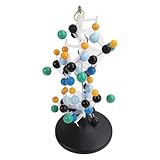
- [VIBRANT COLORS & SAFE DESIGN] The protein molecular model features bright and standardized atomic colors making it visually appealing and easy to identify. The high quality plastic construction ensures durability and safety for classroom use. The colorful balls and connecting are well made providing a tactile learning experience for students.
- [3D MOLECULAR VISUALIZATION] This model offers a comprehensive 3D representation of protein structures allowing students to study molecular and angles from all directions. The detailed design helps in understanding complex protein configurations making it an excellent tool for biochemistry and biology education.
- [HANDS ON LEARNING TOOL] Perfect for building both common and slightly complex protein structures this kit enhances interactive learning in classrooms and laboratories. The easy to assemble and disassemble design with included disconnect tool encourages student participation and engagement.
- [PORTABLE & USER FRIENDLY] Designed for convenience this molecular model is lightweight and easy to store or transport. The tightly held atoms and ensure stability during use while still allowing for effortless disassembly making it ideal for repeated classroom demonstrations.
- [EDUCATIONAL ENHANCEMENT] Specifically tailored for the QH3212 2 protein molecule this model aligns with textbook structures to boost student interest and comprehension. Teachers can leverage this visual aid to deliver more intuitive and effective lessons in molecular biology.
What the similarity supports
- They are experimentally foldable. The sequences did not merely form insoluble aggregates; the characterized designs adopted the intended cage architectures.
- They have measurable kinetic behaviour. Folding was studied as a process with a rate, rather than treated as an instantaneous consequence of expression.
- They can be stable molecular objects. Stability comparable to natural proteins indicates that the assembled structures can persist under the conditions tested.
What it does not support
- It does not show that synthetic cages perform natural enzyme catalysis.
- It does not establish a universal rule for all protein-origami designs, sizes or sequences.
- It does not mean the designs evolved, have a natural biological function or reproduce every feature of natural protein folding.
A 2022 review describes useful parallels between designed origami structures and natural proteins in folding processes, final shapes and mechanical properties, while explicitly treating the systems as different. “Inspired by” and “analogous to” are therefore more accurate than “the same as.”
Where the cages were made and what was observed
The 2017 work demonstrated tetrahedral cage assembly in bacteria, mammalian cells and mice. These experiments matter because a design that works only after purification in a controlled laboratory mixture faces a different challenge from one that can assemble in living systems.
Outdated Drivers Are Slowing You Down
One free scan finds every outdated or missing driver and matches the right update for your exact hardware.Free scan · exact hardware matchWindows Errors? Fix Them Before They Spread
Repair common Windows errors and clear accumulated junk for a smoother, more stable PC - no reinstall needed.Free scan · no reinstallThe demonstrations reported no evidence of inflammation in those settings. That observation is limited to the experiments and conditions in the paper; it is not evidence that every protein cage is immunologically inert or ready for medical use. The study was a proof of molecular design and intracellular or in vivo assembly, not a clinical treatment study.
Protein origami versus DNA origami
DNA origami uses nucleic acids as construction material, usually folding a long scaffold strand with many shorter “staple” strands into a programmed shape. Protein origami uses amino-acid sequences and protein-protein interactions. Both let a designer specify a nanoscale arrangement, but their chemistry, synthesis, folding pathways and applications differ.
| Comparison | Protein origami | DNA origami |
|---|---|---|
| Primary material | Polypeptides, including designed coiled-coil modules | DNA scaffold and staple strands |
| Assembly basis | Protein folding and specific protein–protein interfaces | Base pairing between complementary nucleic-acid strands |
| Demonstrated example in the cited work | Polyhedral cages: tetrahedra, four-sided pyramids and triangular prisms | Two connected nanocompartments that organize enzyme steps |
| Experimental setting | Purified designs plus assembly in bacteria, mammalian cells and mice | Cell-free reaction system |
| Primary result | Defined cage architecture, stability and folding kinetics | Changed rates and selectivity of compartmentalized reactions |
They should not be compared as though they performed the same task. The protein study asked whether designed polypeptides could form stable cages. The DNA study asked whether a nanoscale layout could bring reaction components together and restrict unwanted reactions.
Rank #3

- FOR BASIC TEACHING TO ADVANCED SCIENCE: 444 pieces molecular model kit, including 136 atoms, 158 bonds and 150 parts for Carbon-60(Fullerene), provides to students from Grade 7 to Graduate level.
- TWO CHEMICAL STRUCTURE MODELS: The ball-and-stick models use spheres to represent atoms and sticks to represent chemical bonds. In the space-filling model, the spheres are drawn to scale and are next to one another as atoms are in real molecules.
- CHEMISTRY EDUCATIONAL MOLECULE MODEL IN 3D: It can display chemical structure, molecular bond, and bond angle in all directions. Demonstrate fundamental molecular geometry, chemical molecular structure, stereochemistry with 3D modeling studies.
- EASY TO LEARN: The universal standard adopted for each atom's color makes it easier for you to use and learn. Atoms and chemical bonds combine tightly and firmly and can be easily disassembled by disconnecting tools.
- If you’re not in love with it for whatever reason, we’ll give you a full replacement or refund—no questions asked. If you have any doubt, please tell us. With nothing to worry about, or even to share with your friends, try it now.
What DNA origami adds to the enzyme story
Two connected reaction compartments
In a 2024 Nature Nanotechnology study, Kaiser and colleagues built two connected DNA-origami nanocompartments. Each measured 25 × 41 × 53 nanometres. One compartment housed p97, a protein-unfolding machine; the other housed α-chymotrypsin, a protease.
The arrangement created a synthetic reaction pathway in a cell-free model. Spatial confinement increased individual reaction rates by up to tenfold. Connecting the compartments coupled the two steps and reduced off-target proteolysis by almost sixfold. The reported values belong to that DNA-origami system and its experimental conditions; they are not measurements of the 2017 protein cages.
Why confinement can change a reaction
Separating and then connecting reaction zones changes which molecules encounter one another, how long intermediates remain nearby and where unwanted substrates can go. A compartment can raise the effective local concentration of a partner while shielding other molecules from an active enzyme. In that sense, DNA origami acts like a nanoscale factory layout.
This example answers a different question from “Can a designed protein fold into a natural-looking structure?” It shows that origami-inspired molecular engineering can organize enzymes that already have catalytic activity. It does not turn a structural protein cage into an enzyme and does not show that the 2017 cages catalyse reactions.
What folding studies suggest about design rules
Folding is not always a one-way march from disorder to the final shape. A separate study of DNA-origami folding pathways found cooperative assembly, reversible bond formation and a role for early long-range connections in guiding particular folds. Reversibility allows a transiently mispaired segment to detach and try again instead of trapping the whole structure permanently.
Rank #4
- Build common and slightly complex protein structures with this molecular model kit, perfect for teaching and lab use.
- Brightly colored balls and connectors follow standard color coding, making it easy to identify and use.
- Ideal for demonstrating protein molecular features from textbooks, boosting student interest and helping teachers explain clearly.
- 3D modeling shows basic molecular structure from all angles, helping visualize molecular and angles.
- Easy to learn, store, and carry; atoms and connectors fit tightly yet can be easily disassembled with a disconnect tool.
Those observations are relevant as a design analogy. A protein-origami sequence may also benefit from interfaces that form in a controlled order and from avoiding strong early contacts that lock in the wrong topology. However, the DNA results concern nucleic-acid nanostructures, not the coiled-coil protein cages or the folding of natural enzymes. They provide molecular-design principles to consider, not direct measurements of the protein system.
Independent reader supportYour contribution helps us test, update, and keep practical guides available for everyone.How natural enzyme folding differs from a designed cage
Natural enzymes are selected to bind particular substrates, stabilize transition states and accelerate reactions. Their folds create active sites with precise chemical groups, often supported by cofactors, metal ions or dynamic movements. Evolution also tunes expression, degradation, regulation and compatibility with a cell.
A designed cage has a different success criterion: the geometry, connectivity and stability specified by its designer. It may have an internal cavity or display useful surface patterns, but a cavity alone is not an active site. Catalysis requires a chemical mechanism that has been demonstrated experimentally.
Natural proteins can also fold co-translationally as a ribosome produces them, whereas a synthetic cage’s modules may need to find one another or arrange correctly after translation. The 2017 results show that the designed sequences achieved their intended structures and had natural-protein-like stability and kinetics in the tested comparisons; they do not erase these mechanistic differences.
The Tool Desk
Outbyte Driver Updater FREEFix the driver behind crashes, sound loss and screen glitchesFind Drivers →Outbyte PC Repair FREEClear out junk files and repair common Windows errorsFree Scan →Why the work matters—and what remains unresolved
Designable architecture
Being able to specify a cage’s connectivity makes protein nanostructures more predictable than trial-and-error assembly. A modular toolbox can be extended, tested and recombined, allowing researchers to explore containers, scaffolds and multivalent surfaces without inventing an entirely new strategy for every shape.
Best Value

- Model the molecular mechanics of gene expression — from DNA to protein. The Protein Synthesis Molecular Model Set from Mega Molecules is a hands-on educational tool designed to guide students through the complete process of protein synthesis: transcription and translation. Using color-coded components, this set allows learners to construct and manipulate accurate physical models of DNA, mRNA, tRNA, and amino acids—making the molecular biology behind gene expression tangible and engaging.
- This model set supports an active learning experience in which students construct DNA nucleotides using phosphoric acid, deoxyribose, and the four nitrogenous bases: adenine, thymine, cytosine, and guanine.
- Users build a DNA strand from a gene sequence (e.g., T-A-C-C-T-G-C-A-G-A-C-T), physically connecting the nucleotides via gray bonding links to represent covalent bonds.
- Users transcribe mRNA by pairing RNA nucleotides (adenine, uracil, cytosine, guanine) to the DNA template, demonstrating base pairing rules (e.g., A–U, C–G).
- Users model tRNA molecules with built-in anticodons and specific amino acid attachments—highlighting how tRNA ensures accurate translation at the ribosome.
Biological compatibility questions
Assembly in bacteria, mammalian cells and mice is an important feasibility result. It does not settle pharmacokinetics, long-term stability, tissue distribution, immune responses across populations, toxicity, manufacturing yield or regulatory requirements. Those questions would require dedicated studies for each sequence and application.
Scale and complexity
The largest cage in the cited study was more than 700 amino acids and 11 nm across. That is a substantial molecular object, but it is one demonstrated point in design space, not a field-wide maximum. Larger assemblies introduce more opportunities for misfolding, aggregation and incomplete assembly, while smaller designs may have less room for cargo or functional surfaces.
From structure to function
A stable shape is a platform, not a finished product. Turning a cage into a useful sensor, delivery vehicle or catalyst would require adding and validating the relevant binding, release or chemical functions. The available examples establish structural assembly and, in the DNA case, reaction organization; they do not establish a consumer product or an approved treatment.
What’s actually slowing this PC down?
Pick the symptom - the matching free tool is one click away.
Can designed molecules fold into structures like natural proteins?
Yes, within the scope of the experiments described. The 2017 protein-origami study produced multiple intended polyhedral cages and reported stability and folding kinetics similar to natural proteins for those designs. The careful conclusion is that engineered sequences can be made to fold into well-defined, natural-protein-like molecular objects. The stronger claim—that synthetic origami universally folds like natural enzymes or reproduces their catalytic function—has not been demonstrated by these studies.
Quick Recap
Product prices and availability are accurate as of the date/time indicated and are subject to change. Any price and availability information displayed on Amazon at the time of purchase will apply.

