The U.S. Strategic Petroleum Reserve (SPR) is federally owned crude oil held for emergencies; commercial oil inventories are industry-held stocks used in ordinary supply, refining, and distribution. The categories are reported separately: the Energy Information Administration (EIA) labels its commercial crude series “Commercial Crude Oil Stocks (Excluding SPR),” so a figure for commercial crude does not include SPR barrels.
How the SPR and commercial inventories differ
| Dimension | Strategic Petroleum Reserve | Commercial oil inventories |
|---|---|---|
| Owner and control | Federally owned and managed by the U.S. Department of Energy (DOE). | Held by companies across the commercial petroleum system. |
| Purpose | Emergency crude supply intended to counter significant disruptions in commercial supply. | Supports routine supply, storage, refining, and distribution operations. |
| Where it is held | Deep underground salt caverns at four sites on the Texas and Louisiana Gulf Coasts. | Commercial crude stocks are reported at refineries and bulk terminals and in pipelines, as well as other industry locations covered by EIA reporting. |
| How EIA reports it | As a separate SPR series or line. | The commercial crude series explicitly excludes the SPR. |
These distinctions matter because an inventory total only means what its table heading and notes say it means. Commercial crude, SPR crude, and total petroleum stocks are not interchangeable measures.
As an Amazon Associate I earn from qualifying purchases.
Are SPR barrels included in commercial crude stocks?
No. EIA reports commercial crude stocks excluding the SPR and shows SPR stocks separately. For example, EIA’s September 30, 2026 weekly report said commercial crude oil stocks were 427.320 million barrels for the week ending September 25, up 0.922 million barrels from the previous week. That dated commercial figure is not an SPR-inclusive total. See the EIA Weekly Petroleum Status Report.
Recommended Free Tools
Be careful when comparing figures labeled “total petroleum stocks.” Those totals may include refined products as well as crude, and tables can present totals either with or without the SPR. Check the exact table title and footnotes before adding or comparing numbers. EIA’s stocks of total crude oil and petroleum products (excluding SPR) page describes its scope and period-end convention.
#1 Best Overall

- These are hobby grade products securely packed for protection in shipping
- Please handle with care when removing from package or breakage could occur
How much oil is in each category?
Inventory figures are snapshots tied to specific dates and reporting periods. The latest figures in the cited official releases are not same-day measurements:
- SPR: DOE’s site table listed 294.1 million barrels as of August 20, 2026, against 714 million barrels of authorized storage capacity. The inventory is a dated site-table snapshot, not a weekly figure. Details are on DOE’s SPR Quick Facts page.
- Commercial crude: EIA reported 427.320 million barrels for the week ending September 25, 2026, in its September 30, 2026 report.
Because the dates differ, these values should not be presented as a direct, same-day comparison. Nor should the commercial crude figure be added to the SPR figure without clearly stating the dates and categories involved.
Rank #2

- A wide 575,000-gallon tank
- A stairway molded to fit the tank body
- Berm crossover stairways
- Realistic decals
- Modular retention berms which can be used to combine multiple tanks into a complete scene
Why the government maintains a separate reserve
The SPR was established after the 1973–74 oil embargo under the Energy Policy and Conservation Act, signed in 1975. DOE describes its purpose as helping counter disruptions to commercial oil supplies that could threaten the economy. Commercial inventories, by contrast, are part of the industry’s working supply chain rather than a federally controlled emergency reserve. DOE’s Strategic Petroleum Reserve page explains the reserve’s ownership, purpose, and storage.
Free tools Windows power users keep installed
One-click scans. No signup required.
How an SPR release reaches the market
The SPR is not gasoline waiting to be pumped directly into motorists’ cars. It stores crude oil, which must be sold or exchanged and then moved into the market for refining and distribution. DOE says oil can begin entering the market within 13 days of a presidential decision, a timeline that includes sales arrangements and logistics. Its maximum nominal drawdown capability is 4.4 million barrels per day; DOE’s FAQ says that rate can be sustained for up to 90 days before declining as caverns empty. These are release capabilities, not a promise that all of that oil will reach consumers at once. See DOE’s quick facts and SPR FAQs.
Rank #3

- New in manufacturer packaging.
- Realistic Detail.
- Robust materials.
- Original packaging.
- Scale Miniature for For Model Trains and Dioramas.
Sales and exchanges
DOE can arrange competitive sales when statutory conditions are met. An exchange can work as a time-based loan after an external disruption—such as a hurricane or channel closure—when a company requests it and DOE determines that the action serves the public interest. On September 29, 2026, DOE issued a request for proposals for an exchange of up to 40 million barrels as part of a previously announced release commitment. That was a specific action, not a routine commercial inventory movement. DOE’s FAQ on the SPR describes exchanges; its September 29, 2026 announcement details that action.
Why the SPR stores crude rather than gasoline
DOE says the reserve holds crude oil, not refined products. Its FAQ points to the refining industry’s capacity, the cost of acquiring, storing, and transporting crude versus products, and crude oil’s flexibility: refiners can process different crude qualities to meet demand for different products. DOE classifies sweet crude as having no more than 0.5 percent sulfur by weight and sour crude as more than 0.5 percent but less than 2.0 percent. Those definitions describe crude held in the reserve; they do not mean the SPR contains finished gasoline or other fuels.
Rank #4

- 【Durability】 Train Building Kit is crafted from pp, ensuring long term use and resistance to wear during frequent handling or display
- 【Versatile】Great for dioramas, sand table models, and train scene displays; the HO Scale Water Tank Kit is ideal for hobbyists and collectors alike
- 【Compact】Assembly Measuring 8cm in length, 4cm in width, and 7.5cm in height, the HO Scale Model Kit fits seamlessly into various model railway setups without taking up excessive space
- 【Realistic】Designed in HO scale 1:87, this miniature water tank model accurately replicates railway scene architecture for authentic train layouts
- 【Complete】Includes 1 miniature water tank model assembly per package, ready to integrate into your HO scale railway environment
How “days of imports” figures can differ
DOE estimated that SPR crude represented approximately 125 days of U.S. crude net imports at December 31, 2025. Separately, the International Energy Agency obligation described by DOE is 90 days of net imports and can be met using both public and private stocks. These are different calculations with different stock coverage; the 125-day estimate is not the same measure as the 90-day obligation. DOE sets out both figures on its SPR Quick Facts page.
What’s actually slowing this PC down?
Pick the symptom - the matching free tool is one click away.
Quick Recap
Best Value
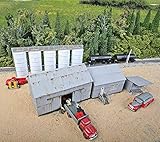
- Narrow design fits easily between or along tracks - perfect for shelf layout
- Separate office and warehouse buildings
- Parts for five tanks, plus piping and other details
- Printed signs
- Molded in 5 colors and clear plastic
A practical way to read inventory headlines
- Identify the category. Look for “commercial crude,” “SPR,” or “total petroleum stocks”; they describe different buckets.
- Read the date. Weekly commercial figures refer to a stated week ending, while DOE’s site inventory table can be a dated snapshot.
- Check what the total includes. Confirm whether refined products and the SPR are included before combining values or comparing one total with another.
- Interpret a release as a process. Government sales or exchanges are different from companies’ ordinary movements of commercial stocks, and crude needs to pass through the supply chain before it becomes refined fuel.
Product prices and availability are accurate as of the date/time indicated and are subject to change. Any price and availability information displayed on Amazon at the time of purchase will apply.

