Do these 3 things before closing this tab:
1Clear out junk files and repair common Windows errors2Fix the driver behind crashes, sound loss and screen glitches3Repair Windows errors before they cause bigger problemsThere is no universal “best” textile actuator. Choose a shape-memory alloy (SMA) when compact, energy-dense contraction matters more than cycling speed; choose a pneumatic textile when force, stroke and soft contact dominate; choose an electroactive textile when thin, distributed electrical actuation is worth managing high voltage, electrolyte lifetime or heat. Published demonstrations use different loads, geometries and drive hardware, so performance figures must be compared only after those conditions are normalized.
What the three actuator classes do
A textile actuator turns an electrical, pneumatic or thermal input into contraction, bending, extension or pressure. The textile is not merely a covering: knitted loops, woven reinforcement, coated fabrics, yarn twists, airtight chambers and compliant bias layers determine how much of the active material’s motion reaches the user or mechanism.
As an Amazon Associate I earn from qualifying purchases.
The practical comparison has two levels. First is the active element: an NiTi wire, an inflatable chamber or an electroactive film/fiber. Second is the complete system: current driver and cooling path for SMA; pump, valves, tubing and seals for pneumatics; and voltage conversion, insulation, encapsulation or heat spreading for electroactive textiles. A small actuator can therefore become a large wearable system if its support hardware is ignored.
Shape-memory alloy textiles
How SMA actuation works
Most textile SMA actuators use nickel-titanium (NiTi). The alloy is trained to remember a shape. Heating it through its transformation range causes a reversible phase change and recovery toward that trained shape. Cooling allows the material to return only if a bias spring, textile tension or opposing load is provided. Current is usually supplied directly to the wire, so Joule heating is the simple electrical input.
#1 Best Overall
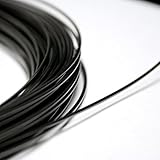
- Trained straight - the wire is very soft and pliable at room temperatures, and becomes stiff and straightens out at a very low heat point of 40C (about 100F), making it suitable for demonstrations without getting burned.
- 1.0 mm (0.04") diameter is very thick, this wire can hold or pull many pounds of weight and it is virtually unbreakable.
- Wire can be trained to take on a different shape by heat treating it at 500C and quenching in water.
- Thick, strong & smooth - black oxide finish is shiny and low friction, with a mysterious sheen.
A 2023 Advanced Materials review describes SMAs as having high energy density, useful actuation strain and biocompatibility, and surveys wires, springs, soft composites and knitted or woven architectures. Applications discussed include mobile robots, robotic hands, wearables, aerospace and automotive components, and biomedical devices.
Textile integration patterns
- Wrapped or coated yarn: an active SMA wire is combined with conventional fibers so the textile carries load and protects the wire.
- Stitched tendons: short SMA elements are sewn into a fabric panel or along a soft-gripper finger, with the textile providing the return bias.
- Knitted or woven composites: repeated wires distribute contraction over a larger area instead of concentrating force at one point.
- Spring elements: a coiled SMA increases available stroke and can fit where a straight wire cannot, at the cost of additional thermal mass.
A Sensors study demonstrated an active SMA fiber wire wrapped with conventional fibers and an inactive knitting yarn; three actuators were stitched into each soft-gripper finger. This is a useful design pattern for wearables: the SMA supplies compact contraction while the textile supplies compliance, routing and load distribution.
Where SMA is strongest—and where it struggles
| Attribute | SMA textile implication |
|---|---|
| Compactness | Wire and spring elements pack useful strain and energy density into a small volume. |
| Drive | Usually a controlled current; the textile must also provide a thermal path and a return bias. |
| Speed | Heating can be rapid, but cooling governs the next cycle, especially with thick coatings, multiple wires or body-contact insulation. |
| Control | Transformation temperature, current, preload and hysteresis must be calibrated together. |
| Durability | Fatigue, over-temperature exposure and unsuitable preload can shorten life; wire diameter and thermal mass change the result. |
The central penalty is thermal. Heat must leave the wire before it can contract again, and a hot element near skin creates a safety and comfort problem. Hysteresis means the heating and cooling paths do not occur at exactly the same temperature, so a temperature or position sensor is often preferable to open-loop timing. SMA is therefore attractive for intermittent assistance or compact distributed contraction, not automatically for high-frequency motion.
Free tools Windows power users keep installed
One-click scans. No signup required.
Pneumatic textile actuators
How textile pneumatic actuation works
A pneumatic textile actuator uses an airtight chamber, shell or bladder. Increasing pressure makes the chamber expand in a controlled direction; woven restraints, seam placement and differential stretch convert that expansion into bending, shortening or force against the body. Releasing pressure reverses the motion, often with help from the fabric’s elasticity or an external bias.
Rank #2

- The best way to get started exploring the properties of nitinol muscle wire is to get the feel for the different temperatures. Each wire has its unique properties that are best experienced in person.
- This sample pack contains a total of 7 wires, each 1 foot long and 1mm thick, which is a perfect thickness that exerts good strength for demonstrations and experimentation. The seven wires are the same appearance but each exhibit the memory effect at a different temperature.
- Wire temps in the pack: -30°C ( -22F ) ... 0°C ( 32 F ) ... 15°C ( 60 F ) ... 30°C ( 86 F ) ... 40°C ( 104 F ) ... 60°C ( 140 F ) ... 80°C ( 176 F )
- Nitinol is hypoallergenic, high tensile strength, and impervious to most corrosive chemicals.
- Black oxide finish is lustrous, smooth, and low friction. Get the feel for each wire to choose the right one.
The 2024 review Pneumatic smart textile actuation characterizes pneumatic soft actuators as safe in contact, capable of high output force and large displacement, but dependent on high actuation flow and generally limited to lower frequencies. A Chemical Society Reviews comparison similarly lists high force and displacement and easy implementation as advantages, while warning that a bulky pump is often required and puncture is a persistent risk.
The complete pneumatic system
- Air source: a pump, compressor or stored reservoir sized for the required pressure and flow.
- Valves: proportional or on/off valves that meter inflation and exhaust.
- Plumbing: tubing, manifolds and connectors add mass, dead volume and possible leak points.
- Sensing: pressure sensing is useful for repeatability and for detecting a leak or a blocked line.
- Fabrication: coated or laminated layers, welded seams and reinforcement must remain airtight through bending and repeated loading.
In a 2024 arXiv study titled “Sealing the Deal: Effects of Fabrication Parameters on the Performance of Textile Pneumatic Haptic Actuators,” one textile actuator reached 36.1 N blocked force. In that study’s own test setup, it was 96.4% thinner and 57.2% lighter than the compared elastomeric pneumatic actuator. Those are study-specific results, not class-wide benchmarks: pressure, chamber geometry, seam construction, flow hardware and the definition of blocked force all affect the measurement.
When pneumatics are the right answer
Choose a pneumatic textile when the user needs substantial force over a large stroke, a broad soft contact area or an actuator that remains compliant when it touches the body. Pneumatics are often the most forgiving choice for assistive motion and haptic pressure, provided the design can carry or remotely locate the air hardware.
The trade-off is infrastructure. A thin chamber does not make the entire wearable thin if the pump, battery, valves and reservoir sit on the garment. Flow rate and pneumatic dead volume also determine how quickly pressure can change. Seams can leak gradually, while a puncture can cause abrupt failure; designs intended for field repair should use replaceable bladders or accessible modules.
Rank #3

- Brand New and High Quality
- Extensive Size Options:Available in 14 sizes from 0.1MM to 1.8MM, catering to a wide range of applications.
- High-Quality Nitinol Alloy:Crafted from premium Nitinol alloy, this wire resists rust and offers exceptional elasticity.
- Versatile Application:Ideal for diverse uses, from fishing hooks to medical equipment, thanks to its adaptability.
- Operating Temperature Range:Performs reliably from -15℃ to 150℃, ensuring consistent performance across various temperatures.
Electroactive textile actuators
“Electroactive textile” is a family name rather than a single mechanism. Reviews in ACS Nano and Advanced Fiber Materials describe fibers and fabrics that contract, coil, bend or fold through electrostatic, electrochemical, electrothermal or piezoelectric effects. Their power, speed and safety differ substantially.
Dielectric-elastomer actuators (DEAs)
A DEA places a dielectric elastomer membrane between two compliant electrodes. Applying an electric field creates Maxwell stress that compresses the film through its thickness and expands it in-plane. A 2024 review in Advanced Intelligent Systems notes that the required voltage is usually a few kilovolts.
DEAs can provide large strain, high energy density and fast response, making them the leading candidate when a reader asks for the fastest large-strain soft actuator. Their limits are equally important: insulation and electrode durability, dielectric breakdown, arcing risk, electrical clearance and the need for a high-voltage converter. Thin films reduce voltage for a given field but can be harder to manufacture and protect.
Kang and colleagues reported a 7 cm fiber-format DEA with up to 10% axial strain. Bundles in that demonstration reached 134 W kg−1 at 4 Hz, while the demonstrated bundles themselves remained shorter than 1 cm overall. These figures belong to that specific fiber design and test protocol; they should not be treated as a universal textile-DEA rating.
Rank #4

- What You Will Get: the package contains 2 pieces of nitinol wire with a diameter of 1 mm, each can be up to about 5 feet in length, long enough to meet your experimental needs
- Quality Material: nitinol memory wire is a special alloy that can automatically restore its own plastic deformation to its original shape at a certain temperature; In addition, it also has the characteristics of wear resistance, corrosion resistance, high damping and elasticity
- Easy to Operate: plastically deform the memory alloy in a low temperature environment, when the temperature exceeds 40°C or below 0°C, the elasticity of the memory line weakens, and it can be bent at will, and can be folded into other shapes at will; When the temperature is kept at 0°- 40°C, the memory line is bent at will, and can still spring back into a straight line
- Basic Parameters: the diameter of nitinol alloy wire is about 1 mm, and the usable temperature is about 40° C, you can conduct experiments and applications according to the diameter and temperature requirements
- Wide Application: 5 feet shape memory wire can be applied in teaching experiments, meet the application requirements of various engineering and medicine
Ionic and electrochemical actuators
Ionic systems move ions through an electrolyte or change an electrochemical material’s volume. Chemical Society Reviews summarizes ionic actuators as generally operating below 10 V, a major advantage for battery-powered wearables. The lower voltage usually comes with compromises in force, bandwidth, hydration control and lifetime. Electrolyte drying, leakage and encapsulation quality can dominate service life, and the 2024 artificial-muscle-fiber review describes electrochemical fiber applications as still underdeveloped.
Electrothermal and piezoelectric fibers
Electrothermal yarns use resistance heating. They can be compact and easy to address electrically, but they inherit the same heat-management and time-constant problems that limit SMA cycling. Piezoelectric fibers are light and fast, yet their free stroke is often small; a textile mechanism may need geometric amplification, preload or resonance to produce useful displacement.
| Electroactive type | Typical benefit | Primary engineering concern |
|---|---|---|
| Dielectric elastomer | Large strain, fast response and high energy density | High voltage, insulation, breakdown and electrode fatigue |
| Ionic/electrochemical | Low-voltage operation, generally below 10 V | Limited bandwidth, hydration, encapsulation and lifetime |
| Electrothermal | Simple resistive drive and compact integration | Heat transfer, skin temperature and thermal response time |
| Piezoelectric | Low mass and rapid response | Small free stroke and the need for mechanical amplification |
Side-by-side comparison
| Criterion | SMA textile | Pneumatic textile | Electroactive textile |
|---|---|---|---|
| Primary input | Joule heating or another SMA stimulus | Air pressure and flow | Electric field, ionic transport or resistive heat |
| Best-supported advantage | Compact, energy-dense wire or spring integration | High force, large displacement and compliant contact | Distributed, lightweight and electrically addressable deformation |
| Main infrastructure | Current driver, thermal path and biasing structure | Pump or compressor, valves, tubing, seals and pressure sensing | High-voltage converter and insulation for DEA; electrolyte and encapsulation for ionic; thermal management for electrothermal |
| Typical limiting factor | Cooling and cycle rate | Pump bulk, flow rate and leaks or puncture | Voltage safety, breakdown, hydration or heat |
| Textile integration | Knitting, weaving, wrapped wire and composites | Coated or laminated airtight chambers | Conductive fabrics, dielectric films, ionic fibers and electrothermal yarns |
| Key variables | Transformation temperature, wire diameter, preload and cooling | Pressure, chamber geometry, seam quality and flow hardware | Field strength, film thickness, electrode compliance, electrolyte and test frequency |
The comparison is directional, not a league table. A high-pressure chamber measured at low frequency is not directly comparable with a thin DEA tested at 4 Hz, and a short SMA pulse is not equivalent to continuous cycling. Normalize load, stroke, actuator mass, support hardware, duty cycle, ambient temperature and safety limits before declaring a winner.
Which textile actuator is fastest?
For electrically driven soft materials, a DEA or piezoelectric element can respond faster than a thermally driven SMA or electrothermal yarn. DEA demonstrations show the potential for high-frequency operation, but the useful system speed still depends on charging electronics, mechanical load and heat in the electrodes. Piezoelectric fibers are fast but may not deliver enough stroke without amplification.
Best Value
- Brand New and High Quality
- Extensive Size Options:Available in 14 sizes from 0.1MM to 1.8MM, catering to a wide range of applications.
- High-Quality Nitinol Alloy:Crafted from premium Nitinol alloy, this wire resists rust and offers exceptional elasticity.
- Versatile Application:Ideal for diverse uses, from fishing hooks to medical equipment, thanks to its adaptability.
- Operating Temperature Range:Performs reliably from -15℃ to 150℃, ensuring consistent performance across various temperatures.
Pneumatic textiles can move quickly only when the pump, valves and air volume provide sufficient flow. A long tube, large chamber or small pump can make the fabric appear slow even when the material itself is compliant. SMA is usually the slowest for repeated large motions because cooling sets the recovery interval. “Fastest” must therefore specify rise time, stroke, force, frequency, duty cycle and complete system hardware.
Which can produce high force without a bulky wearable?
SMA offers the most compact active element, but its force and stroke depend strongly on wire diameter, temperature, preload and cooling. It can be distributed through a garment with little pneumatic plumbing, yet the battery and thermal spreader still count toward bulk.
Pneumatic textiles commonly provide the strongest combination of force and large displacement at the actuator surface, but the pump, valves and reservoir are the source of bulk. Locating that hardware at the waist, in a backpack or off-body can preserve a thin sleeve while sacrificing portability or acoustic privacy.
Electroactive textiles can be exceptionally thin and distributed. DEAs may deliver high specific performance but require high-voltage electronics and insulation; ionic systems simplify voltage requirements but generally sacrifice force or bandwidth; electrothermal systems reintroduce heat. The best answer is therefore a system-level compromise, not a material property alone.
How to choose and power one
- Define the mechanical requirement. Record peak and continuous force, stroke or bend angle, response time, operating frequency, duty cycle and allowable actuator mass. Measure these at the actual attachment geometry, not only at a free actuator.
- Set the body and safety envelope. Specify skin-contact temperature, pinch points, electrical insulation, pressure limits, noise, washability and what happens after a leak or power loss.
- Choose the infrastructure you can carry. SMA needs a current-controlled driver and a deliberate cooling path. Pneumatics need pressure and flow capacity plus valves, seals and sensing. DEAs need a high-voltage converter, insulation and discharge protection; ionic devices need electrolyte containment; electrothermal devices need heat spreading.
- Prototype the textile transmission. Test stitches, woven restraints, bias layers, seam peel strength and strain concentration before optimizing the active material.
- Close the control loop. Use temperature, position, pressure, current or voltage sensing as appropriate. Open-loop timing drifts with ambient temperature, battery state, leakage and material aging.
- Run a normalized endurance test. Report actuator and hardware mass, load, stroke, frequency, ambient conditions, pressure or voltage, cycle count and failure mode. Repeat tests after washing, bending and connector replacement if the product is wearable.
Common failure modes and fixes
- SMA stops returning: reduce preload, verify transformation temperatures, limit peak current and add a stronger or better-aligned bias element. Improve heat spreading rather than simply increasing current.
- SMA feels hot: lower duty cycle, isolate the wire from skin, add a temperature cutoff and move heat into a ventilated layer.
- Pneumatic actuator is weak or slow: check leaks and valve flow, shorten tubing, reduce dead volume and match the pump to both pressure and required flow.
- Pneumatic chamber delaminates: redesign seam geometry, validate peel and burst strength, and protect high-flex regions from sharp folds.
- DEA arcs or loses output: inspect insulation and electrode edges, reduce field stress, control film thickness and add current limiting and a safe discharge path.
- Ionic actuator dries out: improve encapsulation and hydration management, then retest force and bandwidth over the intended environmental range.
- Electrothermal textile is too slow: reduce thermal mass, improve heat rejection and avoid placing insulation directly over the active yarn unless the resulting temperature is acceptable.
- Piezoelectric textile barely moves: add mechanical amplification or resonance only after confirming that the load and drive frequency remain within safe limits.
Practical selection guide
| If your priority is… | Start with… | Why |
|---|---|---|
| Compact distributed contraction | SMA wire, spring or knitted composite | High energy density and straightforward electrical heating fit narrow textile paths. |
| High force and large stroke | Pneumatic chamber or shell | Pressure produces compliant force over a broad area, if the air system fits. |
| Thin electrical actuation | Electroactive textile | Distributed fibers and films avoid pneumatic tubing, with voltage, electrolyte or heat constraints chosen by subtype. |
| Fast small motion | Piezoelectric or DEA architecture | Electrical field-driven materials can respond quickly, but stroke and safety must be engineered. |
| Skin-adjacent intermittent assistance | SMA or low-pressure pneumatic textile | Both can be compliant; SMA requires thermal limits, while pneumatics require leak-safe construction. |
Bottom line
Use SMA when compact contraction and textile integration outweigh thermal cycling limits. Use pneumatic textiles when force and displacement are the primary requirements and a pump-and-valve system is acceptable. Use electroactive textiles when distributed, thin electrical actuation is valuable and you can engineer the relevant high-voltage, electrolyte-lifetime or heat-management constraints. Quote every performance number with its test conditions; unmatched demonstrations cannot establish a universal winner.
Quick Recap
Product prices and availability are accurate as of the date/time indicated and are subject to change. Any price and availability information displayed on Amazon at the time of purchase will apply.

