A 520-million-year-old larva named Youti yuanshi preserves three-dimensional traces that scientists interpret as its brain and nervous system, digestive glands, and spaces linked to circulation. The fossil is only about four millimetres long, and the findings were published in Nature on 31 July 2024. The larva cannot show what the animal looked like as an adult, but it offers an unusually detailed view of anatomy from the early history of the arthropod lineage.
What the fossil is
- Name: Youti yuanshi. The name combines Pinyin words meaning “larva” and “primitive.”
- Classification: The study places it in the lower stem group of Euarthropoda, the lineage that includes living arthropods such as insects, crustaceans, and spiders. It is an early relative, not a member of any modern group.
- Age and setting: The authors date it to the early Cambrian, approximately 520 million years ago, in the late Atdabanian stage (Cambrian Series 2, Stage 3). It comes from the Yu’anshan Formation at Xiaotan, Yongshan, Yunnan Province, China.
- Size: The Natural History Museum describes it as a worm-like fossil almost four millimetres long, smaller than a grain of rice.
How researchers looked inside
The fossil is preserved in three dimensions rather than squashed flat, which made it possible to examine its interior without splitting the specimen. The team used X-ray computed tomography, including synchrotron imaging at Diamond Light Source in the United Kingdom, to build a three-dimensional picture of internal structure. The general workflow was:
As an Amazon Associate I earn from qualifying purchases.
- Scan the intact fossil with X-ray tomography to capture its internal density differences.
- Repeat key imaging with synchrotron X-rays at Diamond Light Source, which provides a more intense beam for fine detail.
- Reconstruct the scans in three dimensions and identify internal cavities and fine structures.
- Interpret the cavities as organ systems by comparing their shape, position, and relationships with one another and with related fossils.
The step that matters most for readers is the last one. The structures are interpretations drawn from preserved cavities and traces, so the claim is about the layout of organ systems, not a view of soft tissue as it was when the animal lived.
Recommended Free Tools
What the anatomy shows
Head and nervous system
The most striking result is the head region. The authors describe a sophisticated head and nervous-system architecture, and they interpret the cavities there as the brain and associated nerves. This is the feature behind the headline: the larva’s brain is not preserved as an intact organ, but its arrangement is recorded in the rock.
#1 Best Overall

- 🔬 Glimpse into Dinosaur DNA: Experience the fascination of prehistoric life with our mosquito in amber replica, inspired by iconic dinosaur movies 🦖. Perfect for science enthusiasts, fossil collectors, paleontology lovers, history buffs, natural history fans, making it a unique piece for any collection, display, or educational setting
- 🌟 Authentic VEOJEIN Detailing: Crafted with meticulous detail, our mosquito embedded in high-quality resin showcases nature's ability to preserve prehistoric moments 🦟. Ideal for educational gifts, science displays, paleontology exhibits, museum collections, history enthusiasts, and science teachers
- ✨ Premium-Quality Resin: Made from premium-quality resin, our replica mimics the allure and beauty of genuine amber 🧬. Offers a captivating visual and tactile experience for home decor, office decor, science classrooms, museum displays, collector exhibits, science lovers, and kids' rooms
- 🎁 Unique and Educational Gift: Perfect for classrooms, fossil collectors, and anyone intrigued by ancient life. Makes a thoughtful gift for birthdays 🎉, Christmas 🎄, Father’s Day, Mother’s Day, graduations 🎓, retirements, colleague farewells, anniversaries, Valentine’s Day 💝, Thanksgiving, Halloween 🎃, housewarming parties, baby showers, weddings, Easter 🐣, and more. Enhances learning and curiosity for kids and adults
- 🖼️ Compact and Convenient: Sleek, unobtrusive design fits any desk, shelf, or workspace. Our mosquito in amber replica is an excellent addition to home decor, office spaces, science labs, study areas, children’s rooms, display cabinets, blending scientific curiosity with aesthetic appeal. Lightweight and portable for easy display anywhere
Digestive glands
The paper describes midgut glands, structures that in living animals secrete digestive enzymes and help process food. Their preserved form shows how the digestive system was organised in this early animal.
Circulation
The authors also describe structures interpreted as haemolymph circulation. Haemolymph is the fluid that carries nutrients and waste in many arthropods, so identifying its pathways is a sign that the internal plumbing of this larva was laid out in a recognisably arthropod-like way.
Rank #2

- Realistic Fossil Replica: Museum-quality cast of an Early Eocene bat skeleton from the Lower Green River Formation, Lincoln County, Wyoming
- Historic Specimen: Represents one of the earliest known mammals, offering a glimpse into life approximately 50 million years ago
- Great Gift for Fossil Lovers: Appropriate for fossil collectors, educators, and anyone fascinated by prehistoric life and natural history
Lobopodous appendages
The larva also has lobopodous appendages, which are unjointed, stubby limbs. These are a feature of several early panarthropod-line animals, and their presence helps place the fossil relative to later arthropods.
What’s actually slowing this PC down?
Pick the symptom - the matching free tool is one click away.
Why three-dimensional preservation matters
Many Cambrian fossils, including the carbonaceous compression fossils of the Burgess Shale, were flattened as sediments were compacted over time. That flattening keeps the outline of an animal but can hide or distort what lay inside. Youti is valuable because it keeps its volume, so internal relationships can be examined directly.
Rank #3

- ✅ [DURABLE AND SOILD] Hand-cast from high-quality solid resin, Heavier than ordinary resin, it looks like a stone. NOTE: Because each dinosaur figurines is partially handcrafted and polished, color tone may vary from pictures
- ✅ [REALISTIC DETAILS] powerfully convincing color and texture, Highly Distressed Finish in Shades of Brown that Makes it Look Like it Was Recently Unearthed ancient fossilized dinosaur skeletons
- ✅ [MULTI-PURPOSE STATUE] It's The Perfect Dinosaur Gifts For Adults. This dinosaur model can be used not only for decoration in-home/office/school, but also as a fun teaching tool and geographic archeology game kit
- ✅ [WALL HANGING AND DESKTOP DISPLAY] This decorative dinosaur skeleton statue has hooks on the back and comes with two different styles of desktop stands to add sophistication to your room decor. Your home or office will shine with your dinosaur art. Easy to clean, it's fun to easily sweep the dust off the dinosaur skeleton statue when you are bored. BONUS: Cleaning brush, dark red resin holder, black plastic holder, white cotton gloves
- ✅ [NICE PRESENT IDEA] Our dinosaur statue is a nice present to your families, friends, relatives or someone else for Valentines Day, Christmas, New Year's Day, Mother's Day, Father's Day, Anniversary Thanksgiving Day,Birthday etc. This detailed crafted dinosaur gift measures 11x 7x 0.36inch/ 29 x 18 x 1 cm, 2lb
| Feature | Youti yuanshi (three-dimensional) | Flattened compression fossils (for example, Burgess Shale-type) |
|---|---|---|
| Preservation form | Three-dimensional, scanned with X-ray tomography | Carbonaceous compression, flattened by geological compaction |
| Visibility of internal anatomy | Cavities and organ-system traces can be mapped in 3D | Internal anatomy can be obscured by compaction |
| Spatial relationships between organs | Can be inferred from the three-dimensional layout | Harder to confirm because depth information is lost |
| Main use in this study | Provides a three-dimensional comparison for interpreting flattened fossils | Interpreted with the help of comparisons such as Youti |
The authors say that Youti offers a framework for reading flattened fossils more accurately. The larva does not turn every compressed specimen into a 3D one. It gives researchers a reference case, showing what internal organ layouts look like when they survive in volume.
Why the discovery surprised the researchers
Developmental stages are rarely fossilised because larvae are small and fragile. Martin R. Smith, the lead researcher, told the University of Strathclyde: “When I used to daydream about the one fossil I’d most like to discover, I’d always be thinking of an arthropod larva, because developmental data are just so central to understanding their evolution.” He added: “But larvae are so tiny and fragile, the chances of finding one fossilised are practically zero – or so I thought.”
Rank #4
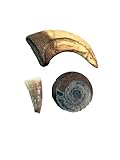
- Three-Item Fossil Set – Includes one Velociraptor claw replica, one Mosasaur tooth (B-grade), and one genuine small ammonite fossil
- Educational and Collectible – A great hands-on way to explore prehistoric life and paleontology
- Genuine Fossils Included – Both the Mosasaur tooth and ammonite are real fossil specimens
- Realistic Replica Claw – Velociraptor claw cast features high quality texture and curvature
- Ready for Display or Teaching – Great for collectors, educators, or science-themed gifts
Katherine J. Dobson, a study co-author, described what the imaging revealed: “It’s always interesting to see what’s inside a sample using 3D imaging, but in this incredible tiny larva, natural fossilisation has achieved almost perfect preservation.”
What the larva cannot tell us
The specimen is a larva, and that limits what can be said about the adult. Emma J. Long, a study co-lead author, told the Natural History Museum: “We have to be cautious when speculating about what this animal may have looked like as an adult because it was only a larva and hadn’t yet reached maturity.” Researchers have suggested possible relationships with other fossils, but they caution that features absent from a larva may have appeared only later in development.
Best Value

- MUSEUM-INSPIRED SABER TOOTH TIGER SKULL REPLICA: Closely modeled after the iconic Smilodon fatalis skull, this large-scale replica captures the fearsome detail of one of prehistory's greatest predators - from the elongated canine fangs to the textured bone structure. Impressive enough to anchor any shelf, desk, or display.
- PREMIUM CONSTRUCTION - A SKULL BUILT TO DISPLAY: Made from high-quality material that replicates the natural texture of fossilized bone. Durable, and fade-resistant so it looks great for years. - no setup required.
- A CONVERSATION PIECE THAT COMMANDS ATTENTION: Whether it's a man cave, home office, library, bar, or trophy room - this Smilodon skull stops people in their tracks. Saber Tooth Tigers roamed the Americas for over 2 million years and remain one of the most recognized symbols of prehistoric power. Now you can own a piece of that history.
- THE PERFECT GIFT FOR HISTORY & FOSSIL ENTHUSIASTS: An unforgettable gift for paleontology fans, natural history lovers, collectors, and anyone fascinated by prehistoric predators. Arrives ready to display straight out of the box - ideal for birthdays, Father's Day, Christmas, and graduation gifts.
- DETAILED ENOUGH FOR SKULL COLLECTORS, BOLD ENOUGH FOR DECOR: Designed with the fossil enthusiast in mind but striking enough for anyone who wants something genuinely unique on their shelf. Far more interesting than another generic sculpture - and a fraction of what a professional museum cast would cost.
The study is also not a claim that the whole brain or every organ survives intact. The evidence is a set of preserved cavities and traces, interpreted by the authors. That is still a substantial result, because it reveals how the head, gut, and circulatory spaces were arranged in an animal from the early Cambrian.
Quick Recap
Sources
- Nature, “Organ systems of a Cambrian euarthropod larva,” 31 July 2024 (primary study covering taxonomy, methods, and interpretation).
- Natural History Museum, “Rare 520-million-year-old larva could reveal more about early animal evolution,” 31 July 2024 (quotations from Emma J. Long and size and comparison details).
- University of Strathclyde, “520-million-year-old worm fossil solves mystery of how modern insects evolved,” 1 August 2024 (quotations from Martin R. Smith and Katherine J. Dobson).
“
Product prices and availability are accurate as of the date/time indicated and are subject to change. Any price and availability information displayed on Amazon at the time of purchase will apply.

