For most desk gamers, the 27-inch Samsung Odyssey G5 at 1440p is the better choice. Both sizes render the same 2560×1440 image, but 27 inches concentrates those pixels at about 108.8 pixels per inch (PPI), compared with about 91.8 PPI on 32 inches. The smaller model therefore looks roughly 18.5% denser at a normal close desk distance, which usually means crisper text, game interfaces and fine edges. Choose the 32-inch version if you sit farther away, want a larger and more immersive picture, or prefer physically bigger interface elements over maximum sharpness.
27 or 32 inch 1440p? The short answer
The right size depends mainly on viewing distance and what you value more: image density or physical scale. A 27-inch 1440p G5 is the safer all-rounder for a desk 60–80 cm from your eyes, competitive games, reading and multi-monitor arrangements. A 32-inch 1440p G5 makes games feel larger and more cinematic, and it is more comfortable when your chair is farther back or you deliberately want a big image without moving to a higher resolution.
As an Amazon Associate I earn from qualifying purchases.
| Decision factor | 27-inch 1440p | 32-inch 1440p |
|---|---|---|
| Resolution | 2560×1440 | 2560×1440 |
| Approximate pixel density | 108.8 PPI | 91.8 PPI |
| Close-desk image | Sharper text and finer edges | Less dense; can look softer up close |
| Perceived size and immersion | Easier to scan at once | Larger, more enveloping picture |
| Best seating distance | Usually 60–80 cm | Farther seating is more comfortable |
| Graphics workload | Same pixel count as 32-inch | Same pixel count as 27-inch |
| Desk and multi-monitor fit | More compact | Requires more width and depth |
Those recommendations assume the two displays are genuinely 1440p versions. “Odyssey G5” is a product family, not one universal specification, so the model code matters as much as the screen size.
The Tool Desk
Outbyte Driver Updater FREEFix the driver behind crashes, sound loss and screen glitchesFind Drivers →Outbyte PC Repair FREEClear out junk files and repair common Windows errorsFree Scan →Why the 27-inch model looks sharper
Both screens have the same number of pixels
At 2560×1440, each monitor has 3,686,400 pixels. The 32-inch panel does not provide extra detail; it spreads the identical pixel grid over a larger physical area. The 27-inch panel fits that grid into less space, so each inch contains more pixels.
#1 Best Overall

- QHD Resolution (2560 x 1440) has 1.7 times the pixel density of Full HD for incredibly detailed pinsharp images
- HDR10 provides brighter highlights and nuanced shadow for added depth - making every scene feel more vivid and realistic
- The 180Hz refresh rate minimizes lag for gameplay with ultra-smooth action. Plus, the 1ms response time helps capture your moves in real-time, allowing you to react fast for gaming precision
- AMD FreeSync reduces choppiness, screen lag and image tearing, ensuring that your fast-paced, complex in-game action is stable with minimal stutter
- Ergonomic stand allows for tilt, pivot and height adjustments to maximize gaming comfort
Using the diagonal size and 16:9 aspect ratio, the 27-inch version works out to approximately 108.8 PPI, while the 32-inch version is approximately 91.8 PPI. The 27-inch screen is therefore about 18.5% denser. Small type, thin lines, distant foliage, map labels and HUD elements generally have cleaner edges when viewed from the same distance.
What the density difference feels like
On a typical desk, the 27-inch image tends to look more “tight” and resolved. Windows and browser text have less visible pixel structure, and a game’s fine geometry is less likely to appear coarse. The 32-inch image is not automatically unusable or bad; its lower density is simply easier to notice when your eyes are close to the panel, when you display small text at 100% scaling, or when you compare both sizes side by side.
Samsung describes QHD as offering 1.7 times the pixel density of Full HD (1920×1080). That is a manufacturer description of the move from 1080p to 1440p, not an independent measurement of either G5 size. Both G5 sizes receive that QHD benefit, but the 27-inch screen uses the pixels more densely.
Quick wins for a faster PC:
Fix the driver behind crashes, sound loss and screen glitchesFind Drivers →Repair Windows errors before they cause bigger problemsFix Now →Scan for outdated or missing drivers - takes under a minuteDriver Scan →The 32-inch model does not require a stronger GPU
Games are rendered at the resolution selected in the graphics settings, not according to the diagonal measurement. If both monitors run at 2560×1440, the graphics card processes the same number of pixels. Moving from a 27-inch to a 32-inch G5 at the same resolution should therefore have essentially the same GPU workload, assuming comparable settings, refresh capability and connection.
A larger panel can make performance feel different because the image is more imposing, but it does not create additional rendering work. Performance changes come from resolution, detail settings, ray tracing, frame generation, game engine behavior and refresh-rate targets—not from the extra five inches alone.
Viewing distance decides whether 32-inch 1440p looks blurry
At a close desk distance
If your eyes are roughly 60–80 cm from the screen, the 27-inch model is generally the more forgiving choice. Its higher PPI keeps text and interface details crisp without relying on unusually high operating-system scaling. It also lets you see the whole image with less eye movement, which helps in competitive games and applications with many panels.
The 32-inch version can look softer at this distance because the same pixels occupy more area. “Soft” does not mean out of focus: a good panel can still display a clear 1440p image. It means that individual pixels and stair-stepped diagonals are easier to perceive, particularly in desktop text or high-contrast lines.
Crashes, No Sound, or Screen Glitches?
Random freezes, missing sound and display glitches usually trace back to one bad driver. Find and replace yours safely.Free scan · under a minutePC Slower Than It Used to Be?
A free scan shows the junk files, broken settings and background clutter dragging Windows down - then fixes them in one click.Free scan · Windows 10 & 11When sitting farther away
Distance changes the practical effect of pixel density. As you move back, the larger 32-inch image occupies a similar visual angle while its pixel structure becomes less apparent. A deep desk, a reclining chair, a controller-based setup or a monitor mounted behind the keyboard can make 32 inches feel more natural than it would at the front edge of a shallow desk.
Before buying, measure from your usual eye position—not from the desk edge—to the panel surface. If you cannot move the chair back without compromising posture, the 27-inch model is the safer bet. If you routinely lean back and still want a substantial image, 32 inches has a stronger case.
Rank #2
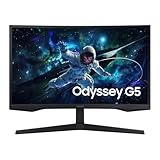
- QHD resolution: Your gaming world, more lifelike than ever before. Packing in 1.7 times the pixel density of Full HD, QHD resolution boasts incredibly detailed, pin-sharp images. Experience a fuller view with more space to take in all the action.
- 1000R curvature: Vivid scenes wrap even more tightly around you. Experience the next level of heart-pounding gaming that's superior to anything you've seen before. The 1000R display fills your peripheral vision and draws you into the character's shoes.
- 165Hz refresh rate 1ms response time(MPRT): Speed through scenes. 165Hz refresh rate eliminates lag for exhilarating gameplay with ultra-smooth action. Jump on enemies right when you see them with a 1ms response time(MPRT) for frames with minimal blur.
- AMD FreeSync: Superfluid entertainment experience. AMD Radeon FreeSync" keeps your monitor and graphics card refresh rate in sync to reduce image tearing. Watch movies and play games without interruptions. Even fast scenes look seamless and smooth
- HDR10: Awe-inspiring graphics with HDR10. A kaleidoscope of shades brings game scenes to life with incredible vibrancy. Uncover the secrets hiding in the shadows with deep dark blacks, luminous whites, and outstandingly detailed resolution.
Immersion, field of view and ergonomics
Why 32 inches feels more immersive
The 32-inch G5 creates a larger physical image at the same game settings. Character models, racing tracks and landscape details occupy more of your visual field, which can make single-player games and films feel more involving. The larger surface is also useful when you want a generous game window alongside a chat or monitoring panel, although fitting multiple windows comfortably depends on your operating system and application layout.
That scale has a trade-off: you may need to move your eyes or head farther to inspect the corners, especially in fast games. A larger display does not automatically show more of a game world. The game’s field-of-view setting and aspect ratio determine how much world is rendered; the 32-inch size mainly makes that rendered view physically larger.
Why 27 inches is easier to scan
A 27-inch screen keeps the edges closer to the center of your gaze. That can make minimaps, status bars and corner notifications easier to monitor without repeatedly looking across a broad surface. The smaller footprint also leaves more room for speakers, a microphone arm or a second display.
Curvature is model-specific
Samsung states that the 27-inch G5’s 1000R curved screen is designed to keep the edges within the natural viewing range. That is a manufacturer design claim, not an independent ergonomic measurement. Curvature can make a broad screen feel more cohesive, but it does not remove the underlying PPI difference. Confirm the exact panel and curve in the regional product page or retailer listing for the model code you are considering.
Odyssey G5 specifications vary by generation and region
Do not buy from a listing that says only “Odyssey G5 27” or “Odyssey G5 32.” Samsung has used different suffixes and generations, with changes to refresh rate, panel details and connectivity. The following examples show why the full code is essential; they are not interchangeable specifications for every G5 sold worldwide.
| Documented model example | Size and key details | What the example does—and does not—tell you |
|---|---|---|
| G55H | 27-inch curved VA; 2560×1440; up to 180Hz; 300 cd/m² brightness; 2,500:1 contrast; FreeSync | Confirms one current 27-inch configuration. Other 27-inch G5s may differ. |
| G55A | 32-inch; 2560×1440; 165Hz; 1ms MPRT | Confirms one 32-inch configuration. It is not evidence that every 32-inch G5 is 165Hz. |
| Older 27-inch G5 pages | 144Hz examples exist | Older stock can have a lower maximum refresh rate than newer listings. |
| G55C | 32-inch; 165Hz example | Shows another 32-inch generation with 165Hz. |
| G50A identified by RTINGS | 27-inch; 165Hz | RTINGS’ test applies to that tested model, not automatically to every 27-inch G5. |
| G55C identified by RTINGS | 32-inch; 165Hz | RTINGS’ 32-inch results apply to the tested G55C, not to all 32-inch G5 variants. |
The family can therefore include 144Hz, 165Hz and 180Hz examples. Refresh rate, variable-refresh support, stand adjustments, ports and panel behavior must be verified for the exact regional SKU. A retailer’s size filter is not enough if it hides the suffix.
Refresh rate and variable refresh rate: check the exact SKU
Refresh rate affects motion, not pixel density
A 144Hz, 165Hz or 180Hz display can update more often than a 60Hz screen, making camera movement and fast scrolling appear smoother when the computer can supply suitable frame rates. The 27-inch-versus-32-inch decision does not alter that principle. A 32-inch 165Hz model is not inherently smoother than a 27-inch 165Hz model; the difference is image scale and density.
The documented G55H specification reaches 180Hz, while G55A and G55C examples list 165Hz and older 27-inch pages list 144Hz. Treat those as model-specific values. Confirm the maximum refresh rate over the connection you plan to use, because a monitor’s headline rate may depend on the input, cable and graphics output.
FreeSync and other VRR details
Samsung lists FreeSync on the G55H page. Variable refresh rate (VRR) synchronizes panel updates with changing frame delivery, reducing tearing and some judder within the monitor’s supported range. VRR behavior, compatible ports and operating-system setup can vary by SKU. Check the manual and graphics-driver control panel for the exact model instead of assuming that every Odyssey G5 exposes the same range or feature set.
Rank #3

- Samsung’s 32” Odyssey G5 QHD Gaming Monitor delivers brilliant visuals for exhilarating gameplay that’s more immersive than ever before.
- QHD resolution (2560 x 1440) boasts incredibly detailed, pin-sharp images.
- With a wide 178° viewing angle, the IPS panel consistently delivers crisp, clear hues from various viewpoints.
- 180Hz Refresh Rate and 1ms response time (GtG) allow fast reactions for ultra-smooth gaming, plus G-Sync compatibility syncs the GPU and panel to reduce choppiness, screen lag, and image tearing.
- HDR10 provides brighter highlights and nuanced shadows for added depth.
Which size suits your games and applications?
Competitive shooters and fast esports
Choose 27 inches if you sit close and prioritize rapid visual scanning. The smaller image is easier to take in at once, while the higher density keeps distant outlines and interface text cleaner. A 32-inch screen can still work if you sit farther back or prefer a larger target image, but its extra size does not provide a competitive field-of-view advantage by itself.
Recommended Free Tools
Racing, role-playing and cinematic games
Choose 32 inches when immersion matters more than compactness. A larger image gives tracks, environments and cut scenes more physical presence. Keep the seating distance in mind: if the panel is too close, the broad view can become tiring because your eyes travel more to reach the edges.
Strategy, simulation and management games
The decision is more balanced. The 27-inch panel gives cleaner small labels and lets you scan a dense interface quickly. The 32-inch panel gives menus and maps larger physical dimensions, which can be helpful if you sit back or prefer larger UI elements. Game-specific interface scaling often matters more than the diagonal once the basic readability requirement is met.
Work, browsing and creation
For text-heavy work, coding and long browsing sessions at a normal desk distance, 27 inches is usually easier to read without changing scale. The 32-inch option can be comfortable for spreadsheets, timelines and large canvases when you have enough depth to sit farther away. Neither size adds workspace in the pixel-count sense: both provide the same 2560×1440 desktop. The 32-inch screen makes that workspace physically larger, while 27 inches makes it denser.
Multi-monitor desks
Two 27-inch displays are easier to place side by side than two 32-inch displays, both in width and in the distance required to keep the outer edges comfortable. A single 32-inch panel can replace some multi-window use, but its footprint may crowd a compact desk. Measure available width, stand depth and the position of speakers or a laptop before choosing the larger size.
Do these 3 things before closing this tab:
1Repair Windows errors before they cause bigger problems2Scan for outdated or missing drivers - takes under a minute3Clear out junk files and repair common Windows errorsIs 32-inch 1440p blurry?
It is more accurate to call it lower-density or softer at close range than to call it universally blurry. At approximately 91.8 PPI, a 32-inch 1440p monitor has fewer pixels per inch than a 27-inch 1440p monitor, so fine text and diagonal lines can look less crisp from the same distance. At a farther seating position, the difference becomes less conspicuous, and the larger image may be more comfortable.
Perceived clarity also depends on panel coating, operating-system scaling, font rendering, game anti-aliasing and your eyesight. If you use a 32-inch model close to your face and dislike the appearance of small text, increasing scaling or moving the display back can help, but those changes do not increase the underlying PPI. If maximum desktop sharpness is the priority, select 27 inches or move to a higher-resolution display class rather than expecting size alone to add detail.
Buying checklist: identify the right G5 before paying
- Record the complete model code. Look for the suffix, such as G55H, G55A, G55C or G50A, on Samsung’s regional page and the retailer listing. Do not rely on the family name alone.
- Confirm 2560×1440 resolution. Some listings use “G5” branding across generations; verify that the panel is QHD rather than assuming every result has the same specification.
- Verify maximum refresh rate. Check whether the exact unit is 144Hz, 165Hz or 180Hz and which input supports that rate.
- Check VRR wording. Confirm FreeSync or another stated VRR feature, its supported connection and its operating range in the manual.
- Check the panel and curvature. The cited G55H is a curved VA panel, but panel type and curve should be verified for your SKU.
- Check brightness and contrast claims. For example, the G55H page lists 300 cd/m² and 2,500:1. Those numbers belong to that documented configuration, not necessarily to every G5.
- Inspect stand and ports. Desk depth, height adjustment, tilt, VESA compatibility and available video inputs can vary by generation and region.
- Match the size to your measured distance. Use your actual seated eye position. Pick 27 inches when you cannot move back comfortably; pick 32 inches when the extra distance and width fit your setup.
- Check the return policy. A display’s perceived uniformity, curve and text sharpness are personal. A practical return window is useful if the panel does not suit your desk.
Setup tips after choosing a size
Set the operating-system scale for readability
Start with the operating system’s recommended scale, then adjust based on your measured distance and eyesight. A 27-inch 1440p panel often remains comfortable near default scaling because of its higher density. A 32-inch panel can make interface elements physically larger, which may allow comfortable reading without aggressive scaling, but the same desktop still contains 2560×1440 pixels.
Use the monitor’s native resolution
Run the display at 2560×1440 when possible. Lowering resolution can make text and fine game detail appear less defined, while non-integer scaling can introduce softness. If a game is too demanding, reduce internal render resolution or selected graphics settings deliberately rather than treating the larger diagonal as a reason to change the desktop resolution.
Rank #4

- Samsung’s 27” Odyssey G5 QHD Gaming Monitor delivers brilliant visuals for exhilarating gameplay that’s more immersive than ever before.
- QHD resolution (2560 x 1440) boasts incredibly detailed, pin-sharp images.
- With a wide 178° viewing angle, the IPS panel consistently delivers crisp, clear hues from various viewpoints.
- 180Hz Refresh Rate and 1ms response time (GtG) allow fast reactions for ultra-smooth gaming, plus G-Sync compatibility syncs the GPU and panel to reduce choppiness, screen lag, and image tearing.
- HDR10 provides brighter highlights and nuanced shadows for added depth.
Enable the intended refresh rate
After connecting the monitor, open your operating system’s advanced display settings and select the advertised refresh rate for the exact model. Then verify the game’s refresh setting and frame limiter. A 165Hz or 180Hz panel running at 60Hz will not deliver its advertised motion benefit.
Configure VRR carefully
Enable the monitor’s stated VRR feature and the corresponding option in your graphics driver, then test a game with changing frame rates. If you see flicker, black screens or an unstable signal, check the manual’s supported range, use the recommended input and cable, and test a lower refresh rate. Do not assume a setting documented for one G5 suffix applies to another.
Place the panel so its size works for you
Center the screen directly in front of your chair, keep the top edge near eye level and leave enough depth for a comfortable viewing distance. With 32 inches, moving the panel farther back can reduce corner-to-corner eye movement and make its lower PPI less noticeable. With 27 inches, avoid placing it so close that the higher density becomes irrelevant because the entire panel is inside an uncomfortable viewing angle.
Common mistakes and how to avoid them
Comparing size without comparing model codes
A 27-inch G5 listing at 180Hz and a 32-inch listing at 144Hz are not a clean size comparison. First match the relevant generation, refresh rate, panel description, ports and stand. Only then decide whether the diagonal better fits your desk.
Free tools Windows power users keep installed
One-click scans. No signup required.
Assuming a bigger screen shows more game world
Diagonal size changes physical scale. It does not automatically increase field of view or reveal extra map area. Use the game’s field-of-view control when supported, and keep any competitive-game advantage claims separate from the size decision.
Expecting 32 inches to add desktop space
Both cited sizes provide the same 2560×1440 workspace. The larger screen makes windows bigger, not more numerous in pixel terms. Choose 32 inches for physical legibility or immersion, not because it has more QHD pixels.
Generalizing an independent review
RTINGS identifies a 27-inch G50A at 165Hz and a 32-inch G55C at 165Hz. Results from its 27-inch test should not be applied automatically to every 32-inch G5, and the 32-inch G55C test should not be treated as a verdict on every 32-inch generation. Reviews are useful only when the tested code matches the unit you can buy.
Ignoring the return and regional specification
Regional pages can list different refresh rates, ports or stands under similar names. Save a screenshot or the specification page for the exact product code, and verify the delivered box label. This avoids receiving a lower-refresh or differently equipped variant that merely shares the Odyssey G5 family name.
What’s actually slowing this PC down?
Pick the symptom - the matching free tool is one click away.
Final decision
Buy the 27-inch 1440p Odyssey G5 when your desk is typical, your eyes are close to the panel, you read a lot, play competitive games or want the sharpest image from this resolution. Its approximately 108.8 PPI is the stronger everyday compromise.
Buy the 32-inch 1440p Odyssey G5 when you can sit farther back and want a larger, more immersive picture with physically bigger interface elements. Accept that approximately 91.8 PPI is less dense up close, and verify the exact generation because refresh rate and other specifications vary.
Quick Recap
Product prices and availability are accurate as of the date/time indicated and are subject to change. Any price and availability information displayed on Amazon at the time of purchase will apply.

