Recommended Free Tools
Use a push-to-talk (PTT) app for routine crew coordination only when everyone has a working device and a dependable cellular-data or Wi-Fi connection. Use a properly installed marine VHF radio for maritime calling, distress traffic and safety information. An app is a convenience layer, not a substitute for VHF or other equipment appropriate to your voyage. The U.S. Coast Guard says cellular communications do not replace maritime distress and safety radio because a cellular call normally reaches only the party dialed, while a VHF call can be heard by nearby mariners who may be able to help.
What each system is designed to do
A PTT app turns a phone, tablet or compatible connected device into a voice channel. A user presses a button, speaks, and the service sends the audio through an internet connection. The group or channel normally consists of specifically configured users, so it is well suited to private, routine coordination: asking someone to take a line, checking who is on watch, coordinating a tender, or relaying a non-urgent change of plan.
As an Amazon Associate I earn from qualifying purchases.
Marine VHF is a shared radio service intended for ship-to-ship and ship-to-shore communications. Its channels are used for routine calling as well as distress, urgency and safety traffic. A transmission on a shared channel can be heard by other stations within range, including vessels that are not in your contact list. That open audience is a safety feature, not an inconvenience.
Free tools Windows power users keep installed
One-click scans. No signup required.
The Coast Guard’s January 1994 Cellular Telephones on Boats fact sheet states: “The Coast Guard does not advocate cellular phones as a substitute for the regular maritime radio distress and safety systems recognized by the Federal Communications Commission and the International Radio Regulations — particularly VHF maritime radio.” The wording is dated, but the role distinction remains consistent with the Coast Guard’s current navigation-center guidance.
#1 Best Overall

- Uniden's Marine Radios protect you from what lies ahead, as well as getting you out of dicey waters, by informing you the moment a storm starts brewing and transmitting your location should you need help.
- With triple watch features, DSC capabilities, a range of international marine channels and S. A. M. E Weather Alert—the UM385 brings everything you’ll need on the water into one compact design.
- The UM385 rugged handheld mic allows you to transmit easily from the wheel while keeping your focus on the waters ahead.
- Waterproof Radio – Complies with IPX4 waterproof standards, which means the radio is resistant to damage from rain or splashing water.
- DSC (Digital Selective Calling) - Includes Distress Button, Position Send and Request. Gives you the ability to press one button to call for help during an emergency. Full Class D DSC capability. High performance transceiver ensures clear communication and
Side-by-side comparison
| Question | PTT app | Marine VHF radio |
|---|---|---|
| Connection | Requires an available data connection, such as cellular data or Wi-Fi. The vendor describes its service as operating over those networks, but does not establish coverage at your particular location. | Uses marine radio channels. Usable range depends on antenna height, transmitting power, geography, interference and receiving stations. The Coast Guard characterizes VHF as generally short range. |
| Who hears you? | The users or channel configured in the app. Exact group, notification and history behavior varies by service and settings. | Other stations monitoring the same channel and within radio range can hear the call. This may put your request in front of a nearby vessel able to assist. |
| Distress and safety role | Do not treat the app as a replacement for maritime distress radio. Loss of data service, a dead battery or an unmonitored channel can make it unavailable when needed. | Supports maritime distress and safety communications and urgent information broadcasts. A set with Digital Selective Calling (DSC) can send a formatted distress alert. |
| Privacy | Some vendors describe their service as secure. That is a vendor claim; check the service’s current security, retention and administration settings. | VHF conversations are not private. Anyone monitoring the channel and in range may hear them. |
| Routine crew work | Convenient for a known group when every participant has a compatible device, charged battery and data connection. | Useful for marine voice communications, but requires suitable equipment, channel discipline and attention to applicable rules. |
| Offshore use | Cellular coverage offshore is limited and can change without notice. Boat Wi-Fi works only if the boat has a working upstream connection. | VHF is generally short range. Longer trips may require additional communications and alerting equipment. |
| Regulatory obligations | Depends on the app, devices, service configuration and local communications law. | Monitoring and carriage requirements vary by vessel class and jurisdiction. U.S. Coast Guard guidance is not a universal rulebook. |
Why connectivity is the decisive limitation for an app
A PTT app does not transmit directly from your handset to another handset. The voice packet must reach the service and then the recipients over a data path. That path may be a marina’s Wi-Fi, a boat’s internet connection or a cellular network. If any link is unavailable, delayed or congested, the conversation can fail or become unusable.
Coverage shown on a carrier map is not a promise of service at sea. Shore-based cellular signals may fade a short distance offshore, and even near land a phone can attach to a weak or overloaded cell. Wi-Fi aboard a boat is only as good as its access point, power, backhaul and placement. A device may show a Wi-Fi icon while having no working internet route.
Before relying on an app for a trip, test it with the exact devices, accounts and network you expect to use. Have each crew member speak and receive a reply, then repeat the test away from the dock if the route allows. Treat an app as unavailable whenever the connection, battery, account or audio hardware is uncertain.
Quick wins for a faster PC:
Repair Windows errors before they cause bigger problemsFix Now →Scan for outdated or missing drivers - takes under a minuteDriver Scan →App setup checklist for routine coordination
- Install the same PTT service on each intended device and create or verify the required accounts.
- Put all crew members in the correct channel or group; remove former crew and confirm who can transmit.
- Grant microphone and notification permissions, then select a clear ringtone or vibration pattern that can be noticed over engine noise.
- Test the push-to-talk control, microphone position, speaker or headset and Bluetooth accessories. Keep a wired or built-in audio fallback if a paired accessory disconnects.
- Charge devices before departure and carry charging leads or power banks that work with the boat’s electrical setup.
- Run a call-and-response test over the boat’s actual cellular or Wi-Fi connection. Do not infer performance from a test performed ashore.
- Brief everyone on a fallback: stop using the app for safety-critical traffic and use the VHF, emergency beacon or other planned system instead.
Some services also support dedicated buttons or partner hardware. A vendor’s statement that a device works with an app does not establish that the accessory is waterproof, ergonomically suitable or safe for your boat; verify marine suitability separately.
Rank #2

- Uniden's Marine Radios protect you from what lies ahead, as well as getting you out of dicey waters, by informing you the moment a storm starts brewing and transmitting your location should you need help.
- With triple watch features, DSC capabilities, a range of international marine channels and S. A. M. E Weather Alert—the UM385BK brings everything you’ll need on the water into one compact design.
- The UM385BK rugged handheld mic allows you to transmit easily from the wheel while keeping your focus on the waters ahead.
- Waterproof Radio – Complies with IPX4 waterproof standards, which means the radio is resistant to damage from rain or splashing water.
- DSC (Digital Selective Calling) - Includes Distress Button, Position Send and Request. Gives you the ability to press one button to call for help during an emergency. Full Class D DSC capability. High performance transceiver ensures clear communication and
What marine VHF adds
Shared access to nearby help
A cellular call or app transmission is addressed to a person or group. The Coast Guard explains that a cellular distress call reaches the one party called, whereas a marine radio call can be overheard by other mariners in the area. A nearby boat may be the fastest help available, so the ability to be heard beyond your contact list matters during an emergency.
Distress, urgency and safety traffic
Marine VHF is part of the maritime distress and safety system. It carries distress calls, urgent traffic and safety information as well as ordinary ship-to-ship and ship-to-shore conversations. Follow the radio procedures and channel assignments applicable where you operate; do not use a working channel for prolonged nonessential conversation when it could obstruct priority traffic.
Digital Selective Calling
DSC can transmit an automatically formatted distress alert to the Coast Guard or another rescue authority. The Coast Guard strongly urges owners to connect a DSC-equipped radio to GPS, writing: “The Coast Guard urges, in the strongest terms possible, that you take the time to interconnect your GPS and DSC-equipped radio. Doing so may save your life in a distress situation!” See the Coast Guard’s Digital Selective Calling guidance for the function and setup considerations.
A DSC alert is not a substitute for following up by voice. Ensure the radio has the correct vessel identity information, that GPS data is reaching the set, and that the antenna, power supply and controls are working. Check the radio and GPS manuals for compatible wiring, connectors, data format and configuration; compatibility cannot be assumed from the presence of a DSC label alone.
Rank #3

- High Visibility Floating Core - The perfect compact VHF radio for marine use on any size vessel, designed with a high-visibility orange floating core for buoyancy and easy retrieval if dropped overboard
- 6 Watt VHF Power – Switchable between 1/3/6 Watts of power for range demands and battery optimization, use only the amount of power you need for vessels/stations near and far
- Day/Night Display - Day/Night selectable LCD display for easy viewing and high visibility at any time of day or night, regardless of weather conditions
- Tri-Watch Mode - Instantly access Channels 9, 16, and any user-specified channel with Tri-Watch, allowing you to monitor multiple channels at once in busy waterways for safety
- NOAA Weather Alerts - 12 weather channels and National Oceanic and Atmospheric Administration emergency broadcast channel access to stay informed and safe on the water
Watchkeeping and channel discipline
U.S. Coast Guard Radio Watchkeeping Regulations guidance says a vessel equipped with VHF generally must maintain a watch on Channel 16 when the radio is not being used to communicate. Additional requirements apply to certain vessel classes. Confirm the current rule for your vessel, flag and operating area rather than applying U.S. guidance automatically elsewhere.
Range: what the published figure means
The Coast Guard’s Radio Information For Boaters page says a VHF radio is intended mainly for short-range communications, “generally 5-10 miles, and at least 20 miles to a USCG station.” This is Coast Guard guidance, not a guaranteed distance or an independent laboratory result. Actual range changes with antenna height and condition, transmit power, terrain, weather, interference and the receiving station’s location.
That range estimate explains why VHF and an app solve different problems. Within radio range, VHF can reach unknown nearby stations. Outside cellular coverage but within VHF range of a vessel or shore station, the app may be useless while the radio still works. Farther offshore, neither a normal phone connection nor ordinary VHF should be assumed to cover the whole voyage.
Planning communications for coastal and offshore trips
Harbor, marina and near-shore trips
For a short trip in reliable cellular coverage, an app can reduce shouting across the deck and keep routine crew traffic organized. Keep the VHF powered, correctly configured and available for marine calls, weather or safety traffic. Do not let the convenience of a private group cause the crew to miss a call intended for all nearby mariners.
Rank #4

- High Visibility Floating Core - The perfect compact VHF radio for marine use on any size vessel, designed with a high-visibility orange floating core for buoyancy and easy retrieval if dropped overboard
- 6 Watt VHF Power – Switchable between 1/3/6 Watts of power for range demands and battery optimization, use only the amount of power you need for vessels/stations near and far
- Day/Night Display - Day/Night selectable LCD display for easy viewing and high visibility at any time of day or night, regardless of weather conditions
- Tri-Watch Mode - Instantly access Channels 9, 16, and any user-specified channel with Tri-Watch, allowing you to monitor multiple channels at once in busy waterways for safety
- NOAA Weather Alerts - 12 weather channels and National Oceanic and Atmospheric Administration emergency broadcast channel access to stay informed and safe on the water
Trips near the edge of coverage
Document where the app is expected to stop working and identify the point at which the crew must switch to radio procedures. A phone can lose data before it appears completely disconnected, so use a failed call or delayed message as a warning rather than repeatedly retrying while a time-sensitive situation develops.
Longer offshore passages
The Coast Guard advises boaters going more than a few miles offshore to plan for equipment such as MF/HF radio or satellite communication, an EPIRB, and a second VHF or cellular phone. The appropriate combination depends on the voyage, vessel, crew and local requirements. VHF remains useful for nearby traffic, but its short-range nature means it should not be the only long-distance or distress plan for an offshore passage.
Write the communications plan before departure. List the primary and backup methods, who is responsible for monitoring them, how to report a position, and what to do if power, antenna, GPS, cellular data or the boat’s network fails. Store the plan where every watchkeeper can find it.
PC Slower Than It Used to Be?
A free scan shows the junk files, broken settings and background clutter dragging Windows down - then fixes them in one click.Free scan · Windows 10 & 11Crashes, No Sound, or Screen Glitches?
Random freezes, missing sound and display glitches usually trace back to one bad driver. Find and replace yours safely.Free scan · under a minuteChoosing between a PTT app, VHF or both
Choose an app as a supplement when all of these are true
- The traffic is routine crew coordination rather than distress, urgency or safety information.
- Every participant has a compatible, charged device and understands the channel or group configuration.
- Your route has a tested cellular-data or Wi-Fi connection, with a realistic fallback if it disappears.
- The crew can still hear and monitor the required marine-radio traffic.
- You have accounted for wet conditions, glare, engine noise, gloves and the risk of dropping or losing a phone.
Prioritize marine VHF when any of these are true
- You need to contact unknown nearby vessels, a marina, a bridge, a harbor authority or a Coast Guard station.
- The message concerns distress, urgency, navigation safety, weather or another matter that nearby mariners should hear.
- Cellular or Wi-Fi coverage is uncertain, intermittent or absent.
- You need DSC alerting or a radio watch under applicable rules.
- The boat’s route extends beyond the dependable range of shore-based connectivity.
Use a layered system for higher-consequence voyages
A practical hierarchy is: marine VHF for local maritime communications and safety traffic; a PTT app for low-consequence internal coordination when connected; and additional offshore equipment, such as satellite communication, MF/HF, an EPIRB or a second VHF, when the voyage warrants it. The layers should be independent enough that one failed battery, antenna, account or network does not remove every means of calling for help.
Best Value
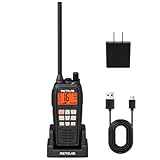
- IP68 waterproof marine radio; the RM15 VHF radio marine resists saltwater corrosion; rated for water immersion up to 1.5 meters for 30 minutes; corrosion-resistant charging contacts; perfect for offshore fishing, bass fishing, and fishing tournaments
- Floating design; the RM15 vhf radio marine stays on the water’s surface if dropped overboard; a water activated emergency strobe light indicates its location; suitable for marine activities such as boating fishing or kayaking; RM15 complies with PART 80
- Dual-way noise reduction system; the RM15 VHF marine radio reduces noise on both transmit and receive audio for clearer two-way communication; a powerful 1000mW (1W) speaker delivers loud, crisp sound even in noisy marine environments
- 16km long range communication;6W vhf marine radio;designed for open water marine activities;whether racing sailboats or navigating choppy seas during fishing trips;helps you stay connected in demanding offshore environments
- Long battery life; the RM15 VHF marine radio features a 2000mAh battery, USB-C ports on both the radio body and charger, and a included cable for 5V/2A or 5V/1A adapter charging. Enjoy over 10 hours of operation and up to 100 hours standby.
Operational pitfalls and fixes
| Symptom | Likely cause | Action |
|---|---|---|
| PTT messages remain queued or never arrive | No usable cellular data or Wi-Fi, a failed boat internet link, or service/account trouble. | Stop treating the app as available. Move routine traffic to the planned radio method and investigate connectivity when safe. |
| Only one person hears the call | Wrong group, muted notifications, disconnected headset or per-user permission issue. | Verify group membership and audio settings ashore, then run a full crew call-and-response test before departure. |
| VHF transmissions are weak or intermittent | Damaged antenna or cable, poor installation, low battery, obstruction or distance beyond practical range. | Check power and connectors, inspect the antenna system, move to a better position if possible, and use the backup communications plan. |
| DSC alert lacks a position | GPS is not connected, not outputting compatible data, or the radio is not configured correctly. | Check the radio and GPS manuals, verify the vessel identity and position display, and test the connection before sailing. |
| Crew misses important radio traffic | Radio volume is low, the set is on the wrong channel, or app conversations distract the watchkeeper. | Restore the required watch, set a useful volume, brief the crew on channel use and reserve the app for noncritical coordination. |
Equipment and compliance checks before departure
- Confirm the VHF is an appropriate marine set for the vessel and jurisdiction, with a serviceable antenna, power source and controls.
- If the radio has DSC, verify its identity information and GPS connection; test indications without sending a false distress alert.
- Know which channels are used for calling, working traffic and local services on your route, and follow the applicable operating procedures.
- Confirm who is responsible for Channel 16 watchkeeping when the radio is not otherwise in use, subject to the rules that apply to your vessel.
- Check that phones, app devices, charging equipment and any headsets are protected from spray and can be operated in the expected conditions.
- Carry an independent backup appropriate to the voyage. For longer offshore trips, review the Coast Guard’s recommendations for MF/HF or satellite communication, an EPIRB and additional VHF or cellular capability.
- Record emergency contacts, vessel position procedures and the handoff point from app coordination to radio or other emergency equipment.
What to buy or configure
The Coast Guard’s boater guidance calls VHF the most important radio system a boater should buy. A handheld set can provide portability and redundancy; a fixed-mount set generally suits a boat that needs a permanently installed radio and external antenna. The right choice depends on vessel layout, power, exposure, range needs and applicable carriage requirements. Current model specifications, prices and availability are not established here, so compare those details against the manufacturer’s current documentation and your local rules.
When evaluating a radio, look for the features your operating plan actually needs: marine-channel support, a suitable antenna installation, reliable power, DSC where appropriate, and a documented GPS interface if you intend to use position-enabled alerts. Do not assume that every radio, GPS and cable combination will interoperate without checking manuals.
For an app, evaluate coverage on the route, offline behavior, account administration, group controls, notification reliability, audio accessories, battery demand and the service’s current privacy and security documentation. A paid team tier or a supported hardware button may change administration or convenience, but it does not create cellular coverage offshore or turn the app into a maritime distress system. Service features and prices can change; verify them directly at the provider’s current service information and pricing page if that service is under consideration.
Decision guide
- Define the message. If it is distress, urgency, safety or a call to unknown nearby help, start with marine VHF and the other emergency systems required for the voyage.
- Check the audience. If nearby mariners should be able to hear it, use the shared radio channel rather than a private app group.
- Check the network. If the app’s data path has not been tested for the route and conditions, do not make it the primary method.
- Check the distance. For offshore travel beyond dependable VHF and cellular coverage, add the long-range and alerting equipment appropriate to the passage.
- Check compliance. Confirm watchkeeping, licensing, carriage and channel requirements with the authority governing the vessel and waters.
- Layer the tools. Keep the app for convenience, VHF for maritime communications and safety, and independent emergency equipment for the consequences neither system can cover alone.
Bottom line for onboard crews
PTT apps and marine VHF radios are complementary, not interchangeable. A tested app can make ordinary crew coordination quieter and more convenient when data service is available. Marine VHF provides the shared, maritime-specific path for ship-to-ship and ship-to-shore calling, distress and safety traffic, with DSC available on equipped systems. Keep the VHF and required watch in place, connect DSC to GPS when supported, and add offshore communications and alerting equipment when the route exceeds VHF’s practical range.
Quick Recap
Product prices and availability are accurate as of the date/time indicated and are subject to change. Any price and availability information displayed on Amazon at the time of purchase will apply.

