Quick wins for a faster PC:
Repair Windows errors before they cause bigger problemsFix Now →Fix the driver behind crashes, sound loss and screen glitchesFind Drivers →Clear out junk files and repair common Windows errorsFree Scan →Buy the Nintendo Switch OLED for the best all-around experience if you play handheld often and can spend $399.99. Its 7-inch OLED display, 64GB storage, adjustable stand, improved handheld/tabletop audio and wired-LAN dock make the $60 premium over the current standard Switch easy to justify. Choose the standard Nintendo Switch at $339.99 if you need TV, tabletop and handheld modes but want the lower hybrid-console price. Choose Nintendo Switch Lite at $229.99 only if you are comfortable with handheld-only play; it cannot output video to a television.
The prices above are Nintendo’s US MSRPs shown on its current product pages checked October 16, 2026. Retail prices and stock can change.
As an Amazon Associate I earn from qualifying purchases.
Quick comparison
| Model | Play modes | Display | Built-in storage | Nintendo battery rating | US MSRP |
|---|---|---|---|---|---|
| Nintendo Switch OLED | TV, tabletop and handheld | 7.0-inch OLED touch screen | 64GB | Approximately 4.5–9 hours | $399.99 |
| Current standard Switch (HAC-001(-01)) | TV, tabletop and handheld | 6.2-inch LCD touch screen | 32GB | Approximately 4.5–9 hours | $339.99 |
| Switch Lite | Handheld only | 5.5-inch LCD touch screen | 32GB | Approximately 3–7 hours | $229.99 |
All three are Switch-family systems, but the play-mode restriction is decisive. OLED and standard Switch can be connected to a TV, used on a table or played in your hands. Lite is a compact handheld and has no TV mode.
Do these 3 things before closing this tab:
1Scan for outdated or missing drivers - takes under a minute2Repair Windows errors before they cause bigger problems3Fix the driver behind crashes, sound loss and screen glitchesWhat changes between the three models
Switch OLED: the premium hybrid
The OLED model has a 7-inch OLED touchscreen, compared with 6.2 inches on the standard Switch and 5.5 inches on Lite. OLED pixels produce their own light, allowing more vivid colors, deeper blacks and higher contrast than an LCD panel. That difference is most apparent in dark scenes, colorful games and any title you play regularly in handheld mode.
#1 Best Overall

- Compatible with Nintendo-Switch (NOT Nintendo-Switch 2)
- Incredible speeds in a microSD card officially licensed for the Nintendo Switch, Nintendo OLED, and Nintendo Switch Lite systems
- Spend less time waiting and more time playing with read speeds up to 100MB/s(1) and write speeds up to 90MB/s(1).
- Instantly add up to 256GB (1GB=1,000,000,000 bytes. Actual user storage less.)
- Store your downloaded games, screenshots and video captures in 1 place so you can travel light.
It includes 64GB of internal storage, twice the 32GB provided by the other two models. Game downloads, updates and screenshots still make a microSD card useful, but the extra internal space gives you more room before you need one.
The rear stand is wide and adjustable rather than the small fixed support used by the standard design. This makes tabletop viewing more flexible, particularly when you are sharing a screen or playing with a controller detached from the console. Nintendo also specifies enhanced handheld and tabletop audio.
The OLED dock includes a built-in wired LAN port. If you prefer a wired network connection for downloads or online play, you can plug an Ethernet cable directly into that dock instead of buying a separate USB LAN adapter. OLED supports the full Nintendo Switch game library and all three play modes.
Use a screen protector made specifically for the 7-inch OLED model. Nintendo warns that protectors designed for the standard Switch or Lite may not fit correctly.
Standard Switch: the value hybrid
The current standard model, identified by Nintendo as HAC-001(-01), retains TV, tabletop and handheld play and works with the full Switch library. Its compromises are the 6.2-inch LCD screen and 32GB of storage. LCD technology is still perfectly usable, but it does not provide the OLED model’s black levels and contrast.
Rank #2
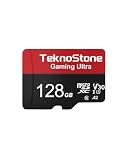
- Optimized for Gaming Speed: Specially tuned for gaming devices, TeknoStone Gaming Series cards deliver up to 100MB/s read speed with UHS-I interface. A2-rated performance ensures faster app launch, smoother in-game loading, and reduced lag on handheld consoles and mobile platforms.
- Compatible with Top Devices: Perfectly compatible with Nintendo Switch (Not 2), Steam Deck, ROG Ally, Android phones, tablets, and even retro game emulators. Includes a full-size SD adapter for seamless use with laptops, handheld consoles, and compatible card readers.
- Smooth 4K/HD Recording & Playback: Supports stable 4K UHD and 1080P Full HD recording and playback, ideal for gameplay footage, game stream content capture, or immersive in-game video rendering.
- Battle-Tested Durability: Engineered for long sessions and intense environments. Waterproof, shockproof, temperature-resistant, X-ray safe — designed to withstand accidental drops, outdoor use, and frequent device swapping.
- Actual Capacity: Storage may be smaller than the labeled capacity because manufacturers use the decimal system (1 GB = 1,000,000,000 bytes) , operating systems display storage using the binary system (1 GiB = 1,073,741,824 bytes). This is a normal industry practice and does not affect performance.
The standard dock does not have built-in wired LAN. For Ethernet networking, you need a separate USB LAN adapter. Its tabletop support and hybrid flexibility otherwise make it the sensible choice when you want one console for a television and portable play but do not need OLED’s screen, storage or dock upgrades.
Switch Lite: the dedicated handheld
Nintendo describes Lite as “Dedicated to portable play.” It is smaller and lighter than the hybrid systems, with integrated controls, a 5.5-inch LCD touchscreen and 32GB of storage. Nintendo’s product-family wording calls it “lightweight, compact, and 100% for handheld play.”
Free tools Windows power users keep installed
One-click scans. No signup required.
Lite plays Switch games that support handheld mode, which Nintendo says is the vast majority of titles. Nintendo does not publish a percentage, so no precise compatibility rate should be assumed. Games that require a mode or accessory unavailable in handheld play may not work as intended.
Lite has no TV output. Nintendo support states: “Important: Nintendo Switch Lite does not support TV Mode.” This is a hardware limitation, not a setting you can unlock with a dock or cable. Lite also has no built-in stand. Tabletop play requires a separate adjustable charging stand or licensed stand and compatible wireless controllers, so the lowest console price does not automatically produce the lowest cost for multiplayer use.
Which model fits your play style?
Choose Switch OLED when handheld quality matters
- You expect to play in handheld mode frequently and will notice a larger, higher-contrast screen.
- You want 64GB internal storage instead of 32GB.
- You will use tabletop play and value a wide adjustable stand and enhanced audio.
- You want wired Ethernet without purchasing a separate LAN adapter for the dock.
- The $60 premium over the standard model fits your budget.
OLED is the strongest default recommendation because it preserves TV, tabletop and handheld flexibility while improving the part of the system you look at and hold most often. It is not the right choice if your budget is fixed at the standard model’s price or if you almost never play away from a television.
Rank #3

- Nintendo Switch 2 uses a new standard of expandable memory card called microSD Express (sold separately). This kind of memory card is needed for faster access speeds and to ensure games will run smoothly.
- Please note: Nintendo Switch 2 is only compatible with microSD Express cards. If the microSD cards you have used for Nintendo Switch do not support microSD Express standards, you cannot use them with Nintendo Switch 2.
Choose the standard Switch when flexibility and price are the priority
- You need all three play modes.
- You mainly play on a TV and will not benefit much from the OLED screen.
- You want to save $60 compared with OLED.
- You are comfortable adding a microSD card later and using a USB LAN adapter if wired networking is important.
The standard Switch is the practical hybrid-console value. It offers the same broad game-library compatibility and the same approximate 4.5–9-hour battery rating as the current OLED model, while accepting a smaller LCD panel, half the built-in storage and a less capable dock.
Windows Errors? Fix Them Before They Spread
Repair common Windows errors and clear accumulated junk for a smoother, more stable PC - no reinstall needed.Free scan · no reinstallCrashes, No Sound, or Screen Glitches?
Random freezes, missing sound and display glitches usually trace back to one bad driver. Find and replace yours safely.Free scan · under a minuteChoose Switch Lite when handheld-only is certain
- You will never need to play on a TV.
- You want the lowest upfront price and the lightest, smallest system of the three.
- You mostly play games that support handheld mode.
- You prefer integrated controls and do not want a detachable-console design.
Lite is a good dedicated handheld, not a cheaper version of a complete hybrid console. If there is a realistic chance that you will later want TV play, buying the standard Switch now is usually less expensive than buying Lite and replacing it.
Screen and comfort differences
| Consideration | OLED | Standard Switch | Lite |
|---|---|---|---|
| Panel | 7.0-inch OLED touchscreen | 6.2-inch LCD touchscreen | 5.5-inch LCD touchscreen |
| Black level and contrast | OLED pixels emit their own light, enabling deeper blacks and higher contrast | LCD | LCD |
| Portability | Hybrid design | Hybrid design | Smallest and lightest design; handheld only |
| Stand | Wide, adjustable stand | Tabletop mode is supported; the standard design does not have OLED’s wide adjustable stand | No built-in stand |
The size difference is more noticeable when reading small text or playing split-screen tabletop games. OLED’s panel is not simply larger: its self-lit pixels change the perceived depth of dark scenes. LCD models remain a reasonable choice for bright rooms, TV-first players and anyone prioritizing price.
Battery life, including used consoles
Nintendo rates the current standard Switch HAC-001(-01) and Switch OLED at approximately 4.5–9 hours. Switch Lite is rated at approximately 3–7 hours. Actual runtime changes with the game, screen brightness, wireless functions and other features in use.
If you are shopping second-hand, identify the hardware revision rather than relying on a seller’s “original Switch” description. The original HAC-001 is rated at approximately 2.5–6.5 hours, substantially less than the current HAC-001(-01). Lithium-ion battery capacity also declines over charge cycles, so an older console may run for less time than Nintendo’s original rating even when its model number is correct.
Rank #4

- [Gaming Series] Especially designed for Gaming Consoles. A1 spec enables high speed data transfer for game professionals
- [Ultra HD] Read/Write up to 100/60 MB/s. UltraHD video displaying/recording
- [Compatibility] Storage for Laptop, Tablet, PC, Smartphones, Camera, e-Reader. Files, Videos, Music [Notice] Compatible with Nintendo Switch 1; not compatible for gaming with Nintendo Switch 2
- [Environment] Waterproof, shockproof, temperature-proof and X-Ray proof
- [Support] Gigastone 5-year limited warranty
- Ask for the model number and a photo of the system information screen or rear label.
- Confirm that the console charges normally and does not shut down under load.
- Test battery behavior with a demanding game rather than judging it from a brief menu demonstration.
- For a used OLED, check the screen for scratches and uneven pixels; for any model, inspect the USB-C port and controls.
Storage: plan for a microSD card
Nintendo’s technical specifications allow microSDHC and microSDXC cards up to 2TB, sold separately. A microSDXC card marketed for Nintendo Switch is the broadly useful expansion choice for every model.
The need is greatest on the 32GB standard Switch and Lite. System software and reserved space mean the full advertised capacity is not available for games, and large downloads can fill it quickly. OLED’s 64GB gives you more breathing room but does not eliminate the value of expandable storage if you buy digital games or keep many updates installed.
Independent reader supportYour contribution helps us test, update, and keep practical guides available for everyone.TV, tabletop and multiplayer requirements
TV play
OLED and standard Switch support TV mode through their docks. Lite cannot connect to a TV, regardless of which dock, adapter or cable you buy. If TV play is a requirement, remove Lite from consideration before comparing screens or prices.
Tabletop play
OLED’s wide adjustable stand is designed for stable tabletop viewing. Standard Switch supports tabletop mode, while Lite needs a separate adjustable charging stand or licensed stand because it has no built-in stand.
On Lite, tabletop multiplayer also requires compatible wireless controllers when the game cannot be played comfortably with the integrated controls. Include those accessories in your budget rather than comparing only console MSRPs.
Best Value

- Compatible with Nintendo-Switch (NOT Nintendo-Switch 2)
- Expand your storage in a flash: ideal for Android smartphones and tablets, Chromebooks, and Windows laptops.
- Increase your TV show, movie, and Full HD video[4] recording collections dramatically with up to a massive 1.5TB[1].
- Transfer files fast with up to 150MB/s[2] read speeds and SanDisk MobileMate USB micro 3.0 microSD card reader[6].
- Load apps faster with A1-rated performance[3].
Wired networking
OLED’s dock has built-in wired LAN. The standard dock does not; add a USB LAN adapter if you need Ethernet. Lite has no TV dock mode, so its networking setup is oriented toward portable wireless use.
Total-cost decisions
| Purchase path | Console MSRP | Difference from OLED | Likely additions to consider |
|---|---|---|---|
| Switch OLED | $399.99 | — | 7-inch OLED screen protector; microSD card if needed |
| Standard Switch | $339.99 | $60 less | MicroSD card; USB LAN adapter for wired networking |
| Switch Lite | $229.99 | $170 less | MicroSD card; adjustable charging or licensed stand and compatible wireless controllers for tabletop play |
These are Nintendo’s US MSRP figures, not guaranteed retail prices. A sale can change the value calculation, but it does not change the functional distinction that Lite lacks TV output. For a fair comparison, add the accessories you actually need before deciding that Lite or standard Switch is cheaper.
Game compatibility and common surprises
OLED and standard Switch support the full Nintendo Switch game library. Lite supports games that support handheld mode, described by Nintendo as the vast majority of titles. Because Nintendo does not publish a percentage, check the individual game’s packaging or product listing when a specific title is important to you.
Some games depend on features or control arrangements that are not available in a handheld-only system. On Lite, you may need separate compatible wireless controllers for games designed around detached controls or tabletop play. This does not add TV capability; it only expands the ways you can use Lite away from a television.
Quick Recap
A buying checklist
- Mark the required modes. If TV play is required, choose OLED or standard Switch. If handheld is the only acceptable mode, Lite remains eligible.
- Set the console budget. Compare $399.99 OLED, $339.99 standard and $229.99 Lite against current retailer prices, remembering that Nintendo’s figures are US MSRPs checked October 16, 2026.
- Decide how important the handheld display is. Frequent handheld players gain the most from OLED’s 7-inch panel and higher contrast.
- Estimate storage. Choose OLED for 64GB built in, or budget for a microSDHC/microSDXC card up to 2TB on any model.
- Count accessories. Add a screen protector sized for the correct model, a USB LAN adapter for standard Switch wired networking, or a stand and wireless controllers for Lite tabletop use.
- Check game mode support. Verify that must-play games support handheld mode before buying Lite.
- For used systems, verify the revision and battery. Distinguish current HAC-001(-01) from original HAC-001, then test charging, controls, screen and battery behavior.
Bottom-line recommendation by buyer
- Best overall: Switch OLED, when the $60 premium over standard Switch is affordable and handheld play matters.
- Best hybrid value: Current standard Switch HAC-001(-01), for TV, tabletop and handheld play at the lower price.
- Best low-cost handheld: Switch Lite, only when you are certain you do not need TV mode and accept its handheld-game and accessory limitations.
Product prices and availability are accurate as of the date/time indicated and are subject to change. Any price and availability information displayed on Amazon at the time of purchase will apply.

