Free tools Windows power users keep installed
One-click scans. No signup required.
Plugging a router or modem into a correctly wired wall receptacle is not automatically dangerous. The problem is what the receptacle does not provide: point-of-use surge suppression, battery backup during an outage, or protection for surge paths entering through Ethernet, coaxial or telephone cables. A basic power strip may only add outlets.
For most home networks, use a genuine, properly rated surge protector for the equipment you want to protect. Choose a UPS instead when keeping the modem and router online through short outages matters, and consider electrician-installed whole-home protection when you need coverage beyond plug-in devices. None of these products can guarantee safety from a direct lightning strike.
As an Amazon Associate I earn from qualifying purchases.
Is plugging networking equipment into the wall always wrong?
No. A sound, grounded receptacle can power a modem, router, switch or access point directly. “Never” is too broad because a direct wall connection can be electrically appropriate when the wiring, receptacle rating and equipment load are suitable.
The practical disadvantage is that there is no protective device between the outlet and your equipment. A wall receptacle does not add surge suppression, battery runtime or a protection-status indicator. It also does not address a surge that arrives on a communication cable rather than the AC power cord. The right replacement depends on the risk you are trying to reduce.
#1 Best Overall

- 【4+4 Outlets Power Strip with 4 USB Ports】- The 3-side power strip with 8AC widely outlets and 4 USB charging ports, each USB A port features 5V/2.4A Max output. USB C charging port features 5V/3A MAX. can power up to 12 devices simultaneously.
- 【Surge Protector Power Strip with 3 Side Design & Wide Space】- 3-side design that makes it easier to make the plugs not covering any outlet, and the 8 AC outlets with 1.8 inches long space in between, larger than standard 1.5-inch socket. Larger spacing makes it easier to use for all kinds of equipment. The compact design saves more space, suitable for the home, office, and college dorm room.
- 【Multi Safety Protection】- ETL Certificates. This power strip has overload protection, short-circuit protection, over current protection, over-voltage protection and overheating protection. The surge protector with overload protection protects your electrical appliances from lighting, surges or spikes. The minimum energy-absorbing capacity of 900 Joules. It will automatically cut power to protect connected devices when voltage surge is overwhelming.
- 【6 Ft extension cord with Flat Plug】- The 45° flat plug design prevents the bottom plug from clogging and allows for easy installation in tight spaces; the 6-foot power cord allows for flexibility, and two mounting holes on the back allow for secure installation of this power outlet in a variety of applications.
- 【 Our After Sale Service 】- ETL Certificates. Our friendly and reliable customer service will respond to you within 24 hours. You can purchase with confidence, with our 30-day return and 12-month warranty.
- Want protection from most transient overvoltages? Use a listed point-of-use surge protector.
- Need the network to remain up during a brief outage? Use a UPS sized for the modem and router load.
- Need coverage for hard-wired appliances and the whole electrical system? Ask a qualified electrician about service-entrance protection.
Reason 1: A power strip may only multiply outlets
The difference between a surge protector and a power strip is not the number of sockets or the shape of the housing. A basic power strip distributes AC power to several plugs; it may provide no suppression at all. Eaton advises looking for explicit “surge protection” or “surge suppression” labeling, a stated joule rating and an indicator showing whether the protective components are still active.
What to check before connecting a router
- Surge language: The package or nameplate should identify surge suppression, not merely multiple outlets.
- Joule rating: Eaton’s buying guidance lists 1,000 or more joules as a typical high-protection level for computers and networking equipment. That is guidance, not a legal minimum or a guarantee that a device will survive every event.
- Protection indicator: Look for a light or alert that confirms the suppression circuit remains available. Surge components can wear as they absorb disturbances.
- Grounding and markings: Use a receptacle and protector that match the manufacturer’s grounding and safety requirements.
- Load rating: Keep the connected load within the protector’s current rating and leave ventilation around the unit.
A strip with six outlets can therefore offer less protection than a properly specified two-outlet surge protector. Do not infer performance from outlet count, a reset switch or a low price.
Reason 2: Surges can start inside your home
ESFI defines a power surge, or transient voltage, as “a sudden and unwanted increase in voltage that can damage, degrade or destroy the sensitive electronic equipment in your home or business.” Lightning and utility switching are familiar causes, but they are not the only ones.
The Tool Desk
Outbyte PC Repair FREERepair Windows errors before they cause bigger problemsFix Now →Outbyte Driver Updater FREEFix the driver behind crashes, sound loss and screen glitchesFind Drivers →ESFI cites a National Electrical Manufacturers Association estimate that 60–80% of surges originate within a facility (2015). That figure describes the estimated source of surges in facilities; it is not a router-specific failure rate, a current measurement or a prediction of your household’s losses. Motors and compressors switching on and off, for example, can create disturbances on the building’s wiring.
One event may not produce an immediate failure. ESFI says repeated small-scale surges can gradually damage electronics and shorten their service life. A modem or router may continue working while its power supply or other components accumulate stress. A point-of-use protector gives the equipment a sacrificial suppression stage between it and the receptacle, although it cannot eliminate every failure mode.
Rank #2

- All the Power You Need: Features 12 AC outlets, 1 USB-C port, and 2 USB-A ports to power appliances, mobile devices, and more. Total USB output is shared across all USB ports, with a maximum output of 15W.
- Fast Charge Your iPhone: Use the 20W USB-C port to give your iPhone 15 a high-speed charge from 0-50% in just 26 minutes.
- 8-Point Safety System: Combines surge protection, fire resistance, overload protection, temperature control, and more to protect you and your devices.
- Optimized Layout: Features extra space between outlets to accommodate bulky plugs. The 5 ft cord is ideal for desks (4 - 5 ft wide), bedside tables, and sofa side tables.
- What You Get: Anker 351 Power Strip, 2 mounting screws, welcome guide, our worry-free 18-month warranty, lifetime* $200,000 connected equipment warranty, and friendly customer service.
Reason 3: The surge path may be a data cable
Networking equipment is connected to more than AC power. Eaton notes that surges can travel through communication cables as well as power wiring. Depending on the installation, that can include Ethernet, coaxial cable from a broadband service, or a telephone line.
When line protection deserves attention
- Coaxial broadband: A cable modem can have an incoming coax path that bypasses an AC-only protector.
- Ethernet between buildings: A cable running outdoors or between separately powered structures can create a different grounding and surge path.
- Telephone-based equipment: Older DSL or telephone connections may carry disturbances on the phone pair.
- PoE cameras and access points: Inline protectors exist for some Power over Ethernet installations, but the connector type, Ethernet speed, grounding arrangement and PoE standard must match.
Do not buy an arbitrary line protector and insert it into a high-speed or PoE link. Check the manufacturer’s specifications for data rate, pinout, voltage, grounding and compatibility with the equipment. In some homes, the safest improvement is to have the incoming services and bonding inspected rather than adding an unverified adapter.
Reason 4: A wall outlet cannot keep the network running during an outage
A surge protector addresses voltage transients; it does not supply electricity when utility power fails. If the modem, router and network switch are plugged directly into the wall, they shut down as soon as the outlet loses power.
A UPS typically combines surge protection with a battery that supplies AC during an outage. Eaton’s UPS guidance places the modem and router on battery-backed outlets when continued connectivity is needed. Runtime depends on the UPS capacity, the actual load and battery condition, so there is no universal number of minutes. Measure the equipment’s wattage and choose a UPS for the runtime you actually need.
Connect a UPS according to its manual
Schneider Electric guidance for APC Back-UPS and Smart-UPS units says the UPS should be plugged directly into the wall receptacle for the best available input power. It warns against attaching a surge strip, ordinary power strip or extension cord to UPS outputs because that can interfere with load reporting, overload protection, grounding or normal operation. Other UPS models may have different instructions, so follow the manual for your exact unit.
Rank #3
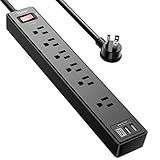
- Power Strip with 6 Outlets & 3USB Ports: 6 AC Surge protector outlets(1680 Joules) including 1 Widely Spaced Outlet, 2 USB A Ports & 1 USB C Port, 6 feet power cord, Surge protector indicator and 10A Overload Protector switch protects against spikes and fluctuations.
- Smart Charging USB Ports: Build in smart charging technology, Each USB A port features 2.4A Max output. USB C charging port features 3A MAX, 3 USB ports can charge almost any USB device (smart phone, tablet, fire stick, e-reader, blue tooth headphones, portable speaker etc).
- Surge Protector outlet: The 6 AC outlets provide surge protector against electrical spikes. with response speed less than 1Ns, and minimum energy-absorbing capacity of 1680 Joules, its response time is much shorter than the single MOV surge protector circuit, It truly provides great protection of your precious plugged-in devices.
- 6 Feet Flat Plug Power cord with Cable Ties: 6 Ft Extension Cord makes it more flexible, Reusable Fastening Cable Ties Can tie up the unused cord and make it better organized. the Mounting hole at the back allows this wall mount power strip to be securely installed in various applications, such as wall mounts, floor mounts, workbenches, under counters & more.
- Our After Sale Service: Our friendly and reliable customer service will respond to you within 24 hours. You can purchase with confidence, with our 30-day return and 12-month warranty.
Do not assume a UPS makes every connected cable path safe. It protects the outlets and circuits specified by its design; Ethernet, coaxial and telephone lines still require a compatible solution when those paths are exposed.
Do these 3 things before closing this tab:
1Repair Windows errors before they cause bigger problems2Fix the driver behind crashes, sound loss and screen glitches3Clear out junk files and repair common Windows errorsWhich protection method fits your network?
| Option | What it does | What it does not do | Installation and checks |
|---|---|---|---|
| Basic power strip | Adds outlets and may provide a switch or resettable breaker. | Does not necessarily suppress surges or provide battery power. | Confirm the label; never treat outlet count as a protection rating. |
| Point-of-use surge protector | Diverts excess voltage from connected equipment during most surges; many use metal-oxide varistors (MOVs). | Does not guarantee survival, protect unplugged devices or handle a direct lightning strike. | Check joule rating, safety markings, grounding, indicator and load rating. |
| UPS | Adds battery power during an AC outage and typically includes surge protection. | Does not provide unlimited runtime or automatically protect every communication cable. | Size for load and desired runtime; plug the UPS directly into the wall unless its manual says otherwise. |
| Whole-home/service-entrance protection | Protects the home’s electrical system at the main panel or meter, including equipment that cannot plug into a point-of-use device. | Does not guarantee protection from a direct lightning strike. | Requires assessment and installation by a qualified electrician. |
How to protect a modem and router safely
- Inspect the receptacle. Use a correctly wired, grounded outlet with the voltage and current rating required by the equipment. Stop if the receptacle is loose, damaged, warm or ungrounded.
- Inventory every connection. List the AC cords and any coaxial, telephone or Ethernet cables that enter from outside, run outdoors or connect separate structures.
- Select the device. Choose a genuine surge protector for point-of-use suppression, or a UPS if outage runtime is part of the goal. Verify that the device supports the connected load.
- Check the specifications. Confirm the joule rating, protection-status indicator, grounding requirements and any safety listings stated by the maker. For data-line protection, verify connector, speed and PoE compatibility.
- Connect directly. Plug the protector into the wall and the modem/router into its protected outlets. Do not plug one power strip or surge strip into another.
- Keep cables and airflow sensible. Avoid sharply bending communication cables, crushing them behind furniture or covering ventilation openings on a UPS or protector.
- Test and monitor. Confirm that the modem and router start normally and that the protector or UPS indicator shows an active state. A UPS self-test can reveal a weak battery or overload.
- Replace when required. If the indicator says protection has failed, follow the manufacturer’s replacement instructions. After a major surge, inspect the unit and replace it when the instructions call for replacement; no universal protector lifetime is established.
Limits, mistakes and recovery steps
“The light is on, so nothing can go wrong.”
An indicator usually shows that the suppression circuit is connected, not that every possible surge has been blocked or that the network equipment cannot fail. Continue to use proper grounding and follow the stated ratings.
Daisy-chaining strips
Eaton warns against plugging power strips into one another. Daisy-chaining can overload a circuit, increase heating and raise fire risk. Use a single correctly rated device with enough outlets instead.
Installing a strip downstream of a UPS
Do not add a surge strip or extension cord to the output of an APC Back-UPS or Smart-UPS. Follow the UPS manual and use its designated outlets. If you need more outlets, select a UPS designed for that requirement rather than improvising.
Expecting a plug-in protector to stop lightning
ESFI states that no surge-protection device can handle a direct lightning strike. When severe weather or a suspected surge presents a risk, unplug sensitive equipment if it can be done safely. A protector is a layer of risk reduction, not a promise of immunity.
Crashes, No Sound, or Screen Glitches?
Random freezes, missing sound and display glitches usually trace back to one bad driver. Find and replace yours safely.Free scan · under a minutePC Slower Than It Used to Be?
A free scan shows the junk files, broken settings and background clutter dragging Windows down - then fixes them in one click.Free scan · Windows 10 & 11Rank #4

- 【Power Strip with 8AC outlets & 4 USB】- Power bars with surge protector with 8AC outlets & 4 USB charging ports (1 USB C Outlet), 6 Feet Heavy Duty extension cord, surge protector(2700 Joules) with overload protection protects against spikes and fluctuations.
- 【USB- C Fast & Smart Charge】- 4 USB Charging ports, each USB A port features 2.4A Max output. USB C charging port features 3A MAX. Built- with smart technology, detecting charging devices and deliver optimal charging speed automatically, compatible with most USB devices. NOTE: The UCB-C port doesn't support any other devices which need 9~22V charging voltage.
- 【8AC Surge Protector Outlets】- This power Strip provides 2700 joules of surge protection for electronic devices and serves as a reliable power extension cord. (The “Protected” indicator light turns on to indicate that your devices are protected.)
- 【Safety and Certificate】- ETL safety certified, with extension cord and other major components certified by ETL. The over current protection switch limits the power strip's working current to certain setting, so it will not get hot during usage. Environmental protection and fire-resistance PC shell with flame retardant at 1382℉ makes it more durable and longer lifetime.
- 【What You Get】- Nuetsa Power strip, Maunal, 30-day return, our worry-free 12-month, and reliable customer service will respond to you within 24 hours.
Ignoring a failed or overheated device
Unplug and replace a protector that is hot, cracked, discolored, buzzing or showing a failed-protection alert. Investigate a tripped breaker or repeatedly damaged adapter instead of repeatedly resetting it.
When whole-home protection is worth discussing
Point-of-use equipment protects only the devices connected to it. Service-entrance protection is installed at the main electrical panel or meter and can cover parts of the electrical system that cannot be plugged into a strip, such as permanently wired equipment. ESFI describes this as a broader option installed by a qualified electrician.
Ask an electrician to evaluate the panel, grounding electrode system, bonding, incoming utility services and local code requirements. Whole-home protection is not a substitute for a properly rated point-of-use device or a UPS when you need battery runtime, and it still cannot guarantee survival of a direct lightning strike.
Bottom line
A wall outlet can power networking equipment safely when the wiring and load are appropriate, but it supplies no point-of-use surge suppression and no outage backup. Replace the bare wall connection with a correctly specified surge protector for transient protection, a UPS for battery-backed operation, or a professionally installed whole-home system for broader coverage. Treat Ethernet, coaxial, telephone and PoE paths separately, follow each manufacturer’s grounding and connection rules, and never daisy-chain strips.
Quick Recap
Product prices and availability are accurate as of the date/time indicated and are subject to change. Any price and availability information displayed on Amazon at the time of purchase will apply.

