PC Slower Than It Used to Be?
A free scan shows the junk files, broken settings and background clutter dragging Windows down - then fixes them in one click.Free scan · Windows 10 & 11Crashes, No Sound, or Screen Glitches?
Random freezes, missing sound and display glitches usually trace back to one bad driver. Find and replace yours safely.Free scan · under a minuteAI can help organize near-miss reports and spot recurring conditions that deserve attention. That makes it a possible aid to workplace risk assessment—not a proven way to predict exactly when or where an accident will happen. The useful outcome is a signal for workers and safety professionals to investigate and control a hazard.
Why near-miss reports can reveal safety risks
A near miss is a close call that did not result in the injury or illness that could have occurred. Its report may capture the task, location, equipment, conditions and controls involved. When reports are collected consistently, similarities across events can point to a hazardous task or condition that warrants investigation.
As an Amazon Associate I earn from qualifying purchases.
OSHA describes incidents, including close calls and near misses, as indicators of where hazards exist. It recommends investigating to identify underlying causes—which may be multiple—rather than stopping at individual blame. Grouping similar incidents and considering both potential severity and likelihood can help prioritize corrective actions. OSHA’s hazard identification and assessment guidance explains this approach.
The Tool Desk
Outbyte PC Repair FREEClear out junk files and repair common Windows errorsFree Scan →Outbyte Driver Updater FREEFix the driver behind crashes, sound loss and screen glitchesFind Drivers →A report is a clue, not proof that a particular hazard caused or will cause an injury. Its value comes from combining the account with a closer look at the work and the conditions in which it took place.
#1 Best Overall

- Essential Workplace Safety Guide – Educates employees on proper PPE usage, reducing injury risks in construction sites, factories, warehouses, and laboratories, ensuring a safer work environment.
- OSHA-Compliant PPE & Hazard Prevention – Follows OSHA safety regulations, providing clear instructions on selecting and using the right protective gear, including gloves, goggles, respirators, and hard hats.
- Clear & Easy-to-Read Design – Features bold text, detailed illustrations, and color-coded sections, making it an effective quick-reference PPE compliance poster for all industrial and workplace environments.
- Durable, Waterproof & Tear-Resistant – Made from high-quality, heavy-duty material, this safety poster withstands harsh industrial conditions and outdoor environments, ensuring long-term visibility.
- Ideal for All Workplaces & Industries – Perfect for construction sites, warehouses, factories, healthcare facilities, and laboratories, reinforcing safety awareness and reducing workplace accidents.
What AI can do with incident data—and what it cannot establish
Make reports easier to organize
Incident reports often include free-text descriptions. Natural-language processing can help sort those descriptions into categories, surface recurring terms and make larger collections easier to review. OSHA’s Injury Tracking Application documentation describes an example: OIICS codes generated with a BLS AI-powered auto-coder add standardized categories to narrative fields, helping cases be grouped and analyzed. Categorization can support analysis, but it is not by itself proof that a model can forecast future accidents. OSHA’s ITA documentation describes the system and its data.
Look for patterns across different kinds of information
Depending on the setting and available data, analysis may combine reports with context such as sensor readings, images or video. NIOSH has described sensors as potentially useful for exposure estimates and prediction of adverse events, and natural-language processing as a possible way to review safety reports. These are potential applications, not evidence that every system can reliably predict a future event at every workplace. NIOSH’s discussion of AI and the future of work notes both the promise and the research gaps.
Rank #2

- DURABLE ALUMINUM: 'Wear Personal Protective Equipment' signs are made from heavy-duty 40 mil thick aluminum. Unlike steel signs, our aluminum signs do not rust. Signs easily last up to 7 years outside.
- EASY INSTALLATION: Signs have four 3/16 inch corner holes. Mount with screws, nails, tie-wraps or wires. Signs can also be attached with foam or double-sided velcro tape. Sign attachment accessories are not included.
- LAMINATED PROTECTION: With lamination, graphics are protected from weather and abuse to preserve a fresh look. Graffiti can be cleaned off too. Clear UV laminate resists chemicals, UV rays, water, and abrasion.
- MADE IN USA: All components are made in the USA and offer superior quality.
- PACK CONTENTS: One 14 x 10 inch green, black and white aluminum sign.
Treat a signal as a prompt for investigation
A model may flag a repeated task, location or condition for review. People who understand the site can check whether the pattern reflects a genuine hazard, incomplete reporting, a change in work or some other context. The model’s output should guide attention; the investigation and hazard-control decisions remain human responsibilities.
Free tools Windows power users keep installed
One-click scans. No signup required.
How to turn reports into corrective action
- Make reporting practical. Explain what counts as a near miss, how to report one and what details help reconstruct the event. Make the process accessible and encourage reporting without treating a report as an admission of fault.
- Review reports promptly. Involve the relevant managers and worker representatives. Investigate what happened, what could have happened and which underlying factors—including tools, time, training, maintenance or supervision—may have contributed.
- Standardize without losing context. Apply consistent categories so similar reports can be compared, while retaining the original narrative and relevant task and site details.
- Find recurring conditions and prioritize carefully. Group similar events and assess plausible severity and likelihood. Raw report counts alone are not a risk score: differences in reporting practice or data completeness can affect what appears most frequent.
- Assign and verify controls. Give corrective actions an owner, communicate relevant lessons and follow up to check whether the change addressed the hazard.
- Validate any AI-assisted analysis. Compare model classifications and alerts with human review and local outcomes. Document limitations, monitor for bias or drift, and keep a person accountable for decisions.
Choosing an analysis approach
The right level of technology depends less on having the most complex model than on whether the organization can investigate findings and close corrective actions. These approaches are not a head-to-head product comparison; they describe different ways to organize the work.
Rank #3

- DURABLE PLASTIC. Signs use 55 mil thick HDPE (high density polyethylene) and can last up to 2 years outside. Signs have a 100% recyclable base material.
- ROUNDED CORNERS. Signs have rounded corners and burr-free corners for safe handling, longer life and a professional appearance.
- DIGITAL PRINTING. Signs are digitally printed in high resolution and over coated for additional protection.
- INSTALLATION. Signs have pre-punched and pre-cleared mounting holes for easy installation. Signs mount to walls, fence posts and doors, and can be used indoors or outdoors.
- SAFETY FIRST. Use this friendly and instructive Safety First sign to remind everyone to take care and keep safety a priority.
Reporting and investigation process
A consistent reporting and investigation process can expose hazards without predictive software. OSHA recommends planning investigations and preparing forms or templates. A log or form is a recordkeeping aid: it does not predict risk or replace a sound investigation.
In-house trend analysis
An organization can group reports using consistent categories and compare them with site and task context. This can make recurring patterns visible while preserving local knowledge. The approach still depends on staff having the time and skill to review trends and verify what they mean.
Rank #4

- DURABLE PLASTIC. Signs use 55 mil thick HDPE (high density polyethylene) and can last up to 2 years outside. Signs have a 100% recyclable base material.
- INSTALLATION. Signs have pre-punched and pre-cleared mounting holes for easy installation. Signs mount to walls, fence posts and doors, and can be used indoors or outdoors.
- ROUNDED CORNERS. Signs have rounded corners and burr-free corners for safe handling, longer life and a professional appearance.
- PROMOTE SAFETY. Signs speak volumes about your commitment to everybody’s well-being by promoting safety.
EHS or predictive-analytics software
Software may help consolidate reports and other safety information, standardize categories or surface trends. Before adopting it, check whether it connects reports to inspections and corrective actions, whether its alerts can be explained and verified, and whether the organization has a process to respond. Ask what evidence supports its performance: a case study describes one deployment, not validated accuracy across comparable workplaces.
Do these 3 things before closing this tab:
1Repair Windows errors before they cause bigger problems2Scan for outdated or missing drivers - takes under a minute3Clear out junk files and repair common Windows errorsData quality, coverage and worker protections
Analysis can only reflect the information it receives. Missing details, inconsistent descriptions or changes in reporting practice can distort patterns. An increase in reports does not automatically mean conditions became more dangerous, just as a decrease does not establish that risk fell. The cited guidance does not quantify underreporting or provide a universal adjustment for it; assess the quality and consistency of local reporting rather than applying an assumed correction.
Best Value
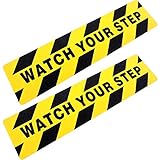
- Striking Design: watch your step sticker tape with black stripes is easy to get people's attention, the printed words " watch your step" will always remind you to walk carefully and safety first
- Right size: this warning sticker is in 6 x 24 inches/ 15 x 60 cm (LW), normal size and large enough to be noticed, can be applied to most smooth and flat surfaces
- Abrasion Resistant Material: the watch your step tape made of PVC, the adhesive tape features waterproof, wear resistance, and good stability; Please make sure the surface you pasted on is dry and clean before applying it, press it tightly to avoid intrusion of water and dust into interior
- Applications: apply it to the stairs, platforms, raised thresholds, loading docks, and ramps to attract attentions, or use it on the wet slippery floors as temporary custodian to avoid slip and fall accidents, fit for industrial parks, malls or other potential dangerous areas
- Package: coming with 2 pieces watch your step sticker tapes, please periodically inspect it for better use and replace it in time, if necessary
Published datasets also have limits. OSHA’s Injury Tracking Application covers defined groups of establishments, not every workplace. OSHA cautions that the data may not generalize to the worker population, notes that some submitted errors remain unresolved and says establishment counts are not agency-validated. It also says rates in these data should not be used alone to label establishments the most or least dangerous. For operational decisions, check the dataset’s coverage and year, and give preference to comparable local information when available. OSHA’s ITA page sets out these qualifications.
Workplace AI also raises issues beyond analytic accuracy. NIOSH has highlighted black-box challenges and concerns involving worker autonomy, privacy and bias. A responsible deployment should tell workers what information is collected and why, limit access appropriately, test whether errors or effects differ across groups and sites, and provide a meaningful way for workers to add context or challenge a misleading inference. A person should remain responsible for deciding what action to take. NIOSH’s 2024 discussion of managing AI-related workplace risks addresses these concerns.
What current survey and case-study figures show
Employer interest, not universal adoption
The National Safety Council’s 2024 Safety Technology Survey covered 500 employers and 1,000 employees in safety-sensitive industries. In its spotlight on predictive analytics, 20% of surveyed employers reported currently using it, while 45% said they were testing or considering it. Those figures describe that survey population and year, not workplace adoption everywhere. The NSC also identifies development cost, data security, human oversight and bias as considerations. Read the NSC’s 2024 predictive-analytics spotlight.
Reported deployments are examples, not general performance guarantees
An NSC case-study report published in 2023 describes a JE Dunn/Newmetrix deployment that used project, weather, staffing, image and video data from 2016 to 2021. The report says 75% of recordable incidents occurred on the seven projects ranked highest for risk each week, and reports 350 additional safety conversations. These are outcomes attributed to that vendor-associated case study; they do not establish general model accuracy or show that the same results should be expected elsewhere.
The same report describes Los Alamos National Laboratory’s Cority implementation, reporting that 75 surplus software applications were decommissioned and 1–2 FTEs’ worth of work was redirected to other initiatives. Those figures are also specific to the case-study account, not typical savings estimates or evidence of predictive performance. Read the NSC’s 2023 predictive-analytics and machine-learning case studies.
Quick Recap
Product prices and availability are accurate as of the date/time indicated and are subject to change. Any price and availability information displayed on Amazon at the time of purchase will apply.

