Do these 3 things before closing this tab:
1Repair Windows errors before they cause bigger problems2Fix the driver behind crashes, sound loss and screen glitches3Clear out junk files and repair common Windows errorsIf a multirotor will not leave the ground with a payload that appears to be within its rating, do not begin with a maximum-throttle test. First verify the aircraft’s actual all-up takeoff weight and the exact definition of “payload” in its current manual. Then inspect the payload position, propellers, motors, warnings, and takeoff restrictions in that order. A payload number from another model cannot prove that your aircraft has enough usable thrust.
Start by separating payload capacity from maximum takeoff weight
The most common mistake is treating a payload rating as if it were the aircraft’s total allowable mass. A payload is only one part of the takeoff configuration. The aircraft itself, batteries, guards, cameras, lights, release mechanisms, cables, landing gear, and the carried item all contribute to the mass that must be lifted.
As an Amazon Associate I earn from qualifying purchases.
Autel Robotics’ EVO II Enterprise V3 manual expresses the relationship as Payload Maximum Weight ≤ Maximum Takeoff Weight - Aircraft Weight. In practical terms, subtract the aircraft weight defined by that manual from the model’s maximum takeoff weight; the remaining allowance is the maximum payload under the stated conditions. It is not permission to add equipment without recalculating the complete configuration.
Use the manual’s definitions rather than assuming that “aircraft weight” means the bare airframe. Some manufacturers define a published weight with a particular battery or standard equipment installed. Others specify a measurement point or a particular payload attachment. The exact wording controls.
#1 Best Overall
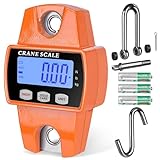
- Accurate Reading:Built with a cast aluminum housing, this digital hanging scale provides accuracy within 0.1% for reliable weight measurements; Crane scale design delivers consistent performance in rugged outdoor conditions
- Heavy Duty: Available in 660 lbs / 300 kg and 1100 lbs / 500 kg capacities, this hanging weight scale delivers reliable measurements with 0.05 kg / 0.11 lb / 0.5 N increments; Built for weighing livestock, hay bales, and large equipment
- Smart Controls: Switch between kg, lb, and N on this digital hanging scale with one button press; Hold mode locks the reading after the load is removed, while tare function removes container weight for accurate net weight readings
- Wide Use: Weigh deer and game on hunting trips, check your catch at the dock, or check feed bag weights on the farm; A portable fish scale that fits in your pack for any outdoor weighing task
- Quick Attach: Detachable hook attaches in seconds for fast setup at any location; Designed for convenient operation on farms, hunting sites, docks, and outdoor work environments
What “all-up takeoff weight” includes
- The aircraft and every battery installed for the flight.
- Factory equipment that is already attached.
- Optional equipment, such as a camera, spotlight, loudspeaker, guard, landing accessory, or release device.
- The payload, including its mounting bracket, fasteners, cable, container, or sling.
- Any item that remains attached during takeoff, even if it will be released later.
Record the configuration exactly as it will fly. A payload that is within a nominal limit can still create a problem if the mounting location moves the center of gravity outside the approved envelope.
Read the exact model manual before changing hardware
Write down the aircraft model, variant, firmware or manual revision identified by the manufacturer, battery arrangement, payload attachment, and installed accessories. Then find the current operating manual for that exact aircraft. Do not substitute a similar-looking model’s chart or a specification copied from a different product family.
When comparing two aircraft or two payload configurations, use the same set of questions for each:
| Item to compare | Why it matters |
|---|---|
| Maximum takeoff weight | Sets the model-specific upper mass limit; it is not automatically the payload limit. |
| Aircraft or empty weight definition | Determines what must be subtracted before calculating available payload allowance. |
| Payload definition and measurement point | A rating may apply only to a named connector, mount, or configuration. |
| Center-of-gravity limits | An acceptable mass can still be unsafe if it is mounted too far forward, aft, high, low, or to one side. |
| Altitude and environmental conditions | Published capacity may be measured at a stated altitude and can decrease in thinner air. |
| Approved propulsion, batteries, and service limits | Substituting parts or configurations can invalidate the model’s published performance. |
No universal thrust-to-weight threshold can be inferred from these specifications. Multirotors differ in motor, propeller, battery, flight-control, and environmental limits, so a ratio that appears adequate for one design is not a safe rule for another.
Measure the complete flight configuration
Use a suitable scale to measure the aircraft in the same configuration in which you intend to take off. Measure the payload and its attachment hardware as a unit when possible, then verify the combined result. A digital hanging scale can help with mass checks, but a scale cannot prove that the propulsion system has adequate thrust, that the center of gravity is approved, or that the aircraft is safe to fly.
Rank #2
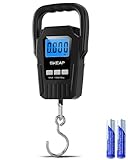
- 【Weighing Accurate 】: This digital fish scale provides reliable and precise results with an increment of 0.001kg / 0.01oz / 0.01lb.From 50g /0.11 lb to 50kg/110lb weighing capacity.Its accuracy level is also remarkable because of its excellent high precision sensors.
- 【Durable and Comfortable Handle】:Unlike the metal hand other fishing scales, SKEAP digital hanging scale is equipped with the durable ABS plastic rubber coated handle makes you feel comfortable when hanging heavy objects. It is also convenient to hold the handle by hand without leaving any pain and marks.
- 【best option】:Intelligent fish scale with professional functions such as weighing unit conversion, data lock, auto shut-off function, tare function, etc. is definitely good news for amateur and avid fishing enthusiasts! If you have weighing needs, please feel free to buy, we will provide you with all services!
- 【Multifunctional fish scales digital wight】: This fish scales digital weight with extra-wide soft plastic handle is easy for you to carry outdoors, and the blue LCD backlight with data locking makes you easy to read the value at day and night. The hanging scale is powered by 2 AAA batteries (included) for your convenience.
- 【Luggage Scale with Hook】:Crafted from premium high strength stainless steel, the large and durable hook concealed in the back slot is convenient for you to hook up and remove from fish's mouth, luggage and everything in between.
Make the calculation model-specific
- Copy the aircraft-weight and maximum-takeoff-weight definitions from the exact manual.
- Weigh the assembled aircraft with the intended batteries and permanently attached equipment installed.
- Weigh the payload together with its bracket, cable, sling, container, and fasteners.
- Add the values to obtain the actual all-up takeoff mass.
- Compare both the mass and the payload location with the manual’s limits. Do not rely on the mass comparison alone.
If the measured result is over the stated maximum, remove weight or use an aircraft approved for that load. Do not attempt to “make up” the difference with more throttle. If the mass is below the limit but the aircraft still cannot lift, continue with the mechanical and software checks rather than assuming the published rating is wrong.
A model-specific example, not a general benchmark
DJI’s current Matrice 400 specifications, accessed in 2026, list a maximum payload of 6 kg measured at the third gimbal connector under sea-level conditions. The same page lists a 15.8 kg maximum takeoff weight and states that payload capacity decreases as altitude increases. Those figures describe the Matrice 400 under the stated measurement conditions; they cannot be applied to another DJI model or to a different multirotor manufacturer.
Inspect the payload mount and center of gravity
Check that the payload is attached at the approved connector or mounting point and that all fasteners, locks, and latches are fully engaged. Look for a bracket that has shifted, a cable caught against a frame member, or a container that can swing during spool-up. A payload can weigh less than the limit yet still make the aircraft unstable if its center of gravity is outside the permitted area.
Use the diagram and dimensions in the model’s manual. Do not infer an acceptable position from a photograph of another setup. If the manual gives separate limits for a gimbal, connector, rail, or release mechanism, apply the limit to that specific location.
Check propellers with the motors disarmed
Incorrectly installed or damaged propellers are a direct cause of insufficient lift. DJI’s troubleshooting guidance lists incorrect propeller installation as a possible reason for a takeoff failure. VEX’s model-specific drone guidance similarly warns: “If the propellers are not functioning properly the drone may not be able to create enough lift to take off.”
Rank #3
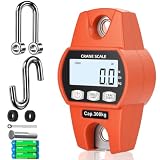
- High‑Precision & Thickened Hook: The digital crane scale built with high‑precision load cell for 0.1 lb precision. Equipped with a 0.38 in diameter thickened hook for greater sturdiness, less prone to bending and deformation. Perfect for weighing requirements in industries and farms
- Heavy‑Duty & Sturdy Long‑Lasting Build: Available in 660 lbs / 300 kg capacity, this digital hanging scale features 0.1 lb precision. Built with aluminum‑alloy housing and high‑load stainless‑steel hook, great for livestock, hay bales, farming, hunting and industrial applications
- Tare & Hold Function: This hanging scale is equipped with three practical buttons: TARE function reset to subtract sling weight for accurate net weight measurement, HOLD data lock & UNIT conversion function and ON/OFF power switch
- Wide Industrial & Daily Application:Compact portable hanging scales for weighing is ideal for factory hoisting, warehouse inventory, farm livestock weighing, logistics cargo checking and on-site heavy goods measurement
- Easy Assembly & Responsive Technical Support: This crane scale comes with full accessories for quick installation and hanging mounting. We back this digital hanging scale with a 2‑year warranty against quality defects
Secure the aircraft, disarm the motors, and follow the exact inspection procedure for the model. Check each item below:
- Correct propeller type and location for that motor.
- Correct orientation and rotation direction.
- Propeller seated fully on the motor shaft or hub.
- Retainer, nut, quick-release mechanism, or screw tightened according to the manual.
- No cracks, chips, bends, delamination, severe scratches, or missing sections.
- No dirt, tape, hair, cable, or payload strap touching the blades.
- Propeller and motor able to move freely when the aircraft is secured and power is off.
Replace a damaged propeller with the exact approved type for that aircraft. Do not mix clockwise and counterclockwise parts, swap a propeller from another model because it appears to fit, or reshape a blade. Never improvise a powered propeller test while holding the aircraft or standing near the rotor disk. If the manufacturer specifies a maintenance test, follow that procedure and its safety distances exactly.
Check motors, propulsion warnings, and the aircraft status page
After the propeller inspection, use the manufacturer’s app, controller, or status interface to look for motor, propulsion, ESC, battery, overload, or takeoff warnings. A motor that does not rotate normally is not a payload-adjustment problem. DJI states that a motor that fails to rotate may indicate an error and advises repair service if the prescribed troubleshooting does not resolve the problem.
With the aircraft disarmed and secured, compare the motors for obvious differences in free movement, rubbing, or physical damage. Stop if you find a bent shaft, loose motor mount, damaged arm, burnt smell, exposed wiring, or a motor that binds. Do not open a propulsion assembly or substitute an ESC, motor, battery, or propeller without model-specific compatibility and service instructions.
Capture the exact warning text and the conditions under which it appears. “Motor error,” “propulsion system error,” and “takeoff prohibited” can require different actions. Clearing a warning without correcting its cause is not a repair.
What’s actually slowing this PC down?
Pick the symptom - the matching free tool is one click away.
Rank #4

- High Precision:RESHY digital crane scale use high-precision sensors, and the weighing is more accurate.Max.Cap. 1000kg/2200lb;Devision: 0.5kg/1.1lb.Suitable for farm, factory, construction, hunting, fishing, etc.
- Very sturdy: Our digital hanging scale housing is made of aluminum alloy, which can be used in harsh environments. The ring and hook of the crane scale have been thickened to make them stronger and more sturdy.Obtained CE/RoHS/FCC/UKCA certification
- Multiple functions: RESHY digital crane scale supports TARE, Hold, ZERO, Unit switching Kg/Lb. hanging scale uses 2 AA batteries for power supply, which is easy to replace.
- High-definition display: The digital crane scale uses a high-definition display with backlight, which shows larger numbers and is easy to read data.
- Customer Service: If there is any problem with the digital hanging scale, please contact us first, we will replace the digital crance scale within 3 years.
Rule out takeoff restrictions and operating modes
Not every aircraft that stays on the ground has a lift-capacity fault. DJI’s general troubleshooting material identifies restricted zones and beginner or tutorial mode among conditions to check for applicable aircraft. Review the aircraft’s current app warnings, location status, and flight-mode setting before changing the payload.
Restricted or geofenced area
Confirm that the aircraft is authorized to take off at the present location under the manufacturer’s current geospatial system and local rules. A restriction can block takeoff or limit operation even when the motors appear normal. Do not attempt to bypass a restriction by modifying software or moving the aircraft into an unapproved area.
Beginner, tutorial, or training mode
Check whether a beginner or tutorial mode is active. Such a mode may limit available controls or flight behavior on models that provide it. Exit it only through the normal settings path and only when the operator meets the model’s training and safety requirements.
Warnings that are not payload ratings
Read the warning category carefully. A low-battery, compass, positioning, calibration, or hardware warning should be handled according to that model’s procedure; increasing throttle or removing a small amount of payload is not a substitute for resolving it.
Windows Errors? Fix Them Before They Spread
Repair common Windows errors and clear accumulated junk for a smoother, more stable PC - no reinstall needed.Free scan · no reinstallCrashes, No Sound, or Screen Glitches?
Random freezes, missing sound and display glitches usually trace back to one bad driver. Find and replace yours safely.Free scan · under a minuteAccount for altitude and the stated test conditions
Published payload figures are conditional. The Matrice 400 example is measured at sea level, and DJI explicitly says its payload capacity decreases as altitude increases. At higher elevation, the same aircraft and mass may have less available lift than the specification suggests. Weather, air density, and the aircraft’s approved operating envelope also matter, but the manual’s stated conditions remain the reference point.
Best Value

- Portable and Accurate ABS plastic Case: Handheld Crane Scale with Anti drop S-shape stainless steel hook, 880lbs / 400kg with high accuracy, it is available for Fishing,Travelling,Gym,workshops,households, and father's day gifts. The Mini portable ABS plastic Case, it’s light and easy to carry. Also, its sleek design feels oh-so-right in your hand.
- Multiple Units and Hold & Tare unction: Press”UNIT” button,easily switch between N,LB,KG. Press”HOLD” button and weight an object it will hold the weight even after you take it off; Tare button, you can re-zero the weight when you put an empty container or vessel.
- Big LCD Display & full 360-degree view: The Hanging Scale with a big white backlight LCD Display is visible number in any light. Full 360-degree view, ensuring convenient and clear readings in any angle
- Assembly: Please refer to the product picture,it is easily to assemble and disassembly this crane scale.
- Simple and Easy to use: You don’t need read the manual,because the operation is very simple. It’s handheld size and with lightweight design, you can carried in your car’s glove compartment or packed in your outdoor gear. You can carry it almost anywhere to use. Powered by 3 AA batteries that included. (Non-rechargeable)
Do not convert a sea-level figure into a universal field allowance. If your operation is at a different altitude or with a different attachment point, look for the manufacturer’s derating information. If no model-specific guidance is provided, treat the published number as insufficient evidence for a maximum-load attempt and consult the manufacturer or a qualified service professional.
A safe diagnostic sequence
Use this order so that a simple configuration error is found before any maintenance decision:
- Stop the lift attempt. Land or keep the aircraft secured, disarm the motors, and remove people and loose objects from the rotor area.
- Identify the exact model. Record variant, installed equipment, battery configuration, payload attachment, and the current manual.
- Measure actual mass. Weigh the complete flight configuration and compare it with the model’s maximum-takeoff and payload definitions.
- Verify payload position. Confirm the approved connector or mount, attachment security, and center-of-gravity limits.
- Inspect every propeller. Check location, direction, security, damage, and free movement with motors disarmed.
- Check motors and warnings. Use the manufacturer’s interface and stop for a motor that does not rotate normally or for a propulsion warning.
- Review restrictions and modes. Check geofencing or restricted-area status and beginner or tutorial mode where applicable.
- Compare operating conditions. Account for altitude and any other conditions named in the manual’s payload specification.
- Escalate unresolved faults. Contact the manufacturer or a qualified service provider rather than attempting an overload or an improvised maximum-throttle test.
What not to do
- Do not borrow a payload rating from another aircraft, even if the frame and propellers look similar.
- Do not count only the cargo and ignore batteries, mounts, cables, or installed accessories.
- Do not assume that a scale reading proves adequate thrust or safe center of gravity.
- Do not run a hand-held, unrestrained, or improvised powered propeller test.
- Do not continue repeated takeoff attempts after a motor, propulsion, or structural warning.
- Do not fit replacement motors, propellers, ESCs, or batteries without exact compatibility evidence.
- Do not perform an overload or maximum-throttle test unless the manufacturer expressly authorizes that procedure for the model.
When to stop and seek service
Stop payload flight attempts if the aircraft exceeds any stated limit, the payload cannot be placed within the approved center-of-gravity area, a propeller is damaged or incorrectly retained, a motor does not rotate normally, or an aircraft warning remains after the documented checks. DJI’s troubleshooting guidance recommends manufacturer repair when its listed steps do not resolve a takeoff problem. The same conservative decision is appropriate for other aircraft when a persistent fault cannot be isolated safely.
Recommended Free Tools
Give service personnel the model and serial information, manual or firmware revision, measured all-up mass, payload attachment point, altitude, warning text, and the inspection results. That record is more useful than reporting only that “the propellers spin but it will not lift.”
Why propellers may spin while the aircraft stays on the ground
Spinning blades do not prove that the aircraft is producing the required lift. The propellers may be in the wrong positions or orientations, damaged, loose, obstructed, or attached to a motor that is not operating normally. The actual mass may also exceed the model-specific allowance, the payload may be outside its approved location, or a takeoff restriction or training mode may be active. Follow the sequence above instead of increasing throttle blindly.
The practical decision
A multirotor that cannot lift its rated payload needs a configuration and fault check, not a universal performance assumption. Verify the exact manual, measure the complete aircraft, confirm the payload’s center of gravity and mounting point, inspect the propulsion system with the motors disarmed, and clear applicable restrictions. If those checks do not identify and correct the cause, keep the aircraft grounded and obtain manufacturer or qualified service support.
Quick Recap
Product prices and availability are accurate as of the date/time indicated and are subject to change. Any price and availability information displayed on Amazon at the time of purchase will apply.
The Tool Desk
Outbyte PC Repair FREERepair Windows errors before they cause bigger problemsFix Now →Outbyte Driver Updater FREEScan for outdated or missing drivers - takes under a minuteDriver Scan →
