Dividing a target throughput by 625 MBps to get an iSCSI session count or an NVMe/TCP queue count is not a method AWS documents, and it did not hold up in a measured Amazon FSx for NetApp ONTAP test. In that Single-AZ environment, the calculation under-predicted throughput at one connection, over-predicted it at two and far more at sixteen, so it cannot be used as a sizing rule. Size the target configuration by measuring it.
Where the 625 MBps figure comes from
The number traces to AWS’s iSCSI and NVMe/TCP setup procedures for FSx for ONTAP, which describe an Amazon EC2 single-client maximum of 5 Gbps (about 625 MBps) as context before an optional step for adding sessions when you want more throughput than one client path delivers. The shortcut is the step that readers add on their own: take the required bandwidth, divide by 625, and treat the quotient as the number of sessions or queues to configure.

As an Amazon Associate I earn from qualifying purchases.
Yoshiki Fujiwara, an AWS Community Builder, made this distinction in his write-up of the test, which is the source for the measurements below: Moving on-premises block storage to AWS? The “divide by 625 MBps” sizing approach comes out wrong (published September 30, 2026). His characterization of the procedures is that “AWS does not instruct you to divide,” and that “No formula is given.” These are his descriptions of the linked AWS procedures, not verbatim AWS statements. The division itself was his test subject, not an AWS recommendation.
What was measured
The test ran on a second-generation FSx for ONTAP deployment with the SINGLE_AZ_2 topology in AWS Region ap-northeast-1. The file system had one HA pair rated at 6,144 MBps, 4,096 GiB of SSD storage, and 200,000 provisioned IOPS. The test LUN or namespace was 600 GiB on a 900 GiB volume. The client was a c5n.9xlarge EC2 instance with 50 Gbps guaranteed network bandwidth.
#1 Best Overall

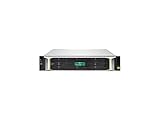
- Versatile, Scalable Storage - Seagate Exos X 2U12 SAN Array with Dual 10Gb/s iSCSI Controllers, and 192TB 7.2K SAS HDDs is purpose built for versatile, easily expandable storage. Made for hassle free scalability, up to 3 expansion units can be added to ensure the system can grow with your company’s data storage needs.
- High Performance - Exos X 2U12 storage arrays enable even small businesses to get data to applications quickly with up to 3.5GB/s throughput and 16GB cache per system. Nearline SAS hard drives deliver reliable Seagate enterprise grade storage while still maintaining high capacity. Plus, dual controllers provide four 10Gb/s iSCSI ports for lightning fast data transfer speeds.
- Eliminate System Downtime - Virtually eliminate system down time and provide up to 99.999% data availability through features such as parallel architecture, data replication, fast streaming, and ADAPT for data protection.
- Feature Rich Software - Base Array Software Features: Virtual pools, thin provisioning, ADAPT, read cache, and encryption; Advanced Software Features: Auto-tiering, snapshots, and asynchronous replication; High-Availability Features: Hot-swappable controllers, drives, fans, and power as well as automatic failover and multi-path support
- Built In Security - Seagate ADAPT provides an added layer of security beyond RAID by employing smart learning technology to respond to potential or active failures and self healing to decrease drive rebuild time. Additionally Seagate Secure provides built in security measures for safe file access, transfer, and management.
The load generator was VDBENCH 5.04.07 in direct mode with unlimited I/O rate (iorate=max), 512 threads, a 60-second warmup, and a 300-second measurement window. The window includes bursts, so the figures describe what this setup delivered during that period, not a steady-state baseline.
iSCSI results: measured versus divisor prediction
The three iSCSI results were recorded on ONTAP 9.18.1P5. The table compares each measured sequential throughput with the value the 625 MBps division predicted for the same connection count.
| Counted TCP connections | Measured throughput (MB/s) | Predicted by 625 MB/s division (MB/s) | Measured as a multiple of prediction |
|---|---|---|---|
| 1 | 1,135.18 | 625 | 1.82x |
| 2 | 1,135.18 | 1,250 | 0.91x |
| 16 | 1,970.43 | 10,000 | 0.20x |
The prediction missed in both directions. One connection beat the formula, two connections fell short of it, and sixteen connections delivered only a fifth of the figure it projected. Going from one to two connections produced no change in the measured sequential throughput, so the extra session added nothing in this configuration.
Quick wins for a faster PC:
Fix the driver behind crashes, sound loss and screen glitchesFind Drivers →Repair Windows errors before they cause bigger problemsFix Now →The author also reports that a measurement in a different environment changed the same configuration’s result by 2.64x. That is the reason the numbers should not be read as stable expectations for a given setup.
Rank #3

- Synology DiskStation DS3622xs+, made for a variety of server roles, such as iSCSI targets backup, file storage, email servers, and domain controllers. Powerful, high-capacity, scalable storage that fits in any environment. A powerhouse capable of fitting into small and medium business environments with intensive, multi-user workloads.
- Xeon D-1531 6-Core 2.2GHz CPU, Up To 2.7GHz Turbo; 48GB DDR4 ECC SODIMM Memory; 216TB (12 x 18TB) SATA HDDs for High-Capacity Storage; 2 x RJ-45 1GbE LAN Ports and 2 x RJ-45 10GbE LAN Ports (with Link Aggregation / Failover support); 2 x USB 3.2 Ports; 2 x Expansion Ports; Btrfs File System for Advanced LUN iSCSI Service
- Operating System: Synology DSM Software
- Synology NAS chassis comes in a sealed box.
- Hard drives and memory upgrades included separately, NOT installed, installation required.
NVMe/TCP results: requested versus effective queues
For NVMe/TCP, the tunable that matters is the queue count rather than an iSCSI session setting. In the author’s test, requesting 36 queues produced four effective submission and completion queues. The queue-allocation test ran on a separate deployment whose ONTAP version was not recorded. Allocation depends on negotiation between host and transport, so the number you request may not be the number you get. Check the effective count on your own host rather than assuming the requested value.
What the results do and do not establish
The measurements show that a linear divisor did not predict throughput for this one Single-AZ FSx for ONTAP environment, in this Region, on these software versions. They do not establish a replacement formula, a general per-session throughput, or a general ceiling for FSx for ONTAP. They also say nothing about iSCSI versus NFS or SMB, because no protocol comparison was run.
The author states that Multi-AZ behavior was not verified. Compression and inline storage-efficiency settings were not recorded. Possible explanations for the protocol behavior, including placement-group status and flow treatment, were not tested, so treat them as open questions rather than findings.
How to size block storage without the shortcut
Use the target configuration and measure it under a workload that resembles yours. A practical sizing check covers these items:
Best Value

- Ryzen V1500B -Core 2.2GHz 4MB CPU; 32GB DDR4 PC4-21300 2666MHz SO-DIMMs; 32TB (8 x 4TB) SATA III Solid State Drives for Ultra-Fast Storage
- Compact and Reliable: The RS1221+ is a compact powerhouse designed for space-sensitive deployments, delivering exceptional performance of over 100K 4K random read IOPS and 2,315 MB/s sequential read1, perfect for data-intensive environments.
- Ultimate File Management: Seamlessly manage and share files with File Station, a secure web-based tool that enables hassle-free drag-and-drop operations, ensuring compatibility with protocols like AFP, FTP, iSCSI, NFS, SMB, and WebDAV.
- Data Protection Solutions: Enjoy comprehensive data protection with built-in features like Hyper Backup, offering diverse backup destinations, and Snapshot Replication, providing flexible point-in-time backups with fast recovery options for shared folders and LUNs.
- Hard drives and memory upgrades included separately not installed, installation required.
- Protocol behavior: the session count for iSCSI or the queue count for NVMe/TCP, and the effective count the host actually negotiates.
- Workload shape: I/O size, read/write mix, concurrency, and whether the load is steady or bursty.
- Performance together: IOPS, throughput, and latency measured jointly, since a throughput number alone does not show whether latency targets are met.
- Duration: sustained results over the period you need, not only short bursts.
- Client path: instance network bandwidth and any EC2 limits that cap what one client can send.
- Storage ceilings: the file system’s throughput and IOPS, sized in the Region and Availability Zone topology you will run.
- Versions: the ONTAP release and protocol settings you actually deploy, recorded alongside the results.
Keep FSx client networking separate from EBS limits
If part of the migration uses Amazon EBS instead of FSx, the planning rules differ. AWS’s EBS-optimized instance documentation states: “An instance’s EBS performance is bounded by the instance type’s performance limits, or the aggregated performance of its attached volumes, whichever is smaller.” It also notes that maximum IOPS and throughput limits are interdependent and depend on I/O size. A volume’s advertised maximum is therefore not guaranteed through every instance, so check both the instance’s EBS capability and the combined capability of the attached volumes.
The EBS instance reference lists baseline and maximum throughput in MB/s at 128 KiB I/O, and IOPS at 16 KiB I/O. Some instance types can sustain maximum performance only for 30 minutes at least once in every 24 hours, while others sustain the stated performance indefinitely. Those distinctions appear in the table footnotes, and the table changes over time, so check the instance family you choose when you plan.
Striping is a remedy for specific limits, not a response to session counts
Striping across EBS volumes makes sense when a single volume cannot meet the throughput, IOPS, size, or operational requirement. AWS’s SAP HANA guidance gives single-volume maximums of 1,000 MB/s for gp3 and 4,000 MB/s for io2 Block Express, and it says most HANA deployments do not need striping on io2 Block Express. The guidance recommends considering higher-performance volume types or settings before adding stripes. Its worked example, a 4 TiB-memory system with a gp3 throughput target of 1,250 MB/s, suggests two 2,450 GiB filesystems at 625 MB/s each. That is a HANA-specific example and does not transfer to the FSx test above.
Free tools Windows power users keep installed
One-click scans. No signup required.
A 625 figure from Amazon RDS is a different constraint
Readers may also find 625 in AWS RDS documentation. For RDS for MySQL gp3 storage, setting IOPS to 40,000 requires storage throughput of at least 625 MiB/s. That is a storage-performance relationship inside RDS. It is not the 5 Gbps (about 625 MBps) client-network figure in the FSx procedures, and MiB/s and MBps are different units.
Quick Recap
“
Product prices and availability are accurate as of the date/time indicated and are subject to change. Any price and availability information displayed on Amazon at the time of purchase will apply.

