Choose a mixer grinder by matching its motor and jars to the work you actually do. For occasional household jobs, Bosch Home India places the useful starting range at 500–750 watts. Frequent, varied cooking is commonly covered by 750 watts, while Bosch recommends 750 watts or more and Philips identifies 1000 watts as an option for heavier grinding and larger quantities. Treat those figures as manufacturer guidance, not a universal performance rating. Then check each jar’s rated capacity for dry grinding, wet grinding, and liquidising; its nominal volume can be much larger than the safe working amount.
Start with workload, not the biggest number on the box
Wattage indicates the motor’s electrical power, but it does not by itself tell you how well a machine will handle a particular recipe. The right choice depends on what you grind, how often you run the appliance, and how much you process in one batch.
As an Amazon Associate I earn from qualifying purchases.
Occasional, lighter work
If you mainly blend small portions, make an occasional chutney, or grind modest amounts of spices, a model in the 500–750W range is a sensible starting point. Bosch Home India describes 500–750W as generally sufficient for regular household use. That is a recommendation for household products in the Indian market, not an independently tested minimum.
Recommended Free Tools
Frequent daily cooking
People who prepare several wet and dry items every day should look at the complete 750W specification. Philips presents 750W as suitable for varied daily cooking. A three-jar configuration can be convenient when it provides separate vessels for wet grinding, dry grinding, and chutney-sized portions, but the jar count alone does not establish stronger performance.
#1 Best Overall
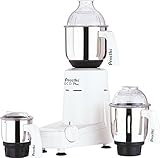
- The Preethi ECO PLUS MG-138 Mixer Grinder features 550 Watt motor. The mixer comes with 100% stainless steel jars with flow breakers for fine grinding.
- The steel blades of the mixer grinder are machine ground and polished for maximum grinding efficiency.
- It has high grade Nylon Couplers for smooth and hassle free operation. The clear and transparent polycarbonate domes & lids add to the quality factor. The sturdy handles are ergonomically designed.
- Comes with 3 (1.5 Liter, 1.0 Liter and 0.4 Liter) Stainless steel Jars for Wet and Dry grinding, whipping, churning Grating, Mincing, and Chopping
- Please user manual under the product details for setup and usage related guidance.
Heavy grinding or larger quantities
For harder ingredients, repeated batches, wet batter, or larger quantities, Bosch recommends 750W or more. Philips describes 1000W as an upgrade for heavier workloads. Before buying, confirm that the particular model is specified for the task and batch size; higher wattage does not guarantee that its blades, jar, cooling system, or operating limits are suitable.
| Typical workload | Starting wattage guidance | What to verify in the specification |
|---|---|---|
| Occasional, lighter household tasks | Bosch: 500–750W for regular household use | Small grinding or chutney jar, plus a mid-size jar; check the actual rated capacity. |
| Frequent cooking with wet and dry tasks | Philips highlights 750W for varied daily cooking | Separate dry-grinding, wet-grinding, and liquidising capacities; a three-jar set may cover the core jobs. |
| Heavier grinding or larger quantities | Bosch: 750W or more; Philips identifies 1000W as a possible upgrade | Specified workload, batch limits, blade and jar design, cooling, overload protection, and warranty. |
These are vendor recommendations rather than a tested ranking or an independently established threshold. The same wattage can behave differently across models because of motor construction, blade geometry, jar design, cooling, speed control, and protection circuits.
Why wattage alone can mislead
Orient Electric’s buying guide states, “More watts do not automatically make one mixer grinder better for every kitchen.” The point is practical: a powerful motor paired with an unsuitable jar or unclear operating limit may be less useful than a lower-wattage model designed for your normal recipes.
What’s actually slowing this PC down?
Pick the symptom - the matching free tool is one click away.
Compare the motor rating with the rest of the machine:
Rank #2
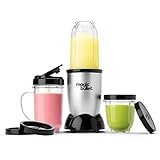
- The O.G. magic bullet: the tiny flavor vortex that started it all. This compact countertop wizard chop chop chops the freshest pico, whips up the creamiest milkshakes, and zhuzhes all your concoctions in basically zero seconds
- COMPACT SIZE: Not only is it fast and versatile, it’s also compact. This easy-to-use blender takes up way less countertop space than bulky full-size food processors and blenders
- EASY-TO-USE: Just load your ingredients into the cup, twist on the blade, line up the tabs and place on the power base
- POWER: High torque 250-watt motor powers the machine’s versatility. There’s no limit to the sauces, dips, drinks and snacks you can create
- HASSLE-FREE CLEANING - simply twist off the blade, rinse with soap and water, and put the cups in the top rack of the dishwasher. This item comes with a 1 year Limited Warranty
- Blade system: blade shape and material affect how ingredients are cut and circulated.
- Jar design: the vessel needs enough room for the recipe and a shape that keeps ingredients moving around the blades.
- Cooling: repeated heavy batches place different demands on the motor than a short blend.
- Speed control: multiple settings can make it easier to handle both delicate blending and tougher grinding.
- Overload protection: this can stop the motor when a load is excessive, but it does not make an undersized jar safe to overfill.
- Safety features, warranty, and service: Bosch lists these among the selection criteria, and they matter when the appliance will run frequently.
Jar capacity: nominal volume is not the working capacity
The largest number printed for a jar is often its nominal volume, not the amount the manufacturer rates for a specific job. A Bosch manual (document 8001217264_A, search results dated approximately 2020) illustrates the difference:
| Jar | Nominal volume | Rated capacity stated in the manual | Rated use |
|---|---|---|---|
| Big jar | 1.2 litres | 0.6 litre | Wet grinding or liquidising |
| Medium jar | 0.8 litre | 0.4 litre | Dry grinding |
| Chutney jar | 0.4 litre | 0.2 litre | Dry or wet grinding |
The same manual says minimum capacity is at least up to blade level. These figures apply to the product covered by that manual, not to every Bosch model or to mixer grinders generally. Use the manual for the exact model you are considering and do not assume that a 1.2-litre jar can safely process 1.2 litres of ingredients.
Choose the jar by the recipe
- Small chutney or spice portions: a small jar reduces the empty space around a small load and is easier to use for short batches. Confirm its rated dry and wet capacities.
- Dry grinding: look for the model’s dry-grinding rating, which may be lower than the jar’s headline volume. Spices, grains, and other dense ingredients can load the motor differently from liquids.
- Wet grinding: check both the wet-grinding rating and any instructions about adding liquid. A large nominal jar does not mean you can fill it to the rim.
- Liquidising: compare the liquidising capacity separately. It may be specified differently from dry or wet grinding because movement and expansion are different.
How to select wattage and capacity step by step
- List your real jobs. Write down whether you mostly make chutney, dry spice powders, wet pastes, batter, smoothies, or liquidised dishes. Include the hardest ingredient and the largest usual batch.
- Estimate frequency. Occasional short runs do not impose the same duty cycle as several batches every day. If heavy work is routine, begin your search at the higher end of the manufacturer guidance.
- Set a wattage shortlist. Use 500–750W as a starting range for regular household use, 750W for varied daily cooking, and 750W or 1000W options for heavier workloads. These are filters, not a final verdict.
- Read the model’s manual or specification sheet. Confirm the intended workload, operating limits, and any instructions for hard ingredients, batter, or consecutive runs.
- Record task-specific capacities. Note the rated dry-grinding, wet-grinding, and liquidising amounts separately. Ignore a comparison that lists only the largest nominal jar volume.
- Check the included jars. Buy the jar types you will use, not the highest count. Two jars can be enough for one kitchen; a third or fourth is valuable only when it adds a needed size or function.
- Evaluate supporting hardware. Compare speed settings, blade and jar construction, cooling, overload protection, safety features, warranty, and local service support alongside wattage and capacity.
- Plan your batch size. If a recipe exceeds the rated amount, divide it into batches rather than filling to the nominal rim. This also gives the ingredients room to circulate.
Practical examples
Small daily portions
Suppose you make one small chutney and occasional spice mixes. A 500–750W model with a properly rated chutney or small grinding jar may be more appropriate than a larger machine whose smallest vessel is oversized. Confirm that the small jar’s wet and dry ratings cover your recipe.
A household making several preparations
If you regularly prepare chutney, masala, wet pastes, and liquidised dishes, 750W is a reasonable starting point according to Philips’ guidance for varied daily cooking. A three-jar set can reduce changeovers, but compare each jar’s rated task capacity before deciding that it fits your family’s batch sizes.
Rank #3

- ALL-IN-ONE KITCHEN SYSTEM: Blend, chop, crush and more in this powerhouse blender and food processor combo.
- POWERFUL MOTOR:1500-watt motor base to crush ice, blend frozen fruit, and power through tough ingredients with the 2-horsepower motor, designed for professional results.
- BLENDING TECHNOLOGY: The XL 72-oz.* pitcher, ideal for large batches and entertaining, features Total Crushing Blades that crush ice to snow in seconds and powers through tough ingredients. *64-oz. max liquid capacity.
- FOOD PROCESSING: 8-cup food processing bowl delivers consistent, even vegetable chopping, pureeing, and mixing. Includes a dedicated chopping blade, plus dough blade, capable of mixing up to 2 pounds of dough in just 30 seconds.
- ON-THE-GO CONVENIENCE: Includes two 16-oz. Nutri Ninja Cups with To-Go Lids, perfect for personalized shakes and smoothies.
Large or demanding batches
If you grind harder ingredients frequently or process larger quantities, consider models at 750W or 1000W, then verify the operating limits. A 1.2-litre nominal jar with a 0.6-litre wet or liquidising rating, for example, should be treated as a 0.6-litre rated working capacity for those tasks.
Independent reader supportYour contribution helps us test, update, and keep practical guides available for everyone.Common buying mistakes and how to avoid them
Buying the highest wattage without checking limits
A bigger motor does not compensate for a jar that is too small, a blade system unsuited to the ingredient, or a duty cycle that does not support repeated runs. Treat wattage as a shortlist criterion and inspect the complete specification.
Comparing nominal jar volumes as if they were equivalent
Two jars both labelled “1 litre” may have different rated capacities for dry grinding, wet grinding, and liquidising. Ask for the task-specific figures or consult the manual.
The Tool Desk
Outbyte PC Repair FREERepair Windows errors before they cause bigger problemsFix Now →Outbyte Driver Updater FREEScan for outdated or missing drivers - takes under a minuteDriver Scan →Assuming more jars means better value
Jar count improves convenience only when the sizes and functions match your cooking. A spare jar that duplicates a size you never use adds storage and cleaning without solving a problem.
Rank #4

- POWERFUL 1200W MOTOR: 1200-watt motor base is made for powering through the toughest ingredients for smoothies, shakes, frozen drinks, and more
- AUTO-IQ INTELLIGENT TECHNOLOGY: Auto-iQ technology with a Crush preset program combines unique timed pulsing, blending, and pausing patterns that take the guesswork out of blending
- XL FAMILY-SIZE PITCHER: 72-oz.* full-size pitcher is great for making large batches for the whole family, with 64-oz. max liquid capacity clearly marked
- ICE CRUSHING BLADES: Stacked blade assembly with Total Crushing blades turns ice to snow for shakes, frozen drinks, and creamy textures
- PRECISE MANUAL CONTROL: Low, medium, high, and pulse manual speed settings allow for complete control of your blend
Ignoring safety and after-sales support
Speed controls, interlocks, overload protection, warranty terms, and service availability become more important as usage becomes heavier. Include them in the comparison instead of choosing on wattage alone.
Overfilling because the jar looks large
Stay within the rated amount for the particular task. The manual’s minimum level and maximum guidance are more useful than the jar’s physical height. Process an oversized recipe in batches.
A concise buying checklist
- Identify the hardest ingredient, largest batch, and frequency of use.
- Use manufacturer wattage guidance only to create a shortlist.
- Check the exact model’s supported workload and operating limits.
- Compare rated dry, wet, and liquidising capacities, not nominal volume alone.
- Choose jar sizes and count based on recipes you actually make.
- Review blades, jar design, cooling, speed settings, overload protection, safety features, warranty, and service.
- Follow the manual’s fill limits and run the appliance in batches when necessary.
The best combination is therefore not “the most watts and the biggest jar.” It is the wattage that matches your workload, paired with jars whose rated capacities cover your real recipes, supported by a design and warranty appropriate to how often you will use the machine.
Quick Recap
Product prices and availability are accurate as of the date/time indicated and are subject to change. Any price and availability information displayed on Amazon at the time of purchase will apply.

