Windows Errors? Fix Them Before They Spread
Repair common Windows errors and clear accumulated junk for a smoother, more stable PC - no reinstall needed.Free scan · no reinstallCrashes, No Sound, or Screen Glitches?
Random freezes, missing sound and display glitches usually trace back to one bad driver. Find and replace yours safely.Free scan · under a minuteThe Walters Art Museum’s Maya urn with jaguars and skulls is an earthenware funerary vessel from Guatemala, dated 600–900 CE. Its painted scene shows a jaguar-costumed deceased person between skulls and dark underworld figures. The museum interprets the image as a transformation into an ancestral spirit, though the person’s identity as a ruler is not certain.
What is the urn with jaguars and skulls?
The Walters catalogs the object as Polychrome Figural Urn with Jaguars and Skulls, accession 48.2818. It is Maya earthenware with paint, assigned to the Late Classic period and dated 600–900 CE. Guatemala is the recorded place of origin; the catalog does not give a more precise findspot. The vessel measures 17.5 × 19.75 × 21.5 inches (44.5 × 50.2 × 54.6 cm). The Walters Art Museum’s collection record identifies it as a funerary urn used to preserve ancestors’ bones.
| # | Preview | Product | Price | |
|---|---|---|---|---|
| 1 |
|
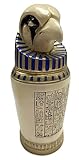
The Mummy CANOPIC Falcon Head Horus Prop Bird Replica Resin Bottle Urn Display Jar | $49.90 | Buy on Amazon |
As an Amazon Associate I earn from qualifying purchases.
The urn’s lid is missing, but loops at its top remain, indicating that an elaborate lid was once tied to the base. The museum lists the object in the Latin American Art galleries at its Charles Street building. Its recorded provenance includes William P. Palmer III, the Merrin Gallery, a private collection in May 1988, and a gift to the Walters in 2008; earlier acquisition dates and circumstances are unknown.
What do the figures and skulls depict?
At the center, the Walters identifies a deceased ruler dressed as a jaguar, with raised, clawed hands and blood across the figure. Dark-colored Lords of the Underworld appear on either side, seemingly receiving the deceased. Two pairs of skulls separate the central figure from these underworld beings: the upper skulls retain eyes and partial noses, while the lower pair are fully skeletal. These are the museum’s interpretations of the imagery, not a named identification of a particular person.
#1 Best Overall
- Ancient Egyptian Aesthetics: Intricately Designed Replica Of A Falcon's Head Or Horus In The Form Of A Canopic Jar, Bringing An Authentic Touch Of Ancient Egyptian Culture.
- Height And Dimensions: Stands At An Impressive Height Of 9 Inches, With A Wide Jar Diameter Of About 3 1/2 Inches At Its Widest Point And 3 Inches At The Base, Providing A Substantial And Visually Striking Presence.
- Hollow Jar Design: Crafted To Be Hollow, Allowing For Easy Storage And Display Of Items While Maintaining An Authentic Appearance Reminiscent Of The Ancient Canopic Jars.
- Historical Significance: Replicates The Vessels Used By The Ancient Egyptians In Their Mummification Process, Symbolizing The Preservation Of Inner Organs For The Afterlife According To Their Rich Funerary Practices.
- Quality Resin Construction: Made From High-Quality Resin, Ensuring Durability And A Remarkable Level Of Detail In The Design, Making It A Sturdy And Long-Lasting Piece For Collectors Or Enthusiasts.
The museum’s educational tour card presents the scene in terms of three realms—sky, earth, and underworld—and describes a deceased community member becoming an ancestor able to communicate across them. In this reading, death is a transformation: the ancestor can continue to mediate between the living and the gods. The card identifies the culture as K’iche’ Maya, while the collection record classifies the urn as Maya. These descriptions explain the museum’s interpretation of this object; they should not be taken to mean that every Maya community understood death in exactly the same way. The Walters’ educational material summarizes this cosmological reading.
Independent reader supportYour contribution helps us test, update, and keep practical guides available for everyone.Why does the urn have spikes?
The spikes projecting from the vessel’s sides imitate thorns on Ceiba tree trunks. The Walters describes the Ceiba as a sacred conduit between realms. In the museum’s interpretation, the jaguar figure likewise mediates among the earthly world, the underworld, and the gods. The spikes are therefore part of the image’s symbolic landscape, not simply decoration.
Was the central figure definitely a ruler?
No personal name or direct identification is supplied. The Walters calls the central figure a deceased ruler, while a Live Science report published October 5, 2026 says the figure may be a ruler. The Walters’ educational card describes the figure more generally as a deceased person. It is safest to call the ruler identification an interpretation rather than an established identity.
Free tools Windows power users keep installed
One-click scans. No signup required.
The same date range also puts the headline shorthand “1,400-year-old” in perspective. The museum’s catalog dates the urn broadly to 600–900 CE, rather than assigning it an exact age. It is a collection object, not a newly excavated discovery.
Quick Recap
Product prices and availability are accurate as of the date/time indicated and are subject to change. Any price and availability information displayed on Amazon at the time of purchase will apply.

