Quick wins for a faster PC:
Clear out junk files and repair common Windows errorsFree Scan →Fix the driver behind crashes, sound loss and screen glitchesFind Drivers →Mammograms have traditionally been read to look for signs of cancer that may already be present. Researchers are now testing whether AI can also use mammogram images to estimate a person’s chance of developing breast cancer in the future. That is a different task: a risk estimate is not a forecast with certainty, and it does not show that a future tumor is already there.
How is future-risk AI different from cancer detection?
A detection tool analyzes the current mammogram for suspicious findings. It may help a radiologist decide what deserves closer attention now. A future-risk tool instead analyzes an image to estimate the likelihood of cancer over a period of time. It is not trying to locate a tumor that will appear later.
As an Amazon Associate I earn from qualifying purchases.
The FDA’s product classification for software that predicts future breast cancer risk describes professional-use software that produces a probability or risk category for qualified health professionals. Its intended use is distinct from diagnosing, detecting, treating, or guiding interpretation of cancer. That distinction matters: an AI risk score is information for a clinical conversation, not a diagnosis or a replacement for a radiologist’s reading of the current exam.
How strong is the evidence so far?
A 2026 systematic review, Current State of Mammography-based Artificial Intelligence for Future Breast Cancer Risk Prediction, covered studies published from January 1, 2012, through February 28, 2025. It included 41 studies, and every one was retrospective. The review reported these median AUCs for predicting later breast cancer:
#1 Best Overall

- Breast Self-Examination Model: This educational breast model is designed to assist in teaching the correct techniques for breast self-examination, promoting early detection of abnormalities.
- High Simulation Model: The replica simulates a realistic left breast. It can provide a lifelike experience, enhancing the learning process for students and patients.
- Education Teaching Model: Ideal for medical training, patient education, and healthcare demonstrations, this model serves as an effective teaching aid for a variety of audiences.
- Pathological Breast Model: The breast model includes representations of common breast pathologies, such as lumps and masses, allowing for hands-on practice in identifying potential issues.
- Breast Lump Model: This female breast model accurately simulates the texture and structure of real breast tissue. Equipped with palpable lumps, this model helps users to practice locating and recognizing abnormal growths during self-examinations.
| Prediction window | Median AUC across reviewed studies | What the figure means |
|---|---|---|
| Up to 2 years | 0.71 | How well model scores tended to distinguish people who later developed cancer from those who did not in the reviewed studies |
| 3–4 years | 0.72 | Same measure, for the stated prediction window |
| 5 or more years | 0.71 | Same measure, for the stated prediction window |
AUC is a measure of discrimination: broadly, how well a model separates people who later develop cancer from those who do not. These are medians across studies, not an individual’s probability of cancer and not a guarantee of performance at a particular clinic. AUC also does not tell you by itself whether a model’s predicted absolute risks are accurate.
Why do calibration and representation matter?
For a score to help guide decisions, its estimated risks need to correspond reasonably well to what happens in the population where it is used. That is calibration. In the 2026 systematic review, only six studies reported calibration, and their results ranged from good calibration to overestimation of risk. A model can distinguish between higher- and lower-risk groups yet still assign probabilities that are too high or too low.
Rank #2

- Breast Examination Features: Designed for breast examination education, this breast model features a lactiferous duct and irregular masses at locations identified on the information card; the display base also illustrates common self-inspection patterns
- Informative Display: This breast anatomy model includes an information card and a display base for convenient presentation; the model measures 8-3/4" x 6-1/4" x 3", while the base measures 8-7/8" x 6-1/4" and the card measures 8-1/4" x 6-1/4"
- Anatomical Learning Resource: Designed for patient education in a doctor's office or healthcare clinic, this self breast exam model also serves as a classroom teaching aid for breast examination, self-inspection, and recognition of irregular masses
- Self-Inspection Demonstration: Provides a hands-on visual aid for demonstrating breast examination and self-inspection patterns; helps illustrate the placement of irregular masses shown on the information card for breast cancer education and teaching
The same review found that most studies used 2D mammograms and that White, non-Hispanic women were the most represented group. That leaves important questions about how well models perform across different populations and with 3D digital breast tomosynthesis. The review’s authors call for more diverse study populations, assessment of aggressive or advanced cancers, and prospective evaluation.
Recommended Free Tools
For an AI estimate to be meaningful in a new setting, researchers need to test it on people and facilities other than those used to develop it, examine performance across racial and ethnic groups, and check calibration as well as discrimination. They also need to account for what the model predicts, over what time horizon, and whether cancers detected on or near the mammogram used for the estimate are included in the outcome.
Rank #3
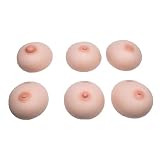
- Suitable for the teaching of physiology and in the teaching of anatomy in medicine schools, schools and health schools
- 6pcs/set Made of Silicone material, and practical, excellent and useful for long- lasting use
- Let you explain the knowledge in the books more concretely, which makes it easier for students to learn
- The human breast creative design, with flexible design to display, easy for teaching, great and nice
- Fine craftsmanship and exquisite details, make it and lifelike, excellent and educational
What do current evaluations aim to find out?
Comparison of commercial risk algorithms
An NCI-funded project listed for fiscal year 2025 plans an independent evaluation of four commercial mammography-based risk algorithms at seven U.S. screening facilities. It is designed to compare performance by race and ethnicity and to compare the AI algorithms with existing clinical risk-factor models. The project is an evaluation plan, not evidence that the algorithms have improved health outcomes.
AI-assisted interpretation of screening mammograms
A separate NCI-listed clinical trial, Artificial Intelligence Intervention for Improving Interpretation of Screening Mammography, compares 3D mammography interpretation with and without AI and tracks immediate measures as well as one-year outcomes. It was listed as active when accessed on October 3, 2026. This trial concerns AI-assisted interpretation of screening images; its existence should not be taken as proof that future-risk scoring improves outcomes.
Rank #4

- The breast lump training model is made of soft silicone material, close to the softness and hardness of the skin, without irritating chemical odor, and has a real touch
- There are a number of hypoechoic clusters of varying sizes inside the breast to simulate a lump, which can be used for fine needle puncture. The model can be washed and cleaned, and you can practice it repeatedly until you fully master this medical skill
- Design for medical students, doctors and medical staff in the breast lump training, is the most economical solution for breast lump basic skills training. Make it possible to practice repeatedly and become an expert in this field
- It can be detailed demonstration in science classes, biology classes, and anatomy classes, and also with a good assistant teaching and demonstration effects. Perfect for students and teachers
- This medical model is very suitable for the training and teaching needs of hospitals, medical schools, research centers, etc. It is a rare auxiliary tool for actual combat and provides you with relevant skills training exercises
Could an AI risk score change screening or prevention?
Potentially, a clinician could use a risk estimate as one input when discussing screening intensity or prevention. But that is a possible future application, not an established standard demonstrated by the evidence summarized here. The 2026 review calls for prospective evaluation, and the NCI-funded project is still assessing how commercial algorithms perform in screening populations.
What’s actually slowing this PC down?
Pick the symptom - the matching free tool is one click away.
Risk estimates describe patterns in groups, not a certain outcome for one person. NCI expert Ruth Pfeiffer, Ph.D., put it plainly: “Unfortunately, these models cannot predict the future with certainty for any one individual.” A lower score does not establish that screening can be skipped, and a higher score does not mean cancer is inevitable. Decisions about screening or preventive medication belong in a discussion with a healthcare provider, including consideration of recommendations and, for medication, possible side effects. NCI expert Peter Kraft, Ph.D., also cautions that “these estimates of risk do not guarantee a specific outcome.”
Best Value

- Realistic Simulation: Female lactation breast model features the appearance and softness similar to breasts during the lactation period, designed exclusively for simulating and learning breastfeeding massage techniques.
- Enhanced Experience: The human lactation model is connected to a syringe, simulating the effect of successful milk secretion through the correct breast massage techniques, providing more authentic feedback.
- Safe Materials: The breast lactation model is crafted from advanced silicone materials, aiding users in practicing breast massage techniques repeatedly. The product is latex-free to avoid allergy risks, making it safe for a broader range of users.
- Easy Product Maintenance: Silicone breast model is easy to clean with water and a cloth. We also provide talcum powder to maintain the model's softness and smoothness, prolonging its lifespan.
- A Valuable Training Tool: This Breast Simulating Model is an essential training tool that complements and enhances breastfeeding and childbirth educator courses. It is a must-have for breastfeeding mothers to learn and practice. Educators can effectively demonstrate key techniques such as manual expression, pumping, relieving blocked milk ducts, and performing breast self-exams using this model.
What should a patient ask about a risk estimate?
If a clinician discusses a mammography-based AI estimate, useful questions can clarify what the number does and does not mean:
- What time period does this estimate cover, and what kind of breast cancer outcome does the model predict?
- Does the result estimate my absolute chance of cancer, or does it place me in a relative risk category?
- Has this model been validated and calibrated in people like me and at facilities like this one?
- How does this result compare with risk estimates based on my health history and other clinical factors?
- Would the result change a recommended screening or prevention decision, and what evidence supports that change?
These questions separate a model’s statistical performance from whether using its output leads to a useful decision. The distinction is important because the 2026 review found limited calibration reporting and called for prospective work. NCI expert Pfeiffer has noted: “The more data we have, and the more representative those data are of the populations in which we would use a model, the better that model will perform.”
What would establish that the technology is useful?
Stronger evidence will require independent validation in broad screening populations, with transparent checks of calibration and subgroup performance. Prospective or pragmatic studies must then show whether using the estimates helps clinicians and patients choose screening or prevention strategies that improve outcomes without worsening inequities. The studies and evaluation plans described so far do not establish that AI-based future-risk assessment has improved mortality or patient outcomes.
Windows Errors? Fix Them Before They Spread
Repair common Windows errors and clear accumulated junk for a smoother, more stable PC - no reinstall needed.Free scan · no reinstallOutdated Drivers Are Slowing You Down
One free scan finds every outdated or missing driver and matches the right update for your exact hardware.Free scan · exact hardware matchQuick Recap
Product prices and availability are accurate as of the date/time indicated and are subject to change. Any price and availability information displayed on Amazon at the time of purchase will apply.

