What’s actually slowing this PC down?
Pick the symptom - the matching free tool is one click away.
If running or jumping causes pain, you can still build a useful bone-health program. Walking and stair climbing provide low-impact, weight-bearing loading; progressive resistance trains the muscles and bones; and balance and functional drills help reduce falls. The right combination depends on your fracture history, symptoms, balance, fitness and other medical conditions. Start at a comfortable level, progress gradually and obtain individual advice if pain, fractures or fall risk complicate exercise.
What to do when impact exercise hurts
Bone-health exercise is not limited to jogging, jumping or other high-impact activity. A practical program combines three components:
As an Amazon Associate I earn from qualifying purchases.
- Low-impact weight-bearing activity: walking and stair climbing load the legs while producing less impact than running or jumping.
- Progressive resistance: muscles work against body weight, elastic bands or weights, with the challenge increased over time.
- Balance and functional training: drills such as chair stands, heel raises and turning practice improve movement control and help reduce falls.
Osteoporosis Canada’s 2023 guideline recommends balance and functional training at least twice weekly and suggests progressive resistance training at least twice weekly. These recommendations were written for postmenopausal females and males aged 50 years and older in the guideline population; they are not a personal prescription for every adult.
Exercise supports bone health and physical function, but it does not replace osteoporosis medicine when medication is indicated. The Royal Osteoporosis Society states that exercise is not a substitute for prescribed treatment.
#1 Best Overall

- High End Exercise Bands. Our 12"³ By 2"³ Heavy Duty Loop Resistance Bands Come In 5 Varying Resistance Levels. This Makes Them Perfect Whether You Are Just Starting To Workout Or A Seasoned Workout Warrior. Our Extra Light And Light Bands Are Great For Beginners, While Our Medium, Heavy And Extra Heavy Exercise Bands Are Targeted For More Intermediate And Advanced Strength Training.
- Great With Any Workout. This Resistance Band Set Can Be Integrated Seamlessly With Various Popular Workout Program. Or Use Them For General Exercise, Stretching, Strength Training, Power Weight Programs. The Included Carry Bag Makes It Easy To Take Your Bands With You And Do Any Workout Away From Home Or Your Home Gym.
- Multiple Uses. While These Resistance Bands Are Often Used For Sports And Fitness, Physical Therapists Love These Physical Therapy Bands (Rehab Bands) To Help Them Rehabilitate Their Patients. Our Stretch Bands Work For People Suffering From Leg, Knee And Back Injuries. They Are Also Perfect For Use By Women After Pregnancy And Birth To Keep Their Bodies In Shape.
- Superior Quality. All Of Our Exercise Resistance Bands Are Thoroughly Tested Before We Ship Them Out To You. This Ensures Your Bands Are Easy On Skin And Will Provide You With A Worry Free Experience. The Instruction Booklet Includes Dozens Of Different Illustrated Exercises That Demonstrate How To Use Our Resistance Bands For Legs, Arms, Back, Shoulders, Ankles, Hips And Stomach.
- What You Get: Five Exercise Bands With Color-Coded Resistance Levels, Portable Travel Carry Bag And Instruction Guide.
Low-impact weight-bearing choices
Walking
Walking is the simplest low-impact weight-bearing option identified by the Royal Osteoporosis Society. Begin with a duration and pace that do not increase symptoms. You might start with several short walks on level ground, then add minutes, hills or a faster pace one change at a time. Supportive footwear, a clear route and a walking aid prescribed by a clinician can improve safety.
Walking is not automatically safe for every person. Pain that changes your gait, severe dizziness, a recent fracture or repeated falls calls for professional assessment before you increase distance or speed.
Stair climbing
Stair climbing adds more load than level walking while remaining a low-impact activity. Use a handrail, take one step at a time if needed and choose a number of flights you can complete without losing control. A low step or a single stair can be used for repeated step-ups, but the exercise should be stopped if the knee, hip, back or foot becomes painful.
Free tools Windows power users keep installed
One-click scans. No signup required.
Because stairs challenge balance as well as strength, they may be inappropriate without supervision for someone with frequent falls or marked unsteadiness. A physiotherapist can suggest a safer height, hand support and progression.
Rank #2

- 5 STACKABLE RESISTANCE LEVELS — Train with 10, 20, 30, 40 or 50 lb, or connect multiple tube resistance bands with handles for up to 150 lb. The 10 lb steps make it easy to adjust resistance for warmups, mobility, strength training and progressive workouts.
- MULTI FUNCTION & PORTABLE: Our resistance bands for working out can apply to different types exercise. Great for toning your arms,shoulders, chest, gluts, legs etc.Also comes with convenient travel pouch,You can take them outside, to the gym, wherever you want to work out
- HIGH QUALITY MATERIALS: Bands for working out is made of natural latex. Strong wear resistance and perfect elasticity, steel metal buckle for stronger strength, non-slip handle, comfortable and absorbent
- YOUR HOME GYM: Our work out bands includes 5 exercise bands, 1 door anchor, 2 cushioned handles, carrying case and user manual to allow you to perform the widest variety of resistance training exercises possible at home
- SUITABLE FOR DAILY USE: Each exercise bands set is carefully constructed to resist snapping and breaking, which are able to withstand intense daily exercise sessions.Now enjoy the exercise with WHATAFIT resistance bands set
How to progress without chasing impact
Progress one variable at a time: frequency, duration, pace, incline or number of steps. Keep the change modest and allow recovery. The goal is consistent, manageable loading rather than a maximal workout. If symptoms remain elevated after exercise or worsen from session to session, return to the last comfortable level and seek advice.
Progressive resistance exercises
Resistance training gives bones and muscles a repeated mechanical stimulus without requiring jumping. Osteoporosis Canada and the Royal Osteoporosis Society list body weight, elastic bands and external weights as valid resistance sources. Bands are optional; a well-chosen body-weight exercise can be effective when it is progressed appropriately.
Lower-body and hip exercises
- Chair stands: Sit on a firm chair and stand without using your hands if that is safe. Lower under control. Increase repetitions, reduce hand support or use a lower seat only when your form remains steady.
- Squats: Hinge at the hips and bend the knees to a comfortable depth while keeping the trunk controlled. Hold a support if balance is limited.
- Lunges: Step forward or backward into a short range, keeping the front knee aligned with the foot. Use a counter or rail for stability.
- Hip hinges: Move from the hips while keeping the back relatively straight. This pattern lets you train the hips and legs while limiting loaded spinal flexion.
- Bridges: From a comfortable lying position, lift the pelvis using the hips and buttocks. A clinician should modify this if getting on or off the floor is difficult.
Upper-body, trunk and back exercises
- Rows: Pull an elastic band or handle toward the ribs while keeping the shoulders controlled.
- Press movements: Press a band or weight forward or overhead only through a comfortable range and without arching or twisting the spine.
- Back-extensor work: Include suitable exercises for the muscles that support an upright trunk. A physiotherapist can select a version that matches fracture risk and symptoms.
- Abdominal exercises: Choose controlled trunk-stability work rather than repeated forceful sit-ups if spinal fracture risk is high.
Use a load that permits controlled repetitions and good alignment. When an exercise becomes easy, increase resistance, repetitions, range or sets gradually—not all at once. The guideline’s minimum frequency is twice weekly, with recovery between challenging sessions.
Balance and functional training to reduce falls
Balance work addresses a different pathway to fracture prevention: preventing falls. Osteoporosis Canada’s 2023 guideline recommends it at least twice weekly. The guideline’s evidence summary reports a rate ratio of 0.44 (95% confidence interval 0.25–0.76) for fall-related fractures with functional and balance training across seven studies involving 2,139 participants. The estimate is low certainty, so it should not be interpreted as a guaranteed reduction for an individual.
Rank #3

- 5 Level Resistance(3-20pounds): You will get a set of resistance bands including five colors, different colors represent different stretching forces. Each stretch strength (color) is suitable for different exercise levels and different exercise purposes. And unisex.
- Resistance Levels: Gym resistance bands come in 5 different resistance levels: Yellow Band (X-Light, 0.25mm), Red Band (Light, 0.3mm), Green Band (medium, 0.35mm), Blue Band (heavy, 0.4mm), Gray Band (X-heavy, 0.5mm).Five levels of workout bands, which can be easily switched at any time according to your preferences and needs.
- High-Quality Material: Open-ended Pilates flex bands is 59 inches(4.9FT) long and 6 inches wide, made of high-quality TPE material, latex-free, skin-friendly,odorless, smooth surface, safe and durable, can maintain long-term elasticity, not easy to break.
- Training And Rehabilitation: It is a high-quality Pilates elastic band product for resistance training and rehabilitation. It is ideal for Pilates, resistance training, physical therapy and mobility training. Simple and effective resistance bands can stretch and tone muscle groups and improve your posture.
- Suitable For People: Suitable for athletes, exercisers, the elderly, rehabilitation trainers, and the stretch bands can be used for physical therapy, rehabilitation, wrestling, bodybuilding, Pilates, yoga, etc. Simple but effective exercises will build strength and speed recovery.
Useful drills
- Heel raises: Rise onto the balls of the feet while holding a stable surface, then lower slowly.
- Supported one-leg stance: Stand near a counter, lightly touch it and lift one foot briefly. Increase time only while control is secure.
- Chair stands: This functional movement combines leg strength, balance and the ability to rise from a seat.
- Direction changes: Practice slow turns and stepping around a few clearly visible objects. Avoid sudden pivots.
- Stair-climbing practice: Rehearse stepping up and down with a rail before adding height or speed.
- Tai chi: Its slow, controlled weight shifts can be adapted to ability and performed with support when needed.
Keep a sturdy support within reach, remove loose rugs and perform balance drills when you are alert rather than fatigued. A supervised class or individual session may be safer for someone with a history of falls.
How common activities compare
| Activity | Impact and weight-bearing | Progressive resistance | Balance demand | Spinal considerations | When to modify or seek advice |
|---|---|---|---|---|---|
| Level walking | Low-impact, weight-bearing | Limited unless pace, incline or duration progresses | Low to moderate | Usually neutral if posture is comfortable | Painful gait, dizziness, recent fracture or repeated falls |
| Stair climbing or step-ups | Low-impact, higher leg loading than level walking | Can progress by step height, repetitions or support | Moderate to high | Stay upright; avoid twisting while stepping | Unsteady balance, severe knee or hip pain, unsafe environment |
| Chair stands or squats | Weight-bearing through the legs | Yes, using body weight, bands or weights | Moderate | Use a hip hinge and avoid loaded rounding | Unable to rise safely, acute pain or poor control |
| Rows and presses | Not primarily weight-bearing through the legs | Yes | Low to moderate, depending on stance | Keep the trunk controlled; avoid forceful twisting | Shoulder problems or pain with the selected range |
| Tai chi | Low-impact weight shifts | Limited direct resistance | Moderate to high | Use comfortable ranges; avoid extreme spinal positions | Frequent falls without support or difficulty following movements |
No source establishes a universal ranking of these options. Choose by impact level, ability to progress resistance, balance demands, spinal movement, comfort, access and your fracture and health history.
Spinal safety and movement modifications
People at high fracture risk—especially those with painful spinal fractures, multiple fractures or many falls—may need to limit rapid or repeated spinal bending and twisting, deep end-range positions and bending or twisting while carrying a load. This does not mean all movement is forbidden. It means the range, speed and load should be selected deliberately.
Use a hip hinge
A hip hinge bends at the hips while keeping the back relatively straight. It can replace rounding forward to pick up an object or to begin a lower-body exercise. Move slowly, keep the item close to the body and use a raised surface or assistance when necessary.
Rank #4

- 100% Natural Latex
- Package Included: 5 pull up bands, 1 carrying bag and 1 workout guide. Resistance bands are 5-15 lbs,15-35 lbs, 25-65 lbs, 35-85 lbs, 50-125 lbs. Use these exercise bands to perform rows, pulls, raises, and fly workout sets to exercise your arms, back, hips, legs, chest, and abdominal region
- Durable Natural Odorless: Pull up bands are made of 100% high-grade natural latex with double-layered tubing to ensure longer durability, These Resistance bands are Non-toxic, Odorless, Anti-slip, Our Exercise bands improve wear-resistant performance with long-lasting elasticity
- Versatile 5-piece fitness bands: Ideal for all fitness levels (beginners to enthusiasts), men & women. Perfect for home gyms, travel workouts, or hotel rooms—great for assisted pull-ups, chin-ups, cross-training, powerlifting, yoga, pilates. Easily pair with extra bands to match your fitness goals
- Boost Your Strength: We recommend that athletes use resistance bands together. Start your workout with the thin fitness band. Then switch to the thicker fitness band when you tire out. Effectively replace a range of over a dozen sets of dumbbells
Modify rather than force a position
Reduce range, slow the tempo, use a wall or chair, or choose a different exercise that trains the same muscles. Yoga and Pilates may be included when safe and modifiable, but Canadian guidance places them alongside—not instead of—balance, functional and resistance training. Avoid assuming that a class is safe simply because it is labelled gentle; tell the instructor about fractures and request osteoporosis-informed modifications.
Independent reader supportYour contribution helps us test, update, and keep practical guides available for everyone.Building a weekly routine
The following framework shows how the components can fit together without requiring running or jumping. It is an example for discussion with a clinician, not an individualized prescription.
- Choose two or more resistance sessions: Select a chair stand or squat, hip hinge, bridge, row and suitable press or trunk exercise. Use manageable resistance and rest between sessions.
- Add balance and functional work at least twice weekly: Include heel raises, supported one-leg stance, controlled turns and chair stands. Perform them near stable support.
- Accumulate low-impact aerobic activity: Walk or climb stairs at a comfortable level, using short bouts if needed. Increase total time gradually.
- Include recovery: Alternate harder and easier days, sleep adequately and stop increasing the workload if pain or fatigue persists.
- Review progress: Every few weeks, assess whether you can add a small amount of time, resistance, repetitions or balance challenge without loss of control.
For general U.S. adult activity guidance, the National Institute of Arthritis and Musculoskeletal and Skin Diseases reports 150 minutes (2.5 hours) of moderate-intensity activity per week or 75 minutes of vigorous activity, plus muscle-strengthening activity at least twice weekly. This is population-level guidance, not an osteoporosis-specific target or a requirement to exercise through pain. A lower starting volume may be appropriate when symptoms or medical conditions limit activity.
Quick wins for a faster PC:
Repair Windows errors before they cause bigger problemsFix Now →Scan for outdated or missing drivers - takes under a minuteDriver Scan →When to obtain individual guidance
Ask a doctor or physiotherapist for an assessment before progressing if you have a recent fracture, painful spinal fractures, multiple broken bones, many falls, substantial pain or another condition that interferes with exercise. An osteoporosis-informed exercise professional can help choose movements, set an initial intensity and progress the program.
Best Value
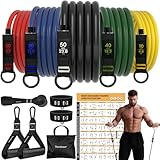
- What Are Included: 5 Tube Resistance Bands, 2 Handles, 2 Ankle Straps, 1 Door Anchor, 1 Exercise Instruction, 1 Carrying Bag.
- Adjustable Resistance Bands : Maximum equivalent of 150 lbs, come as a set of 5, 55-inch long colored exercise bands: Yellow(10 lbs), Red(20 lbs), Blue(30 lbs), Green(40 lbs), Black(50 lbs). 5 bands can be used alone or stacked in any combination of intensity from 10lbs to 150lbs.
- Premium Materials: Bands for working out is made of natural latex. Strong wear resistance and perfect elasticity. Non-slip handle,strong fabric and iron buckles to ensure maximum life and safety during use.
- Lightweight and Portable: It comes with a convenient carrying bag, You can take them outside, to the gym, wherever you want to work out. It is very convenient to carry and store.
- Multifunctional for Workout: Our Readaeer resistance band set is great with any workout like Yoga, Pilates and Fitness. Great for toning your arms,shoulders, chest, gluts, legs etc.
Bring a list of current activities, the movements that hurt, fracture history and any fall episodes. Ask specifically how to lift from the floor, turn, use stairs, carry objects and modify exercises that involve spinal flexion or rotation.
Stop signs and urgent symptoms
Stop exercising and seek appropriate medical care for concerning symptoms. The Royal Osteoporosis Society lists pain, dizziness, severe shortness of breath, chest tightness, nausea and clamminess as reasons to stop. Sudden severe pain, a new inability to bear weight, a suspected fracture or neurological symptoms warrants prompt medical evaluation rather than attempting another exercise variation.
Ordinary effort and mild, short-lived muscle fatigue are different from escalating joint or bone pain. Do not use pain medication to mask symptoms so that you can continue increasing a workout without advice.
What exercise can—and cannot—do for bone health
Regular, appropriately loaded activity can improve strength, balance, function and confidence, and it may support bone health. The evidence does not justify promising that one exercise prevents or treats osteoporosis, nor does it show that everyone needs high-impact training. The Royal Osteoporosis Society states, “High-impact exercise is not specifically recommended for osteoporosis,” and notes insufficient evidence that high-impact exercise adds benefit over moderate impact. That statement does not mean every impact activity is unsafe; suitability depends on the person and the clinical context.
Continue prescribed osteoporosis medication and other medical care. Exercise is one part of fracture-risk management, alongside diagnosis, medication when indicated, nutrition, vision and home-safety measures.
Quick Recap
Product prices and availability are accurate as of the date/time indicated and are subject to change. Any price and availability information displayed on Amazon at the time of purchase will apply.

