Choose the Lenovo Yoga Pro 9i Gen 11 if your work depends on Windows, NVIDIA CUDA/RTX acceleration, a touch or pen interface, or a larger 16-inch canvas. Choose the 14-inch MacBook Pro with M5 if your applications run well on macOS and you prioritize a compact body, quiet mobile editing and long unplugged sessions.
This is not a like-for-like size comparison: the current Yoga Pro 9i Gen 11 Aura Edition is a 16-inch laptop, while the MacBook Pro is a 14.2-inch model. The exact Yoga SKU also matters because RTX 5060, RTX 5070, display and memory options change the result substantially.
As an Amazon Associate I earn from qualifying purchases.
Quick verdict
| Priority | Better fit | Why |
|---|---|---|
| Windows-only creative software | Yoga Pro 9i Gen 11 | Runs Windows applications directly and offers NVIDIA RTX graphics. |
| CUDA, GPU rendering or local AI | Yoga Pro 9i Gen 11 | RTX 5060 or RTX 5070 options provide CUDA, OptiX and dedicated video memory. |
| macOS software and Apple media workflows | MacBook Pro 14 M5 | Uses Apple’s integrated M5 platform and macOS application ecosystem. |
| Largest editing timeline or canvas | Yoga Pro 9i Gen 11 | Its 16-inch screen gives more physical workspace than a 14.2-inch panel. |
| Travel and battery endurance | MacBook Pro 14 M5 | Independent testing measured 18 hours in a Tom’s Guide battery lab. |
| Touch or pen interaction | Yoga Pro 9i Gen 11 | Selected configurations include a 120Hz OLED touchscreen. |
| HDR display quality | Depends on configuration | Yoga’s optional tandem OLED reaches higher stated peak brightness; Apple’s XDR panel has a mature HDR workflow. |
There is no independent, directly comparable Gen 11-versus-MacBook application benchmark in the available evidence, so neither machine can be declared universally faster. Match the computer to the software, GPU API and working style that matter to you.
What each laptop actually is
Yoga Pro 9i Gen 11: a 16-inch Windows creator machine
Lenovo’s current Gen 11 Aura Edition documentation describes a 16-inch system built around Intel Core Ultra processors and optional NVIDIA laptop graphics. An Australian configuration pairs a Core Ultra 9 386H processor with an RTX 5060 containing 8GB of GDDR7 memory, 32GB of LPDDR5X-7467 memory and a 1TB PCIe Gen 4 SSD. That configuration also lists a 92.5Wh battery, a 5MP camera and a 16-inch 2.8K 120Hz OLED touchscreen.
#1 Best Overall

- Processor - Intel Ultra 9 285H Processor (E-cores up to 4.50 GHz P-cores up to 5.40 GHz)
- Operating System - Windows 11 Pro 64
- Graphic Card - NVIDIA GeForce RTX 5060 Laptop GPU 8GB GDDR7
- Memory - 32 GB LPDDR5X-8400MT/s (Soldered)
- Storage - 1 TB SSD M.2 2242 PCIe Gen4 TLC
Lenovo’s US family specifications list optional Core Ultra 9 processors, RTX 5070, RTX 5060 or RTX 5050 graphics, up to 64GB of soldered LPDDR5X memory and up to 2TB of storage. Those are family limits, not a guarantee that every retailer or country sells every combination. Verify the individual SKU before ordering.
MacBook Pro 14 M5: a 14.2-inch Apple-silicon workstation
The 14-inch MacBook Pro uses Apple’s M5 architecture rather than a separate NVIDIA graphics card. Apple’s technical specifications describe a 10-core M5 CPU, a 16-core Neural Engine and a 14.2-inch 3024×1964 Liquid Retina XDR display with 254 pixels per inch and up to 120Hz ProMotion. Apple’s published test configuration uses 24GB of unified memory and a 1TB SSD, while retail configurations vary.
Apple says the M5 delivers up to 1.6 times the graphics performance of M4 in professional applications. That is Apple’s own generation-over-generation claim, not an independent head-to-head test against the Yoga. Tom’s Hardware recorded 4,288 Geekbench 6 single-core points for its M5 review unit, approximately 10 percent above its M4 result; the score applies to that tested configuration and workload.
GPU acceleration: RTX and CUDA versus the M5 GPU
Why the Yoga is the safer choice for CUDA workloads
An RTX-equipped Yoga provides a discrete NVIDIA GPU with its own high-speed memory. CUDA and OptiX support can be decisive in applications that use NVIDIA-specific renderers, AI frameworks, GPU effects or 3D viewport acceleration. A creator using Blender’s CUDA or OptiX paths, a Windows AI tool that requires NVIDIA drivers, or an effects plug-in certified for RTX avoids the compatibility compromises that come with an integrated-only platform.
Choose the graphics option deliberately. The RTX 5070 is the higher tier listed for the family, while the RTX 5060 configuration documented by Lenovo has 8GB of GDDR7. The RTX 5050 is also listed in the US specifications. More GPU capability generally raises price, power draw and heat, so buying the highest tier only makes sense when your software can use it.
What the M5 platform does well
The M5 combines CPU, GPU and system memory in one unified architecture. That design can be very efficient for applications optimized for Apple silicon, and it avoids the fan noise and power draw of a separate high-wattage graphics card during lighter work. Apple’s media software and many macOS creative applications are designed around this architecture.
The limitation is categorical rather than merely numerical: there is no NVIDIA discrete GPU in the 14-inch M5 model. If your render engine, plug-in or AI package requires CUDA, an Apple GPU cannot substitute for it. Check the developer’s macOS and Apple-silicon support before assuming a Windows RTX workflow will transfer unchanged.
Displays and color work
| Specification | Yoga Pro 9i Gen 11 | MacBook Pro 14 M5 |
|---|---|---|
| Physical size | 16 inches | 14.2 inches |
| Panel technology | OLED; optional 3.2K tandem OLED | Liquid Retina XDR |
| Resolution | 2.8K in the documented Australian configuration; 3.2K option listed in US specifications | 3024×1964 |
| Refresh rate | 120Hz | Up to 120Hz ProMotion |
| HDR brightness | Optional tandem OLED rated up to 1,600 nits HDR | XDR HDR capability; the cited specification does not provide a single peak-brightness figure for every 14-inch M5 configuration |
| SDR brightness | Optional tandem OLED rated at 1,000 nits SDR | Not stated in the cited specification |
| Color coverage | Optional panel rated at 100% sRGB and P3, 99% Adobe RGB | Apple specifies the XDR panel and wide color support; an equivalent Adobe RGB percentage is not stated |
| Color accuracy | Optional panel rated Delta E<1 | No comparable Delta E figure stated |
| Touch and pen | Available on documented OLED touchscreen configurations | No touch or pen input |
When the Yoga display is the advantage
The 16-inch panel gives a video editor more room for a timeline, scopes and a preview without shrinking every panel. The optional 3.2K tandem OLED is the stronger specification on paper for bright HDR work: Lenovo rates it up to 1,600 nits HDR, 1,000 nits SDR, 100 percent sRGB and P3, 99 percent Adobe RGB and Delta E below 1. A touchscreen can also be useful for mask adjustments, storyboard work or pen-based retouching.
Those figures apply only to the optional panel. A 2.8K OLED configuration may have different brightness and color characteristics, so confirm the exact display part number rather than relying on the Yoga family name.
Rank #2

- Flagship Processor >>> Intel Core Ultra 9 285H, 16C (6P + 8E + 2LPE) / 16T, Max Turbo up to 5.4GHz, 24MB Intel Smart Cache. Work, game, create and get the best AI PC experiences. It’s all possible on the Intel Core Ultra processors. The ultimate balance of performance, battery life and security let you do more with ease without sacrificing mobility and peace of mind.
- Built for Creators. Designed to Inspire >>> NVIDIA GeForce RTX 5060 8GB GDDR7, Powered by NVIDIA Blackwell, GeForce RTX 50 Series Laptop GPUs bring game-changing AI capabilities to gamers and creators. Multiply performance with NVIDIA DLSS 4, generate images at unprecedented speed, and unleash your creativity with NVIDIA Studio.
- Your Canvas, Brighter and Truer Than Ever >>> Witness your creations on the 16" 3.2K Tandem OLED screen, offering true-to-life color accuracy, HDR visuals with 1000 nits peak brightness, and energy efficiency. The 120Hz refresh rate ensures smooth motion, bringing your ideas to life effortlessly.
- Unleash the Power of X >>> Lenovo X Power optimizes performance for 3D projects, edits, and multitasking. With ultra-fast RAM and biomimetic cooling achieving 130W TDP, it ensures faster, smoother workflows. Whatever you’re working on, it ensures effortless execution.
- Memory & Storage >>> 32GB Soldered LPDDR5X-8400, Upgraded to 2TB SSD M.2 2242 PCIe NVMe. Get up to 15x faster performance than a traditional hard drive. Give you a long-lasting and smooth experience, both system boot up and application start are very fast.
When the MacBook display is the advantage
The MacBook’s 3024×1964 XDR panel is smaller but very dense and color-focused, with 120Hz ProMotion for smooth scrolling and timeline playback. Its 14.2-inch footprint is easier to fit on an airplane tray or a small desk. It is not touch-enabled, so direct manipulation and pen work require a trackpad, mouse or external tablet.
For color-critical delivery, calibrate either laptop and use the correct application color-management settings. A panel’s advertised gamut does not by itself guarantee that a particular unit, operating-system profile or application is configured correctly.
What’s actually slowing this PC down?
Pick the symptom - the matching free tool is one click away.
Video editing, 3D and AI: which workflow wins?
Video editing
The Yoga’s combination of a larger screen and RTX graphics is attractive for editors who use GPU-heavy effects, multiple 4K streams, AI denoising or codecs supported by NVIDIA acceleration. The 16-inch canvas reduces the need for an external monitor while traveling. It also leaves more headroom for Windows-only plug-ins and capture utilities.
The MacBook is compelling when your editor is macOS-compatible and your priority is a quiet, mobile system that can run for a long time away from an outlet. Apple’s hardware media engines and optimized applications can make everyday cutting, transcoding and color work efficient, but the available evidence does not establish a direct Gen 11-versus-M5 export-time winner. Test your own codec, effects stack and proxy settings before a production purchase.
3D rendering and local AI
For Blender, Unreal, CUDA renderers, Stable Diffusion packages that require NVIDIA, or other RTX-accelerated tools, select the Yoga with RTX 5060 or RTX 5070. The discrete GPU is the deciding feature, not merely the processor brand.
The M5 can be a good choice for Apple-silicon-native 3D and machine-learning applications, especially when they use Apple’s GPU or Neural Engine APIs. It cannot provide CUDA compatibility, so confirm that every plug-in, model and renderer has a supported macOS path.
Quick wins for a faster PC:
Fix the driver behind crashes, sound loss and screen glitchesFind Drivers →Repair Windows errors before they cause bigger problemsFix Now →Scan for outdated or missing drivers - takes under a minuteDriver Scan →Photoshop, Lightroom and 2D design
Both platforms have enough memory and display quality for serious photo work when configured appropriately. The Yoga offers touch input, a larger working area and optional Adobe RGB coverage that is explicitly rated at 99 percent on the 3.2K tandem OLED. Those are meaningful benefits for retouching, illustration and clients who expect a Windows workflow.
The MacBook’s XDR display, high pixel density and broad macOS software support suit photographers who already organize their libraries and plug-ins on Apple devices. The 14.2-inch screen is less spacious for side-by-side panels, so an external display may be useful for long sessions. In either case, keep the working color space, monitor profile and export profile consistent; neither laptop can correct an unmanaged workflow.
Battery life and sustained performance
What is known about the MacBook
Tom’s Guide measured 18 hours for the 14-inch M5 in its battery-life laboratory test. Brightness, workload, browser tabs, wireless activity and the exact configuration affect the result, so treat 18 hours as a test outcome rather than a guaranteed runtime. Tom’s Hardware’s 4,288 Geekbench 6 single-core result is likewise a controlled measurement, not a promise for every application.
Rank #3
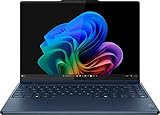
- UNOPENED RETAIL PACKAGING, sold as configured by Lenovo. Includes one year of Courier or Carry-in Lenovo Warranty. Add up to 4 years Lenovo Premium Care Onsite Plus when you register your computer with Lenovo.
- Powered by the high performing Intel Core Ultra 7 258V processor, the Yoga 9i 2-in-1 laptop is ready to take on any challenge, big or small. It unlocks maximum performance and creative efficiency, it has plenty of memory with 32 GB and even more storage with 1 TB.
- The 14″ 4K OLED touchscreen display brings sharp clarity and bold colors, with 100% DCI-P3 for spot-on color accuracy. With the Anti-fingerprint WQUXGA high resolution OLED touchscreen and up to 600 nits of brightness.
- Ports: 1x USB-A (USB 10Gbps / USB 3.2 Gen 2), Always On; 1x USB-C (USB 20Gbps / USB4 Gen 2x2), with USB PD 3.0 and DisplayPort 1.4; 2x USB-C (Thunderbolt 4 / USB4 40Gbps), with USB PD 3.0 and DisplayPort 2.1; and 1x Headphone / microphone combo jack (3.5mm).
- The Yoga Pen, with tilt and pressure detection, low latency, and magnetic attachment to the lid, extends your flexibility, offering precise control and smooth drawing.
What is known about the Yoga
Lenovo lists a 92.5Wh battery for the documented Australian Core Ultra 9/RTX 5060 configuration. A large battery does not translate directly into a comparable number of hours: a discrete GPU, OLED brightness, refresh rate and sustained rendering load can change consumption dramatically. The available review material does not provide a directly comparable Gen 11 battery test against the 14-inch M5, so do not infer a winner from battery capacity alone.
Free tools Windows power users keep installed
One-click scans. No signup required.
For long unplugged editing, the MacBook has the stronger independent evidence. For sustained GPU-heavy work, the Yoga’s performance advantage may justify carrying its charger; expect higher power draw when the RTX GPU is active.
Independent reader supportYour contribution helps us test, update, and keep practical guides available for everyone.Memory and storage configurations
| Item | Yoga Pro 9i Gen 11 | MacBook Pro 14 M5 |
|---|---|---|
| Documented review-style configuration | 32GB LPDDR5X-7467, 1TB PCIe Gen 4 SSD | 24GB unified memory, 1TB SSD in Apple’s official test configuration |
| Family maximum listed | Up to 64GB soldered LPDDR5X and up to 2TB storage | Retail memory and storage combinations vary by model |
| Upgradeability | Memory is soldered; verify capacity before purchase | Memory and internal storage are not presented as user-upgradeable components |
| Best practice for creators | Choose 32GB or more for large projects, 3D and virtual machines | Choose enough unified memory for your largest libraries, effects and applications because later expansion is not a normal upgrade path |
Video editors with large source caches, photographers holding many high-resolution files open and 3D artists working with heavy scenes should avoid buying the minimum memory configuration merely to reduce the initial price. External SSDs can expand project storage on either platform, but they do not replace fast local scratch space for every application.
Operating system and application compatibility
Choose Windows and the Yoga when
- Your employer or clients require Windows-specific applications, plug-ins, fonts, drivers or asset-management tools.
- Your workflow depends on CUDA, OptiX, NVIDIA broadcast features or RTX-only AI software.
- You need a touchscreen, pen input or Windows tablet and monitor utilities.
- You want to run local virtual machines or development tools that are validated for x86 Windows and NVIDIA hardware.
Choose macOS and the MacBook when
- Your editor, audio tools and plug-ins are fully supported on Apple silicon and macOS.
- You value a compact 14-inch body, low-friction sleep and wake behavior, and long mobile sessions.
- Your existing workflow uses Apple media libraries, synchronization and color-managed applications.
- You do not need CUDA or an NVIDIA-specific renderer.
Check every mission-critical application’s current system requirements, plug-in architecture and license rules. A software title may run through translation while a particular extension, driver or hardware interface does not.
Ports, camera and audio
The Yoga configuration cited by Lenovo includes a 5MP camera, useful for production meetings and creator calls where image detail matters. Port selection can vary by SKU, so inspect the retailer’s port diagram before ordering, especially if you need full-size HDMI, USB-A, an SD reader or high-speed external storage.
Crashes, No Sound, or Screen Glitches?
Random freezes, missing sound and display glitches usually trace back to one bad driver. Find and replace yours safely.Free scan · under a minuteWindows Errors? Fix Them Before They Spread
Repair common Windows errors and clear accumulated junk for a smoother, more stable PC - no reinstall needed.Free scan · no reinstallApple’s 14-inch design family includes MagSafe 3, HDMI, SDXC and a headphone jack, with three Thunderbolt-class ports depending on the exact model. Verify the chip tier and port count for the specific M5 configuration: the phrase “14-inch MacBook Pro” covers more than one port arrangement. Both laptops can drive external displays and storage, but adapters may be required for a particular camera, card reader or dock.
Price and configuration strategy
Current prices and stock vary by country, retailer and promotion, and no single global price is reliable for this comparison. Compare complete configurations rather than starting prices: an RTX 5070 Yoga with a 3.2K tandem OLED is a different product proposition from an RTX 5060 model with the 2.8K panel, just as a MacBook with more unified memory is different from Apple’s 24GB test configuration.
- Write down the applications, plug-ins, codecs and render engines you use most.
- Mark any requirement for Windows, CUDA, NVIDIA drivers, touch or pen input.
- Choose the Yoga GPU tier and display only after checking those requirements.
- For the MacBook, select unified memory and storage for the largest project you expect to keep local.
- Compare the full local price, warranty, charger and required adapters in your country.
- Confirm the exact CPU, GPU, panel, memory, SSD, camera and port list on the seller’s SKU page.
Which creator should buy which laptop?
Buy the Yoga Pro 9i Gen 11 when
- You need Windows or NVIDIA CUDA/RTX acceleration.
- Your 3D, AI or effects work benefits from dedicated GPU memory.
- A 16-inch timeline, OLED touchscreen or pen workflow improves your day.
- You can accept carrying a charger for demanding work and want the option of up to 64GB memory and 2TB storage in the family.
Buy the MacBook Pro 14 M5 when
- Your complete application stack is macOS-compatible.
- You prioritize a smaller travel footprint and the best independently measured battery result in this comparison.
- You prefer Apple’s integrated CPU/GPU/Neural Engine design and media-software ecosystem.
- You do not require CUDA, NVIDIA-only plug-ins or a touch display.
Bottom line
The Lenovo Yoga Pro 9i Gen 11 is the more flexible creator workstation when Windows compatibility, RTX acceleration, touch input or a large 16-inch canvas is the deciding factor. The 14-inch MacBook Pro M5 is the better mobile choice for macOS-based creators who value efficiency, a compact body and long unplugged sessions. Neither is automatically better for every editor: verify the exact Yoga GPU and panel, the MacBook memory tier and your software’s platform support before paying.
Quick Recap
Product prices and availability are accurate as of the date/time indicated and are subject to change. Any price and availability information displayed on Amazon at the time of purchase will apply.
Do these 3 things before closing this tab:
1Repair Windows errors before they cause bigger problems2Scan for outdated or missing drivers - takes under a minute3Clear out junk files and repair common Windows errors
