Quick wins for a faster PC:
Repair Windows errors before they cause bigger problemsFix Now →Fix the driver behind crashes, sound loss and screen glitchesFind Drivers →The Kawasaki CP110L is a four-axis articulated palletizing robot with a 110 kg maximum payload and 2,505 mm maximum reach. Kawasaki Heavy Industries launched it globally on February 16, 2026. Kawasaki Robotics (USA) has scheduled its North American debut for PACK EXPO International 2026 in Chicago, October 18–21, at booth N-5933 in McCormick Place. The company’s announcement is dated October 8, 2026, so the debut is a scheduled trade-show event, not a completed one. Kawasaki has not published a separate order date, price, or shipping date for North America in the materials it has released.
What the CP110L is
The CP110L is a palletizing robot aimed at packaging, consumer packaged goods, and end-of-line automation. Palletizing means loading products or goods onto pallets for transport, and Kawasaki’s launch release uses that definition. The robot’s main selling points, according to Kawasaki, are a compact body, a hollow wrist, and fast palletizing performance. The company says the compact design addresses constrained installation space, and that the hollow wrist improves cable routing and tool flexibility. Those are manufacturer claims, not independent findings.

As an Amazon Associate I earn from qualifying purchases.
Key specifications
The figures below come from Kawasaki’s official specification and its launch and installation materials. Each one should be checked against the load diagrams and drawings the supplier provides for a real cell design.
| Attribute | Kawasaki-stated value | What it means in practice |
|---|---|---|
| Type and axes | Articulated, four axes | Floor-mounted on the Kawasaki Robotics product page |
| Maximum payload | 110 kg | A robot rating, not a guarantee at every pose or speed. Tool weight counts against it. |
| Maximum reach | 2,505 mm | The farthest point, not usable reach in every direction. Kawasaki’s brochure includes motion and working-range diagrams. |
| Positional repeatability | ±0.05 mm | Stated in Kawasaki’s specification; the press release says it conforms to ISO 9283 for the cited specification |
| Robot mass | 820 kg | Relevant to floor loading and installation planning |
| Required ceiling height to maximum reach point | 2,242 mm | Kawasaki’s figure; the company attributes the claim of the smallest value in the 110 kg palletizing class to itself |
| Revolute-axis interference radius | 453 mm | Kawasaki’s figure; use it to check clearance around neighbouring equipment |
Payload includes the gripper
The 110 kg figure is the robot’s maximum payload. The load that matters for a cell is the product plus the gripper, hoses, brackets, and any other wrist-mounted hardware. Kawasaki’s throughput example counts the hand weight within its 60 kg transfer load, so any calculation you make should do the same.
Repeatability is not package placement accuracy
A ±0.05 mm repeatability figure describes how consistently the robot returns to a commanded position. It does not describe the accuracy of finished pallet patterns. Gripper fit, conveyor timing, fixtures, vision, and calibration all affect where a product lands on the pallet, and Kawasaki does not quantify those effects in the materials it has released.
The 2,200 cases per hour figure
Kawasaki reports 2,200 cases per hour for one specific motion pattern. The conditions are:
- Transfer load of 60 kg, including hand weight
- Reciprocal motion with a 400 mm rise
- 2,000 mm horizontal travel
- 400 mm descent
This is a manufacturer-stated figure under those conditions. It is not an independently validated customer production rate, and it is not an unconditional line speed. A plant’s real rate depends on carton size, pallet pattern, gripper behaviour, acceleration and settling, and how many shifts the cell runs. Ask Kawasaki or an integrator for the cycle assumptions behind any rate you plan around, and avoid comparing the figure with other robots unless the load, tool, travel path, and cycle assumptions match.
Do these 3 things before closing this tab:
1Repair Windows errors before they cause bigger problems2Scan for outdated or missing drivers - takes under a minute3Clear out junk files and repair common Windows errorsWhat the North American debut covers
Kawasaki Robotics (USA) announced the North American debut on October 8, 2026. Its release states:
“The CP110L palletizing robot demonstrates flexible product handling with a single custom Piab end-of-arm tool, seamlessly palletizing both boxed dog food and bagged cat food without changing tooling or cell footprint.”
That sentence describes the planned demonstration. It is company language, not an independent test. Kawasaki does not name the Piab tool model in the release, and it does not publish the full cell design, cycle conditions, package dimensions, pallet pattern, or safety-cell details for the demo. The demo is a useful example of handling two different package types with one tool, but it does not establish that the tool handles all bags or cases. Expect the actual performance of a given product to depend on its own packaging.
Rank #4
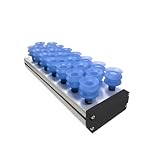
- Vacuum suction cup
- [Application]: Suitable for handling workpieces of various sizes shapes materials and surfaces
- [Material]: Constructed with premium sponge for enhanced elasticity and wear resistance; replaceable individually; filter mesh available
- [Features]: Housing constructed from premium aluminum alloy; compatible with external vacuum generators or blowers
- [Advantages]: High strength lightweight design; gripping capability accommodates diverse product specifications
Lineup and model choice
Kawasaki’s launch announcement lists CP series models at 110, 180, 300, 500, and 700 kg payloads. Its broader palletizing brochure, dated February 2026, also includes an 80 kg RD080N. The cited materials give full specifications only for the CP110L, so other models should be compared directly with Kawasaki’s data sheets.
| Model | Payload stated by Kawasaki | Reach, mass, and envelope |
|---|---|---|
| CP110L | 110 kg | 2,505 mm reach, 820 kg mass, 2,242 mm ceiling height to maximum reach point (Kawasaki-stated) |
| CP series, 180 kg | 180 kg | Not stated in the cited materials |
| CP series, 300 kg | 300 kg | Not stated in the cited materials |
| CP series, 500 kg | 500 kg | Not stated in the cited materials |
| CP series, 700 kg | 700 kg | Not stated in the cited materials |
| RD080N (palletizing brochure, February 2026) | 80 kg | Not stated in the cited materials |
Nominal payload is a poor basis for choosing a model on its own. Match the model against the actual product-plus-tool load, the reach your pallet positions require, and the space you have.
Best Value
- Pneumatic Mufflers
- [Application]: Suitable for handling workpieces of various sizes shapes materials and surfaces
- [Material]: Constructed with premium sponge for enhanced elasticity and wear resistance; replaceable individually; filter mesh available
- [Features]: Housing constructed from premium aluminum alloy; compatible with external vacuum generators or blowers
- [Advantages]: High strength lightweight design; gripping capability accommodates diverse product specifications
Questions to answer before you compare or buy
A fair comparison between the CP110L and another robot, or between a robot and a manual or automated palletizing cell, should cover the following:
- Actual load: product, gripper, hoses, brackets, and any other wrist hardware, measured together.
- Reach and geometry: pallet dimensions, conveyor position, stack height, approach and departure paths, and which poses the robot can reach with the load.
- Space: floor footprint, ceiling clearance, arm and wrist interference, maintenance access, and infeed and outfeed layout.
- Cycle definition: product orientation, stacking pattern, transfer distances, acceleration, settling time, and the rate needed across a full shift.
- Tooling: gripper type and model, package materials, bag stability, carton dimensions, tool-change requirements, and how cables and hoses route through the hollow wrist.
- Cell engineering: controller, power, guarding, safety functions, controls integration, commissioning, operator training, and service support.
- Integration cost: the robot price is only one part of a cell. Kawasaki has not published pricing for North America in the materials it has released.
Safety functions
Kawasaki’s brochure lists Cubic-S as an optional safety monitoring function for the CP and RD palletizing family. Confirm regional availability and configuration with Kawasaki and your integrator. A robot-level safety function does not, by itself, make a complete palletizing cell safe; guarding and the application-level risk assessment still need to be designed for the specific installation.
Documentation and where to find it
Kawasaki’s EMEA product page lists CAD files in STEP and DXF formats, specifications, and manuals for download. Regional page availability and documentation may differ, so check the North American channel for the files that apply to your region.
Free tools Windows power users keep installed
One-click scans. No signup required.
What is and is not established
- The core performance and comparison claims come from Kawasaki. No independent performance test, customer deployment study, or third-party competitive test is cited in the materials available as of October 9, 2026.
- The North American debut is scheduled for October 18–21, 2026. The announcement does not establish a commercial shipping date, a price, or general order availability in North America.
- The CP110L’s “industry-leading” and “first” descriptions are Kawasaki’s own. Treat them as claims to verify against the specifications rather than as established rankings.
Sources
- Kawasaki Heavy Industries: CP110L launch announcement, February 16, 2026
- Kawasaki Robotics: CP110L product page
- Kawasaki Robotics (USA) via PR Newswire: North American debut announcement, October 8, 2026
- Kawasaki Robotics: February 2026 palletizing brochure
Kawasaki’s own figures are reported here as the company’s claims. Verify them against the load diagrams, drawings, and cycle assumptions from Kawasaki or a qualified integrator before planning a cell around them.
Quick Recap
Product prices and availability are accurate as of the date/time indicated and are subject to change. Any price and availability information displayed on Amazon at the time of purchase will apply.

