Short answer: a desktop Bitcoin miner can be a worthwhile founder experiment, but not a dependable income product. A Bitaxe Gamma 601 produces roughly 1.1–1.2 TH/s while drawing about 17 W. Under the electricity and Bitcoin assumptions used by Bitaxe.de, that works out to about 51 satoshis of average revenue per day (just under four U.S. cents) against roughly 12 euro cents of electricity, before pool fees, hardware, shipping, taxes or downtime. The often-repeated “$50 miner” price is also configuration-dependent: current examples include a US$120 1.2T/18W unit, a US$131 quiet version and a retail listing around €139.
That makes the device a high-variance bet on learning, sovereignty, open hardware, experimentation, heat reuse or surplus solar power. It is not a rational purchase if your only objective is buying grid electricity, mining Bitcoin and receiving a predictable profit.
As an Amazon Associate I earn from qualifying purchases.
What the “$50 Bitcoin miner” actually buys
“$50” is not a stable specification for a complete, ready-to-run Bitaxe. It can describe a kit, a used board, a different model, a temporary listing or a bundle that excludes the power supply and cooling parts. The exact board revision, ASIC, heatsink, fan, display, case and shipping destination all change the final cost.
The Tool Desk
Outbyte Driver Updater FREEFix the driver behind crashes, sound loss and screen glitchesFind Drivers →Outbyte PC Repair FREERepair Windows errors before they cause bigger problemsFix Now →| Reference | Configuration and date | Published price | What to check |
|---|---|---|---|
| Supplier price list | Bitaxe Gamma 601, 1.2 TH/s/18 W; dated 8 October 2025 | US$120 | Whether the listing includes a heatsink, fan, controller, case and power supply |
| Supplier price list | Quiet Bitaxe Gamma 601 version; dated 8 October 2025 | US$131 | What “quiet” changes and whether a suitably rated supply is included |
| Retail comparison | Bitaxe Gamma 601; current page accessed in 2026 | About €139 | Regional tax, shipping, stock and the exact hashrate/power configuration |
| Low-price listings | Unspecified kit, used unit or incomplete bundle | May be near US$50 | Missing electronics, cooling, firmware, warranty or power adapter |
Before comparing any listing, ask for the model name, advertised hashrate, wattage at the wall, included cooler, connector, firmware status and whether the power supply is part of the package. A low sticker price that requires another purchase can cost more than a correctly bundled unit.
#1 Best Overall

- High Efficiency Mining:Bitaxe Gamma 602 equipped with BM1370 chip delivers 1.8TH/s hash rate with only 35W power consumption, energy-saving and low heat. Perfect for beginners, blockchain enthusiasts, or anyone looking to experience solo mining without heavy electricity bills.
- Ultra Quiet & Desktop Friendly:Compact design, low noise operation, perfect for home and office use without disturbing noise.
- WiFi & Web Control:Built-in WiFi management, easy configuration via web browser, real-time hash rate, temperature and status monitoring.
- Open Source & Fully Customizable:Community-driven open source firmware, supports self-tuning and updates, ideal for tech enthusiasts and DIY miners.
- Complete Assembly Ready to Use:Pre-assembled miner with heat dissipation system, just plug in, connect to network and start mining.
How much can a Bitaxe Gamma 601 earn?
The representative Gamma 601 is rated at about 1.1–1.2 TH/s and approximately 17 W in current comparison data. Bitaxe.de’s operating example estimates an average of about 51 satoshis per day. At the Bitcoin price used in that calculation, that is just under four cents per day. The estimate is not a guaranteed payout: Bitcoin difficulty, Bitcoin’s exchange value, pool luck, uptime and fees all move the result.
Electricity is the first cost to calculate. A continuously running 17 W device uses 0.408 kWh per day (17 W × 24 hours). At €0.30 per kWh, the cited tariff, that costs about €0.12 per day. The operating result is therefore negative before the purchase price, pool fees, shipping, tax, replacement fans and downtime are counted.
Rank #2

- ⚡ Efficient Home ASIC Miner – Up to 1.1 TH/s hashrate with just 18W power consumption (15 J/TH), perfect for home or small office use.
- 🇪🇺 Made in Europe – Designed and manufactured in Europe with premium components for reliability and long-term performance.
- 🔧 BM1370 ASIC Chip (Antminer S21 Pro) – Same chip used in the Antminer S21 Pro for professional-grade mining power in a compact, open-source form.
- 📡 Wi-Fi & USB-C Connectivity – No monitor or keyboard required – configure and monitor easily via web interface
- 🎁 Complete Kit Included – Delivered fully assembled with EU/UK/US 5V 6A power supply, premium fan, 3D-printed stand, and OLED display.
| Item | Gamma example | Qualification |
|---|---|---|
| Hashrate | About 1.1–1.2 TH/s | Representative current-comparison figure; actual performance depends on model, tuning and temperature |
| Power draw | About 17 W | Use your wall-meter reading for your own supply and settings |
| Average mining revenue | About 51 satoshis/day | Bitaxe.de calculation using its cited 26 September 2026 Bitcoin-price and difficulty assumptions |
| Value in that example | Just under US$0.04/day | Value changes with the Bitcoin price |
| Electricity cost | About €0.12/day | 17 W running continuously at €0.30/kWh |
| Other costs | Not included | Hardware, pool fees, shipping, tax, cooling and downtime |
To estimate your own electricity cost, multiply watts by hours used, divide by 1,000 to get kilowatt-hours, then multiply by your tariff. For example: 17 × 24 ÷ 1,000 × tariff. Use the rate on your bill, including time-of-use and taxes where applicable, rather than a national average.
Do these 3 things before closing this tab:
1Fix the driver behind crashes, sound loss and screen glitches2Clear out junk files and repair common Windows errors3Scan for outdated or missing drivers - takes under a minuteSolo mining odds are lottery-sized
Solo mining means your device submits work but receives a reward only if it finds a complete Bitcoin block. Bitaxe.de places a factory Gamma’s annual solo-block probability at roughly 1 in 16,900, using network difficulty stated for 26 September 2026. That is an average probability, not a schedule: you could find a block quickly, or run for many years without finding one.
Rank #3

- ⚡ UP TO 1.2 TH/S HASHRATE WITH LOW POWER CONSUMPTION – Powered by the BM1370 ASIC chip, the Bitaxe Gamma 601 delivers up to 1.2 TH/s while consuming only around 17–18W
- 🔓 OPEN-SOURCE BITCOIN MINER – Built on the open-source Bitaxe platform and running AxeOS firmware, this miner gives users full control over configuration, monitoring, firmware updates, and customization. Ideal for developers, makers, and Bitcoin enthusiasts.
- 📶 EASY WI-FI SETUP WITH WEB INTERFACE – Features built-in Wi-Fi and an intuitive browser-based AxeOS dashboard. Configure mining pools, adjust frequency and voltage, monitor hashrate, and view system status without additional software.
- 🏠 COMPACT & QUIET FOR HOME OR OFFICE – The 601 bitcoin miner small desktop design and low power consumption make it suitable for home labs, offices, classrooms, or personal Bitcoin mining projects
- Compact Desktop Design — Small, quiet, and perfect for crypto enthusiasts, collectors, and hobby miners.
A solo pool does not improve the underlying probability. It supplies Stratum coordination and a way to direct a successful block reward to your wallet. NerdMiner Pool describes a single 50–80 KH/s ESP32/NerdMiner as having “extremely low” individual odds, comparable to a lottery. If that device does find a block, the pool says 100% of the Bitcoin reward goes directly to the configured wallet address. The same all-or-nothing logic applies to a Bitaxe; the larger hashrate changes the odds but not the nature of the bet.
Pool mining versus solo mining
| Approach | How payouts work | Best fit | Main trade-off |
|---|---|---|---|
| Pool mining | Your shares are combined with other miners and paid in smaller, more regular amounts under the pool’s rules | Learning, visible activity and smoother cash-flow expectations | Fees, minimum payouts and pool terms reduce or delay payments |
| Solo mining | No routine payout; you receive the full block reward only if your miner or coordinated solo service finds a block | Lottery-style experimentation and direct network participation | Very long, unpredictable waits and no income during ordinary operation |
Both modes use compatible Stratum hardware. Switching from solo to a pool changes the timing and shape of payouts; it does not make a 17 W desktop miner economically efficient on expensive grid power.
Rank #4

- Smart App Control – Manage All Miners Anytime, Anywhere: Due to product upgrades, this device is equipped with proprietary firmware. Please do not update the firmware from open-source websites. The dedicated StarMiner app lets you scan and add all Bitaxe Gamma 601 devices with one tap. Enjoy offline remote management – control scheduled power on/off, monitor real-time hashrate, switch pool configurations, and adjust LED status indicators from anywhere in the world
- Flagship Mining Performance: Powered by the BM1370 ASIC chip—the same chip used in the Antminer S21 Pro—delivering a robust hashrate of 1.2TH/s. As a market leader in single-chip Bitcoin miners, it provides a stable and powerful mining experience for both beginners looking to start and seasoned miners expanding their home racks
- Beyond Open Source – Enhanced Performance, Less Complexity: Built on the open-source Bitaxe Gamma 601 architecture, StarMiner delivers a deeply optimized hardware-software integration. Our proprietary management system significantly reduces operational complexity, bringing enterprise-level control to individual miners – without the usual hassle
- Official Warranty via Independent Website – Buy with Confidence: Every purchase includes STARMINER’s official warranty, verifiable through our dedicated website. Each unit comes with a unique serial number for warranty status lookup. Unlike unprotected generic open-source hardware, we offer legitimate brand support and a full after-sales service system
- Plug & Mine – 30-Second Setup: Pre-loaded with optimized firmware for instant connection to major mining pools. Configure pool address, wallet address, and mining protocol within 30 seconds using the app – no command line required. Multi-pool backup switching ensures continuous earnings
What makes Bitaxe different from a conventional miner?
The Bitaxe project presents its hardware and firmware as fully open source. That lets technically capable owners inspect designs, modify firmware, monitor behavior and build alternatives rather than relying on a sealed appliance. The project describes the device as a quiet, cool, low-power miner intended to run at home.
An onboard controller connects over Wi-Fi, so no external computer is required for normal mining. You choose a Stratum pool or solo endpoint, enter the wallet or payout information required by that service, and let the board run independently. This convenience does not eliminate the need for a reliable wireless network, correct voltage, ventilation and a stable wallet configuration.
Best Value
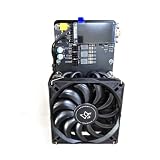
- 6TH/s SHA-256 Mining — High-performance Bitcoin solo miner powered by BM1370 ASIC chips.
- Low Power Usage — Around 120W power consumption with efficient 20.57 J/TH performance.
- Open Source System — Supports AxeOS firmware for monitoring, tuning, and customization.
- WiFi Connectivity — Easy browser-based setup for mining pool or solo mining configuration.
- Desktop Mining Design — Compact cooling system with quiet operation for home or office use.
How to set up a small Bitaxe safely
- Confirm the exact board. Record the model, expected hashrate, nominal wattage and whether it is sold assembled or as a kit. Do not assume every Gamma-shaped listing has the same ASIC or firmware.
- Buy the correctly rated supply. Small Bitaxe models require a 5 V / 6 A power supply. A weak adapter can cause brownouts, restarts and unstable hashrate. Match the connector and polarity specified for your board.
- Inspect cooling before powering on. Ensure the heatsink contacts the chip correctly and that the fan spins freely. A larger heatsink or better fan is the most common sensible cooling upgrade when temperatures are high.
- Power the board and join Wi-Fi. Follow the firmware’s setup page to select your wireless network. Keep the device where signal is reliable; repeated reconnects reduce uptime and complicate troubleshooting.
- Choose pool or solo service. Enter the Stratum URL, worker name and wallet or account details exactly as supplied by the service. Start with a pool if you want to verify that shares are being accepted before trying solo mining.
- Observe temperature, wattage and accepted shares. Check the local status screen or dashboard after startup. A wall meter gives a more useful power figure than the nominal label on the board.
- Secure the payout path. Use a Bitcoin address you control, test it with a small payout where the pool permits, and keep recovery information offline. A mis-typed address cannot be corrected after a payment is sent.
Cooling, noise and power-supply pitfalls
Restarts under load
Repeated reboots usually point first to an undersized or poor-quality 5 V supply, a loose connector or excessive voltage drop. Replace the adapter with a correctly rated 5 V / 6 A unit, shorten questionable cables and inspect connectors before changing firmware.
Heat and throttling
A 17 W board is far cooler than a full-size mining rig, but its ASIC still needs a proper thermal path. A blocked intake, dust buildup or a fan that stops can raise temperatures and reduce stable hashrate. Install the board in open air, keep the heatsink firmly seated and choose a larger heatsink or improved fan when the stock cooler cannot maintain safe temperatures.
Noise and placement
Small fans are often the loudest component. A quiet-version board may cost more, but “quiet” is not a universal noise rating. Place the miner on a hard, ventilated surface rather than inside a closed cabinet, and verify the actual sound and temperature in the room where it will run.
Free tools Windows power users keep installed
One-click scans. No signup required.
Bitaxe or NerdMiner for a first experiment?
These devices serve different purposes. A Gamma 601 is an ASIC miner with roughly terahash-scale performance; a NerdMiner built around an ESP32 is primarily an educational and lottery-style project.
| Factor | Bitaxe Gamma 601 | NerdMiner/ESP32 example |
|---|---|---|
| Hashrate | About 1.1–1.2 TH/s | Roughly 50–80 KH/s |
| Typical power figure | About 17 W | Approximately 3 W |
| Electricity example | About €0.12/day at €0.30/kWh | Under US$5 per year at typical electricity rates |
| Solo odds | About 1 in 16,900 annually under the cited 26 September 2026 difficulty assumption | Extremely low individual odds, described as lottery-like |
| Primary appeal | Open ASIC experimentation, higher hashrate and visible home mining | Low-cost learning, display projects and symbolic solo participation |
| Pool/solo support | Stratum-compatible pool or solo endpoint | Stratum-compatible services, depending on firmware and build |
Choose the NerdMiner when the goal is to learn embedded hardware, display mining statistics or spend very little on electricity. Choose the Bitaxe when you want an actual ASIC platform, more meaningful hashrate and the ability to experiment with open miner hardware. Neither should be presented as a dependable profit engine.
Quick Recap
When the economics can make sense for a founder
- Education: You value hands-on knowledge of wallets, Stratum, ASIC behavior, network difficulty and Bitcoin’s operating mechanics.
- Open-hardware development: You need an inspectable platform for firmware, thermal, telemetry or enclosure experiments.
- Sovereignty and network participation: Running a miner yourself can make infrastructure concepts tangible even when the financial return is negative.
- Surplus energy: Excess solar or otherwise-curtailed electricity can have a lower opportunity cost than purchased retail power. Measure the energy that would otherwise be wasted; do not assume a solar installation makes every mining hour free.
- Heat reuse: In a cold room, a few watts of heat may offset some heating demand. Treat that as a site-specific benefit, not mining revenue.
- Risk capital: A founder can cap the experiment budget at the hardware, supply and cooling cost and accept that the expected cash flow may remain negative.
When you should not buy one
- You need a predictable monthly return or a short hardware payback period.
- Your electricity tariff is high and you cannot use surplus energy.
- The listing does not state the board revision, power draw, included cooler or supply.
- You cannot provide continuous ventilation, stable Wi-Fi and a secure wallet address.
- You are treating the “$50” headline as proof that the complete system costs $50.
- You would borrow money or rely on a block win to cover operating expenses.
A practical buying decision
- Set a hard all-in budget that includes the board, 5 V / 6 A supply, cooling, shipping and tax.
- Write down your electricity tariff and calculate 24-hour operating cost from measured wall watts.
- Decide whether you want regular pool shares or the all-or-nothing solo lottery.
- Buy only a listing that identifies the exact model and includes compatible cooling and power hardware.
- Run the miner for a defined trial period, recording uptime, temperature, wall power and accepted shares.
- Keep the project if the learning, experimentation, sovereignty, heat or surplus-energy value justifies the loss; stop if the only remaining reason is an assumed profit.
Product prices and availability are accurate as of the date/time indicated and are subject to change. Any price and availability information displayed on Amazon at the time of purchase will apply.

