What’s actually slowing this PC down?
Pick the symptom - the matching free tool is one click away.
Windows on Arm can run many traditional Windows programs without an Arm-native build. Windows 11 on Arm emulates both x86 and x64 user-mode applications; Windows 10 on Arm emulates x86 applications but not x64 ones. The emulator translates groups of x86 instructions into Arm64 instructions while the program runs, then caches translated code so it can be reused. That process adds overhead, but the result is not the same as interpreting every instruction from scratch on every call.
Performance depends on the Windows release, processor, application workload, dependencies and compatibility settings. A native Arm64 build is usually the cleanest path, but an emulated app can still be entirely practical—provided it does not rely on an unavailable driver, architecture-specific extension or unsupported code-generation technique.
As an Amazon Associate I earn from qualifying purchases.
What “emulation” means on Windows on Arm
Arm processors execute Arm64 instructions, while much of the existing Windows software ecosystem was compiled for x86 or x64 processors. Windows on Arm includes a software emulator that bridges that instruction-set difference. Microsoft describes this as support for running x86 and x64 applications in Windows 11 on Arm, with x86 support also available in Windows 10 on Arm.
The emulator works on user-mode application code. It does not turn an x86 kernel driver into an Arm64 driver, and it cannot make every architecture-specific integration work automatically. The main executable may open successfully while a driver-backed feature, shell extension or plug-in fails.
#1 Best Overall

- UNOPENED RETAIL PACKAGING, sold as configured by Lenovo. Includes one year of Courier or Carry-in Lenovo Warranty. Add up to 4 years of Lenovo Premium Care Onsite Plus when you register your computer with Lenovo.
- Amazing Display: 14.5" 3K (2944 x 1840), OLED, Glare, Dolby Vision, Touch, HDR 600 True Black, 100I-P3, 1000 nits (Peak)/500 nits (Typical), 90Hz, Glass
- Experience exceptional performance with the Snapdragon X Elite X1E-78-100 processor, Delivering 45 trillion operations per second, ensuring tasks are more efficient and faster. With exceptional power efficiency expertly managed by the tuning of the Slim 7x, you can enjoy up to 23.5 hours of video playback on a single battery charge.
- Designed to get any job done with memory of 16 GB and even more storage capacity at 1 TB. And power through your day with plenty of connectivity, including: 3x USB-C (USB4 40Gbps), with USB PD 3.1 and DisplayPort 1.4.
- The Snapdragon X Elite X1E-78-100 processor is perfect for those with a creative mind and an eye for design. It delivers top-tier performance while cutting power consumption by 68%, letting your creative juices flow all day without any interruptions.
Windows-version boundaries
| Platform | Emulated application types | Important limit |
|---|---|---|
| Windows 10 on Arm | x86 user-mode apps | x64 applications are not supported by the operating system’s emulation layer. |
| Windows 11 on Arm | x86 and x64 user-mode apps | Drivers and other kernel-mode components must be compiled for Arm64. |
That distinction matters when checking an application’s requirements. “Runs on Windows” is not enough information: you also need to know whether the program is x86, x64, Arm64 or a mixture of these architectures, and whether it installs components outside the main process.
How the translation pipeline works
Windows does not normally translate one original instruction and immediately discard the result. Instead, the emulator identifies blocks of x86 instructions, translates those blocks into Arm64 code and applies optimizations to the generated code. A Windows service stores translated blocks in a cache organized by module. Later launches can reuse that work, and Microsoft says another application may benefit when it uses the same module.
Why the first launch can differ
The initial run may spend extra processor time translating code and building the cache. Subsequent runs can avoid some of that work. Cache reuse is not a guarantee of identical startup times: an application can load different modules, update itself, use unusual code paths or invalidate old translated code.
Translation is not native execution
Native Arm64 software is already expressed in the instructions the processor executes. Emulated software must still perform translation, manage the translated-code cache and handle x86 behavior that has no direct one-to-one equivalent. Those tasks create overhead. Optimizations can reduce it, but they do not make an x86 binary literally identical to a native Arm64 build.
What changed with Prism in Windows 11 24H2
Windows 11 version 24H2 introduced Prism, Microsoft’s newer emulation technology. Microsoft designed Prism to improve performance and reduce CPU use compared with earlier Windows on Arm emulation. Prism is available on supported Windows 11 24H2 Arm devices, while some of its performance capabilities depend on hardware features found only in Snapdragon X-series processors.
The practical implication is that two Windows 11 Arm computers running the same application can behave differently even when both use Prism. Processor generation, firmware, cooling and the workload all matter. A short text-editing session, a long software build and a sustained video export stress different parts of the system.
What the documentation does—and does not—prove
Microsoft’s documentation establishes the translation design, caching and Prism’s goals. It does not establish one universal percentage slowdown for all emulated applications, nor does it show that every emulated workload matches native Arm64 performance. Battery use also varies with workload, as Microsoft’s Arm-based Surface FAQ notes. Treat performance claims as workload-specific rather than as a fixed penalty.
Quick wins for a faster PC:
Repair Windows errors before they cause bigger problemsFix Now →Fix the driver behind crashes, sound loss and screen glitchesFind Drivers →Clear out junk files and repair common Windows errorsFree Scan →Rank #2
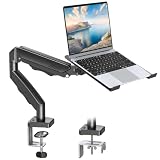
- Versatile 2-in-1 Laptop & Monitor Mount - Stable aluminum laptop arm mount is compatible with Laptop, Monitor, Macbook and Chromebook. With the tray, the laptop stand can hold notebooks up to 17". Simply remove the tray to accommodate monitors ranging from 13-32" with VESA pattern 75x75mm and 100x100mm, holds up to 4.4-19.8lbs. 𝐏𝐥𝐞𝐚𝐬𝐞 𝐧𝐨𝐭𝐢𝐜𝐞 𝐭𝐡𝐚𝐭 𝐢𝐭 𝐢𝐬 𝐧𝐨𝐭 𝐜𝐨𝐦𝐩𝐚𝐭𝐢𝐛𝐥𝐞 𝐰𝐢𝐭𝐡 𝟏𝟎𝟎𝟎𝐑/𝟏𝟓𝟎𝟎𝐑/𝟏𝟖𝟎𝟎𝐑 𝐜𝐮𝐫𝐯𝐞𝐝 𝐬𝐜𝐫𝐞𝐞𝐧𝐬
- Full-Motion Adjustment For Comfortable View -The laptop arm mount offers -45° to +90° tilt, 180°swivel, 360° rotation. Raise your monitor up to 16.9” to support a healthy sitting posture. Whether you’re working from home, gaming through the night, or switching between video calls and documents, getting the screens to your natural line of sight helps relieve neck, shoulder and back strain so you can stay focused longer with less fatigue. 𝐍𝐨𝐭𝐞: 𝟑𝟔𝟎° 𝐫𝐨𝐭𝐚𝐭𝐢𝐨𝐧 𝐢𝐬 𝐫𝐞𝐜𝐨𝐦𝐦𝐞𝐧𝐝𝐞𝐝 𝐨𝐧𝐥𝐲 𝐟𝐨𝐫 𝐦𝐨𝐧𝐢𝐭𝐨𝐫 𝐢𝐧𝐬𝐭𝐚𝐥𝐥𝐚𝐭𝐢𝐨𝐧. When you're using the laptop tray, please do not to rotate the tray to a vertical position to ensure safety
- Space Saving & Keep Your Desk Organized - Elevate your laptop or monitor with this laptop desk mount to free up valuable space and creates a clean work environment. Easily switch between laptop and monitor modes to enhance your multitasking abilities and boosting your productivity while preserving desk space. Built-in cable management guides wires along the arms, keeping cords out of sight and out of the way. Enjoying your working, gaming or viewing hours in a tidy and modern workstation
- Heat Dissipation & Secure - The ventilated tray maximizes airflow and keeping your device cool and running efficiently. The tray includes 4 anti-slip pads and Velcro straps your laptop in place, preventing slips or falls during work or gaming. Ideal for home office professionals, office workers, programmer,designer, gaming enthusiasts and students
- Quick & Easy Setup - Assembly is straightforward with the provided tools and visual user manual. Depending on your desk situation, you can choose clamp or grommet mounting (suitable for desks from 0.39" to 2.76" thick). The hole diameter for grommet base should be 0.39" to 2.36". Do not hesitate to relate with us for any pre-purchase or installation questions
Native Arm64, emulated x86/x64 and Arm64EC compared
| Application form | How code runs | Typical compatibility question |
|---|---|---|
| Native Arm64 | Processor executes Arm64 instructions directly. | Are all plug-ins, drivers and libraries available for Arm64? |
| Emulated x86 or x64 | Windows translates instruction blocks at run time and caches translated code. | Does the app use unsupported drivers, extensions or dynamic code generation? |
| Arm64EC mixed process | Arm64EC portions run natively while x64 portions run through Windows 11 emulation in the same process. | Can the remaining x64 dependencies interoperate with the Arm64EC parts? |
A native build is not automatically available or feature-complete, and an emulated build is not automatically unusable. The useful comparison is the complete application stack: executable, libraries, plug-ins, drivers and the workload you actually run.
Compatibility limits that explain failed features
Kernel-mode drivers
Emulation covers user-mode code, not kernel-mode drivers. Hardware utilities, security products, specialist peripherals and low-level monitoring tools may install a driver that has to be compiled for Arm64. If that driver is missing, the main application can launch while device access or a protected feature does not.
Shell extensions and injected DLLs
Some applications load DLLs into Windows processes, including Explorer shell extensions. Those DLLs must match the architecture expected by the process. A 32-bit extension cannot simply be assumed to work inside a 64-bit or Arm64 process, and an x86 extension may need its own compatible build.
Dynamic code generation
Microsoft’s troubleshooting guidance identifies dynamic-code-generation restrictions as another reason an x86 desktop application may fail. Software that creates executable code at run time, uses unusual self-modifying techniques or assumes a particular memory-permission model may need an update from its developer or a per-app compatibility adjustment.
Do these 3 things before closing this tab:
1Repair Windows errors before they cause bigger problems2Fix the driver behind crashes, sound loss and screen glitches3Clear out junk files and repair common Windows errorsSystem file and registry redirection
x86 processes use the Windows-on-Windows 64 (WOW64) arrangement, including file-system and registry redirection. This can affect installers, configuration files and scripts that expect a particular system folder or registry view. A program that works on a conventional x64 PC can therefore expose a path or registry assumption on Windows on Arm.
For x64 applications on Windows 11 on Arm, Microsoft documents a different arrangement: there is no separate WOW64 layer or separate folder containing only x64 system binaries. Arm64X system binaries can be loaded by both Arm64 and x64-compatible processes, allowing shared components to serve multiple architectures.
How to adjust emulation for one application
Windows provides optional per-application controls. Use them only when you have a compatibility reason or a reproducible performance problem; Microsoft’s defaults are intended to balance speed and compatibility.
Rank #3

- Laptop sitting too low on your desk: Raise it to eye level on a gas spring arm that adjusts from 9 to 18.75 inches and holds where you leave it. A hex key sets the tension, turning one way for heavier laptops and the other for lighter ones.
- Covered for as long as you own it: Mount-It! backs this laptop arm with a lifetime manufacturer warranty and US-based product specialists, available during standard business hours. If setup, tension, or fit raises a question, a product specialist can help.
- Fits laptops up to 17 inches and 13.2 lbs: Side holders open from 9.5 to 16.5 inches wide, and locking buckles, traction pads, and tabs keep the laptop from slipping. The 11.75 x 11 inch tray is ventilated so warm air escapes beneath. Check your laptop's width and weight first.
- Full motion for every working position: A 360 degree swivel, 90 degree tilt, and reach from 10.5 to 23.5 inches let you pull the screen close, push it back, or angle it toward a video call, then reposition it between sitting and standing.
- Screen up high, keyboard and mouse below: This laptop stand arm is a raised screen, not a typing surface, so pair it with an external keyboard and mouse. It clamps to the desk edge instead of a riser taking up space, and cable clips route cords along it.
- Locate the application’s executable in File Explorer.
- Right-click the executable and choose Properties.
- Open the Compatibility tab, then open the available emulation or advanced settings for that executable.
- Change one setting at a time, apply it and test the exact operation that was failing or running slowly.
- Record the original values so you can return to the defaults if the application crashes or stops launching.
Settings you may encounter
- Multi-core operation: controls how translated work uses multiple processor cores.
- Translated-code cache behavior: changes how cached translated blocks are used or maintained.
- x86 hybrid execution: changes compatibility behavior for selected x86 execution paths.
- Self-modifying code: provides compatibility behavior for programs that alter code in memory.
- RWX-page optimization: changes handling of memory pages that are readable, writable and executable.
- Floating-point precision: can help software that depends on older floating-point behavior.
These controls are not a universal speed switch. Stricter compatibility behavior can add synchronization or other work, reducing performance. Microsoft warns that overrides can also cause crashes or prevent an application from launching. If a change makes the result worse, restore the defaults before trying a different setting.
Free tools Windows power users keep installed
One-click scans. No signup required.
CPU-feature masking in Prism
In Windows 11 24H2 and later, Prism can expose additional emulated CPU features, including AVX, AVX2, BMI, FMA and F16C. Per-app settings can hide those features when you need to reproduce the behavior of an earlier environment or work around an application that incorrectly assumes a feature is present. Hiding a feature may restore compatibility but can disable an optimization the application would otherwise use.
How to judge performance in a real workload
Do not use a single launch or a generic benchmark as the entire answer. Evaluate the task that matters to you after the application has completed its first-run setup and translation cache creation.
- Measure the same operation: for example, opening a large project, exporting a video or compiling a fixed codebase.
- Separate startup from sustained work: first-launch translation overhead and long-running CPU throughput are different questions.
- Watch thermals and power: a short burst can look fast while a sustained workload is limited by heat or power policy.
- Check the processor: Prism’s relevant optimizations are not identical across Arm hardware, and some require Snapdragon X-series capabilities.
- Check background components: antivirus filters, plug-ins, drivers and cloud-sync tools can dominate results independently of emulation.
For light office work, browsing, messaging and applications with modest CPU demand, emulation overhead may be unimportant. Long, CPU-intensive jobs, instruction-set-specific software, applications with many plug-ins or workloads that depend on unsupported drivers deserve a native Arm64 build or a careful compatibility test.
Independent reader supportYour contribution helps us test, update, and keep practical guides available for everyone.What Arm64EC gives software developers
Arm64EC is Microsoft’s incremental migration model for Windows 11 on Arm. Arm64EC code runs at native performance, while x64 code in the same process continues to use Windows’ built-in emulation. This lets a developer rebuild the most CPU-intensive modules or selected dependencies without converting the entire application in one release.
An Arm64EC process can use Arm64EC dependencies or x64 dependencies. Ordinary Arm64 dependencies cannot be used in that same mixed arrangement, so library selection and build configuration matter. The approach is useful when a large codebase contains a few expensive components but still depends on third-party x64 libraries.
A practical migration sequence
- Inventory the executable, plug-ins, libraries and any driver or shell-extension components.
- Profile the workload to identify modules where CPU time matters most.
- Port a high-impact module to Arm64EC and keep compatible x64 dependencies where necessary.
- Test process boundaries, memory assumptions, plug-in loading and installer behavior on Windows 11 Arm hardware.
- Continue replacing bottleneck modules as Arm64 or Arm64EC versions of dependencies become available.
This strategy can deliver native execution where it matters without requiring a single all-or-nothing rewrite.
Rank #4

- Step Up to Next-Level Performance - Redefine your laptop experience with the Acer Aspire 16 AI. Powered by the Snapdragon X X1-26-100, a premium integrated GPU with up to 1.7 TFLOPs and NPU with 45 TOPs for optimized processing across CPU, GPU, and NPU workloads and delivering best-in-class performance and power efficiency.
- New AI Superpowers - Discover the power of Recall (preview), improved Windows search, and Click to Do (preview) on Copilot+ PCs. Effortlessly locate past content, perform natural searches, and interact with text and images – all while ensuring your data remains private and you stay productive*.
- Built on Brilliant AI Foundations - The Acer Aspire 16 AI harnesses the industry-leading Qualcomm AI Engine with an integrated Qualcomm Hexagon NPU, delivering transformative experiences for creativity, video conferencing, security, and productivity assistants. The Qualcomm AI Engine supports Windows Studio Effects and many other AI-accelerated applications and experiences, to make possibilities endless.
- Screens that Speak to Your Senses - Immerse yourself in a world of vibrant visuals. Enjoy stunning clarity, rich 100% sRGB colors, and sharp detail on the 16" 120Hz WUXGA ultra-high-resolution touchscreen display – acting as a panoramic playground for entertainment, artistic expression, and engaging AI experiences that dazzle the eye.
- Streamline Your Settings with AcerSense - Intelligent Acer AI solutions are at your fingertips. Effortlessly get answers, streamline settings, optimize your video presence, and elevate communication. Experience intuitive AI that’s easy to use and seamlessly enhances your productivity.
A buyer’s and user’s decision checklist
Before relying on an x86 or x64 application on a Windows on Arm laptop, verify:
- Which Windows release is installed: Windows 10 supports emulated x86, while Windows 11 supports emulated x86 and x64.
- Whether the vendor supplies a native Arm64 or Arm64EC build.
- Whether the application installs a kernel driver, shell extension or injected DLL.
- Whether it generates executable code dynamically or depends on unusual memory permissions.
- Whether your processor supports the Prism capabilities relevant to the workload.
- Whether the developer documents Arm compatibility for every plug-in and peripheral you need.
If the application is mission-critical, test the complete workflow—including printing, hardware access, plug-ins, updates and file exchange—rather than only checking whether the main window opens.
Common symptoms and the most useful response
The program will not launch
Confirm that its architecture is supported by your Windows version, install the latest application update, and check for dynamic-code-generation or driver requirements. Restore any custom emulation settings before further testing.
The program launches but a feature is missing
Look for an Arm64 driver, shell extension or plug-in. The executable’s successful launch proves only that its user-mode code can run; it does not prove that every dependent component is compatible.
The first launch is slow
Allow setup and translation to finish, then compare later launches and the sustained workload. A cache can reduce repeated translation, but updates or different modules can require new translation.
An emulated app is slower or uses more power
Compare the same workload on the same system after caches are warm, check whether a native Arm64 build exists and verify that no compatibility override is adding synchronization or other overhead. There is no single slowdown percentage that applies to every application.
Recommended Free Tools
Bottom line
Windows on Arm emulation is a runtime translation system, not a fresh interpretation of every x86 instruction on every call. Windows 11 24H2’s Prism improves the translation and caching path, but the result still depends on hardware, workload and the rest of the application’s architecture. Native Arm64 remains the best route when available; emulation is a practical bridge when the program is user-mode software and its drivers, extensions and code-generation techniques are compatible. Developers can use Arm64EC to move performance-critical code to native Arm execution gradually rather than rewriting an entire application at once.
Quick Recap
Product prices and availability are accurate as of the date/time indicated and are subject to change. Any price and availability information displayed on Amazon at the time of purchase will apply.

