MapAnything on Replicate turns sets of images, video frames, or geometric data into metric 3D scene information. Vufinder’s hosted listing is the easiest way to try it: upload one or more supported files, choose the geometry outputs you need, run a prediction, and download a GLB mesh or point cloud when requested. You do not need a special camera, but you do need images with enough overlapping visual detail for reconstruction.
This guide separates the MapAnything research project from Vufinder’s Replicate deployment and from the particular checkpoint it uses. It also explains the input formats, video sampling behavior, output controls, API and local options, pricing estimates, licensing, and the situations in which a result should be treated cautiously.
As an Amazon Associate I earn from qualifying purchases.
What MapAnything does
MapAnything is a metric 3D reconstruction model. It predicts factored 3D scene geometry from combinations of images and geometric information rather than generating a new picture. “Metric” indicates that the model is intended to estimate scene geometry in a scale-aware form, while “factored” means the reconstruction is represented through several related geometric outputs instead of a single flat image.
Do these 3 things before closing this tab:
1Clear out junk files and repair common Windows errors2Fix the driver behind crashes, sound loss and screen glitches3Repair Windows errors before they cause bigger problemsThe Facebook Research MapAnything project describes one feed-forward model supporting more than 12 different 3D reconstruction tasks. The examples listed by the project include:
#1 Best Overall
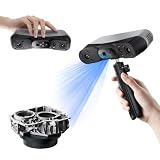
- 【Industrial-Grade Accuracy】Achieve single-frame accuracy up to 0.03 mm and volumetric accuracy of 0.03 mm + 0.05 mm x L(m), faithfully reproducing the finest surface details and complex geometries with exceptional consistency. Full-Field Structured Light accuracy reaches 0.08 mm; VCSEL mode delivers 0.10 mm @ 300-500 mm and 0.20 mm @ 500-800 mm. Engineered to meet the demanding requirements of 3D printing, reverse engineering, and precision modeling applications.
- 【Ultra-Fast Scanning & Robust Frame Rate】Multi-line Laser mode delivers up to 105 fps with NVIDIA GPU acceleration. Full-Field Structured Light mode achieves up to 5,000,000 points/s. The high frame rate ensures a smooth, uninterrupted scanning experience, especially suited for rapidly capturing large objects and complex scenes, significantly boosting overall workflow efficiency.
- 【AI-Powered & Photo-Grade Retopology】 AI object segmentation (Windows only) identifies your target in one click, tracks it throughout the scan, and auto-filters background noise — delivering clean data and streamlining post-processing. The patented 3D Gaussian Splatting converts point cloud and RGB data into true-to-life 1:1 photorealistic models; import photos from your phone or camera to apply real textures, then export in splat format for gaming, animation, and VR.
- 【All-Weather Outdoor Scanning】Multi-line Laser mode operates reliably up to 50,000 lux; with an outdoor filter attached, scanning remains stable in lighting conditions of up to 100,000 lux; VCSEL mode operates reliably in up to 100,000 lux ambient light. Designed to overcome lighting challenges, it provides consistent all-weather performance for construction sites, archaeological digs, and industrial fieldwork.
- 【5 Scanning Modes】NIR band supports Full-Field HD Scanning (markerless, fine structured light), Hybrid HD Scanning (dual projectors, fast high-quality modeling), and VCSEL Rapid Scanning (high-density pattern, fast markerless capture). Blue light band supports 30-Cross Laser Lines Scanning (handles high-reflectivity metals & dark objects) and Single-Line Deep Hole Scanning (captures from deep holes & narrow grooves). Five modes for comprehensive indoor and outdoor coverage.
- Multi-image structure from motion
- Multi-view stereo
- Monocular metric depth estimation
- Image or camera registration
- Depth completion
That capability list describes what the model is designed to handle; it is not a benchmark proving that every task has equal accuracy or that every scene will reconstruct successfully. Vufinder’s Replicate page gives you a practical interface to run the model, but the quality of a prediction still depends on the input coverage, texture, lighting, motion, and scene geometry.
Keep the project, deployment, and weights separate
Three names are easy to conflate:
- MapAnything research and code project: the implementation and documentation published by Facebook Research, including the broad task list and local setup instructions.
- Vufinder’s Replicate deployment: a hosted prediction endpoint with a browser form and API examples. Replicate supplies the compute and returns downloadable results.
- The pretrained checkpoint: the learned weights used by that deployment. The Vufinder README identifies these as
map-anything-apacheweights.
A hosted run therefore is not a separate model family. It is a particular service configuration of MapAnything using a named weight variant. If you reproduce the project locally, confirm which checkpoint you downloaded and which software version you installed before comparing results.
What files can you upload?
The Replicate listing accepts multiple image files, several common video formats, and JSON geometric input. The interface and processing rules are summarized below.
The Tool Desk
Outbyte PC Repair FREEClear out junk files and repair common Windows errorsFree Scan →Outbyte Driver Updater FREEFix the driver behind crashes, sound loss and screen glitchesFind Drivers →| Input | Accepted formats | Important behavior |
|---|---|---|
| Images | JPG, JPEG, PNG, WEBP | You can submit multiple images for a multi-view reconstruction. Images are padded to a common aspect ratio and resized so the maximum dimension is 518 pixels. |
| Video | MP4, AVI, MOV | The service samples frames according to sampling_rate. A value of 1 uses every frame; higher values keep every nth frame. The first and last frames are always included. |
| Geometric data | JSON | Use JSON when you already have compatible geometric information to provide as model input. Follow the live listing’s schema rather than guessing field names. |
Padding preserves all submitted images inside one common canvas, so files with different shapes are not simply cropped to the same rectangle. The 518-pixel maximum dimension is a preprocessing rule, not a promise that the model receives the original camera resolution. Keep the original files for your own archive, but expect the hosted service to normalize them before inference.
Capture images that contain useful overlap
For a room, object, or outdoor area, take a sequence of views in which neighboring images share recognizable features. Move around the subject instead of taking unrelated snapshots from distant locations. Avoid covering the same details with your hand, changing the arrangement halfway through, or mixing a sharply focused image with several heavily blurred ones.
Rank #2

- EASY TO USE FOR BEGINNERS – Perfect for entry-level users, DIY creators, and 3D printing enthusiasts. Quick start, with simple practice giving optimal scan results.
- SMOOTH WIRELESS SCANNING – WiFi6-powered Ferret Pro ensures fast, stable scanning. Works with Windows, macOS, Android, and iOS for flexible cross-platform use.
- HIGH-PRECISION 3D MODELS – Capture detailed 3D models with full-color 24-bit scanning and anti-shake technology. Offers up to 0.1mm accuracy with full-color scanning. Ideal for objects from 50mm to 2000mm. Not suitable for very small or highly detailed items like jewelry or precision parts.cccc
- VERSATILE OUTPUT & ENVIRONMENT – Export in OBJ, STL, or PLY. Works reliably in most settings, including outdoor light (<30,000 lux). Avoid reflective, transparent, or very dark surfaces for best results.
- LIGHTWEIGHT & PORTABLE – Weighing just 105g, carry and scan anywhere—home, studio, or on the go. Compact, convenient, and ready for travel.
Even though the interface accepts ordinary phone and camera files, the model cannot infer reliable geometry from information that is absent. Plain walls, reflective surfaces, transparent objects, repeated patterns, severe glare, and large moving subjects can all make correspondence between views difficult. These are practical limitations of image-based reconstruction, not upload errors.
Use the hosted Replicate page
The hosted route is the best starting point if you want to test MapAnything without installing a machine-learning environment. You need a Replicate account and, for API calls, a Replicate API token. The browser form is suitable for a first run; the API is better when you need repeatable jobs.
What’s actually slowing this PC down?
Pick the symptom - the matching free tool is one click away.
- Open the current Vufinder MapAnything listing. Read the input panel before uploading anything because model versions, field names, and available controls can change.
- Choose your source files. Add one or more JPG, JPEG, PNG, or WEBP images, select an MP4, AVI, or MOV video, or provide JSON geometric input that follows the listing’s documented format.
- Set video sampling when using a movie. Decide whether every frame is necessary.
sampling_ratemeans “take every nth frame”; it does not mean “take n frames total.” The service still includes the first and last frames. - Select the outputs. Enable
return_pcdif you need a point cloud andreturn_meshif you need a polygon mesh. The interface also exposes optional normal and point-scale outputs. - Start the prediction. Wait for preprocessing, inference, and file packaging to finish. A long video or a large set of views can take longer than a small image set.
- Review the returned JSON. The prediction response identifies the generated assets and any additional values returned by the model. Treat the JSON as the machine-readable record of the run.
- Download the GLB or point-cloud file. Save the files with the original input set and the date so you can trace which capture produced which reconstruction.
Replicate provides Python, Node.js, and HTTP examples on the listing. Copy the example for the language you use instead of relying on an old snippet: the required model version identifier is part of the API request and version strings can change. Keep the API token secret, preferably in an environment variable or a secret manager, rather than committing it to source control.
Understanding the output controls
| Control or output | What it is for | What not to assume |
|---|---|---|
return_mesh |
Requests a mesh asset, exposed by the listing as a downloadable GLB file. | A mesh is not automatically watertight, production-ready, or free of holes. |
return_pcd |
Requests a point-cloud asset for inspecting sampled 3D points. | Point density and completeness depend on the input and model prediction. |
| Normals | Optional surface-direction information that can help with shading or downstream processing. | Normals do not repair missing geometry. |
| Point scales | Optional scale-related values associated with predicted points. | They are not a substitute for validating the scene’s measurements. |
| JSON response | Lists generated outputs and related prediction data. | It is not, by itself, a 3D viewer. |
GLB is convenient because it can carry a mesh and associated scene data in one file, while a point cloud is useful when you want to inspect the distribution of reconstructed points before deciding whether a surface representation is appropriate. Use a compatible 3D viewer or modeling application to inspect either file, and check scale, orientation, holes, floating points, and obvious distortions before using the result in a design or measurement workflow.
How video sampling affects a run
Video is a compact way to capture many nearby viewpoints, but processing every frame can create a large input. The sampling_rate setting controls the stride: at 1, the service considers every frame; at 2, it considers every second frame; at 5, every fifth frame, and so on. Regardless of that value, the first and last frames are always included.
Rank #3
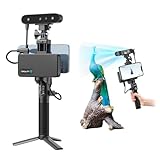
- 【High Accuracy & Fast Scanning】The Creality CR-Scan Ferret Pro 3D scanner delivers up to 0.1mm accuracy, 0.16mm resolution, and 30FPS scanning speed. It captures detailed dimensional data and complex shapes smoothly, creating highly realistic 3D models with ease.
- 【WiFi6 Wireless Transmission】Featuring advanced WiFi6, this handheld 3D scanner offers speeds 3x faster than WiFi5. The high bandwidth ensures stable, efficient data transfer for high-precision scanning and smoother workflow.
- 【Outdoor Scanning & Flexible File Export】Powered by upgraded optical technology and intelligent algorithms, the scanner delivers reliable performance in outdoor environments with ambient light up to 30,000 lux. Export models in OBJ, STL, or PLY formats for seamless integration with 3D printing, design, and reverse engineering workflows. For optimal results, avoid scanning highly reflective, transparent, or extremely dark surfaces.
- 【Anti-Shake Tracking】Equipped with one-shot 3D imaging, the Ferret Pro improves tracking accuracy and scanning success rates. Even with hand movements or quick object shifts, it ensures smooth, error-free scanning—perfect for beginners.
- Ferret Series Performance requirements: Windows: i5-Gen8 CPU or later Windows 10/11 (64-bit), RAM: >8GB, Software: >V2.3.0 Mac OS: M1/M2/M3/M4 series, macOS 11.7.7+ or Intel i5-Gen8+, RAM: >8GB Android: OS: Android 10.0+, RAM: >8GB, Connectivity: Wi-Fi 6, App: V2.0.2 iOS: Model: iPhone 11+, iOS 15+, RAM: >4GB
A lower stride gives the model more temporal coverage but can increase processing work and introduce near-duplicate frames. A higher stride reduces the number of frames while preserving the endpoints, but it can skip useful viewpoints if the camera moves quickly or turns around a small object. Choose a value that leaves enough overlap between consecutive sampled frames; there is no universal setting that is correct for every video.
Cost and completion time
When checked on October 13, 2026, Replicate’s listing estimated approximately $0.018 per run and a typical completion time of about 19 seconds on L40S hardware. These are platform estimates, not fixed prices or service-level guarantees. Replicate states that both cost and prediction time can vary significantly with the inputs, so a long video and a short two-image test should not be budgeted as equivalent runs. Check the live listing immediately before a production batch for current pricing and hardware estimates.
Hosted Replicate or local execution?
The two routes use different operational trade-offs. Neither is established as more accurate by the available documentation; the choice is mainly about convenience, control, and infrastructure.
| Decision factor | Hosted Vufinder listing on Replicate | Local MapAnything project |
|---|---|---|
| Setup effort | Low. Upload files in the browser or call the hosted API. | Higher. Create an environment, install the project, and configure compatible machine-learning dependencies. |
| Hardware | Replicate supplies the inference hardware. | You supply a suitable computer, storage, and any required accelerator. |
| Software control | Convenient but tied to the listing’s current deployment and version. | More control over code, checkpoints, and integration, with more maintenance responsibility. |
| Pricing | Per-run hosted charge; the October 13, 2026 estimate was about $0.018, subject to change and input-dependent variation. | No Replicate per-run charge, but you pay for your own hardware, electricity, storage, and engineering time. |
| Best fit | Learning, prototypes, occasional jobs, and teams that do not want to manage inference infrastructure. | Repeatable pipelines, controlled environments, offline work, or development that requires direct access to the repository. |
Local setup basics
The official repository’s quick start creates a Conda environment with Python 3.12 and then installs the project with pip. The repository does not pin PyTorch or CUDA, so local users must select versions compatible with their operating system, GPU driver, and hardware. That flexibility is useful for experienced developers but is a common source of installation failures.
- Install a current Conda distribution and verify that your terminal can create environments.
- Create a dedicated environment using Python 3.12, as specified by the repository’s quick-start instructions.
- Activate that environment before installing anything else.
- Install the MapAnything project with pip following the repository’s documented command sequence.
- Choose PyTorch and CUDA versions that match your machine rather than copying an incompatible combination from a different system.
- Download or configure the checkpoint required by the workflow. Confirm whether you are using the Apache or non-commercial variant before processing real data.
- Run a small, known input first, then integrate the model into your own script or service.
Replicate also documents local Docker and Cog use. That path can make deployment more reproducible, but it is more involved than trying the hosted page because you must build, configure, and run the container environment yourself.
Free tools Windows power users keep installed
One-click scans. No signup required.
Rank #4

- AI Visual Tracking Technology: Equipped with a new generation of single-frame encoded structured light units that improve surface feature detection for smooth, marker free scanning
- High Precision Scanning: Achieves 0.05mm accuracy using blue light technology, making your model size closely approach reality for detailed reproduction
- Fine Resolution Capability: Features 0.10mm resolution with detailed point clouds that preserve object details providing refined models for printing or display projects
- Versatile Scan Range: Capable of scanning objects ranging from 15mm to 1500mm, accommodating a wide variety of object sizes
- Integrated Software Solution: JMStudio scanning software integrates scanning, editing, and optimizing into one seamless process for efficient workflow
Licensing: code and checkpoints are different
Do not infer the license of a pretrained model from the license of its source code. The MapAnything repository states that its code is Apache 2.0 licensed, while the published weight variants have separate terms.
| Component | Variant or identifier | License information | Practical implication |
|---|---|---|---|
| Repository code | MapAnything project code | Apache 2.0 | Code permissions do not automatically grant the same rights to every checkpoint. |
| Pretrained weights | facebook/map-anything |
CC-BY-NC 4.0 | Non-commercial restrictions and attribution obligations may apply. |
| Pretrained weights | facebook/map-anything-apache |
Apache 2.0 | The repository recommends this variant for commercial use, subject to the full license terms. |
| Vufinder deployment | map-anything-apache weights, according to its README |
Checkpoint terms should be read together with Replicate’s service terms. | Verify the exact deployment and intended use before commercial processing. |
The official Hugging Face model card identifies facebook/map-anything as the CC-BY-NC-4.0 variant. If your application is commercial, check the checkpoint identifier, attribution requirements, restrictions, and the terms of the hosted service you are using. A permissively licensed repository does not remove obligations attached to a separately licensed model weight file.
Accuracy expectations and common failure modes
No comparative accuracy ranking, independent benchmark, or task-by-task limitation was established for the Vufinder deployment. It is therefore not responsible to call it the best 3D reconstruction model or to promise reliable metric accuracy in every scene. Treat each output as a reconstruction to validate, especially when dimensions, alignment, or downstream fabrication matter.
When the geometry looks warped
Check whether the images contain enough overlap and whether the camera moved smoothly. Remove frames with motion blur, severe exposure changes, or a partially covered lens. For video, try a smaller sampling stride if the camera moved rapidly between retained frames.
When large areas are missing
Look for viewpoints that never show the hidden surfaces. A model cannot reconstruct the back of an object that no input image observes. Capture additional angles, keep the subject still, and avoid relying on a single forward-facing pass around a complex scene.
Best Value

- HIGH ACCURACY & FASTER: Boasting an impressive accuracy of up to 0.1mm, a resolution of 0.16mm, and a scanning speed of 30FPS, the Creality CR-Scan Ferret SE 3D scanner demonstrates outstanding performance in capturing extensive dimensional data and intricate details to shape highly realistic models smoothly and quickly
- ANTI-SHAKE TACKING: CR-Scan Ferret SE 3D scanner equipped with the new one-shot 3D imaging technology, this advanced feature enhances tracking efficiency and significantly increases the success rate of scans , ensures smooth, error-free scanning results even with shaky hands or rapid movements, ideal for beginners
- COLORFUL & VIVID TEXTURES: The CR Scan Ferret SE color 3D scanner built-in with the 2MP high-resolution color camera, captures intricate details and colored 3D models in their original colors, vividly bringing every intricate detail to life
- FLEXIBLE SCANNING RANGE: Provides a flexible scanning range of 150mm to 2000mm and a single capture range of up to 560*820mm, easily and efficiently handles the scanning of medium to large objects
- SCAN BLACK/METAL OBJECTS WITHOUT SPRAYING: The Ferret SE is optimized for scanning black or metal objects, it doesn't required you to use a white powder or spray to create a contrasting surface for black objects, much easier and faster to help you to finish your work
When scale or orientation seems wrong
Confirm that you selected the intended metric workflow and supplied the correct geometric JSON schema if using auxiliary data. Inspect the result in a viewer that reports scene units, and compare a known distance in the scene with the reconstructed measurement before using it for planning.
When the API request fails
Refresh the live listing and copy its current model version identifier and input field names. Confirm that your token is valid, that uploaded files use an accepted extension, and that JSON is valid and matches the documented schema. A version identifier copied from an old example may no longer refer to the current deployment.
When local installation fails
Check Python 3.12 first, then verify that the installed PyTorch build matches your CUDA toolkit and GPU driver. Because the repository does not pin those dependencies, an environment that works on one machine may fail on another. Keep the project in a clean environment rather than mixing packages from unrelated computer-vision installations.
Practical workflows for beginners
Quick object scan
Place a stationary object on a stable surface and capture overlapping images from several heights and sides. Upload the image set, request a mesh and point cloud, and inspect both. The point cloud can reveal gaps or stray points that are less obvious in a shaded mesh.
Room or small-space capture
Walk slowly around the perimeter while keeping the camera level and preserving overlap between views. If using video, select a sampling rate that keeps consecutive frames visually related. Include the first and last frames deliberately because the service always retains them.
Automated batch processing
Use the Replicate API example for your preferred language, store the token securely, and record the model version, input filenames, sampling rate, requested outputs, and returned asset URLs for every job. This metadata makes it possible to reproduce a result when the hosted listing changes.
Offline or controlled deployment
Move to the official local project only after a hosted test establishes that your captures contain useful information. Recreate the Python 3.12 environment, choose compatible PyTorch and CUDA versions, verify the checkpoint license, and test with a small sample before scaling up.
PC Slower Than It Used to Be?
A free scan shows the junk files, broken settings and background clutter dragging Windows down - then fixes them in one click.Free scan · Windows 10 & 11Crashes, No Sound, or Screen Glitches?
Random freezes, missing sound and display glitches usually trace back to one bad driver. Find and replace yours safely.Free scan · under a minuteA pre-run checklist
- Do the images show the same subject from overlapping viewpoints?
- Are the files JPG, JPEG, PNG, WEBP, MP4, AVI, MOV, or valid documented JSON?
- Have you allowed for the service’s common-aspect-ratio padding and 518-pixel maximum dimension?
- For video, is the sampling stride appropriate for the camera’s movement?
- Did you enable mesh, point cloud, normals, or point scales only when you need them?
- Are you using the current model version identifier and input names?
- Have you budgeted for input-dependent hosted cost and completion time?
- Does the checkpoint license match your personal or commercial use?
- Will you validate scale, holes, floating points, and alignment before relying on the geometry?
For a beginner, the sensible path is to start with a small, well-overlapped image set on the hosted Replicate page, request both a mesh and point cloud, and inspect the result before automating or moving local. MapAnything offers a broad reconstruction interface, but the quality and legal suitability of each output still depend on the capture, selected checkpoint, deployment terms, and your validation process.
Quick Recap
Product prices and availability are accurate as of the date/time indicated and are subject to change. Any price and availability information displayed on Amazon at the time of purchase will apply.

