The Tool Desk
Outbyte PC Repair FREEClear out junk files and repair common Windows errorsFree Scan →Outbyte Driver Updater FREEFix the driver behind crashes, sound loss and screen glitchesFind Drivers →You can use Windows 10 Mail without a mouse by turning on Narrator, moving through the app with the keyboard, and using scan mode to read message lists and email content. Narrator is built into Windows 10, so you do not need to download a separate screen reader. The essential workflow is: start Narrator with Windows logo key+Ctrl+Enter, open Mail from Windows Search, move through controls with Tab and the arrow keys, and press Narrator key+Spacebar when you need scan mode for reading.
What you need before opening Mail
The basic setup requires a Windows 10 computer, the Mail app installed on that computer, and a keyboard. A standard USB keyboard is sufficient because the workflow relies on Windows and Narrator shortcuts rather than mouse-specific controls. Headphones can make speech easier to follow in a busy environment, and a compatible Braille display may be useful if you prefer tactile output, but neither is required for the steps below.
As an Amazon Associate I earn from qualifying purchases.
Mail availability and the names of some controls can differ between Windows 10 builds. If Mail does not appear in Search, verify that it is installed on your edition and build before troubleshooting keyboard navigation.
Turn on Narrator
Start or stop Narrator with the keyboard
- Press Windows logo key+Ctrl+Enter. This toggles Narrator on or off.
- Wait for Narrator to announce that it has started. It should begin reading the focused item or its introductory message.
- Use the same shortcut when you want to stop Narrator.
Narrator is the Windows 10 screen-reading app that reads text and interface elements such as buttons, menus and dialog boxes aloud. It can also provide output through Braille when supported hardware and settings are available.
#1 Best Overall
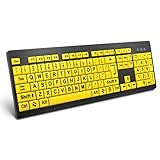
- ⌨【Large Print Keyboard】With letter characters larger than usual and command keys in a larger bolder font, these high-contrast keys can really help those who have trouble seeing keyboards. Perfect for elderly, the visually impaired, schools, special needs departments and libraries, as well as companies.
- ⌨【Spill resistant keyboard】It is designed to keep electronic components of keyboard safe. Water-Resistant function protection against accidental spills provides extra peace of mind. Be sure to air dry completely after spill before further use.
- ⌨【High Contrast】Large print keyboard offers increased visibility with easy to see yellow key caps and crisp large print black letters, Easily seen print, even in low light. With a life cycle of 5 million keystrokes, membrane key switches provide a faster response along with a quieter typing experience.
- ⌨【Ergonomics Design】Unfold the feet at back of the keyboard to reduce hand fatigue and enjoy long hours of playing. Full QWERTY English (US) 104 key keyboard layout with numeric keypad, Large Print keys provides superior comfort without forcing you to relearn how to type.
- ⌨【Wide Compatibility & Lifetime After-Sales Service】Compatible with Windows 10 / 8 / 7 / Vista / XP / 2000 / 98 | Also works with Mac OSX and macOS. Easy to install with plug and play technology | No additional software required.Except for Windows systems, other system hotkeys may not work and are only used for typing
Open accessibility settings
Press Windows logo key+U to open Windows 10 accessibility settings, called Ease of Access in Windows 10. From there you can configure Narrator and adjust related options such as speech behavior. The same area includes visual tools for people who combine speech with magnification, larger text, high contrast or pointer changes.
Open Mail and identify where focus is
- Press the Windows logo key to open Start.
- Type Mail.
- When Mail is announced in the results, press Enter.
- Listen for Narrator to announce the first focused control. Depending on your last session, focus may land on a folder, a message, a toolbar button or another control.
Focus is the control that receives keyboard input. Narrator announces its accessible name, role and sometimes its state. An accessible name is the text that identifies a control to assistive technology; without one, a button or field may be announced ambiguously. Microsoft’s Windows accessibility guidance explains that screen readers expose app text as speech or Braille and rely on accessible names to make controls understandable.
Use Tab to move forward through controls and Shift+Tab to move backward. Use the arrow keys when focus is inside a list, menu or other grouped control. Let Narrator finish announcing each item before pressing another key while you learn the layout.
Do these 3 things before closing this tab:
1Clear out junk files and repair common Windows errors2Scan for outdated or missing drivers - takes under a minute3Repair Windows errors before they cause bigger problemsUse scan mode to read message lists and email
Toggle scan mode
Press the Narrator key followed by Spacebar to toggle scan mode. By default, the Narrator key is either Caps Lock or Insert. For example, press Caps Lock+Spacebar or Insert+Spacebar, depending on which key is active in your Narrator settings.
Rank #2

- SEE WITH EASE, TYPE WITH CONFIDENCE – Featuring large, bold print, this large font key board makes every character easy to see. A great solution for seniors, students, and visually impaired users who want a more comfortable computer keyboard experience.
- SEE KEYS CLEARLY IN ANY LIGHT – Work day or night with a lighted keyboard for PC that includes 7 colors and 4 brightness levels. This backlit keyboard design ensures the keyboard light up keys stay visible in dim rooms, offices, or late-night study sessions.
- BOOST YOUR PRODUCTIVITY – The full-size 107-key layout includes a number pad and 12 shortcut keys, making this keyboard wired perfect for faster navigation, smoother workflow, and more efficient typing on any project.
- PLUG AND PLAY RELIABILITY – A simple USB keyboard connection delivers instant setup for PC, Chromebook, or as a keyboard for laptop. No software required, just connect this wired keyboard and start typing right away.
- DURABLE AND DEPENDABLE DESIGN – Built to handle daily use, this desktop keyboard is a long-lasting solution for home, office, or shared workspaces. A reliable keyboard designed for comfort and ease of use.
Scan mode is intended for navigating apps, email and web-like content with reading commands. When it is on, the arrow keys and scan commands can move through text and lists instead of activating every control immediately. When you need to operate a button or edit field, turn scan mode off or use the command that returns you to normal focus navigation.
Move through a message list
In recent Narrator versions, press I to move to the next list item and Shift+I to move to the previous list item. These commands are useful when an inbox contains many messages. Press Comma to move to the beginning of a long list or table and Period to move to its end.
Use the arrow keys to inspect nearby text when Narrator is reading a message row. Listen for the sender, subject and other details that Mail exposes. If the announcement stops at an item you want to open, press Enter.
Read an opened message
- Move to the target message in the inbox or another folder.
- Press Enter to open it.
- Use scan mode and reading commands to move through the sender, subject, body and available controls.
- Use Tab or Shift+Tab when you need to reach a specific button, such as a reply or delete control.
- Press Escape or use Mail’s visible navigation controls when you need to return to the message list; the exact control and focus location can vary by build.
Mail-specific Narrator command names are not completely documented for every Windows 10 build. If a command does not behave as expected, return to Tab, Shift+Tab and the arrow keys, which provide the most consistent way to discover the current interface.
Rank #3

- 【Large Print Keyboard】- 4X larger than standard keyboard fonts, clear and easy to find, and can really help those who have trouble seeing keyboards. Perfect for elderly, the visually impaired, schools, special needs departments and libraries, etc
- 【White LED Backlight】- Bright and evenly distributed backlit keys, easy typing in lower light environment. Ideal for studio work, office. Backlit can choose to turn on/off and adjust brightness.
- 【Full Size & Ergonomics Design】- Unfold the feet at back of the keyboard to reduce hand fatigue and enjoy long hours of playing. Full QWERTY English (US) 104 key keyboard layout with numeric keypad, Large Print keys provides superior comfort without forcing you to relearn how to type.
- 【Plug and Play & Wide Compatibility】 - This USB keyboard takes away the hassle of power charging or swapping out batteries and is easy to setup. No drivers required.Compatible with Windows 2000/XP/7/8/10, Vista,Raspberry Pi 3/4, Mac OS(Note: Multimedia keys may not fully compatible with Mac, OS System).Works with your PC, laptop.
- 【Spill-proof】- This durable keyboard features a spill-resistant design. So you don't have to worry about spilling coffee and water. Enjoy Keys life of more than 5000W times.
Compose and send a message without a mouse
To write a message, move focus to Mail’s compose or new-message control and press Enter. Narrator should announce the first edit field. Type directly into the active field, then press Tab to move through the recipient, subject, body and send controls. The exact order and labels can vary with the Mail build and account type, so listen to each announcement rather than assuming a fixed sequence.
- Activate the new-message control.
- Type the recipient in the recipient field. If Mail opens a suggestions list, use the arrow keys to choose an entry and press Enter, or continue typing if the address is accepted as plain text.
- Press Tab and enter a subject.
- Press Tab to reach the message body, then type your message.
- Press Tab until Narrator announces the Send control, then press Enter.
Before sending, use Shift+Tab to move backward through fields if you need to correct an earlier entry. If focus appears to leave the compose window, listen for the control name; you may have reached a formatting button or another toolbar item rather than the body.
Keyboard reference for the Windows 10 Mail workflow
| Action | Keys | What to expect |
|---|---|---|
| Toggle Narrator | Windows logo key+Ctrl+Enter | Starts or stops the built-in Windows 10 screen reader. |
| Open accessibility settings | Windows logo key+U | Opens Ease of Access settings, including Narrator options. |
| Move to the next control | Tab | Advances focus through buttons, fields and other controls. |
| Move to the previous control | Shift+Tab | Moves focus backward. |
| Move within a list or group | Arrow keys | Moves among messages, menu entries or text depending on focus. |
| Toggle scan mode | Narrator key+Spacebar | Switches between scan-mode reading and ordinary focus navigation. |
| Next list item in scan mode | I | Moves to the next list item in recent Narrator versions. |
| Previous list item in scan mode | Shift+I | Moves to the previous list item in recent Narrator versions. |
| Beginning of a long list or table | Comma | Jumps toward the start of the current list or table in scan mode. |
| End of a long list or table | Period | Jumps toward the end of the current list or table in scan mode. |
| Activate the focused item | Enter | Opens a message or activates the focused button or field. |
The Narrator key defaults to Caps Lock or Insert, but settings can change that assignment. If a shortcut appears not to work, confirm which key is configured as the Narrator key and whether scan mode is enabled.
Windows Errors? Fix Them Before They Spread
Repair common Windows errors and clear accumulated junk for a smoother, more stable PC - no reinstall needed.Free scan · no reinstallCrashes, No Sound, or Screen Glitches?
Random freezes, missing sound and display glitches usually trace back to one bad driver. Find and replace yours safely.Free scan · under a minuteImprove visual, speech and Braille access
Use high contrast and larger text
Windows 10 Ease of Access includes high-contrast themes and larger-text settings. These options help users who combine Narrator with residual vision. They change the wider Windows interface as well as Mail, so review the preview and choose the contrast and text size that remain comfortable across other applications.
Rank #4

- Large Print Computer Keyboard: It has large print font, Largest print on keycaps available in a full-size keyboard, these high-contrast keys can really help those who have trouble seeing keyboards. Designed for visually impaired, the elderly and Beginners to type.
- High Contrast: Large print keyboard offers increased visibility with easy to see white key caps and crisp large print black letters, Easily seen print, even in low light.
- Ergonomics Computer Keyboard: Full QWERTY English (US) 104 key keyboard layout with number pad, largest print on keycaps available in a full-size keyboard. Equipped 1.35 meters long cord, It just needs to be plugged into the computer to use, which is very convenient.
- High Quality Keyboard: It is made of ABS material, which is very wear‑resistant and durable. Large print keyboard with white keys and black letters, makes print quieter and more accurate. The durable membrane keys switch can provide 5 million keystrokes life.
- Wide Compatibility: Compatible with Windows 10 / 8 / 7 / Vista / XP / 2000 / 98 and OS X. No software installation CD is required. Suitable for notebook computers, desktop, laptop, etc.
Magnify a small area
Press Windows logo key+Plus sign to start or enlarge Magnifier. Magnifier is useful for checking a sender, icon or focus indicator while Narrator reads the same screen. Use the Windows accessibility settings to adjust Magnifier behavior and zoom level.
Adjust pointer and speech options
Ease of Access also provides pointer customization and speech settings. Pointer changes matter when a sighted helper is sharing control, while speech settings let you change how Narrator sounds and how quickly it reads. If you use Braille, configure the display through Narrator’s settings and verify that its driver and connection are recognized by Windows.
Prevent conflicts with another screen reader
Run one primary screen reader at a time. Microsoft warns that starting or stopping Narrator while another reader is already running can be distracting and may produce overlapping speech. If you normally use a different reader, close it before testing Narrator in Mail, or deliberately stop Narrator before returning to that reader. Running two readers simultaneously is mainly useful for a specific testing purpose, not ordinary email work.
Quick wins for a faster PC:
Clear out junk files and repair common Windows errorsFree Scan →Fix the driver behind crashes, sound loss and screen glitchesFind Drivers →Repair Windows errors before they cause bigger problemsFix Now →Troubleshoot common problems
Narrator does not speak
- Press Windows logo key+Ctrl+Enter again and wait for the startup announcement.
- Check the speech volume and output device in Windows sound settings.
- Press Windows logo key+U and review Narrator settings.
- Close another screen reader if it is running and retry.
Scan mode seems to do nothing
- Press the configured Narrator key plus Spacebar and listen for the scan-mode announcement.
- Try I, Shift+I or the arrow keys while focus is inside a message list or message body.
- Turn scan mode off when you need to activate a control, then use Tab and Enter.
Focus jumps or controls have unclear names
Use Shift+Tab to retrace the path and listen for each control’s name and role. An unlabeled or poorly labeled control may be an accessibility problem in the app rather than a keyboard mistake. Try the visible toolbar, menu and arrow-key navigation to locate an equivalent control, and note the exact wording and build if you need to report the issue.
Best Value

- High Contrast: This wired keyboard with yellow keys and large print black letters, Can provide greater visibility,Easy to view even in low light environment. Perfect for elderly and visual impairments
- Large print keyboard: It has large print font, 4x larger than standard computer keyboard fonts. You can easily read keyboard keys,Large print keys can reduce eyestrain and improve typ accuracy. Great for the visually impaired, the elderly and Beginners to type
- Spill resistant keyboard: The Spill resistant keyboard is designed to ensure the safety of the electronic components of the keyboard. Before use, make sure to dry thoroughly after spilling.
- Large Print Yellow keys: Large print keyboard with yellow keys, Makes print quieter and more accurate. High quality ABS print can prevent the color wear of the keys. The durable membrane keys switch can provide 5 million keystrokes life.
- USB Wired & Wide Compatibility: USB wired keyboard with wired USB connection plug and play!, No need to worry about charging or replacing batteries,and is easy to set up, no driver required, compatible with Windows.
Mail cannot be found
Search for Mail from the Windows key. If no result appears, confirm whether Mail is installed on that Windows 10 build and whether your organization has removed or restricted it. The available app and its controls are not guaranteed to be identical on every Windows 10 installation.
Choosing Narrator or another screen-reader setup
Narrator is the simplest starting point because it is already part of Windows 10. If another screen reader is installed, choose the setup that best matches your usual commands, speech or Braille output, Mail behavior and Windows build. The important comparison is practical: whether the reader is available on the computer, announces Mail’s controls clearly, supports the output method you use and can coexist with your existing accessibility workflow without conflicts.
| Decision point | Narrator | Another installed screen reader |
|---|---|---|
| Installation | Built into Windows 10; no separate download is required. | Availability and installation depend on the software and your permissions. |
| Keyboard convention | Uses the Narrator key, Tab, arrows and scan-mode commands documented for Windows. | May use a different command layer or modifier key. |
| Mail navigation | Uses Windows focus navigation and Narrator scan mode. | Behavior depends on that reader’s support for your Mail and Windows build. |
| Speech and Braille | Provides speech and can support Braille through Narrator settings and compatible hardware. | Output features depend on the reader, drivers and connected device. |
| Running together | Microsoft advises avoiding simultaneous use with another reader during normal work. | Use one primary reader unless you have a deliberate testing reason. |
A reliable daily routine
- Start your chosen screen reader before opening Mail.
- Open Mail with Windows Search and identify the focused control.
- Use Tab, Shift+Tab and arrow keys to locate the folder and message list.
- Enable scan mode for long lists or message text.
- Open a message with Enter, then move between reading content and action buttons deliberately.
- When composing, listen to every field announcement and use Tab to reach Send.
- Stop Narrator before starting another screen reader.
Once these focus and scan-mode habits are familiar, checking and composing email in Windows 10 Mail can be done entirely from the keyboard. The exact control names may change with a Windows build, but the underlying method remains the same: start one screen reader, keep track of focus, switch scan mode when reading, and use standard keyboard navigation when operating controls.
Quick Recap
Product prices and availability are accurate as of the date/time indicated and are subject to change. Any price and availability information displayed on Amazon at the time of purchase will apply.

