Test a bank notification parser by checking both what it emits and what it fails to emit, then reconcile its output against a sufficiently complete, authoritative transaction source. In production, monitor for gaps, duplicates, field changes, processing failures and delays—and preserve enough versioned evidence to investigate each discrepancy. Official guidance supports these control goals; the parser-specific test cases and signals below are engineering recommendations, not prescribed standards.
Define what correct parsing means
Before writing tests, document the parser’s contract: which banks and notification formats it supports, which fields it must capture, and what each field means. Include the treatment of signs and amounts, currencies, dates and time zones, merchant or payee text, and account identifiers. Specify how pending, reversed, corrected and repeated events are represented, and whether malformed or incomplete messages are rejected, quarantined or partially accepted.
As an Amazon Associate I earn from qualifying purchases.
This contract is a local design decision, not a format prescribed by regulators. It gives reviewers a concrete basis for deciding whether the parser captured the intended information—a concern reflected in FFIEC examination procedures, which call for periodic testing of system capabilities and thresholds to confirm accurate capture and appropriate filters: FFIEC BSA/AML Examination Manual: Suspicious Activity Reporting.
Quick wins for a faster PC:
Repair Windows errors before they cause bigger problemsFix Now →Scan for outdated or missing drivers - takes under a minuteDriver Scan →Clear out junk files and repair common Windows errorsFree Scan →Build a test set that can expose silent errors
Keep representative input notifications and their expected structured outputs for each supported bank and format. Protect or redact sensitive data under your organization’s privacy and retention controls; preserve the details needed to test parsing behavior.
#1 Best Overall

- Compact and Sturdy: These checkbook registers offer clear pages with 17 lines each, making it easy to track account withdrawals; The bold layout and spacious rows and columns (0.32 in wide) provide a comfortable writing experience
- Simplify financial management: The Casmonal account books help you effortlessly remember automatic deductions, dodge overdraft risks, and gain insight into your spending patterns, making financial tracking simple and clear
- Financial instruments: These transaction Registers simplifie your financial monitoring, helping you easily manage your balance, precisely budget, and work towards your financial goals; It's a convenient tool for achieving financial success
- Personal and Small Business Finances: The check register simplifies tracking of payments and deposits, equipped with columns for item numbers, transactions, and balances, making it an ideal tool for managing both personal and small business finances
- Small and Portable: These compact 6x3 inches checkbooks are perfect for on-the-go financial tracking and feature a stylish calendar from 2026 to 2028, guiding you through a better financial journey
Include positive, boundary and negative cases
- Ordinary transactions and boundary amounts, dates and time zones.
- Different currencies and optional or missing fields.
- Pending items, reversals, corrections and repeated delivery.
- Duplicate-looking notifications that are actually separate, legitimate purchases.
- Malformed content, changed formats and messages that should not produce a transaction.
For each case, assert field-level results—not just that processing completed. Check that amounts, signs, currencies, dates, identifiers and event status match the expected meaning. Include negative cases so the test suite catches false transaction creation as well as omissions.
Check duplicates and gaps as separate failure modes
Replay each fixture and verify that repeated input follows the system’s documented idempotency policy. Where the upstream channel provides event identifiers or sequence information, check for missing values or breaks. Government financial-system guidance identifies duplicate detection, gap detection, joins and reconciliation as data-integrity monitoring techniques: GAO, A Manager’s Guide for Monitoring Data Integrity in Financial Systems.
Rank #2
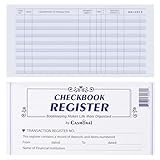
- Compact and Sturdy: These checkbook registers offer clear pages with 17 lines each, making it easy to track account withdrawals; The bold layout and spacious rows and columns (0.32 in wide) provide a comfortable writing experience
- Simplify financial management: The Casmonal account books help you effortlessly remember automatic deductions, dodge overdraft risks, and gain insight into your spending patterns, making financial tracking simple and clear
- Financial instruments: These transaction Registers simplifie your financial monitoring, helping you easily manage your balance, precisely budget, and work towards your financial goals; It's a convenient tool for achieving financial success
- Personal and Small Business Finances: The check register simplifies tracking of payments and deposits, equipped with columns for item numbers, transactions, and balances, making it an ideal tool for managing both personal and small business finances
- Small and Portable: These compact 6x3 inches checkbooks are perfect for on-the-go financial tracking and feature a stylish calendar from 2026 to 2028, guiding you through a better financial journey
A repeated notification is not automatically a duplicate transaction: distinguish repeated delivery of the same event from two genuine purchases with similar details. The FFIEC’s ACH examination procedures discuss investigating possible fraudulent or duplicate ACH transactions, but they do not define a universal deduplication rule for notification parsers: FFIEC BSA/AML Examination Manual: Automated Clearing House Transactions.
The Tool Desk
Outbyte PC Repair FREERepair Windows errors before they cause bigger problemsFix Now →Outbyte Driver Updater FREEScan for outdated or missing drivers - takes under a minuteDriver Scan →Test before release and after meaningful changes
- Run the relevant regression cases. Before deployment, test every affected bank format, mapping, parser rule and dependency against the saved expected outputs. Include cases for unchanged formats that share the affected logic.
- Compare old and new outputs. Review field-level differences and explain intended changes. Investigate unexplained shifts in record counts, amounts, dates, status or null fields.
- Fix material issues and retest. Do not release with unresolved mapping, transaction-coding or data-quality problems. The Central Bank of the UAE’s pre-implementation testing rule calls for remediation and retesting of such issues before deployment: Central Bank of the UAE, Rule Definition and Pre-Implementation Testing.
- Record the change and approval. Retain the change description, affected formats and rules, test evidence, reviewer and release version. Basel Committee guidance supports change controls, tamper detection and clear audit trails: Basel Committee, Digitalisation and financial technology risks.
Set test scope and frequency according to the risk and role of the parser. Federal Reserve interagency information-security guidance supports risk-based testing of key controls and testing performed or reviewed independently of development and maintenance: Interagency Guidelines Establishing Information Security Standards. For systems supporting regulated operations or important customer controls, arrange independent review proportionate to the potential impact.
Rank #3

- Keep Your Finances Organized: A very simple and efficient check register, it suitable for personal and commercial use. You can record checks, deposits, withdrawals and any budget notes you want to achieve your financial goals.
- Holds a Lot of Entries:2834 entries in total /26 entries each page. So many pages and this will last a long time. You can keep it instead of the individual check registers. More room to make notes on an entry. Each line is big enough to read what is written.
- Thick Pages and doesn’t Bleed Through: 100gsm paper, no bleed through. 180°lay flat so it’s easy to write in. With a pen loop, bookmarker and pocket for storing receipts and checks.
- Perfect Size for Carrying: Register book Size 5.8in x 8.3 in, perfect size for keeping track of multiple accounts. Enough to take with you in your purse and write down transactions through out the day.
- Ideal Gift Options: Great for keeping banking activity. A great present for Children, parents, colleagues, friends. during various holidays, birthdays and anniversaries, such as Christmas, Thanksgiving, Mother's Day.
Reconcile parser output against a source of record
Parser-local tests cannot show whether the upstream channel delivered every transaction. At an interval appropriate to the system’s risk and available data, compare parsed events with a bank statement or another authoritative, sufficiently complete transaction source. The guidance supports reconciliation as a data-integrity technique; it does not prescribe a universal matching key or interval for bank notifications.
- Choose the comparison period and source. Document which source is authoritative for the check, its coverage, and any timing differences between notifications and posted transactions.
- Match conservatively. Use stable identifiers where available. If no stable identifier exists, define and validate a matching method using suitable fields such as account, amount, currency and date; allow for legitimate status changes or posting delays rather than treating every difference as an error.
- Compare counts and records. Look for missing, extra, duplicated, unmatched or altered entries, including amount changes and date shifts. Keep a record of the match result and any exclusions or unresolved items.
- Investigate mismatches. Determine whether a difference came from missed delivery, parsing, duplicate handling, timing, source coverage or the matching method. Feed confirmed causes into regression cases and operational fixes.
Monitor the whole pipeline in production
Successful processing alone is not proof that intended information was captured. Combine parser-local health with source-to-output checks and anomaly monitoring. Federal Reserve guidance describes transaction and audit logs as tools to identify unauthorized activity, reconstruct events and promote accountability, and supports anomaly monitoring: Authentication and Access to Financial Institution Services and Systems; Interagency Guidance.
Rank #4

- 12 Easy Read Register Checkbook Transaction Registers: Balance your check account withdrawals with this checkbook register featuring 16 lines per pages. This thicker body paper is small enough to carry in your pocket or wallet. Column headings are bold easy to read.
- Made in the USA. Each register has 444 lines. Lines are gray in color. Standard checkbook registers having Item No. Date, Description of Transaction, Payment Debit, Deposit Credit and Balance Column.
- High-quality ink print is easy on the eyes and a great booklet for easy insertion into your checkbook.
- Calendars on Back: Check register has up-to date 2025-2026-2027 calendars printed on the back.
- Checkbook Measures: Checkbook register measures 6x3 inches.
The following are useful candidate signals inferred from those control goals, not mandated metrics or thresholds:
What’s actually slowing this PC down?
Pick the symptom - the matching free tool is one click away.
- Coverage: mismatches between source and parsed counts, missing source identifiers, or sequence gaps where sequence data exists.
- Integrity: duplicate output rates, unmatched reconciliation entries, and unexpected shifts in null rates or distributions of critical fields such as amounts, currencies and dates.
- Processing health: parsing failures, quarantine volume and time from source receipt to usable output.
- Change: edits to parser rules, bank mappings or thresholds, especially when followed by changes in output patterns.
Set alert thresholds from a measured baseline, known source behavior and the operational cost of a false alert versus an undetected error. The cited guidance establishes no universal numeric threshold, reconciliation interval or parser-specific performance target.
Best Value

- FINANCIAL TRACKING MADE SIMPLE - Say hello to a stress-free financial life with the Superior Register Check and Debit Card Register. This personal transaction register simplifies the process of managing your money, allowing you to record deposits, withdrawals, and budgeting notes. It's the ideal book for expenses, whether for personal use or as an accounting ledger for your small business.
- ENHANCED STANDARD EDITION – The Superior Register’s Standard Edition amplifies your financial organization with extra lines per page for transaction register entries. This allows you to maximize your ledger's space and swiftly reference previous entries in your check register, making it a comprehensive accounting notebook and bookkeeping book.
- OPTIMAL ORGANIZATION AND DESIGN – Experience ultimate financial organization with the Superior Register, doubling as a checkbook register and checking account ledger. Its running tax ticker is ideal for tax season referencing, while the clearance ticker aids in efficient account reconciliation. Its user-friendly design is perfect for frequent debit card users, making it a versatile checkbook organizer for office and personal use.
- HIGH-CAPACITY ENTRY LINES – Designed for meticulous money planners, the Superior Register boasts 2,600 entry lines. Each page offers 26 lines across 50 pages, making it a durable tool for tracking bills, budgets, and general cash flow. This deluxe transaction register and income and expense log book for small businesses can keep pace with even the most robust financial activities.
- PROUDLY MADE IN THE USA - Rest assured knowing your new checkbook register is not only durable but also made right here in the USA. Crafted from both new and recycled materials, the Superior Register is spiral bound and designed to lay flat for easy use. The perfect ledger book for small business or personal finances, measuring a convenient 8.5" x 5.5".
Make discrepancies investigable
For each alert or reconciliation exception, retain the relevant source event, parsed output, parser and mapping versions, timestamps, validation or reconciliation result, and investigation disposition. Restrict access and apply appropriate privacy and retention controls. Logs should be usable to reconstruct what happened and who or what changed it; Federal Reserve guidance describes those reconstruction and accountability purposes, while Basel Committee guidance emphasizes audit trails and tamper detection.
- Detect and preserve. Capture the alert context and evidence before transient data or processing state is lost.
- Investigate. Compare the original event with the parser output and source-of-record result. Identify whether the issue is an omission, incorrect field, duplicate, delay, upstream gap or matching error.
- Escalate and disposition. Route the case to the owner defined by your operational control process, record the decision and any customer or downstream impact, and document the resolution or reason for no action.
- Prevent recurrence. Where the parser or mapping caused the error, add a regression case and use the normal change, review and retest process before release.
FFIEC procedures discuss defined escalation from initial detection through disposition in transaction-monitoring contexts. That is a useful control-design reference, not a claim that every bank notification parser is itself an anti-money-laundering surveillance system.
Choose controls to match risk and jurisdiction
For a parser or monitoring setup, assess whether it can detect omissions and duplicates as well as field-level errors; reconcile against an authoritative source; replay inputs and run regression tests; trace outputs to versions and audit evidence; and support response at an operationally manageable latency. These are control-oriented comparison criteria, not product rankings or benchmark results.
The cited materials come from U.S. Federal Reserve and FFIEC sources, U.S. government financial-system guidance, Basel Committee guidance and a UAE rulebook. They support general control principles, not a jurisdiction-specific legal determination for every deployment. Confirm applicable local requirements, privacy and retention rules, and which transaction source is authoritative and sufficiently complete for your system.
Quick Recap
Product prices and availability are accurate as of the date/time indicated and are subject to change. Any price and availability information displayed on Amazon at the time of purchase will apply.

