Crashes, No Sound, or Screen Glitches?
Random freezes, missing sound and display glitches usually trace back to one bad driver. Find and replace yours safely.Free scan · under a minuteWindows Errors? Fix Them Before They Spread
Repair common Windows errors and clear accumulated junk for a smoother, more stable PC - no reinstall needed.Free scan · no reinstallDo not store a Ryobi lithium-ion battery in a parked car. Remove the pack whenever you leave the vehicle and keep it indoors in a dry, sheltered place away from heat, sunlight, moisture and metal objects. The RYOBI 18V RB1840C operator manual says, “To reduce the risk of serious personal injury, do not store outside or in vehicles.” The U.S. Fire Administration (USFA) likewise says not to put lithium-ion batteries in direct sunlight or keep them in hot cars.
You can transport a battery to a job site, but transport is different from storage. The official instructions do not establish a universally safe number of minutes or hours for leaving any Ryobi model in a vehicle. Your exact pack’s operator manual takes priority, especially if its model, market or temperature guidance differs.
As an Amazon Associate I earn from qualifying purchases.
Can I leave a Ryobi battery in my car?
No. A car is not an appropriate storage location for a Ryobi battery, even if the vehicle is parked in the shade. The RB1840C 18V battery manual prohibits storage “outside or in vehicles,” and RYOBI Support Australia gives the same instruction: “Do not store in a vehicle.” Those are storage instructions, not a claim that every brief stop will cause a failure; they mean the vehicle should not become the battery’s regular resting place.
Heat makes the risk more obvious. A closed passenger compartment or trunk can become much hotter than the surrounding air, and a battery in direct sun receives additional radiant heat through glass. USFA’s lithium-ion guidance specifically says, “Don’t put lithium-ion batteries in direct sunlight or keep them in hot cars.” A shaded car can still be warm, and shade does not change the manufacturer’s general prohibition on vehicle storage.
#1 Best Overall
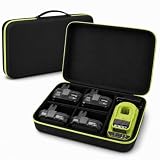
- For ryobi case fits for: For ryobi 18v battery box fits for TTI 18 Volt for Ryobi Charger PCG002/ for Ryobi P118B 18V Battery Charger/ P119 ONE+NiCad Lithium Ion battery charger/ for ryobi 12v battery charger. For ryobi battery bag is also compatible with various types of batteries -- for Ryobi PBP005 ONE+18V Lithium Ion 4.0 Ah/3.5Ah/1.5Ah/3.0Ah/2.0Ah/3.8Ah battery. Note: For ryobi 18v battery charger holder is not suitable for 5.0/6.0/6.5AH batteries (Only tool box)
- Separate storage for ryobi battery charger and batteries: For ryobi 18v battery and charger combo organizer is equipped with removable partitions, two long ones and four short ones. The partitions can be placed according to the size for ryobi 18v charger and for ryobi batteries, so as to better fix for ryobi 18v battery and charger, and reduce their friction and collision.
- Strong for ryobi tools combo kit case: For ryobi 18v container made of -quality materials, is against dust and shockproof. So for ryobi 18v tool box protects for ryobi one chargers and 18v for ryobi battery from dust intrusion and prolong their service life. For ryobi charger 18v storage holder with soft line, better protects for ryobi charger station and for ryobi replacement batteries .
- For ryobi one 18v battery bag with smooth zipper: The sturdy zipper for ryobi 18v battery 4.0 ah carrying holder provides good sealing protection for 18 volt for ryobi battery and charger. Double zipper allows you to quickly open and close for ryobi lithium 18v battery organizer and easily access for ryobi 18 volt battery. The color for roby battery container is consistent with color for ryobi batteries 18v lithium, which is simple and beautiful.
- Easy to carry for ryobi one battery case: Batteries for ryobi box has a sturdy handle, for easily carrying cordless tool battery packs to your workplace. For ryobi 18v lithium battery holder is light and compact. You can also put for ryobi replacement battery organizer behind your toolbox and boot, and it won't take up much space. External dimensions of lithium 18v for ryobi battery storage bag: 15.35 * 8.67 * 3.35 inches.
Because the official guidance does not define a safe in-car duration for temporary transport, do not invent one. Take the pack inside when you arrive, when the vehicle will be unattended, or whenever practical. If you regularly leave batteries in the vehicle between jobs, change that routine rather than trying to solve it with a case or toolbox.
What the official guidance actually says
The instructions below come from three official sources with different scopes. The RB1840C document applies to that specific 18V battery model; USFA provides general lithium-ion safety guidance; and the RYOBI Australia page is regional support advice. Use them together without treating one model’s figures as a universal specification.
| Source | Scope | Relevant instruction |
|---|---|---|
| RYOBI 18V RB1840C operator manual | RB1840C 18V pack | Do not store outside or in vehicles. For storage longer than 30 days, keep below 27°C and in a “charged” condition of at least 30–50%, according to the manual’s wording. Keep terminals from contacting metal objects. |
| U.S. Fire Administration, Battery Fire Safety | General lithium-ion battery safety | Store at room temperature when possible; do not use direct sunlight or hot cars. Do not charge below 0°C or above 40°C. Watch for odor, color change, excessive heat, shape change, leaking or unusual noises. |
| RYOBI Support Australia | RYOBI support guidance for Australia | Do not store in a vehicle. Keep batteries sheltered and away from temperature extremes and humidity. Regional advice may not match every model or country. |
The distinction matters because “Ryobi battery” covers many capacities, chemistries and markets. A figure printed in the RB1840C manual should be applied first to an RB1840C pack, not automatically to every ONE+ battery. Conversely, USFA’s charging limits are general safety guidance, not a replacement for the battery and charger manuals.
Storage and transport are different decisions
| Situation | What to do | What is not established |
|---|---|---|
| Regular storage between jobs | Remove the pack from the vehicle and keep it indoors in a dry, sheltered location. | No official source supports using a car as a normal storage cabinet. |
| Driving directly to a job site | Carry the battery with you, keep it out of direct sun and remove it when you arrive or park for an extended period. | The sources do not set a universal “safe for X hours” limit in a vehicle. |
| Longer than 30 days | For the RB1840C manual’s advice, keep the pack below 27°C and at 30–50% charge. | Those figures are not verified as universal settings for every Ryobi pack or market. |
| Battery is hot, damaged or behaving abnormally | Stop using it, move people away from it and follow the safety and disposal guidance for your area. | A bag, box or organizer has not been shown to make vehicle storage safe. |
Transport still calls for care. Keep the battery from sliding under seats, being crushed by cargo or contacting loose hardware. Do not leave it clipped to a tool that could be switched on accidentally. A short drive to a job site is a different decision from leaving the pack in a parked vehicle through a workday, overnight or a weekend, but neither situation overrides the manual’s storage warning.
A safe routine every time you park
- Plan to take the pack inside. Before leaving home, treat the battery as equipment you must unload, not as a permanent part of the vehicle. This avoids forgetting it after a workday, shopping trip or change of vehicle.
- Switch off the tool and remove the battery. Do not leave a pack clipped into a tool in the car. Separate packs from chargers and tools before carrying them indoors.
- Keep the pack shaded during the trip. If you are driving to a site, place it where direct sunlight cannot reach it. This is a transport precaution, not permission to store it in the vehicle after arrival.
- Prevent movement and impact. Put the pack where it cannot be crushed by lumber, boxes or luggage. Keep it away from liquids and from objects that could strike or scrape the housing.
- Inspect it before putting it away. Look and smell for swelling or another shape change, leaking, discoloration, unusual odor, excessive heat or odd noises. Any of these signs means the pack should not go back into service.
- Let an unusually warm pack cool before charging. USFA says not to charge lithium-ion batteries below 0°C or above 40°C. If a pack has been in a hot vehicle, bring it to a normal indoor temperature and consult the exact operator manual before connecting a charger.
- Choose a stable indoor location. Use a dry, sheltered place away from heaters, radiators, stoves, windows with strong sun and damp areas. Keep the battery where it cannot fall, be crushed or be handled by children.
- Separate the terminals from metal. Loose packs should not share a pocket, drawer or toolbox with keys, coins, screws, nails or other conductive objects. The RB1840C manual warns against objects bridging the terminals, which can create a short circuit.
- Record the model number. Ryobi sells multiple battery models and markets can publish different care instructions. Keep the manual for the exact pack or download it from the manufacturer’s support system so you can check its storage and charging limits.
Where to store a Ryobi battery indoors
The goal is a stable, sheltered environment rather than a special accessory. A dry utility shelf, workshop cabinet or interior cupboard can work if it stays at a moderate temperature and does not expose the pack to humidity, impact or metal clutter. RYOBI Australia’s support guidance emphasizes shelter and avoiding temperature extremes and humidity; USFA says room temperature when possible.
Rank #2

- Note:External dimensions L*W*H: 13.7*9*4.9 inches. Selling box only; no other items available(18V Battery and Charger Combo for Ryobi 18 Volt Cordless Tools Battery and other accessories are not included).
- I've tried many EVA case, but they were low-quality. So I created my own using EVA material. Tested results: waterproof, scratch-proof, and shock-resistant.
- For the inner materials, I chose three options: velvet (great for Velcro integration), super-soft fabric for maximum protection, and common Jersey fabric.
- To create a perfect-fit case, I'll first get an 18V Battery and Charger Combo for Ryobi 18 Volt Cordless Tools Battery,then customize the case specifically for it. It takes time, but that's what makes the fit just right.
- Tourmate Hard Case is here! With a sturdy shell, soft lining, plus handle, clasps, and straps—all custom-designed for Tourmate's needs. Made to bring you tidy, hassle-free convenience!
- Keep the pack away from direct sunlight, especially through a window or glass door.
- Do not place it beside a furnace, radiator, boiler, oven, vehicle exhaust or other heat source.
- Avoid damp basements, outdoor sheds that experience condensation and locations where water can drip onto the terminals.
- Leave enough space to inspect the pack and remove it without scraping the terminals against metal.
- Keep it on a stable surface instead of an edge where it can fall.
- Do not place heavy tools or containers on top of the battery.
- Do not cover a questionable or damaged pack in an attempt to hide symptoms; isolate it according to local hazardous-battery guidance instead.
There is no indication in the cited guidance that a fireproof bag, battery box or organizer makes it acceptable to store a Ryobi pack in a car. Such accessories should not be used as a substitute for removing the battery from the vehicle. An organizer can also conceal swelling, leakage or heat, so inspection must remain part of the routine.
Long-term storage: the RB1840C figures and their limits
If you will not use an RB1840C pack for more than 30 days, its operator manual says to keep it below 27°C and in a “charged” condition of at least 30–50%. In practical terms, readers commonly interpret that wording as maintaining roughly a 30–50% charge for extended storage, but the manual’s exact language and your model’s instructions control. Do not present 27°C or 30–50% as a universal Ryobi specification without checking the label and manual for your pack.
Do these 3 things before closing this tab:
1Clear out junk files and repair common Windows errors2Scan for outdated or missing drivers - takes under a minute3Repair Windows errors before they cause bigger problemsThese numbers describe longer-term storage, not a safe temperature for leaving a battery in a car. A parked vehicle can exceed that condition, particularly in sun or warm weather. A trunk may be out of sight but is still part of the vehicle and can experience substantial heat. If your battery model provides a different storage range or charge recommendation, use that model-specific information rather than copying the RB1840C figures.
Before putting a pack away for a long period, remove it from the tool, check the housing and terminals, and note the date. Recheck it according to the exact manual rather than repeatedly topping it to full charge by habit. The 30-day threshold belongs to the RB1840C instruction; it is not a promise that every Ryobi pack needs the same schedule.
What to do if a battery has been left in the car
If it looks normal
- Remove the pack from the vehicle as soon as practical, keeping it out of direct sun.
- Place it in a dry indoor location away from heat and metal objects.
- Allow it to return to a normal indoor temperature before charging or using it.
- Check the exact model’s manual for any inspection, temperature or charging instruction that applies after exposure.
A normal appearance does not prove that the battery was stored under recommended conditions; it simply means there is no obvious warning sign. Make removing the pack part of your parking routine. Do not assume that a single exposure establishes a safe future practice.
Rank #3

- COMPATIBILITY CHECK: This battery storage case fits compact batteries for Ryobi ONE+ 18V in 1.5Ah, 2.0Ah, 3.0Ah, 3.5Ah, 3.8Ah and 4.0Ah sizes, plus select chargers including PCG002, P118B and P119. Not designed for 5.0Ah, 6.0Ah or 6.5Ah batteries. Case only
- CUSTOM 6-DIVIDER STORAGE: Two long and four short removable dividers create dedicated sections for battery packs, a charger and small accessories. The separated layout helps reduce contact, shifting and workshop clutter
- HARD-SHELL EVERYDAY PROTECTION: The structured shell and soft lining help shield stored power tool batteries from dust, scratches and light bumps during normal storage and transport. No batteries, charger or tools are included
- FAST ACCESS & EASY CARRY: Dual zippers open wide for quick battery selection, while the reinforced handle supports trips between the garage, workshop, vehicle and jobsite
- SIZE BEFORE YOU BUY: External dimensions are 15.35 x 8.67 x 3.35 in. Compare the dimensions of your complete battery-and-charger setup with the case size and divider layout before ordering
If it is hot, swollen, leaking or otherwise abnormal
Do not charge it, install it in a tool or continue testing it. USFA identifies odor, color change, excessive heat, shape change, leaking and unusual noises as warning signs. Keep people away, avoid handling a compromised pack more than necessary and contact your local fire department, waste authority or battery-recycling service for instructions. Do not place a damaged lithium-ion battery in ordinary household trash or a regular recycling bin unless your local authority explicitly says it is accepted.
Quick wins for a faster PC:
Fix the driver behind crashes, sound loss and screen glitchesFind Drivers →Clear out junk files and repair common Windows errorsFree Scan →If the battery is smoking, sparking or igniting, leave immediately and call emergency services. Do not carry a burning pack through the house or put yourself between it and an exit. Tell responders that a lithium-ion battery is involved so they can apply their own procedures.
Charging after vehicle exposure
Charging is a separate hazard from storage. USFA’s general guidance says not to charge lithium-ion batteries below 0°C or above 40°C. Those are charging limits in the USFA guidance, not a Ryobi storage range. A pack that has been sitting in a cold or hot vehicle should be brought inside and allowed to reach an appropriate temperature before charging. Follow the charger and battery manual for the exact model, and charge in the location and manner the manufacturer specifies.
Never use a charger to “test” a battery that is swollen, leaking, discolored, unusually hot or making odd noises. The warning sign itself is a reason to stop using the pack, not a reason to see whether charging restores it. Use the manufacturer-approved charger and inspect its cord and connectors before use; do not improvise a connection or bypass a charger fault.
What happens in a lithium-ion battery fire
If a lithium-ion battery begins smoking, ignites or produces intense heat, leave the area and call emergency services. USFA instructs people to get out and call 911 rather than attempting to extinguish a lithium-ion battery fire themselves. Warn others nearby only if you can do so without approaching the battery, and do not re-enter until responders say it is safe.
Free tools Windows power users keep installed
One-click scans. No signup required.
Rank #4

- COMPATIBILITY CHECK: This battery storage case fits compact batteries for Ryobi ONE+ 18V in 1.5Ah, 2.0Ah, 3.0Ah, 3.5Ah, 3.8Ah and 4.0Ah sizes, plus select chargers including PCG002, P118B and P119. Not designed for 5.0Ah, 6.0Ah or 6.5Ah batteries. Case only
- CUSTOM 6-DIVIDER STORAGE: Two long and four short removable dividers create dedicated sections for battery packs, a charger and small accessories. The separated layout helps reduce contact, shifting and workshop clutter
- HARD-SHELL EVERYDAY PROTECTION: The structured shell and soft lining help shield stored power tool batteries from dust, scratches and light bumps during normal storage and transport. No batteries, charger or tools are included
- FAST ACCESS & EASY CARRY: Dual zippers open wide for quick battery selection, while the reinforced handle supports trips between the garage, workshop, vehicle and jobsite
- SIZE BEFORE YOU BUY: External dimensions are 15.35 x 8.67 x 3.35 in. Compare the dimensions of your complete battery-and-charger setup with the case size and divider layout before ordering
A vehicle fire can spread quickly and exposes occupants to smoke and heat in a confined space. A battery hidden in a trunk may also be discovered later than one stored in an occupied room. This is another reason the safest policy is simple: unload Ryobi batteries instead of leaving them in the car.
Independent reader supportYour contribution helps us test, update, and keep practical guides available for everyone.Common situations and the right choice
| Question | Answer |
|---|---|
| Can I keep a Ryobi ONE+ 18V pack in the trunk permanently? | No. The cited Ryobi manual and RYOBI Australia support both say not to store batteries in a vehicle. |
| Is a shaded parking space enough? | No. Shade may reduce direct sunlight, but it does not turn the vehicle into an approved storage location. |
| Can I leave the pack in the car while I run one quick errand? | The sources do not define a universally safe duration. For a brief transport stop, take the pack with you whenever practical rather than relying on an assumed time limit. |
| Does a closed toolbox make car storage safe? | No indication establishes that a toolbox, bag or battery case makes vehicle storage safe. It may also conceal heat or damage. |
| Should I fully charge a pack before storing it for months? | For the RB1840C manual, storage longer than 30 days is described as below 27°C and 30–50% charge. Check your own model instead of assuming a full charge is appropriate. |
| Can I store the battery in an outdoor shed? | The cited manual says not to store outside, and RYOBI Australia advises sheltered storage away from temperature extremes and humidity. An uncontrolled shed is therefore not a reliable substitute for indoor storage. |
| What if my battery was exposed to freezing temperatures? | Move it to a sheltered indoor place and consult the exact model’s instructions before charging or use. Do not charge outside the temperature limits stated by the manufacturer and USFA guidance. |
| Can I leave the battery connected to a charger in the car? | No. Vehicle storage is already discouraged, and charging adds heat and electrical risk. Charge only in the manner and location specified by the battery and charger manuals. |
| Is a spare battery safer than the one in my tool? | No. Loose and installed packs are both lithium-ion batteries and both should be removed from a vehicle when it is parked. A loose pack also needs protection from metal objects that could bridge its terminals. |
| How do I know which temperature and charge figures apply? | Read the operator manual for the model number printed on your pack. The RB1840C figures are specific guidance for that manual, while USFA’s 0°C and 40°C figures address charging generally. |
A simple end-of-day checklist
- Battery removed from the tool and vehicle.
- No direct sun, heater, moisture or extreme temperature exposure.
- No swelling, leakage, discoloration, odor, excessive heat or unusual sound.
- Terminals separated from keys, coins, screws and other metal.
- Pack stored indoors in a dry, sheltered location.
- For storage beyond 30 days, the exact manual’s charge and temperature guidance checked.
- Battery not hidden under cargo or left where children can handle it.
- Any fire or severe abnormal behavior treated as an emergency: leave and call 911.
The safest answer to “How should I store Ryobi batteries when I’m not using them?” is consistent across the cited guidance: remove them from the car, keep them indoors and sheltered, protect the terminals, and follow the manual for the exact battery model.
Frequently Asked Questions
Can I leave Ryobi batteries in my car overnight?
No. The RB1840C operator manual and RYOBI Support Australia say not to store batteries in a vehicle. Remove the pack and keep it indoors instead.
Is it safe to store a Ryobi battery in a hot car?
No. USFA specifically warns against hot cars and direct sunlight. Bring the battery indoors and let it return to a suitable temperature before charging.
The Tool Desk
Outbyte PC Repair FREEClear out junk files and repair common Windows errorsFree Scan →Outbyte Driver Updater FREEScan for outdated or missing drivers - takes under a minuteDriver Scan →What charge level is best for long-term storage?
For the RB1840C manual, storage longer than 30 days calls for below 27°C and a 30–50% charged condition. Confirm the advice for your exact model.
Best Value

- Tool battery organizer, designed for 12v/18v/40V battery and charger case, this battery organizer is suitable for ryobi 12v/18v/40V (PBP002 PBP003 PBP004 PBP005 PBP006 PBP007 P102 P103 P104 P105 P106 P107 P108 P189 P190 P191 P192 P193 P194 OP4040 OP4050) battery and charger, size of the hard case: 13.5 x 12.2 x 3.7 inches
- The hard case is suitable for different sizes of ryobi 18v lithium battery and contains 5 removable dividers for free DIY storage space inside the hard case, each ryobi oneplus battery can be separated by removable and adjustable baffles to avoid 18 volt ryobi battery from being bumped
- This hard case replacement for ryobi 40 volt battery is made of high quality EVA material, shockproof, dustproof and waterproof, protect your ryobi 40v lithium battery from impact and splash
- The hard shell can ensure your ryobi lithium 18v battery is safe and convenient, with light weight. The classic zipper design makes it easy to open and close.
- Note: Only case is sold, ryobi battery and charger are not included.
Can a battery case make car storage safe?
No official instruction cited here says a case, bag or toolbox makes vehicle storage acceptable. Use accessories to organize transport, not to justify leaving a pack in a parked car.
What should I do with a swollen or leaking Ryobi battery?
Stop using and charging it, keep people away, and contact local fire, waste or battery-recycling authorities for handling instructions. Do not put it in household trash.
Can I charge a battery that was left in a cold or hot vehicle?
Bring it indoors and allow it to reach an appropriate temperature first. USFA says not to charge lithium-ion batteries below 0°C or above 40°C, and your model’s manual also applies.
Is brief transport in a car prohibited?
The sources distinguish storage from transport but do not establish a universal safe duration for a temporary vehicle stop. Keep the pack shaded, secure and with you whenever practical, then remove it when parked.
The Bottom Line
Best practice: transport a Ryobi battery only as needed, then remove it from the vehicle. Store it indoors, dry and sheltered, away from heat, sunlight and metal. For an RB1840C kept longer than 30 days, the manual specifies below 27°C and 30–50% charge; verify the instructions for every other model.
Quick Recap
Product prices and availability are accurate as of the date/time indicated and are subject to change. Any price and availability information displayed on Amazon at the time of purchase will apply.

