Free tools Windows power users keep installed
One-click scans. No signup required.
Stop, reset the wrench, and fit its movable jaw tightly against the fastener’s flat faces. Seat the fastener as deeply as access allows, orient the wrench so the turning force bears toward the permanent (fixed) jaw, then pull slowly and steadily. If the jaws will not stay adjusted, are visibly worn, or the fastener is already rounded, switch to a correctly sized box-end or socket wrench when possible rather than forcing the adjustable wrench.
Quick fix before you try again
- Release the load immediately if the jaw slips. Continuing can round the fastener and injure your hand.
- Wipe oil, grit and loose debris from the fastener and wrench. Look for rounded flats, a bent jaw, a damaged knurl or a loose pivot pin.
- Choose a wrench whose jaw opening covers the fastener without reaching its limit.
- Turn the adjustment screw until the movable jaw contacts both flats with almost no side-to-side play. Do not force the screw tight.
- Push the fastener fully into the wrench throat. Keep the jaws square to the fastener rather than catching only an edge.
- Position the handle so the load turns the wrench toward its permanent jaw. Pull with a controlled, steady movement.
If it slips again after this reset, stop and change the setup or tool. A slipping adjustable wrench is not made safe by pulling harder.
As an Amazon Associate I earn from qualifying purchases.
Why an adjustable wrench slips
The jaw opening is too loose
The adjustment screw controls the movable jaw. If there is a visible gap or the jaw can rock, the wrench can climb out of the fastener under load. Set the opening with the wrench on the fastener, then recheck it after every repositioning. A small amount of clearance is useful for fitting; excess clearance is not.
Do these 3 things before closing this tab:
1Scan for outdated or missing drivers - takes under a minute2Repair Windows errors before they cause bigger problems3Fix the driver behind crashes, sound loss and screen glitchesThe jaws are on the corners instead of the flats
A hexagonal nut or bolt head is designed to be driven on its flat faces. Contact at two corners concentrates force on small areas, encourages the wrench to roll, and can round the fastener. Rotate or reposition the wrench until both jaws sit across opposing flats. If access allows only a corner grip, use a different tool or approach rather than accepting that position.
#1 Best Overall
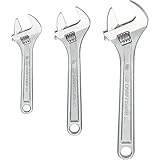
- CORROSION RESISTANCE: The adjustable wrench set has full polish chrome finish
- QUICK SIZE IDENTIFICATION: Adjustable wrench comes with large markings
- ADDED VERSATILITY: The wrench comes with wide opening jaws
- Meets or Exceeds ASME Specifications
The fastener is already rounded
An adjustable wrench cannot recreate missing corners. Once the flats are badly damaged, increasing force with the same wrench usually makes the damage worse. The appropriate remedy depends on the fastener, access and consequences of damage; an extractor or another repair method may be suitable, but there is no single extractor procedure that works for every case. If removal is critical or access is restricted, obtain advice from a qualified technician.
The wrench is loaded in the wrong direction
Adjustable wrenches are strongest when the turning force pushes the fastener into the permanent jaw. The Canadian Centre for Occupational Health and Safety (CCOHS) states: “When turning with an adjustable wrench, the direction of the turn should be against (towards) the permanent jaw.” Handle position can look different depending on whether you are loosening or tightening and which side of the fastener you can reach, so verify the actual load path instead of memorizing a left-or-right handle rule.
The tool is worn or damaged
A worn adjustment screw, distorted jaw, damaged knurl or loose pin can let the opening move while you pull. Corrosion and packed debris can also prevent the jaw from tracking squarely. If the wrench will not remain snug after careful adjustment, retire it from load-bearing work. Cleaning and routine inspection are safer than trying to compensate with extra force.
Quick wins for a faster PC:
Repair Windows errors before they cause bigger problemsFix Now →Scan for outdated or missing drivers - takes under a minuteDriver Scan →Clear out junk files and repair common Windows errorsFree Scan →The wrench is too small or the access is poor
Every adjustable wrench has a maximum jaw capacity. Near that limit, the jaws may engage less deeply and the handle may not clear surrounding parts. Confirm the capacity and use a larger or differently shaped wrench when needed. In a confined space, a fixed-size tool that fits the fastener may provide a more reliable engagement than an adjustable jaw.
Rank #2

- SMOOTH TWIST: Our adjustable wrench is hardened & tempered drop forged alloy steel. It’s a much needed tool for your vehicle and other minor/major fixes. It has adjustable jaws for easy access to small areas.
- FIXES & REPAIRS: Our product features widespread jaw size for a wide range of nuts and bolts fastenings. It can be used for plumbing, automotive repairs, vehicle maintenance and furniture assembling tasks.
- MADE TO LAST: Our durable and long-lasting tools help you with home, garage & industrial projects. With professional-grade quality, easily repair & fix issues with our tool cabinet essentials.
- THE RIGHT TOOL FOR THE JOB: We engineer a range of bolt cutters, clamps, chisels, folding carts, hammers, pliers, saws, screwdrivers, tape measures, utility knives, vises, bolt cutters, saws & wrenches.
- SUPERIOR INSTRUMENTS: Olympia Tools provides quality & innovative hand & specialty tools, tool accessories & outdoor equipment for construction, woodworking, mechanical maintenance & home repair.
How to set and use the wrench safely
1. Stop and inspect
Before another attempt, examine the fastener flats for rounding, cracks, paint buildup, oil or grit. Inspect both wrench jaws, the adjustment screw, the knurl and the pivot pin. Do not use a tool with a bent jaw, a visibly loose pin or an adjustment mechanism that binds or backs off. The CCOHS guidance and manufacturer care instructions emphasize clean, maintained tools; they do not prescribe one universal cleaning method for every wrench, so follow the tool maker’s instructions for solvents and lubrication.
2. Match capacity and access
Compare the fastener size with the wrench’s stated jaw capacity. Leave enough room to seat the fastener deeply, and check that the handle can move without hitting nearby parts. If the fastener size is known and a box-end or socket can reach it, that fixed-size option is generally preferable because it does not depend on a movable jaw staying set.
3. Adjust on the flats
Open the jaws wider than the fastener, place them over opposing flats, and turn the knurled adjustment until the movable jaw is snug. The jaws should touch firmly without being forced past the fastener’s shape. Do not insert paper, metal, tape or another shim to fill a gap; a shim can shift suddenly and create an unpredictable load.
4. Seat the fastener in the throat
Slide the fastener as far into the throat as the surrounding work permits. Deep seating gives the jaws more contact and reduces the chance that the wrench will twist off. Keep the wrench faces parallel with the fastener flats. If only the tips of the jaws contact, reset the angle or choose a tool with a more suitable profile.
Rank #3

- DURABILITY & STRENGTH - Crafted from strong, tempered chrome vanadium steel with a black oxide finish to resist corrosion, ensuring long-lasting durability and performance.
- PRECISION & VERSATILITY - Featuring a machine milled head with laser-etched SAE and Metric scales, these wrenches provide a quick and convenient way to determine fastener size in either SAE or metric, making them perfect for a range of applications.
- QUALITY & COMFORT - With perfectly parallel jaws, high-quality alloy construction, and a design that exceeds US and ANSI standards, this adjustable wrench set is a professional-grade tool that combines comfort and efficiency.
- COMPLETE & CONVENIENT - This comprehensive set includes sizes 6, 8, 10, and 12 inches, perfect for repairs, maintenance, and general use in automotive, industrial, or household settings, providing you with the right tool for any job.
- EASY & FUNCTIONAL - The easy-to-turn thread knurls allow for quick and convenient adjusting of jaw width, making this wrench set a versatile and essential addition to your toolkit.
5. Load toward the permanent jaw
Arrange the wrench so the direction in which you turn makes the fastener bear against the fixed jaw. Apply force close to the end of the handle with your hand positioned so a slip will not drive your knuckles into a nearby surface. Pull rather than push where practical. CCOHS advises: “Pull on a wrench using a slow, steady pull; do not use fast, jerky movements.” Increase force gradually while watching for jaw movement.
6. Reset or change tools when anything moves
If the jaw opens, the wrench cants, or the fastener begins to round, stop. Remove the load, inspect both parts again, and correct the cause. If the setup is already correct, change to a fixed box-end or socket wrench, a different size, or a tool selected for damaged fasteners. Never keep loading a wrench that has demonstrated that it cannot hold.
Understanding the correct orientation
The permanent jaw is the solid side of the wrench; the movable jaw travels on the adjustment screw. Under load, the fastener should push into that solid side rather than push the movable jaw away. To check orientation, place the wrench on the fastener and apply only light hand pressure in the intended turning direction. Watch which jaw receives the reaction force. If the movable jaw is being pushed open, turn the wrench over or approach the fastener from the other side.
The Tool Desk
Outbyte Driver Updater FREEFix the driver behind crashes, sound loss and screen glitchesFind Drivers →Outbyte PC Repair FREEClear out junk files and repair common Windows errorsFree Scan →Illustrations in training manuals can appear to show pulling toward the adjustable-jaw side because the wrench is drawn from a particular viewpoint. The safe principle is the load path: turning must be against, or toward, the permanent jaw. Confirm that principle for both loosening and tightening, since reversing rotation changes which side carries the load.
Rank #4

- Set of four wide jaw adjustable plumbing wrenches with inch/metric measurement scale: 6 inch (150mm), 8 inch (200mm), 10 inch (250mm), 12 inch (300mm)
- Ideal for auto repair, general assembly, maintenance, plumbing, and more
- Drop-forged, heat-treated Cr-V steel construction with corrosion-resistant finish
- Bi-color plastic soft-grip handles with slim head and tapered jaws for improved turning strength
- Precision-machined slide jaw and worm gear for the perfect fit and easy adjustment
Diagnose the fastener and wrench separately
| What you observe | Likely cause | Action |
|---|---|---|
| Movable jaw visibly opens while pulling | Adjustment is loose, screw or knurl is worn, or the pin is loose | Unload, inspect and clean. If it will not hold a snug setting, replace the wrench. |
| Wrench rides up immediately | Jaws are on corners, not flats; fastener is too large; or seating is shallow | Reset squarely on the flats, seat deeper, or select a larger/fixed-size wrench. |
| Only the fastener corners are shiny or damaged | Corner contact or a jaw angle that is not parallel | Stop before more rounding. Reposition on flats or use a tool that fits the remaining shape. |
| Adjustment screw feels gritty, binds or turns without moving the jaw | Debris, corrosion or damaged threads | Clean according to the manufacturer’s care directions. Do not load the wrench until the mechanism works smoothly; replace it if damage remains. |
| Wrench works unloaded but slips under force | Wrong load direction, insufficient throat seating, or worn jaw surfaces | Orient toward the permanent jaw, seat deeper and inspect wear. Change tools if the problem persists. |
| There is no room to swing the handle | Restricted access or unsuitable wrench profile | Use a socket, ratchet, short box-end or another tool designed for the available clearance. |
When a fixed-size wrench is the better choice
A box-end wrench surrounds the fastener and a socket engages it without relying on an adjustable jaw. When the exact fastener size is known and the tool can reach the work, CCOHS recommends these fixed-size options when possible. They are especially useful for high torque, repeated work and fasteners whose flats must be protected. They still require the correct size and full seating; a loose or partially engaged socket can damage a fastener too.
An adjustable wrench remains useful when several sizes must be handled, when carrying one tool is practical, or when the fastener size is uncertain. Treat it as a convenience tool, not as a substitute for a fixed-size wrench whenever the latter fits well. For delicate plated hardware, visible damage or a job where a slip could affect live equipment, choose the tool that gives the most complete engagement and the safest hand position.
Choosing a replacement adjustable wrench
Replace a wrench when the jaw faces are rounded, the adjustment screw will not retain its setting, the rail is bent, or the pivot pin is loose. Compare these characteristics rather than assuming a longer handle or a wider jaw automatically solves slipping:
What’s actually slowing this PC down?
Pick the symptom - the matching free tool is one click away.
- Jaw capacity: It must cover the largest fastener you expect to handle while still allowing deep seating. Milwaukee’s 6-inch wide-jaw model is specified by the manufacturer with a 1.5-inch jaw capacity.
- Adjustment retention: Milwaukee describes an adjustment screw on its 6-inch wide-jaw model as intended to keep the jaws from backing off; its 12-inch wrench page gives the same type of manufacturer description. These are design claims, not independent comparative test results.
- Jaw and rail precision: Klein describes its 4-inch precision model as having a precision-machined knurl and ground rail. That is a manufacturer specification, not a measured slipping rate.
- Parallelism and play: With the jaws closed and then opened slightly, look for smooth travel and minimal rocking. The jaws should remain parallel through the useful opening.
- Access and handle length: A larger wrench may provide capacity but fail to fit around nearby parts. Select a profile and length that let you pull without striking surrounding surfaces.
| Example specification | What is stated | How to interpret it |
|---|---|---|
| Milwaukee 6-inch wide-jaw adjustable wrench | Manufacturer lists a 1.5-inch jaw capacity and describes an adjustment screw intended to keep jaws from backing off. | Useful capacity and retention information; it does not establish performance against other brands. |
| Milwaukee 12-inch adjustable wrench | Manufacturer describes an adjustment screw intended to keep jaws from backing off; a jaw-capacity figure is not stated here. | Verify the current capacity for the exact model before purchase. |
| Klein 4-inch precision adjustable wrench | Manufacturer describes a precision-machined knurl and ground rail. | These construction details may help adjustment feel, but no independent slipping result is established. |
Unsafe fixes to avoid
- Do not add a pipe or sleeve to the handle. The extension can overload the wrench, damage the fastener or cause a sudden release.
- Do not shim the jaws. A loose jaw should be adjusted or the wrench replaced, not packed with material.
- Do not strike an ordinary adjustable wrench. It is not a striking tool; impact can deform it or send fragments toward you.
- Do not use a worn or damaged wrench. Extra force cannot restore a distorted jaw or failed adjustment mechanism.
- Do not use jerking motions. A sudden load increases the chance of slip and loss of balance. Use a slow, steady pull.
Wear appropriate eye protection and keep your free hand away from the line of release. Stabilize the workpiece so it cannot rotate or fall when the fastener breaks free. If the work involves energized equipment, pressurized systems or a fastener whose failure could cause injury, follow the applicable lockout and workplace procedures before touching it.
Best Value
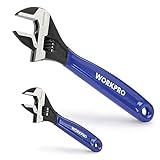
- DUAL-SIZE SET FOR VERSATILE USE: This 2-piece set includes 6-inch and 10-inch adjustable wrenches, designed for everyday household tasks such as plumbing fixes, furniture assembly, bike repairs, and garage work. A great toolkit essential for DIYers and homeowners.
- HIGH-QUALITY MATERIAL: Made from drop-forged Chrome Vanadium Steel with a corrosion-resistant black oxide finish. Built for durability in home and workshop use, but not for industrial or high-stress mechanical tasks.
- PRECISE ADJUSTMENT WITH DUAL SCALES: Laser-etched SAE and metric scales on both sides of each wrench allow for quick and accurate jaw alignment. Smooth worm gear provides consistent control and grip without slippage.
- MAX JAW CAPACITIES CLEARLY DEFINED : 6" wrench fits up to 15/16" (24mm); 10" wrench fits up to 1-5/16" (33mm). Suitable for nuts and bolts from M6 to M14 (6" wrench) and up to M20 (10" wrench). For better performance, avoid using on rusted or oversized fasteners that exceed jaw capacity.
- COMFORTABLE GRIP & TOOLBOX-FRIENDLY: The ergonomic rubberized handle reduces hand strain during extended use. Both wrenches feature hanging holes for easy storage, and the set fits neatly into standard toolboxes or bags.
Maintenance that helps prevent future slipping
After use, wipe the wrench clean and dry, as Crescent recommends for its adjustable wrenches. Store it where grit and moisture cannot pack into the adjustment mechanism. During routine inspection, run the movable jaw through its range: it should travel smoothly, remain aligned and stop without excessive side play. Check that the pin is secure and that the jaw faces are not chipped or rounded. Remove a questionable wrench from service rather than placing it back in a general toolbox where someone may use it under load.
Keep fixed-size tools organized by size so the correct box-end or socket is easy to reach. That simple habit reduces the temptation to force an adjustable wrench onto a fastener that it does not fit well.
Practical decision checklist
- Are both jaws fully on flat faces, not corners?
- Is the movable jaw snug with minimal play?
- Is the fastener seated as deeply as access permits?
- Will the load push the fastener toward the permanent jaw?
- Are the jaws, knurl, rail and pin clean and undamaged?
- Is the fastener within the wrench’s capacity?
- Would a correctly sized box-end or socket fit?
- Have you avoided shims, pipe extensions, striking and jerking?
If any answer is no, correct that condition before applying torque. If every answer is yes and the wrench still slips, retire the adjustable wrench and use a suitable fixed or specialized tool.
What the safety guidance says
CCOHS’s Hand Tools – Wrenches fact sheet was confirmed current on 2023-12-13 and last revised 2017-03-01. Its two central instructions for this problem are to turn against (toward) the permanent jaw and to pull with a slow, steady motion rather than a fast, jerky one. Those principles, combined with a snug fit on the flats and a sound tool, address most preventable slips without resorting to unsafe leverage.
Quick Recap
Product prices and availability are accurate as of the date/time indicated and are subject to change. Any price and availability information displayed on Amazon at the time of purchase will apply.

