A focused home office is not an empty desk or a collection of expensive “ergonomic” products. It is a deliberately limited setup in which every item supports the work you actually do. Start with a stable, uncluttered surface, a chair and desk that fit your body together, and a screen directly in front of you at a comfortable distance and height. Then solve specific problems—laptop height, glare, noise, paper work, or unsupported feet—with the simplest effective tool.
This approach follows workstation guidance from the U.S. Occupational Safety and Health Administration (OSHA), the Canadian Centre for Occupational Health and Safety (CCOHS), and European telework guidance. Those sources explain how to fit a workstation to an individual; they do not establish that minimalism itself increases productivity. The practical goal is fewer physical adjustments, fewer visual distractions, and less avoidable reaching or discomfort while you work.
As an Amazon Associate I earn from qualifying purchases.
What “minimalist” should mean in a home office
Minimalism is useful here as a decision rule, not a style requirement. Keep the tools needed for your tasks and remove objects that consume space, create visual noise, or force awkward movements. A notebook used every day belongs on the desk; three unused organizers do not. A second monitor may be justified for a developer or researcher, while it is unnecessary for someone who writes in one document at a time.
OSHA’s workstation overview states: “There is no single ‘correct’ posture or arrangement of components that will fit everyone.” Your height, eyesight, mobility, work surface, tasks, and room all matter. Treat the chair, desk, screen, input devices, lighting, and noise control as one system rather than buying a universal checklist.
#1 Best Overall

- Fully Adjustable Office Chair: Customized chairs, featuring with an adjustable 2D headrest, backrest with 90° to 120° recline, and 3D adjustable armrests for multiple work postures at will and discover unparalleled comfort throughout the workday.
- Adaptable Lumbar Support: Our computer chair lumbar support system adjusts 1.18" forward & backward and 2.16" up & down to precisely match your height and body shape, providing tailored comfort and promoting optimal sitting posture.
- Supportive Mesh: The minimalist mesh backrest molds to your back with responsive support while promoting maximum airflow to keep you cool. Every component is designed with your safety and well-being in mind.
- Comfy Desk Chair Seat: Adapting 3.14" thick high-density foam to desk chair seat,double your comfort in daily work moreover high weight capacity 330 lbs for long-term durability. Wider seat provides a larger load-bearing area, enhancing overall support and sitting ease.
- Flexible Armrests: Move smoothly rounded PU-padded armrests forward or back and swivel them left or right to find the optimal arm position. Flip the armrests up when you want more freedom or to easily slide the ergonomic chair under the desk.
- Keep: equipment required for your current work, a comfortable chair, and anything that solves a specific physical or environmental problem.
- Remove or relocate: decorative items that block the screen, unused peripherals, tangled cables, and supplies that require repeated reaching.
- Adapt: use a book stack instead of a laptop stand, a footrest instead of replacing a usable chair, or window blinds instead of adding a brighter lamp when glare is the real problem.
The result should be visually calm but functionally complete. Removing an external keyboard that lets you position a raised laptop correctly is not minimalist if it leaves you bent over the built-in keyboard for hours.
Start with the work, not the furniture
Before measuring a desk or shopping for accessories, list the activities you perform in a normal week. The list determines what deserves space and which compromises are unacceptable.
Mostly laptop or document work
You need a readable display, a keyboard and mouse that can sit close to your body, and enough clear surface for notes if you use paper. A raised laptop screen normally requires a separate keyboard and mouse because the built-in keyboard cannot remain at a comfortable typing height when the screen is raised.
Video calls
Place the camera and screen so you can sit upright without turning your torso. Keep the area behind or beside the camera free of distracting movement where possible. Headphones are optional; they do not replace reducing avoidable household noise.
Handwriting, reading, or sketching
Reserve a portion of the surface for paper and add task lighting only if the room light is insufficient. The lamp should illuminate the page without shining into or reflecting across the display.
Multiple displays or reference material
Put the display you use most directly in front of you. Place a secondary screen or documents to the side at a similar height, minimizing repeated neck rotation. Do not sacrifice the primary screen’s distance or readability to fit more objects.
Write down the minimum equipment for each activity. This prevents a “minimalist” desk from becoming an uncomfortable single-purpose arrangement.
Choose and clear the work surface
Use the most stable surface available. It must support the monitor or laptop, keyboard, and mouse without wobbling, and it must leave enough room to keep the input devices close rather than reaching forward.
Rank #2

- 【Adjustable Lumbar & Multi-Angle Headrest】 Experience precision ergonomic alignment. Features a unique movable crossbar system allowing 2cm depth adjustment (forward/backward) to fit your spine's natural curve perfectly. Combined with a height-adjustable, 45° rotating headrest, this desk chair eliminates neck and lower back fatigue during long, high-intensity shifts.
- 【90°-145° Recline & Retractable Footrest for Napping】 Seamlessly transition from "Focus Mode" for typing to "Relax Mode" for gaming, reading, or resting. The smooth reclining backrest locks securely at any angle between 90° and 145°. Simply pull out the padded retractable footrest to enjoy a full-body stretch or a quick office nap, transforming your workspace into a comfort lounge.
- 【Anti-Sagging High-Density Foam & Breathable Mesh】 Say goodbye to sweaty, flattened seats. The seat cushion is crafted from premium high-density polyurethane foam that retains its shape over years of use, effectively alleviating hip and tailbone pressure. The backrest utilizes professional-grade "racing mesh," offering superior airflow to keep you cool all day long.
- 【Heavy Duty 365 lbs Capacity & Certified Safety】 Engineered for maximum stability, this high-back computer chair features an SGS & BIFMA certified Class 4 gas lift and a reinforced heavy-duty nylon base, safely supporting up to 365 lbs. Perfect for big and tall users looking for long-term durability and a wobble-free sitting experience.
- 【Silent Gliding Casters & Professional Aesthetics】 The dual-wheel nylon casters glide effortlessly and silently across hardwood, tile, and carpet without leaving scratches. With its sleek modern aesthetic, this versatile chair fits perfectly into corporate offices, home studies, or gaming setups. Easy to assemble with clear instructions included.
- Remove unnecessary objects. European telework guidance recommends an orderly desk and removing items that are not needed for the task.
- Place the primary display first. Its position determines where your chair and keyboard go.
- Set the keyboard and mouse next. Keep them close enough that your elbows can remain near your sides and your shoulders relaxed.
- Add only task-specific items. Put frequently used paper, a phone, or a lamp where it can be reached without leaning or twisting.
- Route cables once. Secure excess cable length against the rear or underside of the desk so it does not occupy the working area or catch on your feet.
A small desk can work if you prioritize the primary screen and input devices. If the surface is too shallow to keep a monitor at a comfortable viewing distance while leaving room for the keyboard, raise the monitor or change the layout rather than pushing the screen close to your face.
Fit the chair and desk as a pair
An “ergonomic” label does not guarantee a suitable chair. OSHA and CCOHS emphasize adjustability, body support, and individual fit. The chair must work with the desk height and your feet, not just feel comfortable for a few minutes in a showroom.
Set seat height
Adjust the seat so your feet have stable support and your knees are not forced into an uncomfortable angle. The exact height depends on your body and desk. If the desk requires the seat to be higher than your feet can comfortably reach the floor, use a stable footrest rather than letting your legs dangle.
Recommended Free Tools
Check seat depth
The seat should support your thighs without pressing uncomfortably behind your knees. A seat that is too deep can prevent you from using the backrest; one that is too shallow may leave your thighs unsupported. Look for a depth adjustment or a fit that works without forcing you to perch on the front edge.
Use the backrest
Your back should be supported while you work. Adjust the backrest or recline tension so you can sit upright without bracing yourself with your arms or sliding forward. Lumbar support is useful only if its position and shape suit your body.
Set armrests only if they help
Armrests should allow your shoulders to stay relaxed and should not prevent you from pulling the chair close to the desk. If they collide with the desk or encourage raised shoulders, lower them or remove that obstacle rather than accepting a poor keyboard position.
Try the complete arrangement
When possible, test a chair at the desk and with your actual keyboard height. CCOHS notes that chair suitability depends on the individual and recommends trial and adjustment of the whole workstation. A return option is valuable when you cannot test the chair in person.
Free tools Windows power users keep installed
One-click scans. No signup required.
Position the monitor for comfortable viewing
Put the primary monitor directly in front of you so you do not work with your head turned. OSHA’s detailed guidance describes a generally preferred viewing distance of 20–40 inches (50–100 cm); its quick tips specify at least 20 inches. These are setup recommendations, not outcome statistics. Use the distance at which text is clear without leaning forward.
Rank #3

- High-Resilience Molded Foam Seat – Won’t Flatten After 1 Year – Instead of budget foam that hardens and sags within months, the seat is built with high-density, high-resilience molded foam that bounces back day after day. It maintains its shape and cushioning far longer, preventing the “bottoming out” discomfort common at this price point
- Adjustable Lumbar, Not a Fixed Afterthought – Unlike flimsy plastic supports that crack or lose tension, this chair features a durable lumbar mechanism that adjusts depth to match your spine’s natural curve. Genuinely relieves lower back pressure during long sitting sessions
- Breathable Mesh Backrest – No Peeling, No Heat Buildup – Say goodbye to flaking faux leather. The high-tension mesh back promotes continuous airflow, keeping you cool in warm environments and eliminating the mess of peeling upholstery. Mesh holds up significantly better over time and looks professional years later
- Anti-Sink BIFMA Certified Gas Cylinder – A common failure in budget chairs: the pneumatic cylinder loses pressure and slowly sinks during use. Our Class 3 BIFMA-certified gas lift is built to hold its height reliably, so your chair stays exactly where you set it—year after year. No more sudden drops or mid-work adjustments
- Heavy-Duty Metal Core Base (330 lbs Capacity) – Thin plastic bases can crack under stress, especially near the cylinder hub. We use a reinforced nylon base with a metal core, providing the durability and peace of mind you need. Smooth-rolling, 360° silent casters glide across hardwood, tile, or carpet without scratching or catching
Set height and angle
OSHA’s quick tips place the top of the screen at or below eye level. Start there, then adjust for your posture and the size of the display. You should be able to read the center of the screen while keeping your torso upright and your back supported. Tilt the screen only enough to keep the image clear and reflections controlled.
Increase text size before moving closer
If text is difficult to read at a comfortable distance, increase the operating-system or application text size, adjust display scaling, or zoom the document. Leaning toward a small typeface defeats the purpose of correct monitor placement.
Arrange multiple screens deliberately
Center the screen used most often. If two screens are used equally, place their meeting edges in front of you and sit centered on that join. Turn your chair or move secondary material rather than repeatedly twisting your neck.
Quick wins for a faster PC:
Fix the driver behind crashes, sound loss and screen glitchesFind Drivers →Repair Windows errors before they cause bigger problemsFix Now →Give your eyes distance changes
OSHA recommends looking away from the display and focusing farther away periodically. CCOHS and European telework guidance also recommend changing posture, standing, or walking during the day. These are general practices, not a rigid schedule that suits every person.
Make a laptop workstation adjustable
A laptop combines the screen and keyboard in one fixed hinge. A position that gives your hands a reasonable typing height usually leaves the screen low; raising the screen makes the built-in keyboard too high for extended typing. Separate those functions when the laptop is your main computer.
- Raise the laptop display. Use a stable laptop stand or a stack of books that cannot slide. The free alternative is valid if it creates a steady, safe platform and does not block ventilation.
- Add an external keyboard and mouse. Place them close to your body at the height that lets your shoulders relax and your wrists remain neutral.
- Set the raised screen. Aim for the same front-facing position, comfortable distance, and top-of-screen height used for a desktop monitor.
- Check stability and heat. Ensure the laptop cannot tip and that its vents remain unobstructed. Do not place it on an unstable pile near the edge of the desk.
A stand, external keyboard, and mouse are optional tools, not mandatory upgrades. Use them when the laptop’s built-in arrangement prevents a comfortable screen and input position. If you type only briefly and mostly read, the integrated keyboard may be sufficient.
Control glare and light with placement first
Glare can make a correctly positioned monitor unreadable, causing you to lean forward or increase brightness unnecessarily. OSHA’s workstation-environment guidance addresses lighting, glare, airflow, and humidity; the simplest fix is often to change the relationship between the screen and the light source.
The Tool Desk
Outbyte PC Repair FREERepair Windows errors before they cause bigger problemsFix Now →Outbyte Driver Updater FREEScan for outdated or missing drivers - takes under a minuteDriver Scan →Orient the display
Place the screen so a window or bright light is not directly reflected in it. If possible, set the desk so the window is to the side rather than directly in front of or behind the display. Adjust blinds or curtains when daylight changes.
Rank #4
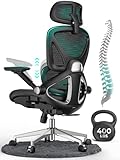
- 【STURDY, SNUG WORK CHAIR】Made for long sits over 8 hours of desk work. Micro-adjust lumbar support, flip-up arms, and a flexible headrest serve people from 5'5" to 6'2", prolonging comfort. BIFMA X5.1 certifies the reliability of its robust, durable structure, ensuring sustained benefits.
- 【LUMBAR MICRO-ADJUST】Offering 2 inches of adjustable support over 8 levels, this lower back feature aligns accurately with the L1-L5 lumbar spine, lessening lower back pressure by 50% and reducing fatigue by distributing weight evenly.
- 【LARGER, COOLER SEAT】The enlarged cushion (19.3"D x 20"W / 18.5"-22.05"H), crafted from exclusive Aerovith Mesh, ensures continuous cooling while enhancing support by 30% and reducing pelvic pressure by 20%.
- 【RELIABLE BASE】The leak-proof SGS gas lift to prevent accidental sinking and ensure stable height adjustment, complemented by a durable stainless steel base that supports up to 400 lbs.
- 【DETAIL-ORIENTED】Wide, non-peeling soft armrests and a 90° flip-up feature paired with silent PU wheels, allowing it to smoothly roll under the desk to maximize your workspace without leaving marks on the floor.
Diffuse harsh light
Use blinds, a diffuser, or a shielded fixture when overhead or window light creates bright patches. Avoid pointing a bare lamp at the screen.
Add a task lamp only for a task
For handwriting or reading paper, a desk lamp can illuminate the page while remaining aimed away from the display. Compare lamps by directional control and by whether the beam can reach the paper without reflecting on the monitor. A brighter lamp is not a solution if the problem is screen reflection.
Keep the room usable
Do not block ventilation or place equipment where airflow becomes uncomfortable. Adjust temperature, airflow, and humidity where you can; a beautifully sparse desk is not useful if the room makes sustained work unpleasant.
Reduce noise and interruptions without overbuying
European telework guidance recommends managing background noise and creating an orderly work area. Placement and agreements often help more than additional gadgets.
- Choose the quietest practical location. A separate room is useful when available, but a defined corner can work.
- Agree on quiet periods. Tell housemates when calls or concentrated work are scheduled and how they can signal an urgent interruption.
- Keep movement out of your sightline. Turn the desk away from a busy hallway if that does not create glare.
- Use headphones selectively. They may reduce distracting sound, but they do not fix a chair, screen, or lighting problem. Use a mode and volume that let you remain aware of important cues.
- Silence nonessential alerts. Group notifications or use focus modes during tasks that require uninterrupted attention.
Do not promise yourself that a noise-cancelling headset, plant, or separate standing desk will independently improve productivity. The available guidance supports reducing interruptions and changing the environment; it does not prove a particular accessory causes better focus.
Independent reader supportYour contribution helps us test, update, and keep practical guides available for everyone.A practical setup sequence
Follow this order so each adjustment supports the next one.
- List your actual tasks. Note laptop use, typing duration, video calls, paper work, and whether you need one or multiple displays.
- Clear and stabilize the surface. Remove unnecessary objects and leave room for the primary display, keyboard, and mouse.
- Set the chair and desk together. Establish back support and stable foot support. Add a footrest if the required seat height leaves your feet unsupported.
- Place the primary screen. Center it in front of you, start at 20–40 inches away (with at least 20 inches as OSHA’s quick-tip minimum), and set the top at or below eye level.
- Make text readable. Increase text size or display scaling before moving the screen closer.
- Set input devices. Keep the keyboard and mouse close, with no repeated forward reach. For a raised laptop, connect an external keyboard and mouse.
- Fix reflections. Reorient the display, adjust blinds, or diffuse light. Add a directional task lamp only if paper work needs it.
- Remove remaining friction. Route cables, move distracting objects, and establish quiet periods or notification rules.
- Recheck after real work. Work for a normal session, then adjust one variable at a time: seat depth, screen height, distance, text size, or light direction.
How to choose optional components
Buy an item only when you can name the problem it solves. The following comparisons use functional criteria rather than brand rankings.
Do these 3 things before closing this tab:
1Fix the driver behind crashes, sound loss and screen glitches2Clear out junk files and repair common Windows errors3Scan for outdated or missing drivers - takes under a minute| Component | Choose or adjust for | Low-cost alternative or caution |
|---|---|---|
| Adjustable office chair | Seat height and depth, back support, armrest position, desk compatibility, and the ability to try or return it. | A high price or “ergonomic” label does not establish fit. Test the chair with your desk when possible. |
| Laptop stand or riser | Stability and whether it raises the screen to a comfortable viewing height. | A stable stack of books can perform the same height-changing function. Pair either option with an external keyboard and mouse when you type for long periods. |
| External keyboard and mouse | Independent placement of hands from the raised laptop screen; comfortable size and reach. | Not needed for every laptop user. Add them when the built-in keyboard forces an unsuitable screen position or posture. |
| Desk task lamp | Directional control and the ability to light paper without reflecting on the screen. | First try changing window, monitor, or overhead-light placement. More brightness can worsen glare. |
| Footrest | Stable foot support when the chair must be raised to align with the desk. | Use a firm, non-sliding platform that does not rock. Do not let unsupported feet hang for long sessions. |
Troubleshoot the setup by symptom
You lean toward the screen
Increase text size or display scaling, check that the screen is at least 20 inches away, and improve contrast or glare control. Recheck lighting before buying a closer monitor.
Best Value

- 【Adjustable Lumbar Support】- The lumbar support of MOLENTS office chair can be adjusted up and down, forward and backward to deliver tailored support for your lower back.
- 【Adjustable 3D Armrests】- MOLENTS ergonomic office chair with 3D adjustable armrests offer tailored support for your arms and shoulders, reducing strain and enhancing comfort throughout the workday.
- 【Breathable and Comfortable Mesh Office Chair】- This computer chair is crafted from premium breathable and high elastic mesh material, without being stuffy, giving you a long time comfort.
- 【Tilt Back 90°-120°】- With a backrest that has three reclining positions from 90° to 120°, MOLENTS ergonomic chair allows you to easily switch from work mode to rest mode, making it a home office essential and perfect for executive offices and studies.
- 【Ergonomic Desk Chair】- Ergonomically designed to conform to the body's curves and pressure distribution, MOLENTS office desk chair helps promote healthy posture, making long hours of work easier and more productive.
Your shoulders feel raised while typing
Lower the keyboard or adjust the chair and desk relationship. Check that armrests are not preventing you from moving close enough to the desk.
Your feet do not reach the floor
If raising the chair is necessary for desk alignment, add a stable footrest. Do not solve the problem by sliding forward and losing back support.
Your neck turns toward a second screen
Center the display you use most. Move secondary screens or documents closer to the center and at a similar height.
Outdated Drivers Are Slowing You Down
One free scan finds every outdated or missing driver and matches the right update for your exact hardware.Free scan · exact hardware matchPC Slower Than It Used to Be?
A free scan shows the junk files, broken settings and background clutter dragging Windows down - then fixes them in one click.Free scan · Windows 10 & 11The screen looks washed out or reflects a window
Move the display or desk so the light is to the side, adjust blinds, and use diffuse or shielded lighting. A task lamp should point at paper, not the monitor.
The desk feels cluttered again
Return to the task list. Remove items that are not used during the current workday, and store occasional supplies outside the primary reach zone.
You keep getting interrupted
Change location if possible, establish quiet periods with housemates, and silence nonessential notifications. Headphones are an optional aid, not a substitute for a workable room arrangement.
What the evidence does—and does not—say
OSHA’s eTools provide workstation guidance and do not create new OSHA requirements. The 20–40-inch viewing range, the at-least-20-inch quick-tip minimum, and the top-of-screen-at-or-below-eye-level recommendation are practical setup guidance from OSHA, not measured improvements in focus or productivity.
What’s actually slowing this PC down?
Pick the symptom - the matching free tool is one click away.
The reviewed ergonomics and telework sources do not provide a named study statistic showing that a minimalist home office independently improves concentration or output. They support fitting equipment to the person and task, reducing glare and interruptions, maintaining support, and changing posture during the day. That is why the strongest design principle is simple: remove what interferes, keep what your work requires, and adjust the complete system until it is comfortable and readable.
Quick Recap
Product prices and availability are accurate as of the date/time indicated and are subject to change. Any price and availability information displayed on Amazon at the time of purchase will apply.

