What’s actually slowing this PC down?
Pick the symptom - the matching free tool is one click away.
Secure SMS OTP login by controlling both sides of the flow: limit how often codes can be sent and guessed, then make every challenge expire and succeed only once. Keep failed-attempt tracking tied to the account, make lockouts temporary and recoverable, and consume a successful challenge atomically before creating a session. These controls reduce guessing and replay; they do not make SMS resistant to phishing, SIM swapping, or number-porting attacks.
1. Issue a fresh, account-bound challenge
Generate each code with a cryptographically secure random generator and associate it with the intended account and login attempt. For an OTP that authorizes a transaction or another specific action, bind the challenge to that action as well. A code for one account or operation should not authorize another.
As an Amazon Associate I earn from qualifying purchases.
Keep the code out of logs, analytics, and long-term plaintext storage. Hashing a short numeric OTP can reduce exposure if stored records are accessed, but it is not strong protection by itself: the small code space can be searched offline. Protect the challenge record and restrict access to it.
NIST SP 800-63B-4 §3.1.3.1 requires, for the out-of-band authentication secrets covered by that section, a randomly generated secret of at least six decimal digits or equivalent. It also requires completion within 10 minutes and rate limiting when the secret is under 64 bits. These are requirements within the standard’s scope, not a blanket declaration that any SMS login implementation complies.
#1 Best Overall

- One-touch control for your entire home: Arm or disarm your ADT Blu security system with a single button press from up to 75 feet away, no keypad or phone required.
- Panic button backed by ADT: With a professional monitoring plan, press and hold to send a direct emergency signal to ADT's monitoring centers so help is on the way fast.
- Always within reach: Compact design with a built-in keychain ring keeps your home security controls in your pocket or clipped to your keys.
- Smart status alerts built in: The LED indicator notifies you when the remote is out of range or the battery is running low, so you are never caught off guard.
- Fully integrated with ADT Blu: Pairs directly with your ADT Blu Base and works alongside every ADT Blu device for a connected, expandable home security setup.
2. Throttle code sending separately from code guessing
Requesting a message is itself a sensitive operation: an attacker can flood a victim or drive up SMS delivery costs without ever submitting a code. Apply issuance limits as well as verification limits.
- Set per-account limits for initial sends and resends, and monitor unusual bursts across accounts and network sources.
- On resend, issue a fresh code and invalidate or overwrite the previous challenge rather than leaving multiple codes active.
- Use consistent public responses for accounts that exist and those that do not, so the send endpoint does not become an account-enumeration tool.
- Record issuance and abuse signals, but never record the OTP value.
OWASP’s Multifactor Authentication Cheat Sheet discusses SMS risks and OTP handling: OWASP Multifactor Authentication Cheat Sheet.
3. Count failed verification attempts at the account level
Use an account- or authenticator-level failure counter as the primary defense against guessing. An IP-only limit is inadequate: a distributed attacker can spread attempts over many addresses. IP, device, and network signals still help identify concentrated abuse, but they supplement rather than replace the account counter.
Recommended Free Tools
Choose and document three policy dimensions: the number of failures that trigger friction, the observation window in which failures accumulate, and how long a delay or lockout lasts. A rolling window can prevent failures from accumulating indefinitely; a progressive delay can raise the cost of repeated guesses without immediately blocking an account.
Rank #2

- COMMON FORMAT: 100pcs Prox 26 Bit Keyfobs access control Proximity Key Fobs formatted with the 26-bit H10301 standard format used on most access control security systems.
- COMPATIBLE: These isoprox compatible contactless Keyfobs work with the same 26 bit weigand readers that both the 1386 ISOProx and 1326 ISOProx key cards work with. Compatible the card readers include: Proxpoint Plus, Thinline II, MiniProx, RP40, RP10, RPK40, RP15, Prox80, ProxPro, EntryProx 4045, Bosch ARD-AYJ12, Viking PRX-2(If you are not sure whether your system is compatible, please contact us before placing an order)
- Facility Code: 127
- Tags number Range: 00001-65000, they are random but running .
- Color:Black . Not all access control systems are compatible. If you are not sure whether your system is compatible, Please contact us before ordering
NIST SP 800-63B-4 §3.2.2 sets an upper bound of 100 consecutive failed attempts for the applicable authenticator throttling requirements, unless otherwise specified, and explicitly allows agencies to choose lower limits. That is a ceiling, not a recommended target for SMS login. Select a lower threshold when the application’s risk warrants it.
Balance guessing resistance with denial-of-service risk
A permanent lockout can be weaponized: someone who knows a victim’s account identifier may deliberately trigger it. Prefer temporary, recoverable friction, such as increasing waits or risk-based checks, and plan a safe recovery path. Avoid revealing through login responses whether an account is unknown, locked, or simply has a wrong code. OWASP’s authentication guidance explains the threshold, observation-window, and lockout-duration tradeoffs: OWASP Authentication Cheat Sheet.
NIST §3.2.2 also describes ways to reduce the chance that throttling locks out the legitimate claimant, including bot detection, increasing waits, and adaptive or risk-based checks. Do not treat its 100-attempt upper bound as a reason to permit that many guesses in every application.
The Tool Desk
Outbyte PC Repair FREEClear out junk files and repair common Windows errorsFree Scan →Outbyte Driver Updater FREEScan for outdated or missing drivers - takes under a minuteDriver Scan →4. Verify within the challenge’s lifetime and scope
When a user submits a code, check that the challenge exists, belongs to the account and intended login attempt, remains unexpired, and has not already been consumed. Enforce the attempt limit before allowing another verification. Expiration narrows the time available for guessing; single-use consumption prevents a captured code from being accepted again while it is still valid.
Rank #3
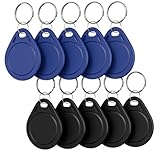
- Package includes: 10pcs(5pcs black and 5pcs blue) 125kHz T5577 key fob. Standard 125Khz ID RFID keyfob, support 125khz proximity ID cards token tag duplication. Note: These are blank key tags without pre-programmed card numbers. You cannot directly add them to RFID locks or use a card reader to read them. Before using, please write data(card numbers) into them by a 125kHz RFID card writer first.
- Product Size: 40*30*4mm(1.57*1.18*0.16 inch). High-Quality Copper Coil inside. Casing Material: ABS Plastic. Waterproof & Durable.
- Applications: Hotel key chain, Access control systems, time attendance system, ticketing, packing card. This T5577 proximity key card can copy duplicate em4100 TK4100 ID Card Keychains tags.
- Chip: ATMEL T5577 (compatible with other universal 125kHz tags). Frequency: 125kHz; Sensing Distance: 2.5 to 10 cm (1 to 4 inch); Data Storage Life: 10 Years. It's rewritable, and it can write in 125khz id format and H-ID WG 125khz format, can be customised to 26-bit Prox format. Compatible with T5567 T5577 EM4305.
- Writable & Rewritable: can be writed by 125KHz RFID writer/copier, DO NOT work with ONITY SYSTEM and Proxmark3 RDV4. It can be erased and written 100,000 times. Suitable for making new and back-up tags. More product info and FAQ is listed in the Product Description. Please read them before purchase.
NIST SP 800-63B-4 §3.1.3.1 states: “Verifiers SHALL accept a given authentication secret as valid only once during the validity period to provide replay resistance, as described in Sec. 3.2.7.” This applies to the covered secrets in that section. OWASP likewise recommends short-lived, single-use OTPs and invalidation after successful verification.
5. Consume the code atomically, then create the session
Verification and consumption must be one coordinated state transition. If two requests submit the same valid code at nearly the same time, the system must not let both succeed. Use an atomic update, transaction, or equivalent concurrency-safe operation that marks the challenge consumed only if it is still valid and unused. Create the authenticated session only after that transition succeeds.
- Load and validate the challenge against its account, purpose, expiry, and unused state.
- Check the submitted code and account-level failure policy.
- Atomically mark the challenge consumed as part of the successful verification.
- Create the authenticated session only for the request that won the consume operation.
NIST defines replay resistance as making it impractical to succeed by recording and replaying a prior authentication message. Fresh challenges and one-time acceptance address reuse, but manual OTP entry does not prevent a real-time attacker from relaying a code to a phishing site.
6. Bind transaction codes to exactly what the user approves
For a code authorizing a transfer, profile change, or other sensitive operation, bind the challenge to the relevant action details. If those details change after issuance or during approval, invalidate the challenge and restart authorization. Check authorization again when the operation is executed; an earlier check must not silently authorize a later, changed action.
Rank #4

- HIGH QUANTITY AVAILABILITY: This set of RFID Key Fobs contains 50 electronic tags and is suitable for large-scale access control systems or visitor management systems. No matter you are an individual user or an enterprise user, you can benefit from it to meet your needs.
- Rewritability: These electronic tags use the T5577 chip, which is rewritable. This means that you can program and erase the information on the tag as many times as needed for easy and flexible management and updating of access rights.
- Versatility: RFID Key Fobs are suitable for a variety of access control systems, door locks and access control systems. You can use them in homes, offices, schools, hotels and other places to provide safe and reliable access control.
- HIGHLY COMPATIBLE: These tags utilize a 125KHz frequency and are compatible with many common RFID readers and access control devices. You can easily integrate them with your existing system without additional equipment or modifications.
- Instructions: When performing read/write operations or cloning, ensure both the target key fob and the programming tool operate at 125kHz; otherwise, cloning will fail. A dedicated programming tool is required for this procedure. Verify that the card to be cloned is 125kHz and that the cloning device also operates at 125kHz
OWASP’s Transaction Authorization Cheat Sheet covers authorization workflows and the need to keep the approved data tied to execution: OWASP Transaction Authorization Cheat Sheet.
7. Respond consistently, recover safely, and monitor
For failed authentication, use externally consistent responses so an unauthenticated user cannot distinguish an unknown account from a locked account or incorrect code. Give legitimate users actionable wait or recovery guidance through a channel that does not expose account state to an attacker.
- Monitor code issuance, verification failures, lockouts, and risk events in aggregate.
- Never put OTP values in application logs, analytics, or support records.
- Reauthenticate with an existing factor before changing a phone number or other authentication setting; apply risk checks and notify the user out of band.
- Provide deliberate recovery for users who lose access to the number, rather than relying on a permanent lockout.
OWASP notes that SMS authentication is exposed to SIM swapping, number porting, phishing, and device risks. If SMS is the only factor, treat that as an explicit risk decision and plan a path to stronger authentication.
Free tools Windows power users keep installed
One-click scans. No signup required.
8. When to move beyond SMS
SMS can be convenient where users lack another authenticator, but it is not phishing-resistant. A phisher can relay a valid code in real time, and control of a phone number can be attacked independently of the login service. OWASP recommends phishing-resistant methods for stronger protection.
| Method | Security distinction | Practical consideration |
|---|---|---|
| SMS OTP | Codes can be phished or relayed; risks include SIM swap and number porting. | Easy to use where text delivery is available, but depends on the phone number and carrier channel. |
| TOTP authenticator app | A time-based code is still manually entered and can be phished or relayed. | Does not depend on SMS delivery, but users need the authenticator and a recovery plan. |
| WebAuthn/FIDO2 | Verifier-name binding provides phishing resistance. | Requires relying-party support and a suitable authenticator; account recovery still needs design. |
NIST SP 800-63B-4 identifies WebAuthn as a FIDO2 example that provides phishing resistance through verifier-name binding. Choosing an alternative does not eliminate the need for sound recovery and account-change controls.
Quick Recap
Product prices and availability are accurate as of the date/time indicated and are subject to change. Any price and availability information displayed on Amazon at the time of purchase will apply.

