Reconcile each carrier invoice to the quote, shipment records and delivery evidence for the same order. Then record the supported carrier cost separately from what you charged the customer, so a higher bill or later credit remains visible in the order’s margin history.
What a per-order shipping margin ledger shows
A per-order ledger connects three things: the amount accepted or quoted for shipping, the carrier’s final supported cost, and the customer shipping charge. The customer charge is revenue; the carrier bill is a cost. Keep them in separate fields rather than treating the carrier’s invoice as the customer’s shipping price.
As an Amazon Associate I earn from qualifying purchases.
The useful unit is one shipment tied to one order. If a quote, invoice or proof of delivery (POD) cannot be confidently tied to that shipment, resolve the identity mismatch before deciding whether the amount is correct.
Recommended Free Tools
For a simple view of the margin effect, compare the customer shipping charge with the expected carrier cost, then with the final supported carrier cost. If the customer charge stays fixed and the carrier cost rises, the order has less margin than expected, all else equal. This is an operational comparison, not a prescribed accounting formula or revenue-recognition policy.
#1 Best Overall

- 【Label Printer & Scale All-in-One】 D422S Phomemo label printer —— an all‑in‑one shipping label printer, scale, and shipping assistant, No longer need a separate scale! This label printer's high‑precision postal scale with tare delivers ±0.1oz accuracy and supports lb/oz/g/kg up to 15kg/33lb. Weight syncs automatically to your phone or computer – no manual entry, no typos. Never type a weight again and never overpay for shipping
- 【Shipping Is More Affordable Than Ever】 The D422S shipping label printer with scale supports ShipCheer, which instantly compares UPS, USPS, DHL, and FedEx to pick the ideal and fastest route. Besides, This Thermal Printer is seamlessly integrated with eBay and other major marketplaces. Undoubtedly, our D422S thermal label printer boosts your profit on every order with zero extra effort. Please note: The ShipCheer is built into Labelife; please look for ShipCheer in the Labelife app
- 【True Offline Printing】 This Phomemo printer supports real offline printing – no phone, no PC, no app needed. Simply load your labels and choose from over 20 pre‑set logo templates. Print instantly without connecting to anything. Faster and more convenient, select any template in this thermal shipping label printer and print with no additional setup or device connection required
- 【Integrated Telescopic Built-in Label Bin】 The 2026 upgraded Phomemo shipping label printer comes with a built‑in telescopic label bin that holds up to 250 4x6 rolls – no external holder needed. Measuring just 10 x 8 x 6 inches, this compact label printer for small business takes up 50% less desk space than conventional models, keeping your workstation neat and clutter‑free
- 【Upgraded Bluetooth Connectivity】 The D422S bluetooth label printer with scale works seamlessly with Windows, macOS, iOS, and Android via Bluetooth 5.0 for true wireless printing. This bluetooth thermal label printer also supports USB connectivity for flexible setup – so you can switch between wireless and wired as needed. Print from your phone, laptop, or tablet without cable clutter, and place your usps label printer anywhere in your workspace
What to record for each order
The following is a practical ledger design based on audit checks, not a mandated or standardized schema. Store links or references to the underlying documents so a reviewer can verify each entry.
- Order and shipment identity: order ID, carrier shipment or tracking reference, quote or booking reference, carrier, booking date, origin and destination.
- Customer amount: the shipping amount quoted to or charged to the customer, kept separate from carrier cost.
- Rate basis: accepted quote or rate agreement reference, quoted base charge, service level, and listed inclusions or exclusions. If there was no one-off quote, record the standing rate basis used.
- Booked shipment facts: pieces, declared weight and dimensions, with references to the bill of lading, scale record or other available evidence.
- Carrier invoice: invoice number and date, billed base charge, each accessorial line, and billed total.
- Service evidence: POD or equivalent delivery record, service level delivered, relevant service-event notes, and any revised invoice or credit.
- Review outcome: expected carrier cost, final supported carrier cost, variance amount and reason, and a status such as supported, needs clarification or disputed.
- Resolution trail: dispute date, carrier response, adjustment or credit reference, and closed date.
Keep the original expectation when the bill changes. Overwriting the quote or expected cost with the invoice total makes it harder to see the size and cause of the variance.
Rank #2

- Accurate to 0.1oz: High precision for postage, packaging, or food preparation.
- Solid design with high weight limit: 50Lbs
- Smart Tare & Hold Functions: Effortlessly subtract container weight or lock readings for larger boxes.
- Clear LCD Display: Large, backlit screen makes weights easy to read, even in dim rooms.
- Multi-measuring units: Kg, lb/oz, oz
How to reconcile the quote, invoice and delivery evidence
- Match the shipment first. Tie the invoice to the order, accepted quote or rate agreement, and shipment document. The U.S. General Services Administration (GSA) advises comparing invoices to the bill of lading, verifying rates and charges, and confirming that services were performed. Its freight audit guidance says: “Compare invoices to the Bill of Lading.”
- Verify the agreed price and service. Compare the base charge and service level on the invoice with the accepted quote or applicable standing agreement. A different price may be explained by a requested service change or upgrade; check the booking record rather than assuming the original quote still applies.
- Compare the shipment facts. Check booked pieces, weight, dimensions and destination against the final shipment records. A changed fact may explain a re-rate, but confirm it against available evidence instead of accepting the billed figure without review.
- Test every extra charge. For each accessorial, check whether it was included in the quote and whether its triggering service or event occurred. Examples include lift-gate or tailgate service, waiting time, inside delivery, redelivery, and re-weigh or re-class. Use the delivery record and other service evidence where available.
- Check arithmetic, duplicates and credits. Confirm that line items add to the total, that the invoice is not a duplicate for the same shipment, and that any promised correction appears as a revised invoice or credit. GSA’s Transportation Audit Handbook identifies checks including total billed versus total charged, accessorials, weight, rate and fuel surcharge.
- Record the decision and its evidence. Note which rate applied, what changed, and which document or service event supports the outcome. Classify an unexplained difference as needing clarification or disputed; a higher charge is not automatically an overcharge.
- Track the resolution. Save carrier correspondence, the final response, any adjustment or credit, and the closure date. Repeated causes can point to booking or delivery practices that need attention.
How to interpret a variance without confusing it with an error
A variance is the difference between what the ledger expected and what the evidence supports as the final carrier cost. It can reflect a legitimate change, such as a different service level, shipment weight or dimensions, destination, or a service that triggered an accessorial. It can also remain unexplained or be disputed. Preserve the reason and supporting record rather than using the variance amount alone to label a bill.
Free tools Windows power users keep installed
One-click scans. No signup required.
For each shipment, the comparison should make these distinctions visible:
Rank #3
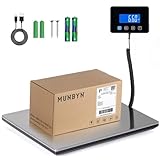
- Cost-Saving Precision: Experience unmatched accuracy with the Munbyn 440lbs digital postal scale. As a digital scale for shipping packages, scale for packages, and postage scale, it ensures you only pay for what you ship—vital for small business essentials—with a margin of error consistently under 0.5%.
- Convenient Hold Function for Easy Use: The MUNBYN 440lbs postal scale features a handy Hold Function that locks the weight on the screen, making it easy to record measurements without rushing. Simply press the “T” key to reset for the next use, making it a reliable shipping scale for small business packages.
- Quick, User-Friendly Operation: With fast USB connectivity and an intuitive display, this digital postal scale simplifies your workflow. It’s a top choice among digital scales for shipping and postal scales for shipping packages.
- Dual Power Options for Uninterrupted Use: Choose between 2 AAA batteries (offering 13 hours of runtime) or USB-C charging with a built-in 250mAh rechargeable battery (11-hour runtime). This versatile digital scale for shipping provides consistent performance as a postal scale, package scale, and essential small business tool.
- All-in-One Weighing Solution: Cover all your needs with one device that works as a digital postal scale, shipping scale, suitcase weight scale, and even package scale shipping small business. It’s the ultimate solution among postal scales for shipping packages and weight scale for packages.
- Quoted base charge versus billed base charge.
- Quoted service level versus service actually delivered.
- Booked versus final pieces, weight and dimensions.
- Accessorials included in the quote versus those billed and supported by an event.
- Expected carrier cost versus final supported carrier cost.
- Initial variance versus the remaining variance after any credit or correction.
- Customer shipping charge versus final carrier cost and the resulting order-level margin effect.
Federal audit guidance is not a universal private-shipping deadline
GSA’s guidance describes federal agency invoice-audit and payment procedures, including prepayment and post-payment audits. Its handbook states that federal agencies must notify a transportation service provider within seven calendar days of receiving an invoice about an adjustment or rejection under the Prompt Payment Act procedures it covers. That is federal-context guidance, not a general deadline for merchants or private shippers. For a private shipment, check the governing contract, carrier terms and applicable jurisdiction for dispute deadlines and remedies.
GSA also discusses documentation, rate verification and third-party audit services in the federal context. Those procedures do not establish a required ledger format for private businesses. The practical records to keep are the accepted rate authority, invoice and evidence of the service, linked to the shipment they concern.
Rank #4

- Lightweight Postal Scale - Max. Capacity: 440lb/200kg, Min. Readability: 40g, Display Resolution: 10g. Features a Carbon Fiber platform paired with a durable ABS housing. Lightweight + sturdy, easy to clean, move, and store.
- Digital Shipping Scale - 3 weighing Modes: kg/lb/lb:oz. Separate large back-lit LCD display with adjustable/disable Auto-off. Easy to handhold or wall-mount with the included drywall anchors and screws.
- User Friendly Design - Ships pre-calibrated and can also be easily calibrated. Dual powered by 2 x AAA batteries or AC adapter (both included).
- Hold & Tare Function - Locks readings and removes container weight for multiple weighing needs. Ideal for post offices, warehouses, commercial and home use.
- Fuzion Support - We offer 2-Year Warranty and Lifetime Support for this digital scale. Full day service by our support team. We are always glad to help with all your questions or concerns.
Build a ledger that leaves an audit trail
A spreadsheet or order-management system can support this process if each row represents a shipment and retains references to its source records. Keep the quote or rate basis, invoice, delivery evidence and correspondence accessible from that row. Use consistent shipment identifiers and preserve adjustments rather than replacing the original values.
The Tool Desk
Outbyte PC Repair FREEClear out junk files and repair common Windows errorsFree Scan →Outbyte Driver Updater FREEFix the driver behind crashes, sound loss and screen glitchesFind Drivers →GSA describes freight auditing as a way for federal agencies to prevent overpayments and recover overcharges, but the cited material does not establish an expected recovery rate, error rate, time saving or margin improvement for a typical shipper. Treat those outcomes as dependent on the actual shipments, contracts and review process.
Quick Recap
Best Value

- Durable & Practical Design - Built for durability and daily use, this all-in-one postal scale features a sturdy ABS housing, along with a stainless steel platform and control panel. Comes fully equipped with 2 AA batteries, a USB cable, and a soft measuring tape, so you're ready to start weighing right out of the box.
- Higher Capacity with Precision Accuracy - Max. Capacity: 90lb / 40kg, Min. Readability: 10g, Display Resolution: 2g / 0.1oz. Perfect for handling everything from small parcels to heavy packages.
- 5 Versatile Measurement Units - Quickly toggle between lb, lb.oz, oz, g, and kg to suit any shipping or postal need. The large, backlit LCD display makes it effortless to read weight values in any setting.
- User-Friendly Features - Simple 5-button interface for easy operation, with useful functions like Hold, Tare, and PCS (piece counting). Ideal for streamlining your shipping, packaging, or inventory processes.
- Easy to Calibration - Equipped with adjustable calibration technology, you can choose any known weight between 3 lb to 80lb(2kg-40kg), making calibration quick and hassle-free.
Product prices and availability are accurate as of the date/time indicated and are subject to change. Any price and availability information displayed on Amazon at the time of purchase will apply.

