Yes, a phone can record Mars and the Beehive Cluster, or M44, in the same wide-field photograph. The practical target is a small, bright point of Mars set against the cluster and its surrounding stars—not a detailed planetary disk. For the October 11, 2026 pairing, use your phone’s main wide camera on a rigid support, lock focus on a distant star, start with a short exposure, and take several variations. Binoculars or a telescope with a low-power eyepiece are optional routes for a larger view, but increased magnification can remove much of the broad cluster from the frame.
The date comes from an October 2026 observing guide and is not a guarantee that the event will be visible from every location. Check a local sky chart or planetarium listing for your exact time, altitude and direction, then choose the darkest unobstructed view you can reach.
As an Amazon Associate I earn from qualifying purchases.
What a phone can—and cannot—show
In a phone-only image, Mars normally remains a bright colored point. A phone’s small lens and sensor do not provide the resolving power needed to record the planet’s disk, polar cap or surface markings. You may see a warmer orange or red tint, but color and brightness are not the same as planetary detail.
Quick wins for a faster PC:
Scan for outdated or missing drivers - takes under a minuteDriver Scan →Clear out junk files and repair common Windows errorsFree Scan →M44 is the Beehive Cluster, also called Praesepe or Messier 44. NASA describes it as roughly 1.5 degrees across and containing about 200 stars. Those figures describe the cluster itself, not the number of stars a phone will reveal. A wide phone lens can include the cluster’s overall shape and nearby sky, while a tight zoom can crop away its outer members.
#1 Best Overall

- CAPTURE IMAGES AND VIDEO THROUGH YOUR SCOPE: The Celestron Smartphone Adapter connects your phone to your telescope, spotting scope, binocular, monocular & microscope! You can capture amazing images & video through the eyepiece to share with friends.
- UNIVERSAL SMARTPHONE ADAPTER: Fits a wide range of smartphones, including the latest iPhone, Samsung Galaxy, and Google Pixel models — even with most cases on.
- EASY TO USE: Simply place your phone in the adapter, center your phone’s camera over the eyepiece, and use the knobs to secure the adapter in place.
- STURDY CONSTRUCTION: Durable metal frame and polymer body for worry-free use in the field — perfect for star parties or birding events.
- COMPATIBLE EYEPIECES: Smartphone adapter fits almost any eyepiece from 29 millimeters to 45 millimeters in diameter, including telescopes equipped with 1.25” eyepieces.
The combined scene is therefore a composition problem. Mars is much brighter than most M44 stars. An exposure that protects Mars can leave only the brightest cluster stars; an exposure that reveals more faint stars can make Mars look swollen, pale or completely blown out. Several short trials are more useful than searching for one universal setting.
When and where to photograph the pairing
Use October 11, 2026 as a planning date, not a universal visibility promise
The current October 2026 sky guide places the Mars–Beehive meeting on October 11, 2026. The exact observing window depends on your latitude, longitude, horizon and daylight conditions. Weather, haze, light pollution, buildings, trees and twilight can all prevent a usable photograph even when the conjunction occurs above the horizon.
- Several days before the event, check a reputable local planetarium, astronomy-club chart or interactive sky map for Mars and M44.
- Note the time when the pair rises high enough to clear local obstructions and the time when twilight or moonlight becomes a problem.
- Visit the site in daylight. Find a stable place where you can point the phone without streetlights shining into the lens.
- On the night, allow your eyes and phone to adjust for a few minutes, then make a test frame before committing to a sequence.
A dark rural site is helpful but not mandatory for a record of the pairing. In a city, the cluster’s fainter stars may disappear into the sky glow; framing, focus and Mars detection can still succeed.
The Tool Desk
Outbyte PC Repair FREERepair Windows errors before they cause bigger problemsFix Now →Outbyte Driver Updater FREEFix the driver behind crashes, sound loss and screen glitchesFind Drivers →Choose a capture method
| Method | Best for | Field of view | Alignment and steadiness | Main compromise |
|---|---|---|---|---|
| Phone alone on a tripod or firm support | A simple wide-field record of Mars and M44 | Usually the widest option, especially at the native main-camera setting | Easy to stabilize; no optical alignment | Mars remains a point and faint stars demand careful exposure |
| Phone aligned with binocular eyepiece | Readers who already own binoculars and want a larger view | Reduced compared with the naked-phone view; enough of M44 must remain visible | Hand-holding is difficult; an adapter improves repeatability | Eyepiece alignment and edge darkening can be troublesome |
| Phone mounted to a telescope eyepiece | A steadier afocal view and closer framing with existing equipment | Often narrow; high power can exclude most of M44 | Adapter and mount make the camera steadier than hand-holding | Compatibility, focus and field-of-view limits; Mars and the cluster may not fit together |
Start with the phone-only route unless you already know your binoculars or telescope. Extra optics do not automatically improve a joint composition. M44 is broad, so a low-power, wide-field eyepiece is usually more appropriate than a high-power planetary setup.
Phone-only wide-field procedure
1. Prepare the phone and support
- Charge the phone and clear enough storage for a series of full-resolution images.
- Clean the main camera lens with a soft lens cloth. A fingerprint can create a large halo around Mars.
- Use the main camera at its native wide setting when possible. Avoid digital zoom for the first attempt; it crops the scene and magnifies every vibration.
- Place the phone on a small tripod, a clamp, or a firm improvised support. A rock or block of wood can work if the phone cannot move while the exposure runs.
- Turn off notifications or use an equivalent do-not-disturb mode so a vibration does not interrupt a frame.
A tripod is useful, but the important requirement is immobility. Leaning the phone against a soft bag or holding it by hand usually produces blur in a dark-sky exposure.
2. Compose a wide scene
Use a sky chart to locate Mars and M44 before opening the camera. Leave surrounding sky in the frame so the cluster reads as a group rather than a random sprinkling of points. Include a small amount of horizon or a recognizable foreground only if it does not block the pair; the foreground can make the image easier to orient but may force a brighter, less star-friendly exposure.
Rank #2

- Capture What You See Through Your Scope — TRIDAPTOR helps connect your smartphone to most spotting scope, telescope, monocular or microscope eyepieces, so you can capture and share birds, wildlife, targets, celestial objects and distant scenes.
- Precise 3-Axis Alignment for Cleaner Shots (Patent Pending) — This 3-axis digiscoping adapter lets you adjust your phone left/right, up/down and forward/back to line up the camera with the eyepiece. The Z-axis adjustment helps reach the right eye relief, reducing dark edges or vignetting for clearer photos and videos.
- All-Metal Build, No Phone Sagging — Rigid aluminum construction helps keep your phone steady and aligned, unlike flimsy plastic telescope phone adapters that can flex, tilt or lose position. Rubber pads help protect your phone and eyepiece from scratches.
- Shoot Without Touching the Scope — Use the included Bluetooth remote with this phone scope adapter to take photos or videos without tapping your phone and shaking the image, making it easier to capture sharper shots and share your view.
- Fits Most Phones & Many Standard Eyepieces — This smart phone adapter for telescope fits most iPhone and Android smartphones from 2.36"–3.44" wide / 60–87.5 mm. It also fits eyepieces with an outer diameter of 0.86"–2.4" / 22–61 mm.
Keep the phone level enough that the cluster is not accidentally pushed to an edge. If your camera app displays a grid, place Mars off-center and leave room toward M44. Do not assume the phone’s night mode will preserve the composition: some automatic modes crop, combine frames or switch lenses without warning.
3. Focus on a distant point of light
Autofocus often hunts in a dark sky. Tap a bright star, Mars or a distant light, then inspect the preview at the highest magnification the app allows. The smallest star points indicate better focus than a large fuzzy blob.
- Point at a bright star or other far-away point of light.
- Tap the point to initiate focus.
- If the app offers focus lock, manual focus or an infinity setting, lock it after the star appears sharp.
- Recheck focus if you change lenses, zoom, or move the phone substantially.
Do not refocus between every frame unless the phone has clearly lost focus. Locking focus keeps a sequence consistent and prevents one test image from being sharp while the next is soft.
4. Begin with a short exposure test
If the camera provides manual shutter control, begin with a few seconds rather than a long preset. The correct duration depends on the phone, sky brightness, lens and tracking of the sky. A short first exposure shows whether stars trail and whether Mars is overexposed.
- If stars become short lines, shorten the exposure or use a steadier support.
- If Mars is a featureless white spot with a large halo, shorten the exposure or reduce sensitivity.
- If the frame is nearly black and M44 is absent, increase exposure cautiously or raise sensitivity in small steps.
- If the app chooses an automatic night mode, make several frames and note whether it changes exposure or lens selection between shots.
Do not treat any single ISO or shutter combination as universal. A prior tutorial suggested experimenting around ISO 400–1600 for a basic phone camera, but those values are starting points only and were not designed as a guarantee for the 2026 event or for every phone.
5. Use a timer or remote shutter
Touching the screen can move the phone during the exposure. Set a two- or ten-second timer, use a wired or wireless remote if your phone supports one, or trigger the camera through a watch or headset. Start the timer after framing and focusing, then let the phone settle before the shutter opens.
Rank #3

- Capture the World :This spotting scope phone adapter allows you to easily capture the beauty of the world through your screen. Connecting your phone to telescopes, spotting scopes, binoculars, monoculars and microscopes, you can capture wonderful images and videos through the eyepiece and share them with your friends.
- Easy Setup:Put your phone into the spotting scope phone mount, precisely align the camera with the eyepiece, and then turn the knob, the adapter will hold your phone firmly in place with just these three steps. The whole process is easy and convenient, no need for complicated adjustments, even a novice can get started quickly.
- Regular Size:This spotting scope phone adapter is extremely compatible with almost any eyepiece on the market with a diameter between 28mm and 47mm. Whether it's a normal eyepiece you use every day or a specialized eyepiece with special features, as long as the diameter is within this range, the adapter can be accurately mated and easily assembled.
- Durable Material :The main body is made of zinc alloy (more durable than aluminum alloy) with grooved metal case. The phone clip is made of high-strength PA plastic, and the metal body of the adapter is durable enough to be used in the field and in harsh weather conditions.
- Fits most smartphones:Ranging from 2.13 inches to 3.54 inches (54-90 mm). Fits almost all smartphones on the market iPhone 16Pro Max, 16 Pro, 15, 15 mini, 14 Pro Max, 14 Pro,14, SE, Xs, Xr, X, S20, S20+, S20FE, S10, S10+, S10E, S8, S7, S6, S5, S4, Note20, Note20 Ultra, Note10+, Note 10, Note 9, Note 6, Note 5, Note 4, A51, A71, A70 and more.
Capture a short sequence instead of one frame. Small gusts, passing vibrations and momentary focus changes can spoil individual images; multiple trials give you a better chance of a sharp frame without changing the scene.
6. Review at full size
Zoom into the original image, not just the thumbnail. Check three separate things: Mars should be a compact point rather than a broad smear, the brighter M44 stars should remain distinct, and the background should not show obvious motion trails. If one element fails, change one variable at a time and repeat.
Balancing Mars against the cluster
Why one exposure may not show everything
Mars can be bright enough to saturate the phone sensor before the fainter members of M44 register. Computational night modes may lift the background and reveal more stars while making Mars larger and less natural. Conversely, a conservative exposure may preserve Mars’s orange color but show only a few cluster stars.
For a single finished frame, decide which compromise matters most. A recognizable pairing with a small Mars point and a visible cluster is usually more informative than a large, clipped planet surrounded by a washed-out background.
Make an intentional bracketed set
- Keep focus and framing fixed.
- Take one short exposure that protects Mars highlights.
- Take a second, slightly longer or more sensitive exposure to test whether additional M44 stars appear.
- Take a third variation only if the first two show a clear need; avoid changing several settings at once.
- Label or remember the settings so you can compare the files later.
You can select the frame that best balances the two subjects. If you combine exposures in an editor, describe the result honestly as a processed composite; stacking or blending can improve contrast and noise, but it cannot create planetary detail that the phone never captured.
Photographing through binoculars or a telescope
Use this route only with suitable equipment
A phone-to-eyepiece adapter is optional. It is useful when you already own binoculars or a telescope and want a steadier connection than hand-holding the phone over the eyepiece. Adapter dimensions and camera placement vary, so check your phone’s width, camera-lens position, camera bump and the eyepiece’s outside diameter before purchasing. A return policy matters because mechanical fit cannot be inferred from a product name alone.
Rank #4
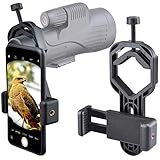
- For phone width range: 55~85 mm(2.16"~3.35"). Fit iPhone X/8/8 Plus/7/7 Plus/6/6s/6 Plus/5/5s - Fit Samsung Galaxy S9/S8/S7/S6/S6/S5 Note 9/8/7/6/5 - Fit Sony, LG, HTC, and other brands.
- With this universal smartphone telescope adapter, you can connect your phone to a telescope or microscope to take images of the moon and cells, or to a spotting scope to take images of birds and other objects.
- Smartphone mount compliable with microscope, telescope, binoculars, monocular, night vision spotting scope. Fit eyepiece diameter 22mm~ 44mm(0.86"-1.73").
- Optimized weight, lighter and reduce the pressure on the telescope eyepiece, weight: 75 g / 2.65 oz.The body is made of high-strength PA plastic. The surface of the mobile phone and eyepiece has a soft EVA pad to avoid scratching and damage.
- Warranty service:If you have questions about installation and not using, please contact us in time, we will reply and deal with your problems as soon as possible.
Binoculars and telescopes do not make the phone a planetary camera automatically. The phone still has to focus through the eyepiece, and the optical system can narrow the field enough to remove M44.
Outdated Drivers Are Slowing You Down
One free scan finds every outdated or missing driver and matches the right update for your exact hardware.Free scan · exact hardware matchPC Slower Than It Used to Be?
A free scan shows the junk files, broken settings and background clutter dragging Windows down - then fixes them in one click.Free scan · Windows 10 & 11Select a low-power, wide-field view
M44’s approximately 1.5-degree span is the key framing constraint. Begin with the lowest-power eyepiece that gives a clean view and then verify that Mars and a useful portion of the cluster fit at once. A high-power eyepiece may produce a larger Mars point but crop the cluster into an incomplete patch.
Align the active camera lens
- Mount the phone securely or hold it squarely behind the eyepiece while you locate the optical view.
- Use the camera lens that is actually centered over the eyepiece. Phones with several rear cameras can switch lenses when you zoom.
- Move the phone slowly until you see a bright, evenly illuminated circular field rather than a crescent, dark edge or black screen.
- Lock focus after the star field appears sharp. Refocus the telescope or binoculars first, then make only small phone adjustments.
- Take multiple short trials and inspect both Mars and the stars before changing magnification.
Camera bumps and protruding lenses can prevent the phone from sitting flush. Do not force the adapter against the glass or eyepiece; an imperfect fit can tilt the phone, introduce vignetting and make the field drift.
Expect a narrower composition
Through optics, the enlarged view may show Mars more prominently but less of M44. If the pair no longer fits, return to a lower-power eyepiece or switch to the phone-only wide frame for the joint photograph. You can photograph Mars separately through higher power, but that is a different objective from recording Mars and M44 together.
Common problems and fixes
| Symptom | Likely cause | Fix |
|---|---|---|
| Stars are short streaks | Phone movement or an exposure that is too long for the support | Use a firmer support, timer or remote; shorten the exposure and retest |
| Mars is a large white blob | Overexposure, lens flare or computational processing | Reduce exposure or sensitivity, clean the lens, disable aggressive night processing if possible |
| M44 is missing | Sky glow, exposure too short, focus error or the cluster is outside the frame | Confirm the location with a sky chart, keep the wide lens, focus on a star and increase exposure cautiously |
| Everything is soft | Autofocus failed or the phone moved while focusing | Tap a distant star, lock focus, use a timer and inspect at full size |
| Black crescent around the image through an eyepiece | Phone lens is off-axis or too far from the eyepiece | Center the active lens, adjust eye relief and secure the adapter |
| Mars and M44 cannot fit through the telescope | Magnification is too high or the eyepiece field is too narrow | Use a lower-power, wider-field eyepiece or return to the phone-only method |
| Color changes between frames | Automatic white balance or lens switching | Lock white balance if available, use one lens and compare original files |
Light pollution, Moon and atmosphere
Urban sky glow raises the background and reduces the contrast of faint cluster stars. Move away from direct lights, shade the phone lens without touching it, and avoid shooting through haze near the horizon. Thin cloud can make Mars look larger and scatter light across the frame.
Moonlight is not automatically disqualifying, but it competes with M44’s fainter members. A clear, darker interval usually gives the cluster more definition. Check the Moon’s position in the same local sky chart you use for Mars and M44.
Best Value

- Capture What You See Through Your Scope — TRIDAPTOR turns your spotting scope, telescope, monocular or microscope into a smartphone viewing and camera setup. View through your phone screen instead of staying pressed against the eyepiece, then capture and share birds, wildlife, targets, celestial objects and distant views.
- Precise 3-Axis Alignment for Cleaner Shots (Patent Pending) — This 3-axis digiscoping adapter lets you adjust your phone left/right, up/down and forward/back to line up the camera with the eyepiece. The Z-axis adjustment helps reach the right eye relief, reducing dark edges or vignetting for clearer photos and videos.
- All-Metal Build, No Phone Sagging — Rigid aluminum construction helps keep your phone steady and aligned, unlike flimsy plastic telescope phone adapters that can flex, tilt or lose position. Rubber pads help protect your phone and eyepiece from scratches.
- One Adapter for Most Phones — The telescope phone mount fits most iPhone and Android smartphones from 2.36"–3.44" wide / 60–87.5 mm. No need to buy a new adapter every time you upgrade your phone or scope.
- Check Eyepiece Size Before Ordering — This smart phone adapter fits many spotting scope eyepieces within 0.86"–2.4" / 22-61 mm outer diameter. Please measure your eyepiece before purchase. Compatible with most Vortex, Swarovski, Celestron, Nikon, Zeiss, Kowa and Leupold eyepieces.
Editing without inventing detail
Modest processing can make a real capture easier to read. Crop only after deciding whether the cluster context is important, then adjust exposure, highlights, shadows, contrast and color temperature gently. Noise reduction can smooth the background, but excessive sharpening turns noise into false stars.
- Keep an unedited original for comparison.
- Lower highlights if Mars is clipped, but understand that recovered highlight sliders cannot restore saturated color.
- Raise shadows or contrast carefully to reveal M44 without producing a gray, washed-out sky.
- Use a modest crop; aggressive cropping enlarges blur and digital artifacts.
- If you stack or blend frames, state that the image is processed and do not describe the result as additional optical detail on Mars.
Do you need a telescope?
No. A telescope is not required to photograph Mars and M44 together. A phone on a stable support is the simplest route and generally preserves the widest field. Binoculars or a telescope become useful when you already own them and want an afocal experiment, a steadier mount or a separate closer view.
The choice depends on your priority:
- Choose phone-only capture for the broad pairing, quick setup and minimal alignment.
- Choose binoculars when you want help seeing the cluster visually and can accept a smaller field.
- Choose a telescope when you already have a low-power eyepiece for the joint scene or want separate high-magnification experiments.
A repeatable night-of checklist
- Confirm the local date, time, altitude and direction for October 11, 2026.
- Check weather, twilight, Moon position and obstructions.
- Charge the phone, clear storage and clean the lens.
- Set up a tripod or firm support before locating the pair.
- Start at the native main-camera wide setting with digital zoom off.
- Frame Mars and enough surrounding sky to include M44.
- Focus on a distant star and lock focus if available.
- Set a timer or remote shutter.
- Begin with a few-second exposure or the closest short manual setting.
- Take several frames, changing only one exposure variable at a time.
- Review full-size files for star trails, clipped Mars and lost cluster stars.
- Save the originals before applying modest edits.
Frequently asked questions
Can I take a picture of Mars with my phone?
Yes, but phone-only optics generally record Mars as a bright point. A stable support and careful exposure are more important than digital zoom. A telescope can enlarge the view, but atmospheric turbulence, focus and the phone’s sensor still limit detail.
Free tools Windows power users keep installed
One-click scans. No signup required.
How do I photograph the Beehive Cluster?
Use the phone’s wide main camera, preserve a dark sky background, focus on a distant star and make several short exposures. M44 is broad, so avoid cropping it with digital zoom or a high-power eyepiece.
Will October 11, 2026 work everywhere?
No. The date identifies the predicted pairing, while local latitude, horizon, twilight, weather and light pollution determine whether you can see and photograph it. Verify local circumstances with a current sky chart.
Should I use night mode?
Try it only after making a controlled frame. Night modes differ by phone and may combine images, change lenses or brighten Mars excessively. Compare the result with a manual or shorter-exposure test if your camera allows those controls.
Can I show Mars as a disk and keep M44 in the same image?
Not realistically with ordinary phone-only optics. A close planetary view needs substantially more magnification, and that narrow field generally excludes the broad cluster. Treat the wide-field pairing and a detailed Mars image as separate compositions.
What’s actually slowing this PC down?
Pick the symptom - the matching free tool is one click away.
Quick Recap
Product prices and availability are accurate as of the date/time indicated and are subject to change. Any price and availability information displayed on Amazon at the time of purchase will apply.

