Measure AI in layers, not with a single “productivity” number. First map the job into observable tasks, then compare an unchanged baseline with an AI-assisted version using the same quality standard. Record time and throughput, but also quality, errors, rework, end-to-end cycle time, handoffs, cost, and worker experience. Only after those measurements should you ask whether the workflow, business results, employment, or job quality changed.
This approach separates three questions that are often confused: which tasks are technically exposed to AI, what happens when people use AI on those tasks, and whether task-level changes produce wider organizational effects. Exposure estimates and self-reported time savings are useful context, but neither is proof of realized productivity or job displacement.
As an Amazon Associate I earn from qualifying purchases.
What “AI impact” should mean in a measurement project
A job is a bundle of tasks performed in a sequence or network of workflows. An AI system may help with one step, slow another through review, and leave the final business outcome unchanged. Define the level of impact before collecting data.
Free tools Windows power users keep installed
One-click scans. No signup required.
| Question | What to measure | What it cannot establish by itself |
|---|---|---|
| Is the task technically exposed? | Whether current AI could perform specified task elements within a defined time and quality threshold. | That workers will use it, that jobs will disappear, or that productivity will rise. |
| Does AI change task performance? | Completion time, throughput, quality, errors, rework, and worker experience under a controlled comparison. | That the entire workflow or business is faster or cheaper. |
| Does the workflow or organization change? | End-to-end cycle time, queues, handoffs, cost, output, earnings, employment, and job quality. | That an observed change was caused by AI unless the design supports a causal conclusion. |
The OECD’s 2024 definition of exposure counts a worker as exposed when at least 20% of job tasks could be completed in half the time with a large language model while maintaining equivalent quality. It estimated that around one quarter of workers met that definition, with regional variation. This is not a forecast that one quarter of jobs will be automated. The International Labour Organization (ILO) reported a mean occupational automation score of 0.29 in 2025, compared with 0.30 in 2023; that score is an estimate of potential exposure, not a measured change in any employer’s productivity.
#1 Best Overall
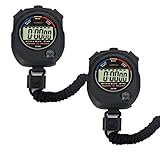
- Time, Date And Alarm Function: Switch between 3 display modes to check the time, date and set your alarm. On the clock mode, hit the two outer buttons at the same time to turn off the alarm.
- 1/100 Second Split Timing, Measure time at an accuracy of one hundredth of a second. Use the split time feature to precisely measure multiple events.
- Color:Black
- Light Weight and included lanyard this sports stopwatch is the ideal time measurement device for athletes - especially runners - coaches and referees.
- 2 Pack
Map the job into tasks and workflow steps
Start with recurring activities that have a clear beginning, end, input, and acceptable output. Avoid treating a whole job title as one task. The ILO’s 2025 assessment illustrates the granularity possible: it examined nearly 30,000 tasks at six-digit occupational detail, combining task data, expert judgment, and AI predictions.
Build a task inventory
- List the workflow’s major stages, such as intake, analysis, drafting, review, approval, delivery, and follow-up.
- Break each stage into actions one person can complete and observe. “Prepare a client report” is too broad; “extract figures from three documents,” “draft the findings section,” and “check citations” are measurable units.
- For each task, record the performer, required inputs, systems used, decision rights, expected output, quality standard, and downstream recipient.
- Mark dependencies: approvals, data availability, queueing, handoffs, and tasks that must occur in a particular order.
- Identify exceptions and difficult cases. A system that performs well on routine inputs may fail on ambiguous, sensitive, or novel work.
| Field | Example entry for a support workflow |
|---|---|
| Task | Classify an incoming support request |
| Input | Customer message, account history, product taxonomy |
| Performer | Support specialist |
| Output | One category, priority, and next-action code |
| Quality rule | Correct category and priority, with no prohibited data disclosed |
| Downstream step | Routing to the appropriate queue |
| Failure or rework | Reclassification, escalation, or customer follow-up |
Keep task boundaries stable during the evaluation. If AI changes the task definition halfway through, record that as an implementation change rather than silently combining unlike observations.
Define the baseline and comparison before collecting results
Write down how work is done without AI and how it will be done with AI. Include the AI product and version, enabled features, prompt or configuration, human-review requirement, training, task scope, participant role, dates, and data sources. A later change in model version, staffing, policy, or demand can otherwise look like an AI effect.
Quick wins for a faster PC:
Repair Windows errors before they cause bigger problemsFix Now →Fix the driver behind crashes, sound loss and screen glitchesFind Drivers →Clear out junk files and repair common Windows errorsFree Scan →Choose an evaluation design
| Design | How it works | Strengths | Main limitation |
|---|---|---|---|
| Random assignment | Randomly assign comparable workers or cases to baseline and AI-assisted conditions during the same period. | Best protection against measured and unmeasured differences between groups. | May be difficult when access, safety, or operational policy requires universal treatment. |
| Concurrent comparison | Run AI and non-AI groups at the same time with matched tasks, demand, and quality rules. | Controls for seasonality and changing workloads better than a before-and-after study. | Groups can still differ in experience, case mix, or motivation. |
| Phased rollout | Introduce AI to defined teams or sites at different dates and compare changes over time. | Useful for operational deployments and learning during implementation. | Other changes may coincide with each rollout phase. |
| Before-and-after observation | Compare the same process before and after adoption. | Simple and often feasible. | Demand, staffing, practice, and technology trends can confound the result; use cautious, non-causal language. |
NIST’s guidance on AI measurement and evaluation emphasizes documenting the strengths and limitations of each metric and method. At minimum, record the sampling rule, assignment method, observation period, missing-data treatment, and reasons the comparison may not be causal.
Measure a balanced set of outcomes
Time, quantity, quality, and error are separate outcomes. A shorter task can produce less usable work, and more output can create extra checking that removes the apparent gain.
| Outcome | Operational definition | Useful calculation or collection method | Interpretation warning |
|---|---|---|---|
| Task time | Elapsed active time from a defined start to an acceptable first completion. | Timestamped system events or a time study with a written start/stop rule. | Do not count waiting time as active work unless the question concerns elapsed cycle time. |
| Throughput | Accepted tasks completed per worker-hour or per defined period. | Accepted output count divided by comparable labor time. | Higher quantity is not a gain if acceptance or quality falls. |
| Quality | Score against a stable rubric applied consistently to baseline and AI outputs. | Blind review by trained raters; report the rubric, rater agreement, and sample size. | Raters can be biased if they know which condition produced an output. |
| Error rate | Share of outputs containing a defined factual, procedural, safety, or compliance error. | Independent audit against a pre-specified error taxonomy. | Rare but severe errors need separate reporting from frequent minor errors. |
| Rework | Additional effort required to correct, verify, rewrite, or escalate an output. | Log revision events, correction time, and downstream returns. | Rework may occur in a different team and be missed by task timers. |
| Worker experience | Workload, autonomy, confidence, enjoyment, cognitive effort, and perceived control. | Short repeated surveys paired with behavioral indicators and interviews. | Self-reports describe experience and expectations; they are not objective productivity estimates. |
Set a quality rubric before seeing results
Define what “acceptable” means in observable terms. A rubric might score factual accuracy, completeness, adherence to policy, clarity, and appropriate escalation on a fixed scale. Use the same rubric, examples, and acceptance threshold in both conditions. If outputs are judged by people, conceal the condition where practical and report how many raters and items were used.
Rank #2

- Large Display --- Large and clear digit display, easy to read.
- Split Function --- Split Function can time single & split events, freezing the split-time display while total time continues; Time-Out Function has separate start/stop & reset buttons.
- Stopwatch for Coaches --- Includes 47" lanyard (neck strap), Light weight, small in volume, geat handheld, easy to carry, It is a good equipment for coaches referee to make practice like swimming running rugby basketball football and soccer etc.
- Multi-functions Stopwatch --- The stopwatch can show calendar and clock, hour, minute, second, week, month, day, selectable 12/24 hour.
- Precise Stopwatch --- PULIVIA this stopwatch is with high-precision, 1/100th second accuracy; One timing maximum up to 99 hours 59 minutes 59 seconds.
Use time studies carefully
A digital stopwatch can help time discrete, observable cycles such as document classification or a physical inspection. It cannot assess quality, attribution, rework, or end-to-end workflow impact, and timing can distort some knowledge work. Prefer system event logs when they capture the defined start and end reliably; otherwise explain who recorded the time and how interruptions were handled.
Run the evaluation as a repeatable protocol
- Pre-register the question. State the task, population, comparison, primary outcomes, quality threshold, observation dates, and what result would count as improvement.
- Freeze the baseline description. Save the non-AI procedure, tools, staffing assumptions, and policy version. Record any concurrent changes.
- Select representative cases. Include routine, ambiguous, high-risk, and difficult cases. Do not test only examples that make the AI look useful.
- Configure and train. Record model or feature version, prompts, retrieval sources, permissions, human review, and training time. Apply the same preparation standard to comparison groups.
- Assign or match observations. Randomize when feasible. If not, match cases or workers and document differences that remain.
- Capture raw events. Log task start and finish, output acceptance, revisions, escalations, handoffs, queue delays, and labor time. Preserve a record of missing or unusable observations.
- Score outputs independently. Apply the pre-set quality and error rubric, preferably with reviewers who do not know the condition.
- Survey workers repeatedly. Ask about workload, autonomy, confidence, enjoyment, and whether AI changed the type or pace of work; use the same questions at baseline and follow-up.
- Analyze by task and user group. Report averages only alongside distributions, sample sizes, observation period, and uncertainty.
- Check downstream effects. Trace accepted outputs through the next steps before declaring a workflow or business improvement.
An OECD 2024 chapter summarized a consultant experiment in which AI users completed 12.2% more tasks, finished them 25.1% faster, and received quality ratings 40% higher. Those are results from one study and context, not a universal expected gain. The same discussion described a deliberately hard task on which participants without AI performed better, which is why a test set must include failure cases and limits.
Measure the workflow after the task
Task completion is only one link in the process. For each case, follow the work until the customer, colleague, or system receives an accepted result.
Track the handoffs and queues
- End-to-end cycle time: elapsed time from intake to final acceptance, including waiting and approval delays.
- Queue time: time spent waiting for a person, system, data, or decision.
- Handoffs: number of transfers and the time between transfer and resumed work.
- Downstream rework: corrections, duplicate work, escalations, complaints, or returns created by the AI-assisted step.
- Resource cost: labor, review, infrastructure, licensing, and remediation cost measured over the same scope.
- Service result: completion, response-time target, resolution, revenue, safety, or other outcome the workflow exists to deliver.
For example, an AI draft may reduce a writer’s active minutes while adding an editor’s verification time. Measure total labor minutes and final acceptance, not just the drafting timer. Likewise, faster classification helps only if routing, queue length, and resolution time improve or remain stable.
Report variation instead of one average
AI effectiveness depends on the task, user experience, and implementation context. Break results out by task type, complexity, worker experience, team, AI-use pattern, and risk category when the sample supports it. Show the number of observations in each group, the observation dates, missing data, and an uncertainty interval or equivalent statistical summary.
The Tool Desk
Outbyte Driver Updater FREEFix the driver behind crashes, sound loss and screen glitchesFind Drivers →Outbyte PC Repair FREEClear out junk files and repair common Windows errorsFree Scan →Inspect the distribution, not just the mean. A small average improvement can conceal a group that is substantially worse, while a large mean can be driven by a few unusually easy cases. Separate first-use learning from steady-state performance and report training time as part of the implementation cost.
Rank #3

- 2‑PACK DIGITAL TIMER WITH BATTERY. This set includes 2 digital timers with 2 AAA batteries. It supports both count‑down and count‑up timing, max timing range up to 99 minutes 59 seconds. Built‑in memory function retains your last time setting without repeated reset, suitable for cooking, homework, focus study and workout timing. ( *It can not set Hour. Also no clock function. )
- LOUD AUDIBLE ALARM & SILENT FLASHING RED LIGHT. 2 reminder modes for different environments. Loud beeping alarm can be heard from another room for kitchen cooking. Silent mode triggers flashing red light only, no beep noise, perfect for quiet classroom, kid's study room and library without disturbing others. ( *For alarm mode, timer will beep during setting. )
- 3‑WAY MOUNTING OPTIONS. Each timer features magnetic back to attach on fridge or metal surface; fold‑out kickstand for desktop tabletop placement; hanging hole allows hanging (Need extra small string). 3 placement solutions fit kitchen, classroom, office and home desk scenarios. Small item size: 2.68"D x 2.48"W x 0.63"H. (You will get: 2 pcs digital timers, 2 pcs AAA batteries (Pre-install).
- SIMPLE OPERATION & BATTERIES PRE‑INCLUDED. Easy M/S buttons make time setting intuitive for kids, seniors and teachers. 2‑pack AAA batteries are pre-included in timer, ready to use out of box. When not in use, please manually switch it to shut-off on the backside. ( *It does not feature auto shut off. Its battery can not be charged. )
- WIDE‑APPLICATION HOUSEHOLD & CLASSROOM TIME MANAGEMENT TOOL. Practical timing tool for kitchen baking, egg boiling; classroom teaching for teachers; kids homework & screen‑time control; fitness exercise, hair salon timing and many more daily timing tasks. Perfect as homeschool supplies, classroom must haves, back to school supplies & teacher essentials. Compact lightweight design for home and travel use.
Compare two implementations on the same axes
| Axis | Disclosure needed for a fair comparison |
|---|---|
| Task completion time | Same task definition, start/stop rule, interruptions, and case mix. |
| Throughput | Accepted-output rule, worker-hours, staffing, and demand level. |
| Quality | Rubric, threshold, raters, blinding, and sample size. |
| Error and rework | Error taxonomy, severity, correction owner, and follow-up period. |
| End-to-end cycle time | Workflow boundaries, queue measurement, approvals, and handoffs. |
| Worker experience | Survey instrument, response rate, workload, autonomy, and confidence measures. |
| Implementation context | AI version, oversight, training, cost, dates, and evaluation design. |
Include worker experience and job quality
Productivity reporting should not erase changes in how work feels or who bears the risk. Track work intensity, pace, autonomy, discretion, learning opportunities, enjoyment, stress, data collection, and the distribution of benefits and burdens across roles. Ask whether people are doing more valuable work or merely supervising, checking, and correcting machine output.
In an OECD 2024 workplace survey, four in five workers said AI improved their performance and three in five said it increased their enjoyment of work. These are survey responses, not objective causal estimates. Pair them with observed workload, overtime, turnover, absence, quality, and safety indicators, and report response rates and question wording.
Also document what data the system collects, who can access prompts or outputs, and whether monitoring changes workers’ autonomy. OECD research identifies concerns about work intensity, data collection and use, and inequality. A workflow that raises output while concentrating surveillance or correction work in a lower-paid group has a different job-quality impact from one that distributes gains and control broadly.
What’s actually slowing this PC down?
Pick the symptom - the matching free tool is one click away.
Know what you can infer about jobs and employment
Use a causal ladder and stop at the highest level your evidence supports.
| Evidence you have | Defensible statement | Statement to avoid |
|---|---|---|
| Task exposure estimate | Specified task elements appear technically amenable to current AI under stated assumptions. | This share of jobs will be automated. |
| Controlled task comparison | Under this test, AI changed time, quality, errors, or worker experience for these users and cases. | The organization is now more productive overall. |
| End-to-end workflow comparison | The measured process changed in cycle time, cost, service result, or staffing under the observed implementation. | Employment or earnings will change in the same direction elsewhere. |
| Longitudinal organizational or labor-market evidence | The study found an association or estimated causal effect under its design and period. | A universal effect across occupations, regions, or future model versions. |
The ILO’s 2026 review reports that claimed time savings have not yet translated consistently into measured output, earnings, or employment. Therefore, do not convert a worker’s estimate of minutes saved into a forecast of jobs, wages, or revenue without separate evidence connecting each step.
Independent reader supportYour contribution helps us test, update, and keep practical guides available for everyone.A practical measurement worksheet
Use one row per task and one linked record per workflow case. The following fields make an evaluation auditable without requiring a particular software package:
Rank #4

- The Best Value PE Stopwatch on the Market
- ACCUSPLIT Exclusive Ergonomic "X" Case
- Special Million Cycle Switches operate cleanly, precisely & reliably every time
- Magnum XL digits for easy viewing
- 5 year Lithium battery
- Task and workflow stage
- Worker role, experience level, and team
- Case identifier and complexity or risk category
- Baseline procedure and AI-assisted procedure
- AI system, version, configuration, and human-oversight rule
- Training and prompt changes, with dates
- Start time, active finish time, acceptance time, and final workflow completion time
- Output-quality score, error type and severity, revision count, and rework minutes
- Queue delays, handoffs, escalations, and downstream outcome
- Worker workload, autonomy, confidence, and enjoyment responses
- Missing-data reason, exclusion decision, and reviewer identity
At the project level, preserve the sampling plan, assignment method, analysis code or calculation rules, metric definitions, cost assumptions, and version history. A future model update should create a new comparison rather than overwrite the old one.
Common measurement failures and fixes
Failure: treating exposure as impact
Fix: Label exposure as a technical potential estimate and run an observed task comparison before making performance claims.
Failure: timing only the AI-assisted step
Fix: Include prompting, checking, correction, approvals, queues, and downstream rework in active and end-to-end measures.
Failure: counting drafts as output
Fix: Count only outputs that meet the pre-set quality and acceptance rule.
Failure: relying on self-reported time savings
Fix: Pair survey responses with event logs, accepted output, error audits, and workflow outcomes. State clearly when a result is perceptual.
Do these 3 things before closing this tab:
1Fix the driver behind crashes, sound loss and screen glitches2Repair Windows errors before they cause bigger problems3Scan for outdated or missing drivers - takes under a minuteFailure: using only easy examples
Fix: Stratify routine, ambiguous, novel, sensitive, and adversarial cases; report where AI underperforms.
Best Value

- Time, Date And Alarm Function: Switch between 3 display modes to check the time, date and set your alarm. On the clock mode, hit the two outer buttons at the same time to turn off the alarm.
- RECALL/SET Button:is used to read the divided timings in the stopwatch mode, and used to switch
- START/STOP Button:used to start or stop timing in stopwatch mode, and to adjust the value when setting the time and alarm.
- Clock setting operation steps:In the clock function interface, press the MODE button three times to enter the clock adjustment interface. Press the START/STOP button to adjust the value, and press the RECALL/SET button to switch the setting items. The parameter items that can be set are: second, minute, hour, day, month, week, cycle in turn.
- Operation steps for alarm setting:In the clock function interface, press the MODE button twice to enter the alarm function interface. At this time, you can see that the value of "hour" is flashing. Each time you press the START/STOP button, the value increases by 1; after setting the "hour", press the RECALL/SET button. When the value of "minutes" flashes, each time you press the START/STOP button, the value increases by 1.
Failure: hiding variation behind an average
Fix: Segment by task, user experience, and context, and disclose sample size, missing data, and uncertainty.
Failure: making causal claims from a simple before-and-after
Fix: Use randomization, a concurrent comparison, or a phased design where possible. Otherwise identify confounders and use associational language.
Failure: ignoring job quality
Fix: Measure intensity, autonomy, enjoyment, data practices, safety, and who receives the benefits or additional checking work.
Recommended Free Tools
How to state the final result
A credible conclusion names the task, population, dates, AI configuration, comparison design, and outcomes that changed. It distinguishes active task time from total cycle time, reports quality and rework beside quantity, and identifies groups or cases that did not benefit. It also says what the study did not measure, such as employment or earnings, instead of implying those outcomes.
The central test is simple: did the defined work produce more accepted value at an acceptable level of risk and job quality, after accounting for all new review and coordination work? If that answer is not supported by the data, report a task-level observation rather than a claim about the whole job or organization.
Quick Recap
Product prices and availability are accurate as of the date/time indicated and are subject to change. Any price and availability information displayed on Amazon at the time of purchase will apply.

