What’s actually slowing this PC down?
Pick the symptom - the matching free tool is one click away.
Use a sound-level meter or a phone app to take repeated readings at a consistent position, then record the weighting (dBA, dBC or dBZ), metric (instantaneous, maximum, peak or average such as LAeq), time and duration. A single displayed number is only a snapshot: it does not describe a person’s total exposure, prove that a home is legally too noisy, or diagnose a sleep or hearing problem.
For informal comparisons, a phone app can show whether one room or appliance is louder than another. A handheld meter is easier to repeat and document. Exposure that changes as you move calls for a dosimeter, while a legal complaint, workplace decision or expensive building remedy calls for a qualified acoustic measurement with appropriate calibrated equipment.
As an Amazon Associate I earn from qualifying purchases.
What a decibel reading actually tells you
A decibel (dB) is a logarithmic way to express sound pressure relative to a reference. It is not a percentage and it does not increase in equal-sounding steps. A change of about 3 dB represents roughly twice or half the acoustic energy, while a 10 dB change is often perceived as approximately twice or half as loud; perception depends on frequency, background noise and the listener.
A meter measures sound at its microphone at a particular place and time. OSHA defines a sound-level meter as a device that measures “the intensity of sound at a given moment” (OSHA Appendix G). A reading therefore needs context: where the microphone was, what made the sound, whether the source was steady or intermittent, and how long it lasted.
#1 Best Overall

- 2.25-inch LCD Screen with Backlight: This TS-501B sound level meter is measured noise levels are expressed in decibels and displayed on the 2.25-inch LCD screen, it easy to read on a big display design. Long press the backlight button to turn on a backlight, making it easy to view even in dim light
- Decibel Meter with A/C Weighting: TopTes TS-501B decibel meter uses a precise condenser microphone to capture sound. It’s equipped with A-weighting and C-weighting facilities that measure noise levels from 30 to 130 dB with an accuracy of 1.5 dB, Frequency from 30 to 8000Hz. Perfect for monitoring noise levels in communities, home theaters, audio systems, automobiles, workshops, schools, offices, factories
- MAX/MIN Measurement: The sound pressure level (SPL) meter has Max or Min measurement values to represent the maximum/minimum (high/low peak) value of the sound produced within a certain time, and the data hold function can freeze the current reading based on the sound measurement according to individual needs
- Easy Use and Feature Packed: The non-slip side design ensures that the portable noise meter fits easily in the hand. TS-501B SPL meter is a battery-operated noise meter that comes with three durable batteries and has an automatic power off function to extend battery life. A low battery indicator will appear on the screen when the battery is low to remind the user to replace the battery in time
- What’s in the Box: One TS-501B Decibel Meter, Three AAA Batteries, One User Manual, One Carry Case. The device has been factory calibrated to ensure high measurement accuracy and compliance with quality standards.
Weightings: dBA, dBC and dBZ
- A-weighting (dBA): Applies a frequency response that broadly reflects human hearing at moderate levels. It is the weighting most often used in hearing-exposure guidance.
- C-weighting (dBC): Responds more to low-frequency sound than A-weighting and can help describe bass-heavy or high-level sound.
- Z-weighting (dBZ): Is intended to be essentially flat across the meter’s frequency range, without the A-weighting correction.
Do not compare a dBA result with a dBC or dBZ result as though they were the same measurement. If you are comparing rooms or dates, keep the weighting unchanged.
Instantaneous, maximum, peak and average values
- Instantaneous level: The value shown at that moment. It can move rapidly when sound fluctuates.
- Maximum: The highest level captured during the selected run, using the instrument’s time response.
- Peak: A very short crest, useful for impulsive events such as a dropped object or firework. It is not interchangeable with maximum sound level.
- LAeq: An energy-equivalent average A-weighted level over a stated period. It can be more representative than a single snapshot when a source cycles or varies.
- Time-weighted average (TWA) and dose: Exposure-oriented measures that combine level and duration. Their reference criteria depend on the instrument and standard.
Always write down the metric with the number. “62” is incomplete; “62 dBA LAeq over 15 minutes” can be compared with another run made under the same conditions.
Choose the right measuring method
| Option | Best use | Limits |
|---|---|---|
| Phone sound-level app | Quick screening, repeated comparisons and a first look at a room or appliance | Phone microphones and apps vary; calibration may be unavailable; not a compliance substitute. The NIOSH app is currently listed for iOS only. |
| Handheld sound-level meter | Repeatable spot readings with a dedicated device | Accuracy class, calibration, weighting, time response and technique determine the result. |
| Noise dosimeter | Accumulated exposure while a person moves between sources | Specialized exposure equipment; unnecessary for a casual room check. |
| Professional acoustic/noise survey | Formal, consequential or technically complex investigations | Requires a qualified provider and a method suited to the question; cost and local rules vary. |
When a phone is enough for screening
Use an app when your question is comparative: Is the bedroom quieter with the door closed? Did a fan become louder after repair? Which location in the room has the highest background level? Treat the result as an estimate, not a certified measurement.
The Tool Desk
Outbyte Driver Updater FREEFix the driver behind crashes, sound loss and screen glitchesFind Drivers →Outbyte PC Repair FREEClear out junk files and repair common Windows errorsFree Scan →When to use a meter or dosimeter
A handheld meter is the straightforward physical choice when you need repeatable spot readings, a visible measurement record or a microphone that can be checked with an acoustic calibrator. A dosimeter is appropriate when exposure follows a person—for example, moving between a workshop, kitchen and living room—because a series of spot readings may miss important periods. OSHA explains the distinction and the need for a series of readings when exposure changes (OSHA monitoring appendix).
Rank #2

- Accurate 30-130dB Noise Measurement: The Goldeep SL750A decibel meter measures sound levels from 30 to 130dB with ±1.5dB accuracy and a 31.5Hz-8KHz frequency response. This sound decibel meter is ideal for checking home noise, neighbor noise, traffic sound, office noise, construction sites, factories, classrooms, baby rooms and musical instruments.
- A/C Weighting for Different Sound Environments: This digital sound level meter supports A/C weighting modes for more flexible noise testing. A-weighting is suitable for environmental noise such as urban traffic, schools, offices, business areas and construction sites. C-weighting is designed for industrial noise from machinery, equipment, aerospace, high-speed rail and other high-intensity sound sources.
- dB/SONE Units for Sound & Loudness Testing: Use the dB unit to measure sound intensity for environmental noise, machine noise, traffic noise and workplace noise. Switch to SONE to better understand perceived loudness, making this db meter useful for music, audio systems, acoustic checks and instrument noise control..
- FAST/SLOW Response with MAX/MIN Tracking: The spl meter includes FAST and SLOW response settings. FAST response, 0.125s per reading, is useful for changing noise levels, while SLOW response, 1s per reading, is suitable for steady-state noise. MAX/MIN value tracking helps record peak and minimum noise levels over a period of time.
- Easy-to-Use Sound Meter for Daily & Professional Needs: Designed with data hold, clear LCD display, anti-slip grip and a windbreak ball, this sound meter is practical for indoor and outdoor use. Package includes 1 sound level meter, 2 AAA 1.5V batteries and 1 user manual, so you can start measuring noise right away.
Use a professional survey when results could support a legal complaint, employment decision, insurance claim or costly construction work. The method may need calibrated instruments, stated time windows, octave or frequency analysis, weather records for outdoor sources, and documentation that a casual app cannot provide.
Prepare a fair home measurement
- Define the question. Decide whether you are checking hearing exposure, a sleep disturbance, an appliance, an intermittent neighbour, or the difference between two locations. The question determines the metric and duration.
- Choose one listening position. Put the microphone where a person’s head would normally be, or document the exact distance from the source. Keep height, orientation and distance consistent for every comparison.
- Describe the source. Note whether it is steady, intermittent, tonal (such as a hum) or impulsive. Record other sound that could mask or add to it.
- Control what you can. Close or open doors consistently, keep HVAC settings the same, and avoid touching the microphone or phone. Do not stand so close that your body blocks the sound path.
- Select weighting and response. Choose the same A, C or Z weighting and, where offered, the same slow, fast or equivalent time response. For changing sound, enable LAeq, maximum or another average metric rather than relying only on the live display.
- Run several trials. Take readings during representative quiet and noisy periods. For an intermittent source, continue long enough to capture several cycles and record the start and end times.
- Log every result. Write the date, clock time, room, microphone position, source state, weighting, metric, duration, device or app and any unusual event.
Repeating the same procedure matters more than chasing a single impressive number. If you change the phone, app, position or weighting, start a new series instead of treating it as a continuous trend.
Using the NIOSH Sound Level Meter app
The National Institute for Occupational Safety and Health (NIOSH) lists a free Sound Level Meter app for iOS. Its current CDC/NIOSH listing describes A-, C- and Z-weighted readings and metrics including LAeq, maximum, peak, TWA and dose (CDC/NIOSH app page). Availability and specifications can change, so check the listing on the day you install it.
Basic workflow
- Install the NIOSH app on a compatible iOS device and grant microphone access.
- Choose the desired weighting and metric before starting a run. For a fluctuating room, LAeq plus maximum is usually more informative than the instantaneous value alone.
- Place the phone at the documented listening position. Keep the microphone orientation and distance the same for every trial.
- Start the measurement, wait for the sound pattern you want to capture, and note the run duration. Save or transcribe the displayed average, maximum, peak or exposure values.
- Repeat under the comparison condition, such as the fan off, a closed door or a different room.
NIOSH laboratory work reported the app within a mean difference of ±2 dB from a reference Type 1 meter. With an external calibrated microphone, the bulletin reported agreement within ±1 dB over 65–95 dB sound pressure level in laboratory conditions. The bulletin also says the app is not a replacement for a professional sound-level meter or noise dosimeter and is not for compliance measurements (NIOSH bulletin).
Rank #3

- 【Widely Used】The noise meter is the use of environmental sound level instrument, can be widely used in such as factories, workshops, schools, residential, office areas, traffic roads, audio and other occasions of sound level measurement. Also suitable for noise engineering, product quality control, health,prevention and control.
- 【Accurate Measurement】Measuring Range:30~130dB ;Accuracy:±1.5dB(94dB@1KHz);Display Resolution:0.1dB
- 【A Weighted Measurement】 A Weighted network (automatic switching range display)
- 【Fast/Slow mode selection】Press the MODE key, you can convert the response speed of the noise meter, FAST fast, SLOW slow
- 【MAX/MIN Measurement】Press RANGE key to measure the maximum value of MAX and minimum value of MIN.A maximum duration of more than 3 seconds is recorded, with a normal test sampling rate of 0.5 seconds. The maximum error is ± 5%.
The current listing describes ±2 dBA performance and IEC 61672:3 Type 2 requirements when used with a calibrated external microphone. Those conditions do not mean every phone, internal microphone or Android app has the same performance. For a consequential result, use an instrument and calibration process appropriate to the decision.
How to take a repeatable reading with a handheld meter
- Inspect the instrument. Confirm battery condition, selected weighting and time response. If the meter supports field calibration, use the manufacturer-specified acoustic calibrator before and after the measurement session.
- Set the measurement mode. Select dBA, dBC or dBZ according to your question, then choose instantaneous, maximum, LAeq or another available metric. Record these settings.
- Position the microphone. Hold or mount it at the listening position, away from walls, corners and your torso. Keep the microphone orientation fixed. A foam windscreen can reduce airflow noise when the manufacturer recommends one.
- Observe the baseline. Let the display settle, then record a quiet-room run. A baseline helps separate the source from normal building and outdoor sound.
- Capture the event. Start before the appliance, vehicle or neighbour noise begins and continue until it ends. For a steady source, collect a defined interval; for a variable source, record LAeq and maximum over a stated period.
- Repeat. Take multiple runs at the same position and, if useful, at a second documented position. Large differences may indicate source direction, reflections or an unstable source rather than a meter fault.
How to measure changing exposure over time
A room check asks “how loud is it here?” Exposure asks “how much sound did this person receive over a period?” Those are different questions. NIOSH describes 85 dBA over an eight-hour workday as an occupational recommended exposure limit, not a universal home threshold (NIOSH exposure guidance).
If a person remains in one place and the source is stable, a defined LAeq run may describe the sound more usefully than an instantaneous value. If the person moves, changes distance or encounters short loud events, a dosimeter can accumulate exposure while worn. Follow the instrument’s instructions for placement and dose criteria; do not infer a daily dose by adding unrelated spot readings without a validated method.
PC Slower Than It Used to Be?
A free scan shows the junk files, broken settings and background clutter dragging Windows down - then fixes them in one click.Free scan · Windows 10 & 11Outdated Drivers Are Slowing You Down
One free scan finds every outdated or missing driver and matches the right update for your exact hardware.Free scan · exact hardware matchFor personal protection, reduce the volume, move farther from the source or shorten the time. When noise cannot be reduced, hearing protection such as earplugs or earmuffs can lower exposure. NIDCD emphasizes that sensitivity varies between people and recommends these practical controls (NIDCD guidance).
Rank #4

- 【Accurate Measurement】 The measuring range of the sound level meter is 30dB to 130dB . Highly accurate with ± 2.0 dB. Real-time monitoring can give you accurate data on the sound level in the area.
- 【A/C Weighted Measurement】 The A weighted simulates the frequency characteristics of low-intensity human ear noise, which is suitable for the detection of ambient noise. The C weighted simulates the frequency properties of high-intensity noises of the human ear, which are suitable for the sound pressure analysis of machine motors and machines. More professional measurement methods provide users with a more perfect user experience.
- 【Fast and Slow Measurement】 The sound level meter has the function of converting the fast and slow response rate. The fast response rate uses a time constant of 0.125s/time for general environmental measurement. The slow response rate uses a 1s/time constant, which is used for environmental measurements with relatively large changes in noise levels.
- 【Digital LCD Display 】 The digital display is a 4-digit LCD display with a resolution of 0.1 dB. Backlit LCD digital display, the reading effect is clearer in dark places. When the battery is low, the LCD display will display a low voltage icon, indicating that the power is low at this point and the battery needs to be replaced.
- 【Convenient and Lightweight 】Tadeto sound level meter is lightweight and easy to carry. It's widely used in factories, transportation, car, baby room and audio system offices, sound quality control in homes, schools, and construction sites.
Interpreting common reference numbers without misusing them
| Figure | What it is | What it is not |
|---|---|---|
| Below 80 dB | WHO safe-listening guidance says levels below 80 dB are unlikely to cause hearing damage (WHO Q&A). | A guarantee for every person, frequency, duration or medical condition; it does not decide whether a home is comfortable or sleep-friendly. |
| 85 dBA for eight hours | NIOSH’s occupational recommended exposure limit, with precautions such as reducing noise, limiting exposure or using appropriate protection. | A residential legal limit or a universal “safe home” line. |
| 85 dBA and 90 dBA eight-hour TWA | OSHA workplace hearing-conservation and control frameworks for covered work settings (OSHA noise standards). | A rule that determines whether a neighbour, music system or home appliance violates local law. |
| ±2 dB app agreement | NIOSH laboratory results under stated test conditions, with tighter agreement reported for an external calibrated microphone. | A promise that all phones and apps will match a Type 1 meter in a real home. |
Use each number only for the purpose for which its source states it. A high, brief peak may matter differently from a lower level that continues for hours. Frequency, distance, room reflections, hearing history and individual sensitivity all affect the practical outcome.
Independent reader supportYour contribution helps us test, update, and keep practical guides available for everyone.Home comfort, sleep and hearing are separate questions
Hearing risk
Hearing risk depends on level, duration and repetition, not on one isolated display. If sound is persistently loud, apply the control hierarchy: reduce the source, increase distance, limit time and use hearing protection when necessary. Ringing, muffled hearing, pain or a sudden change warrants medical advice rather than more phone measurements.
Sleep and annoyance
A sound can disturb sleep or concentration without meeting an occupational hearing-exposure criterion. Intermittent bangs, low-frequency vibration, tonal hums and sound occurring during a quiet period may be especially disruptive. Record the event pattern and time of day, not just the highest dBA value. A professional may need frequency analysis or building-acoustic assessment if the source is difficult to identify.
Free tools Windows power users keep installed
One-click scans. No signup required.
Legal complaints
Residential noise rules vary by jurisdiction and may depend on time, source, zoning, receiver location and a prescribed measurement protocol. The occupational figures above do not establish a home ordinance. Before relying on a result, read the applicable local rule or ask the enforcing authority what weighting, averaging period, microphone position and evidence it accepts.
Best Value
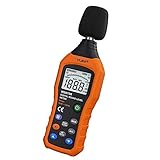
- The sound level meter is an instrument used to real-time measure the sound level,such as sound level around factories,workshops,schools,residential,offices,road,audio etc (Battery not include), Can not keep and generate a report directly from the device
- It also can be appropriate for noise engineering,product quality control,health prevention and treatment,etc.This audio noise measure device is a great tool for checking, monitoring or controlling and test the sound level of any environments. It is widely applicable for personal, families, business, studies, industrial and etc
- With the measuring scope from 30 to 130dB and shifting function. Digital display,good anti-interference performance,power saving
- With the backlight feature,it is appropriate for gathering the sound data at night.Backlight auto power off function is provided.With power saving and high-reliability circuit design,well-design high-efficiency power supply circuit makes the batteries more durable
- Composite material injection molding process is adopted for casing with anti-drop structure design.It is not only extremely wear-resisting,but also elegant,It’s a mini handheld portable sound level reader
Troubleshoot readings that do not make sense
- Numbers jump wildly in a quiet room: Check for HVAC airflow, handling noise, microphone obstruction, automatic gain control or an unsuitable app. Repeat with the phone or meter mounted and untouched.
- Two devices disagree: Compare weighting, time response, distance and metric first. Then check calibration and microphone orientation. Different internal microphones can legitimately produce different estimates.
- The average is low but the noise feels intrusive: Look at maximum, peak, event timing and frequency. A short impact can disappear inside a long LAeq average.
- A reading is high near a wall or corner: Reflections can raise the local level. Repeat at the documented listening position and avoid placing the microphone directly against a surface.
- The app cannot show a meaningful dose: Confirm that the selected standard, duration and weighting match the instrument’s documentation. A casual series of snapshots cannot substitute for a dosimeter.
- You need evidence for a dispute: Preserve original logs, settings, dates and files; do not edit a peak or average into a single unqualified number. Ask the relevant authority whether a qualified survey is required.
A practical recording template
Use a spreadsheet or notebook with one row per run. Include:
- Date and local clock time
- Room, address area or listening position and microphone height
- Source and operating state
- Device, app version or meter model
- Weighting (dBA, dBC or dBZ)
- Metric (instantaneous, maximum, peak, LAeq, TWA or dose)
- Start time, end time and duration
- Result and unusual events
- Calibration details, if applicable
This record lets you compare like with like and gives a qualified professional enough context to decide whether further testing is worthwhile.
When to stop measuring and get help
Stop self-testing when the result could affect a legal claim, employment decision, tenancy action, major renovation or medical decision. A qualified acoustician or occupational-hygiene professional can select the correct instrument, calibration, averaging period and frequency analysis. For hearing symptoms, consult a hearing-care professional or clinician; a sound-level app cannot assess hearing damage.
For ordinary home screening, the reliable pattern is simple: define the question, keep the setup consistent, take repeated readings, label every number with its weighting and metric, and interpret duration and context alongside level. That approach is more useful than treating a single decibel figure as a verdict.
Quick Recap
Product prices and availability are accurate as of the date/time indicated and are subject to change. Any price and availability information displayed on Amazon at the time of purchase will apply.

