Program a gaming mouse by opening the configuration software made for its exact model, selecting the physical button, choosing a mouse action, keyboard remap, or supported macro, saving the profile, and testing it in the target game. The names of menus and the functions that can be stored vary by mouse, software version, and profile system.
What button mapping changes
Button mapping replaces the action a physical mouse button sends. A side button can remain a browser-style back or forward command, become a keyboard key such as R, trigger another mouse function, or launch a supported sequence of keyboard and mouse events. The mouse does not guess the game control: you decide which signal the button should send in the manufacturer’s configuration app, then the game interprets that signal.
As an Amazon Associate I earn from qualifying purchases.
Assignments are normally attached to a profile. A profile can be associated with the desktop, a particular game, or another application, allowing the same physical button to perform different jobs in different programs. If the wrong profile is active, a correctly saved assignment can appear not to work.
Check these requirements before assigning anything
- Exact model support: install or open the software that lists your mouse. A configuration app for a different product family may detect nothing or expose only part of the hardware.
- Connection: connect the mouse before opening the app, then confirm that the device appears in the device list.
- Assignable hardware: some buttons are fixed or reserved. The software should identify which physical controls can be edited.
- Target application: know whether you want a desktop-wide assignment or one that applies only while a game profile is active.
- Software version: menu labels change. Corsair’s documented iCUE flow, for example, applies to iCUE 5.14 or newer and was updated July 15, 2026; older releases use different steps.
- Storage expectation: decide whether the mapping must continue working after the configuration app is closed or when the mouse is moved to another computer. That requirement affects which assignments and profiles you can use.
The basic mapping workflow
- Open the supported configuration software. Connect the mouse and select its device tile or name. If it is not listed, resolve detection first rather than creating a profile for an unknown device.
- Open button or key assignments. The area may be called Button Assignments, Key Assignments, or a similar label. Do not assume that a lighting page or sensitivity page changes button behavior.
- Select the physical control. Click the on-screen button that corresponds to the control you will press, or choose it from a numbered list. Confirm the highlighted control before editing it; selecting the wrong thumb button is an easy mistake.
- Choose an action type. Depending on the model and software, available choices include a mouse function, a single keyboard input, or a multikey macro. If the action you need is not offered, the hardware or current software may not support it.
- Enter the action. For a keyboard remap, press or select the desired key. For a mouse function, choose the available command. For a macro, use the editor described in the next section.
- Save the assignment and profile. Some apps apply changes immediately; others require an Apply, Save, or profile-save command. Wait for the software to confirm the write before disconnecting the mouse.
- Test in the intended game or application. Press the physical button while the target profile is active. Verify the resulting action, not merely that the software displays the assignment.
Assign a mouse function
A mouse-function assignment makes a button send another supported mouse action. This is useful when the default side-button behavior is inconvenient or when a game expects a particular mouse control. In the assignment editor, select the physical button, choose the mouse-function category, select the desired function, and save the profile.
#1 Best Overall

- HERO Gaming Sensor: Next generation HERO mouse sensor delivers precision tracking up to 25600 DPI with zero smoothing, filtering or acceleration
- 11 programmable buttons and dual mode hyper-fast scroll wheel: The Logitech wired gaming mouse gives you fully customizable control over your gameplay
- Adjustable weights: Match your playing style. Arrange up to five 3.6 g weights for a personalized weight and balance configuration
- LIGHTSYNC technology: Logitech G LIGHTSYNC technology provides fully customizable RGB lighting that can also synchronize with your gaming (requires Logitech Gaming Software)
- Mechanical Switch Button Tensioning: A metal spring tensioning system and metal pivot hinges are built into left and right computer gaming mouse buttons for a crisp, clean click feel with rapid click feedback
The exact list is model-specific. If a function is absent, do not substitute an unrelated keyboard shortcut without checking what the application expects. Test both the press and, where the software offers them, separate press-and-release behaviors. A game may treat a mouse signal differently from a keyboard signal even when both appear to activate a similar command.
Remap a button to a keyboard key
iCUE 5 example
Corsair’s iCUE documentation gives a concrete path for current software: select the mouse, open Key Assignments, add an assignment, choose the keyboard-remap action, and then choose the key. The article specifies iCUE 5.14 or newer and notes that older versions use different controls. Use the labels shown by your installed release rather than following an older screenshot literally.
- Select the mouse in iCUE.
- Open Key Assignments.
- Choose the command to add a new assignment.
- Select the keyboard-remap action.
- Choose the key the game should receive.
- Select the physical mouse button that will send that key, then save the profile.
- Switch to the game profile and press the button once. Confirm the game receives the key without an unintended second input.
Other manufacturers use different names for the same operation. Logitech documentation describes selecting a button and assigning a keystroke, while the available controls depend on the particular mouse and software generation. If the software shows a key-down and key-up option, preserve the normal press-and-release sequence unless the application specifically requires a held key.
Quick wins for a faster PC:
Repair Windows errors before they cause bigger problemsFix Now →Fix the driver behind crashes, sound loss and screen glitchesFind Drivers →Clear out junk files and repair common Windows errorsFree Scan →Rank #2
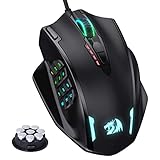
- Professional Gaming Mouse - Redragon M908 optical gaming mouse is designed with up to 12400 DPI, 5 adjustable DPI levels (500/1000/2000/3000/6200 DPI) meet your multiple needs, either for daily work or gaming. DPI can be adjusted freely by ±100 from 200 to 12400 via software. 1000 Hz polling rate, 30G acceleration and high-precision Pixart PAW3327 Sensor giving you a greater edge over your competition.
- RGB Backlight & Programmable Buttons - 16.8 million RGB LED color options (LED Backlight can be disabled). 18 programmable buttons, 5 memory profiles each with a dedicated light color for quick identification. Comes with 8-piece weight tuning set (2.4g x8), easy to change the weight to suit your games.
- Comfort & Precision At Your Hands - Redragon M908 gaming mouse is an essential computer accessory for die-hard with its aggressive design for hands! You will be amazed by the unmatched comfort, lethal accuracy and killer precision of our durable, desktop and laptop pro gaming mouse!
- High-end Design - Redragon M908 Mouse features 6 buttons and 12 MMO programmable side buttons. Durable smooth TEFLON feet pads for ultimate gaming control. 6ft braided-fiber cable with gold-plated USB connector ensures greater durability.
- Die-hard Players Choice - Whether you are targeting, aiming, slashing or attacking, a professional gaming mouse is your basic weapon! The mouse will be your ideal partner. Compatible with Windows 2000/ME/XP/03/VISTA/7/8/10 system for programmable using and Mac OS for normal using.
Build and assign a macro
A macro is a supported sequence of input events assigned to one button. Logitech’s legacy Gaming Software documentation describes macros containing keystrokes and mouse events. The editor may let you record events from your keyboard and mouse or assemble them manually, then adjust the order and timing before assigning the result.
- Open the manufacturer’s macro editor from the button-assignment area.
- Create a new macro with a descriptive name that identifies the game or profile.
- Record or add the supported keyboard and mouse events in the intended order.
- Review the event list. Remove accidental clicks or keys captured while starting and stopping the recording.
- Set any timing controls the editor provides, keeping the sequence as simple as the application requires.
- Save the macro in the profile.
- Select the target physical button and choose the saved macro as its action.
- Test it in a safe menu or practice context, then test again in the actual application.
Macro capabilities are not universal. A mouse may accept a single key but not a multikey sequence, or it may store only certain event types in onboard memory. The editor’s available actions are the reliable boundary; do not assume that a macro created in one software package will transfer to another.
Use profiles for different games and programs
Profiles prevent one layout from disrupting another. Create a profile for each game or program that needs distinct assignments, then associate it with that application when the software supports automatic switching. SteelSeries support describes profiles for games and programs and notes that side-button behavior can depend on the program.
Rank #3
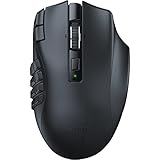
- 19 PROGRAMMABLE BUTTONS — Armed with ergonomically positioned buttons that provide an arsenal of commands at the fingertips for mapping out the essentials or going all out with advanced macros
- RAZER HYPERSPEED WIRELESS (2.4 GHZ) AND BLUETOOTH — Unleash seamless, low-latency performance that's 25% faster than other wireless tech or switch to Bluetooth for longer hours of gaming
- POWERED BY RAZER HYPERSCROLL TECHNOLOGY — Perform repeated commands rapidly or blaze through content in free-spin mode, or activate tactile mode for enhanced precision and satisfying feedback
- LONG BATTERY LIFE — With up to 400 hours on Bluetooth and 250 hours of seamless low-latency gaming on Razer HyperSpeed Wireless (2.4GHz), last longer in the heat of battle with this mouse before having to replace its battery
- FOCUS PRO 30K OPTICAL SENSOR — Razer’s brand-new sensor provides flawless tracking performance on a wider variety of surfaces including glass —supported by intelligent functions for enhanced aim and control
- Create or duplicate a profile in the configuration app.
- Give it a name that identifies the game or application.
- Attach the profile to the game executable or choose it manually, according to the software’s profile controls.
- Make the button assignments inside that profile.
- Launch the game and verify that the profile indicator changes to the intended profile.
- If you alt-tab or run a launcher separately, check which process the software associates with the profile.
A profile can be correct while the game is using another one. When troubleshooting, record the active profile name at the moment you press the button; this distinguishes a profile-selection problem from an assignment problem.
Onboard memory: what it does and does not guarantee
Onboard memory stores some configuration in the mouse instead of relying entirely on the desktop application. Logitech’s G502 documentation describes onboard configuration and button actions, and Corsair documents saving custom key assignments to onboard memory on supported mice or keyboards. These examples do not mean that every mouse stores every kind of action.
Storage is both model- and assignment-dependent. A mouse may retain basic button remaps while leaving a complex software macro dependent on the running app. The number of onboard profiles, the events that can be written, and whether automatic game switching remains available are also implementation details. Before relying on a mapping on another computer:
Rank #4

- 【Extensive Fully Programmable Buttons】16 customizable buttons can improve your gaming skills and performance by complex custom button macro coding of reconfiguration and assignment. The button custom function combines multiple keys into one button that reducing your arsenal of spells (actions) and response time. 12 of 16 thumb grip programmable buttons were designed by different inclination angles to fit for your thumb tip to click.
- 【Dual Modes with Ultra-Speed Wireless Technology】UtechSmart VENUS Pro RGB Wireless MMO Gaming Mouse is a new revolution of RGB MMO gaming mouse. It has 2.4 GHz data transmission technology with Mini signal receiver(Nano) and stable 1. 5m wire transmission that provides professional-level performance. VENUS Pro overcomes the traditional limitation of wireless latency and connectivity which offers stable and fast data transmission with 10-meter reception boundary. You can take this mouse anywhere!
- 【Endurable Battery Life】 UtechSmart Venus Pro Wireless RGB MMO gaming mouse has special auto sleeping mode and low power consumption mode or extending the battery life of wireless mode. Large battery (1000mA) capacity which offers to recharge over 300 times and single 2 hours fully charge. The wireless mode lasts up to 70 hours that fulfill your long-time gaming experience. Moreover, UtechSmart actuation software provides battery specify consumption monitoring for you.
- 【Customizable Mouse High Precision Optical Sensor】Thousands of customers and professional gamers have tested and verified its function. Venus Pro has an UtechSmart custom PixArt PMW3335 ultra-accurate Optical sensor. Up to 16000 DPI with 5 DPI switchable stages and 1000 Hz polling rate that offers you an incomparable MMO and FPS gaming experience. The huge adjustable DPI range from 100-16000 comes with UtechSmart user-friendly software that can perfectly tweak the performance of mouse accuracy.
- 【Ergonomic Design Ensures Your Comfortable】Great as a real mouse stuck in your hand. The UtechSmart Venus Pro Wireless RGB MMO gaming mouse is flawlessly designed to alleviate wrist fatigue while being able to firmly hold the mouse in your hand. The grinding coating on the mouse surface increases the friction between your hand and the mouse. Grinding coating also provides gamer a extra comfortable sweat-resistant and skin-friendly gaming mouse.
- Confirm that the exact model has onboard memory.
- Check the software’s onboard or hardware-mode page rather than assuming the ordinary profile is stored.
- Verify that the specific assignment type—mouse function, keyboard key, or macro—is listed as supported for hardware storage.
- Save the profile to the device using the manufacturer’s command.
- Close the configuration app or connect the mouse to a second computer and test the assignment.
“Onboard memory” by itself is not proof that every software feature will continue to operate after the app closes.
Independent reader supportYour contribution helps us test, update, and keep practical guides available for everyone.Test a mapping systematically
Testing in the desktop alone can hide a game-specific issue. Use this sequence so each layer is checked once:
- Device layer: verify that the configuration app sees the mouse and highlights the intended physical button.
- Profile layer: confirm the intended profile is active for the game or program.
- Assignment layer: read the saved action shown for that button.
- Application layer: press the button where the game accepts input and observe the resulting control.
- Persistence layer: if required, close the configuration app or use onboard mode and repeat the test.
Test one changed button at a time. If several assignments are edited simultaneously, a failure does not reveal which setting caused it. Also check whether the game has its own key-binding screen: a mouse button sending a keyboard key will work only if that key is recognized and bound by the game.
Best Value
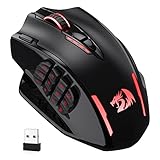
- Wireless/Wired, 2 Ways to Use - Dual modes of 2.4Ghz wireless and USB-C wired mode assemble with 12 side buttons MMO gaming mouse feature. Wireless/wired mode plus easy-access keybinding shortcuts maximize your damage.
- Lightning-Fast Is Not Just Saying - With improved Optical Pixart 3335 gaming sensor, M913 registers each click/swipe instantaneously within 1ms. Efficiency, accuracy and low-latency are all in the box.
- Stay Power-On Day to Night - Low-consumption advanced chip combo with a long lasting battery capacity, guaranteeing its use for long-hours. Eco mode reduces the usage of backlit and levels up the durability of 45 hours (backlit ON) to 80 hours.
- 5 DPIs Designed for Esports - Equipped with 5 onboard DPI levels (1000/2000/4000/8000/16000) which allow you to switch among different needs at ease. Personalizable DPI ± 100 meets your unique need and shorten the get-used-to time.
- Uncompromised Driver Support - 16 buttons including 12 side buttons and 16.8 million color lighting effects are all customizable with its own software, even in wireless mode. Ahead to the victory in your exactly wanted way.
Side buttons do not work: a fault-finding checklist
The software does not detect the mouse
- Reconnect the mouse and reopen the supported configuration app.
- Confirm that the model name matches the device you own.
- Install the current software release intended for that model, while keeping in mind that older products may use a legacy app.
- Do not continue to profile editing until the device appears and its buttons are shown.
The button is visible but cannot be edited
- Check whether that physical control is listed as assignable for the model.
- Look for a mode switch between software profiles and onboard or hardware memory.
- Verify that you selected the correct device if multiple peripherals are connected.
The assignment works in the app but not in the game
- Confirm that the game is using the profile containing the mapping.
- Check whether the game recognizes the mapped keyboard key or mouse function.
- Review the game’s own bindings for conflicts or an unassigned key.
- Test the same button in another application to separate an application-specific behavior from a device problem.
The wrong action occurs
- Re-select the physical button and compare it with the button you are pressing; thumb panels can be easy to misidentify.
- Check for a second profile that may become active when the game launches.
- Open the macro event list and remove unintended recorded inputs.
The mapping disappears after closing the app
- Determine whether the profile was saved only in software or written to onboard memory.
- Check whether that assignment type is supported in hardware mode.
- Save the onboard profile explicitly, then retest with the app closed.
An older guide does not match the current menus
Follow the version indicated by the current manufacturer documentation. Logitech’s G502 support page notes that its firmware update tool is no longer maintained and directs users to check supported devices for Logi Options+. That notice applies to that tool and should not be generalized to every Logitech gaming-mouse configuration app. For Corsair, the iCUE 5.14-or-newer instructions differ from older releases, so use the path for the version installed on your computer.
How to choose a mouse for programmable buttons
If your current mouse lacks enough controls or the software cannot perform the desired assignment, compare the following characteristics before buying another model:
| Decision factor | What to verify | Why it matters |
|---|---|---|
| Button count and placement | Number of physical buttons, their spacing, and thumb-panel position | More buttons help only if you can reach the intended control without pressing neighbors. |
| Action types | Mouse functions, single keyboard keys, multikey macros, or only fixed commands | The available action list determines what can actually be mapped. |
| Profiles | Manual profile selection, application-linked profiles, and profile count | Profiles let one mouse serve different games without rebuilding assignments. |
| Macro support | Whether macros can include keyboard events, mouse events, timing, and playback controls | A macro editor’s limits matter more than the word “programmable” on a product page. |
| Onboard memory | Number of hardware profiles and which assignment types can be stored | Hardware storage determines whether mappings remain available away from the configuration app. |
| Software and operating-system compatibility | Supported operating systems, current app, legacy app requirements, and update status | A physically suitable mouse is not useful if its software cannot run on your system. |
| Ergonomics | Grip, button force, reach, and the feel of a multi-button panel | A dense layout can increase command access while reducing comfort or accuracy for some users. |
Logitech’s G600 documentation illustrates the many-button MMO-style layout and configurable profiles, but that documentation does not establish current retail availability. Treat it as an example of a design category, not as proof that a particular model is currently sold or supported.
PC Slower Than It Used to Be?
A free scan shows the junk files, broken settings and background clutter dragging Windows down - then fixes them in one click.Free scan · Windows 10 & 11Outdated Drivers Are Slowing You Down
One free scan finds every outdated or missing driver and matches the right update for your exact hardware.Free scan · exact hardware matchWhen a programmable mouse is the right solution
A new programmable mouse makes sense when the existing hardware has too few physical controls, lacks software for remapping, or cannot store the action type you need. An MMO-style mouse with a multi-button thumb panel is suited to users who need many commands close together. A simpler mouse with two or three remappable buttons may be preferable when reachability and comfort matter more than command quantity.
Choose based on the assignments you can verify in the current software, not on a category label. Before purchase, confirm the model’s supported app, operating-system compatibility, profile behavior, macro options, and onboard-memory rules. Those details determine whether the mouse will perform the mapping you have in mind.
A maintenance routine that prevents remapping surprises
- Keep a written list of each game profile and the physical button assigned to each command.
- After a software or firmware update, open the profile and verify critical assignments before playing.
- Export or otherwise preserve profiles when the software offers that function.
- When moving to another computer, test both the ordinary software profile and the onboard profile separately.
- If a game update changes its key bindings, recheck keyboard-remapped mouse buttons even when the mouse profile itself was not edited.
With this routine, a missing side-button action can be traced to detection, profile selection, assignment support, application recognition, or onboard-storage limits instead of being treated as an unexplained hardware failure.
Quick Recap
Product prices and availability are accurate as of the date/time indicated and are subject to change. Any price and availability information displayed on Amazon at the time of purchase will apply.
Free tools Windows power users keep installed
One-click scans. No signup required.

