Yellow or brown patches that appear right after a late-season cut are usually mowing injury, not a mysterious autumn disease. Uneven ground can be scalped, more than one-third of the leaf can be removed at once, or a dull blade can shred the tips so they dry pale brown. Raise the deck, make a lighter recovery cut, sharpen the blade, and then investigate water, compaction, thatch and disease if the pattern does not match the mower’s path.
Why a late-season cut can turn grass yellow or brown
Grass does not become healthier merely because the calendar has moved into late summer or fall. Colorado State University Extension states that there is no need to mow turf shorter in late summer or fall. Lowering the deck to “finish” the season can expose older, paler tissue and remove the actively photosynthesizing leaf area that helps the plant recover.
As an Amazon Associate I earn from qualifying purchases.
The most common mowing-related causes are:
- Scalping on uneven ground: the deck rides close to the soil over a mound, root flare or bump, removing far more leaf than it removes on level ground.
- Removing too much in one pass: a lawn that has grown tall is cut down abruptly instead of being reduced in stages.
- A dull or damaged blade: a blunt edge tears the leaf rather than making a clean cut. The shredded ends dry out and look pale brown.
- Mowing wet or stressed grass: clippings clump, wheels sink into soft soil and the cut becomes uneven, increasing the chance of scalping.
A mowing injury normally appears immediately after the cut and is strongest on high spots or along mower passes. If patches expand independently of mowing, have rings or lesions, or occur where irrigation is uneven, treat mowing injury as only one possibility.
The Tool Desk
Outbyte PC Repair FREEClear out junk files and repair common Windows errorsFree Scan →Outbyte Driver Updater FREEFix the driver behind crashes, sound loss and screen glitchesFind Drivers →Diagnose the pattern before changing the lawn
Walk the area the same day as mowing, then inspect it again before the next cut. The combination of timing, shape, leaf texture, soil condition and grass type is more reliable than color alone.
#1 Best Overall

- SHARPEN YOUR MOWER BLADE IN MINUTES: Blade removal is optional with this cordless lawnmower sharpener — many standard residential blades can be sharpened right on the mower, saving you the hassle of disassembly. Routine touch-ups take about 2–3 minutes per blade; badly worn edges take longer and are best done with the blade removed.
- MAINTAIN INSTEAD OF REPLACE: Replacement blades run $20–$40 each and a sharpening service costs money and a trip. Regular touch-ups extend the life of the blade you already own — one tool, all season.
- GREENER LAWN IN DAYS - NOT WEEKS: Dull blades tear grass instead of cutting it, leaving brown stressed edges that take weeks to recover. A sharp blade creates a clean cut that heals fast — visibly greener, healthier lawns within days of sharpening. This rotary blade sharpener delivers results you can see, not just feel.
- ADJUSTABLE ANGLE GUIDE - 20° TO 40° LAWN MOWER BLADE SHARPENING: Dial in the right angle for your specific blade with the adjustable lawn mower blade sharpening attachment (20°–40°). For consistent results, tighten the guide firmly before each pass and recheck position every few strokes — this keeps edge geometry accurate across the full blade. Variable speed (5,000–30,000 RPM) with ergonomic grip for controlled, safe operation.
- CORDLESS & LIGHTWEIGHT: No cords to manage across the yard. Lightweight enough to carry one-handed to wherever your mower sits. One full charge sharpens 1–2 standard residential blades — top it up between sessions for a full multi-blade deck. A reliable lawn gadget for every mowing season.
| What you observe | What it suggests | What to check next |
|---|---|---|
| Yellow cast appears within hours of mowing and follows passes or bumps | Scalping or excessive leaf removal | Compare the deck height over high and low spots; look for exposed crowns or soil |
| Tips are ragged, split or shredded, with a pale-brown fringe | Dull, bent or damaged blade | Remove the spark-plug lead or battery as appropriate, inspect the blade safely, and sharpen or replace it |
| Patches are roughly circular, ring-shaped or gradually enlarging away from tracks | Disease, fairy ring, insects or another non-mowing cause | Look for lesions, fungal threads in dew, insects and a consistent relationship to moisture |
| Brown areas are concentrated where sprinklers miss or overlap poorly | Uneven irrigation or drought stress | Run the irrigation system and compare catch-container depths across the lawn |
| Watered soil is difficult to probe and roots sit in a dense, spongy layer | Compaction or excessive thatch | Use the screwdriver test and inspect the thatch layer before aerating |
| Symptoms differ between grass types or follow a seasonal disease pattern | Species-related stress or fungal disease | Identify the turf and compare the timing with local extension guidance |
Use timing as your first filter
Mower injury is tied to an event: the color change follows a specific cut. Drought, irrigation failure, insects and disease generally develop over days or weeks and do not stop at the edge of a mower pass. A patch that was green before mowing but yellow on every high spot afterward deserves a deck-height and blade inspection before fertilizer or pesticide is considered.
Read the leaves, not just the color
Cleanly cut leaves can look lighter for a short period, but ragged ends point to a blade problem. Brown lesions, visible spores, or fine fungal threads in morning dew point away from simple scalping. Pull a few blades from both healthy and affected areas and compare the cut ends and the rest of the leaf. Damage limited to the ends supports mowing injury; damage distributed along the blade calls for a broader diagnosis.
Set the mower for recovery
Stop lowering the deck for the season
Choose a height that fits the grass species and your local climate. University of Massachusetts Extension gives 2.5 to 3.5 inches as a general mowing range. Clemson University Home & Garden Information Center gives these examples:
Quick wins for a faster PC:
Scan for outdated or missing drivers - takes under a minuteDriver Scan →Repair Windows errors before they cause bigger problemsFix Now →| Turf situation | Height guidance | How to use it |
|---|---|---|
| General lawn where the exact species is unknown | 2.5–3.5 inches (UMass Extension general range) | Stay within the range until a local recommendation for the identified grass says otherwise |
| Tall fescue | 2.5–3.5 inches (Clemson) | Do not drop below 2.5 inches or raise above 3.5 inches without a specific local reason |
| Centipedegrass | 1.5–2 inches (Clemson) | Use the warm-season range rather than applying a cool-season height blindly |
These are examples, not a universal setting for every cultivar, region or season. If your state or county extension service gives a different height for your turf, use that local recommendation.
Reduce a tall lawn in stages
When mowing was delayed and the grass is substantially taller than the target, do not force it down to the final setting in one pass. Colorado State University Extension recommends temporarily raising the mower and removing no more than one-third of the leaf area, then mowing again a few days later at the normal height. The first pass should leave a visibly taller lawn than usual; the later pass brings it to the chosen range without exposing large amounts of stem at once.
- Measure or estimate the current leaf height and select a higher deck setting for the recovery cut.
- Make one pass only when the grass is dry and the mower can discharge clippings without clogging.
- Check the result. If more than one-third of the leaf was removed in a low spot, raise the deck further for the next pass.
- Wait a few days, allowing the surviving crowns to respond, then return to the normal species-appropriate height.
- For the next several cuts, remove small amounts regularly rather than allowing another long interval.
Sharpen or replace the blade
University of Maryland Extension identifies short mowing as an injury because it removes too much growth at one time and notes that shredded tips dry and turn pale brown. Its recommendation is to raise the mowing height and sharpen or replace the blade. University of Nevada, Reno Extension likewise advises sharpening mower blades and mowing high after accidental scalping.
Before working under a deck, disconnect the spark-plug wire on a gasoline mower or remove the battery and follow the manufacturer’s lockout instructions on an electric model. Wear gloves when handling the blade. Replace a blade that is bent, cracked or too deeply nicked to sharpen evenly. A replacement must match the mower’s make, model, length, center-hole pattern and width; do not fit a blade solely because it appears similar.
Rank #2
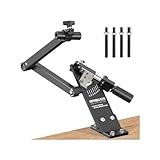
- [ Updated ] Lawn Mower Blade Sharpener: SporGain mower blades sharpener suitable for Blades standard straight, mulching and high-lift mower.
- Fits 1.65"–3.60" Mower Blades: lawn mower blade sharpener jig is designed to accommodate mower blades from 1.65" to 3.60" wide, making it suitable for a wide range of lawn mower blades.
- High-Quality Construction: This lawnmower blade sharpener jig firmly and securely holds the blades in place.
- Lawnmower Blade Sharpener: The lawn mower blade sharpener tool equipped with Ball Bearing, 25mm diameter enlarged Handle and 4 Adapter Screws for angle grinder.
- 15°-45° Adjustable: This mower blade sharpener kit lets you manually adjust the angle of blade holder and angle grinder Bushing by hands (thumb screws). Support you to sharpen multiple blades efficiently.
Set the blade so it cuts rather than tears. If freshly mown tips still look ragged after sharpening, stop mowing and have the blade balanced or replaced. Mow dry grass whenever possible: wet blades bend away from the cutting edge, clippings mat together and the wheels can sink, all of which make an uneven cut more likely.
Check water before treating the color
Uneven irrigation is one of the most common explanations for brown lawn spots, according to Nevada Extension. A mower can reveal drought stress by removing the green outer tissue, but it did not cause a patch that is consistently located in a dry sprinkler zone.
- Run each irrigation zone and place straight-sided containers in several parts of the lawn. Compare the collected depth rather than assuming that a running sprinkler wets every area equally.
- Inspect clogged nozzles, tilted heads, blocked spray patterns and overspray onto pavement.
- Water deeply only when the lawn needs it instead of adding frequent shallow applications. Avoid creating persistently wet conditions.
- Keep a note of whether the patch follows a slope, shade boundary or sprinkler edge. That map helps separate irrigation problems from mower tracks.
For disease-management situations, Clemson lists generally watering to a 4–6-inch soil depth and about 1 inch of irrigation water per week. That figure is not a fixed schedule for every lawn: rainfall, soil, species, temperature and local restrictions change the amount required. Check the soil and the turf response rather than applying a calendar amount automatically.
Test for compaction and thatch
Compacted soil limits roots and can make a scalped area recover slowly. A thick thatch layer can hold moisture near the surface while restricting air and water movement. Nevada Extension recommends testing these conditions before choosing aeration or top-dressing.
What’s actually slowing this PC down?
Pick the symptom - the matching free tool is one click away.
- After irrigation or rainfall has moistened the soil, push a screwdriver into the affected and unaffected areas.
- Compare the resistance. If the screwdriver is difficult to push into wet soil in the patch, compaction or thatch may be contributing.
- Look at a small cut section of turf to distinguish dense soil from a spongy thatch layer. Do not remove large sections merely to inspect them.
- Where compaction is verified and the grass is actively able to recover, core-aerate rather than repeatedly poking isolated holes. Avoid aerating saturated soil, which can smear and worsen compaction.
- If adding compost, apply no more than one-quarter inch at a time, the maximum cited by Nevada Extension in its 2012 guidance. Work it into the openings without burying the leaf crowns.
A manual core aerator is useful only when the test supports compaction or thatch as a cause. Aerating a drought-stressed or diseased lawn without correcting the actual problem adds disturbance without solving the patch.
Independent reader supportYour contribution helps us test, update, and keep practical guides available for everyone.Recognize disease and other look-alikes
Brown patch and large patch
Some fungal diseases produce circular or expanding areas that do not correspond to the mower’s path. Clemson distinguishes cool-season brown patch from warm-season large patch because their seasonal tendencies and host grasses differ. Morning irrigation, excess nitrogen, poor drainage and an incorrect mowing height can all increase disease pressure.
- Water in the morning so foliage has time to dry.
- Avoid excess nitrogen during warm, moist disease periods.
- Keep the mower at the correct species height rather than scalping to hide symptoms.
- Remove clippings during warm, moist periods when disease is active if local extension guidance recommends it for your turf.
- Improve drainage where water remains on the surface.
Do not apply a fungicide merely because the lawn is brown. Confirm the pattern and turf species first, and use local diagnostic or extension advice when lesions, rings or fungal growth are present.
Rank #3
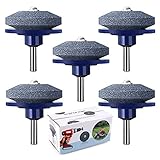
- Lawn Mower Blade Sharpener : The new version of the Lawn Mower Blade Sharpener is Made of corundum, it solves the base wear caused by the excessive speed of grindstone, and effectively prolongs the service life and improves the use effect of the product. Our lawn mower blade sharpener is provided by the original factory, and it is guaranteed.
- Lawnmower Blade Sharpener for Drill : Lawn mower blade sharpener could be used to sharpen mower blades to make the blade sharp again. Using in sharpening lawn blades, lawn tractors, mowers, rototillers, drill blades, sickle bar cutters, etc. Fit for most power drills (Do not need to buy expensive blades).
- Easy to Use : It only takes 10s to install it. You only need to install it on your electric drill to use it. And it can quickly make blunt old blades sharper. Effectively provide your productivity. Fast, automatic, easy, safe, and saves time and effort.
- Size & Package: Each sharpener measures 50 x 47 mm / 1.97 x 1.85 inches, with slight variations possible due to manual measurement. The package contains 5 lawn mower blade sharpeners, each in an attractive box.
- Keep your lawnmower blades sharp with a lawn mower blade sharpener. It's a must-have for any lawn mower or tractor. Enjoy faster, easier mowing and save time. A practical tool for everyday use.
Drought, dog urine, insects and nutrients
Drought stress often follows exposed, sunny or poorly irrigated areas. Dog urine can create small, irregular spots that are unrelated to mowing tracks. Insects may cause thinning, tugging roots or damage concentrated in a particular season. Nutrient stress can produce a more general color change rather than sharply cut high spots. These possibilities can coexist with mowing injury, so correct the mower problem first while continuing to observe unaffected and affected grass side by side.
Do these 3 things before closing this tab:
1Repair Windows errors before they cause bigger problems2Fix the driver behind crashes, sound loss and screen glitches3Clear out junk files and repair common Windows errorsFertilizer is not a repair for an incorrectly diagnosed patch. Extra nitrogen can worsen certain warm, moist fungal problems, and applying products without identifying the cause can delay recovery.
Help the surviving turf recover
Grass crowns that remain alive can refill a thin area after the cutting stress is removed. Keep traffic off the damaged strip when possible, maintain the corrected mowing height, and avoid another aggressive cut while the color is changing. Recovery is slower where roots are compacted, irrigation is uneven or disease is active because the mower injury is only one part of the stress.
Reseed thin or bare sections only when the grass species and local establishment window are suitable. Extension diagnostics list reseeding as an option for damaged areas, but seed choice and timing are regional. Prepare the surface, use seed appropriate for the existing turf and follow local establishment guidance rather than scattering seed into a dense thatch layer or onto hard, dry soil.
Prevent another late-season mowing injury
- Confirm the deck setting before every cut, especially after switching between turf areas.
- Keep the mower at the normal species height; do not lower it because summer or fall is ending.
- Use the one-third limit when catching up on an overgrown lawn, with a second cut a few days later.
- Inspect the blade for a rounded edge, bends and missing corners; sharpen or replace it before the next full mowing.
- Mow dry grass and avoid turning sharply on soft ground.
- Slow down over bumps and use a deck setting that clears high spots without exposing soil.
- Check sprinkler coverage after maintenance, landscaping changes or a newly appearing dry strip.
- Probe suspicious areas for compaction or thatch before aerating or top-dressing.
- Watch for circular expansion, lesions or fungal threads that would point to disease rather than a cut-related problem.
- Record the grass species and the height that performs well in your climate so a seasonal change does not become a guess.
A practical decision path
Use this sequence when the cause is still uncertain:
Free tools Windows power users keep installed
One-click scans. No signup required.
- Did the color change immediately after mowing? If yes, inspect height, bumps and blade condition first.
- Does the damage follow tracks or high spots? If yes, raise the deck and stage the next cut.
- Are the tips shredded? If yes, sharpen or replace the blade before mowing again.
- Is the patch independent of mowing and expanding? If yes, inspect for disease, insects and irrigation problems.
- Is wet soil hard to penetrate? If yes, test for compaction or thatch and aerate only when conditions and turf recovery permit.
- Does the grass type change the recommended height? If yes, follow the local species-specific range rather than the general 2.5–3.5-inch guidance.
The objective is not to make every brown blade green immediately. It is to stop the stress that caused the discoloration, avoid a second damaging cut, and address the separate water, soil or disease issue if the evidence points there.
Quick Recap
Product prices and availability are accurate as of the date/time indicated and are subject to change. Any price and availability information displayed on Amazon at the time of purchase will apply.

