Quick wins for a faster PC:
Clear out junk files and repair common Windows errorsFree Scan →Fix the driver behind crashes, sound loss and screen glitchesFind Drivers →Repair Windows errors before they cause bigger problemsFix Now →Fix boomy bass and harsh treble in this order: reset tone controls, improve speaker placement, reduce reflections and vibration, then apply small EQ cuts. Keep the main speakers out of corners and tight cabinets, place their tweeters near seated ear height, and leave about 12–18 inches behind them when practical. For a subwoofer, use a crawl to find a position with even bass, start the crossover near 80 Hz, and fine-tune level, phase and polarity. These steps address the room before you compensate for it electronically—the approach most likely to produce clear bass and smooth treble at more than one seat.
Why a system sounds boomy or harsh
A speaker does not sound the same in every room. Walls, floors, furniture and the listening position change the balance that reaches your ears. HARMAN Professional’s Chris Hansen summarizes the low-frequency problem this way: “In the low frequencies, the room is in control; your bass performance correlates directly to placement of your speakers.” A useful fix therefore starts with acoustics and mechanics, not with a large bass or treble boost.
As an Amazon Associate I earn from qualifying purchases.
Boundary gain makes bass swell
When a speaker is close to a rear wall, side wall or corner, reflected low-frequency energy combines with its direct output. A corner reinforces two boundaries at once, so the same bass note can become much louder than it is elsewhere in the room. Bose’s room guidance recommends moving a bass-heavy speaker away from the corner and rear wall, then trying the amplifier’s low-cut filter if one is available.
Recommended Free Tools
Room modes create peaks and gaps
Small rooms support standing-wave patterns called room modes. At some positions, a mode produces a large peak that sounds like one-note or “boomy” bass; a few feet away, the same note may nearly disappear. Harman Audio describes these peaks and dips as a normal result of untreated low-frequency rooms. If the bass changes dramatically as you walk around, moving the listening seat or speaker is usually more effective than turning down one tone-control band.
#1 Best Overall

- Wide Compatibility: The PERLESMITH speaker stands feature an adjustable width of 4.5" to 9", making it compatible with most small bookshelf and satellite speakers up to 11 lbs. These speaker stands are compatible with Bose, Harman Kardon, Polk, JBL, Sony, and more. Please note: it is not suitable for round or irregularly shaped speakers.
- Customizable Height for Optimal Sound: These floor speaker stands feature an adjustable height range from 33.3" to 45", positioning your speakers at the perfect level for the best acoustics, whether you're enjoying music or movies. The twist-lock design ensures quick and easy height adjustment without the need for tools.
- Two Cable Management Options: The speaker stands pair feature a 1.18" H x 0.59" W cable hole for routing wires through the hollow poles for a clean look. Please confirm the size before purchase. If the cable holes are too small for connectors or cables to pass through, the floor speaker stands include hook & loop straps to secure cables along the outside of the poles.
- Enhanced Stability: Made from solid steel with a wide base and 20% deeper threaded hole connections, this surround sound speaker stand delivers a rock-solid foundation to keep your speaker secure and balanced. It also includes non-slip foot pads, ensuring safe and stable placement on any floor type.
- Effortless Assembly & Reliable Support: Each pair of speaker stands comes with standard mounting hardware for hassle-free setup. Our US-based customer support team is always online to assist with pre-sale and after-sale support. If you have any questions, feel free to contact us, and we’ll respond within 24 hours.
Reflections make treble aggressive
Hard floors, bare walls, glass and large untreated surfaces reflect high frequencies. Early reflections arriving just after the direct sound can make vocals, cymbals and consonants sound sharp or “shouty,” even when the speaker itself is not defective. Bose recommends rugs, upholstered furniture and bookshelves to break up reflections without making the room unnaturally dead.
Vibration adds blur and hardness
A vibrating shelf, metal rack or hollow cabinet can radiate sound and feed energy back into the speaker. Philips warns that metal racks may vibrate and that floor placement can add vibration noise. Roku similarly advises avoiding walls and confined cabinets and keeping speakers at seated ear level. Mechanical energy is often heard as muddy bass, a nasal midrange or a brittle edge at higher volume.
Excessive processing can compound the problem
Large bass boosts, a high subwoofer level and an aggressive “presence” or treble mode can overload the room and your ears at the same time. Start from neutral settings so you can identify the physical cause before making a small correction.
Free tools Windows power users keep installed
One-click scans. No signup required.
Establish a neutral starting point
Do this before moving equipment so every later change has a known reference.
- Reset tone controls. Set bass, treble, loudness, dialogue enhancement and any graphic EQ to their center or bypass positions. Set the subwoofer level to its neutral mark rather than compensating for the current room.
- Choose familiar material. Use a vocal recording, an acoustic track with a steady kick drum, and a bass line you know. Avoid judging from a single heavily mastered track.
- Set a moderate volume. Excessive level can make treble seem harsh through hearing fatigue and can drive a small speaker into distortion. Make placement decisions at a level you could tolerate for several minutes.
- Record the current settings. Note speaker distance from each wall, listening-seat position, crossover, subwoofer level and polarity. This prevents circular adjustments.
Place the main speakers for smoother bass and treble
Placement is the highest-value change because it affects every recording and every amplifier setting.
1. Move speakers out of corners and cabinets
Pull each speaker forward and sideways from the nearest boundaries. A practical target from Bose’s cited Lifestyle Ultra Speaker setup is about 12–18 inches behind the speaker when the room allows; use that as a starting range, not a universal law. If the speaker has a manufacturer-specified minimum distance, follow that first. Do not place a full-range speaker inside a bookcase cubby or directly against a rear wall unless it was designed for that location.
2. Create a symmetrical left-right layout
Keep the two main speakers similar distances from their side walls and the listening seat centered between them. Symmetry makes bass and early reflections more alike on both channels. If one speaker must be closer to a wall, expect different bass and use placement or measured correction rather than trying to make both channels identical with one shared tone control.
Do these 3 things before closing this tab:
1Clear out junk files and repair common Windows errors2Scan for outdated or missing drivers - takes under a minute3Repair Windows errors before they cause bigger problemsRank #2
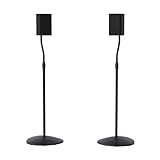
- Height Adjustable: Customize your sound thanks to 10 inches of height adjustment. Now you can mount your speakers directly at ear level, just twist the collar and adjust from 28 to 38 inches. No tools required!
- Premium Design: Built from heavy-gauge steel, these speaker stands will help deliver top quality sound while keeping your speakers safe. The wide base helps prevent against bumps or falls, and included felt pads minimize vibration.
- Universal Speaker Stand: Engineered to securely hold small satellite and bookshelf speakers up to 3.5 lbs, these stands offer three versatile mounting options: L-shaped brackets, a top plate, and a keyhole adapter, ensuring maximum compatibility with your speakers.
- DIY Installation: Easy as 1, 2, 3. This speaker stands pair come with everything you need to take your speakers to new heights, including hardware, base pads and different mounting brackets for your unique setup.
- SANUS Difference: The SANUS adjustable height speaker stand comes with a 5-year warranty, and top-notch Minnesota based customer service. Our experts are ready to chat 7 days a week if you have questions or run into a snag.
3. Raise the tweeters to seated ear height
Use stable stands or furniture that puts the tweeters approximately level with your ears in the listening position. Philips and Roku both recommend seated ear-level placement. A speaker on the floor can receive strong boundary reinforcement and vibration; a speaker on a flimsy shelf can add resonances. Choose stands with enough load capacity, a wide stable base and a way to isolate the speaker from the support.
4. Isolate the support from vibration
Make sure the stand does not rock and that the speaker cannot slide. Suitable isolation pads or feet can reduce transmission into a desk or cabinet, but they cannot cure a corner-induced room mode. Tighten loose hardware and remove objects that rattle sympathetically.
5. Adjust toe-in gradually
Start with the speakers aimed straight ahead, then rotate them inward a few degrees at a time while listening to a clear vocal. Stop when the center image locks between the speakers. Excessive toe-in can put the tweeter’s most energetic axis directly at your ears and make the top end sharp; too little can increase side-wall reflections and soften detail.
6. Keep the listening seat away from major boundaries
A seat pressed against the rear wall often sits in a strong bass maximum. Move it forward when possible, even a modest distance, and recheck familiar bass notes. Do not place the seat exactly halfway between front and rear walls if that position produces a pronounced null.
Reduce reflections without over-damping the room
Once placement is sensible, treat the surfaces that create the most obvious glare.
Use soft furnishings strategically
Place a rug between the speakers and the listening seat if the floor is hard. Curtains, an upholstered sofa and filled bookshelves can scatter or absorb reflections. Bose specifically recommends rugs, upholstered furniture and bookshelves as practical ways to break up hard surfaces. Add treatment where you hear a discrete slap or bright reflection rather than covering every wall.
Find the first-reflection points
Have someone move a mirror along each side wall while you sit in the listening position. Where you can see a speaker’s tweeter in the mirror is an early-reflection area. A thick, broadband panel or substantial furnishing there can reduce treble glare; a thin decorative panel may have little effect at lower frequencies.
Rank #3
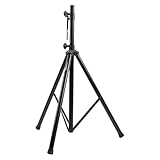
- Tripod speaker stand for easy speaker setup; ideal for use on stage, in a studio, or at home
- 99.2-pound maximum weight capacity; adjustable height (4.1 to 6.6 feet); sturdy, expandable, long tripod legs provide stability in any environment
- Constructed with a durable steel tube for reliable strength; upper shaft measures 1.4 inches (35mm) in diameter; If the inner diameter of speaker bottom hole is 38mm, then need to purchase an additional 35mm to 38mm adapter
- Safety pin ensures secure speaker placement; black finish for easy coordinating with other equipment
- Backed by an Amazon Basics 1-year limited warranty
Keep the room lively enough for speech
Over-absorbing high frequencies can make a room dull while leaving the bass modes untouched. Treat reflections selectively and reassess vocals after each change. If the room sounds muffled, remove or reposition some absorption before adding treble.
Apply small, deliberate EQ changes
Equalization is the finishing step after placement and basic treatment.
Cut before you boost
If bass is swollen, reduce the bass control or the offending low-frequency band rather than boosting treble to make the mix seem balanced. ADAM Audio documents example boundary- and desk-loading cuts of about 2–4 dB. Those values are starting examples, not a required setting; begin with the smallest audible change and stop when the problem is reduced.
Use presence and treble controls sparingly
Harshness can lie in the upper midrange (“presence”) as well as the highest treble. ADAM’s example treble range is +1.5, 0 and −1.5 dB, illustrating how modest changes can alter perceived brightness. Try a small cut, listen to speech and cymbals, and return to zero if detail becomes dull. Do not stack a tone-control cut with a second room-EQ cut without checking the combined result.
Try a low-cut filter when appropriate
A low-cut (high-pass) filter removes the deepest bass from a main speaker. Bose recommends trying one when a speaker remains bass-heavy after moving it away from boundaries. Set it only high enough to reduce overload; an unnecessarily high setting can make the system thin and force the subwoofer to handle too much of the audible range.
What’s actually slowing this PC down?
Pick the symptom - the matching free tool is one click away.
Check for clipping and loudness processing
If harshness appears only at high volume, bypass loudness, dynamic-bass and “clarity” modes and lower the level. A small amplifier or powered speaker that is clipping cannot be repaired with EQ. Reduce the source level, amplifier gain or playback volume and see whether the edge disappears.
Integrate a subwoofer without muddying the system
A subwoofer should extend the mains, not announce its location or dominate every bass note.
Rank #4

- 【Optimal Home Theater Audio Experience】 Home Theater Essential - Whether you’re chilling on the couch or dancing in your socks, easily twist the collar to change bookshelf speaker stands from 28" to 38" to let sound follow your ear. Let's enjoy more immersive, room-filling vibe with fewer reflections!
- 【Universal Speaker Brands Friendly】 Equipped with three key mounts - Top plates(with pads), L-shaped brackets, and Dual brackets, think of the surround sound speaker stand as a universal remote for most satellite speakers and small bookshelf speakers from Klipsch, Polk, JBL, Sony, Vizio, Edifier, and more. Versatile mounting options for theater setup.
- 【Rock Solid Stability】 As a trinity of sturdy metal pole, weighted base, and anti-slip pads, the rear speaker stands make speakers stay put-even when your playlist gets rowdy; Pads protect carpet or tile flooring. Each stand supports up to 11lbs—ideal for small home audio systems.
- 【Cable Wire Management】 Say goodbye to spaghetti wires. The speaker stands for surround sound, keep wires tucked away with larger built-in cable channel. Plus, ten velcro straps make you quickly fix and change the wire.
- 【Quick Setup in Minutes】 The speaker stands pair comes with all the necessary hardware and step-by-step instructions. Grab a screwdriver—no extra tools or hassle required, and you’re done in minutes.
Run a subwoofer crawl
- Temporarily place the subwoofer at the main listening position, ideally with its driver at roughly the height it normally occupies.
- Play familiar bass-heavy material or a slow bass sweep at a moderate level.
- Walk the perimeter of the room and listen for positions where bass sounds even, tight and tuneful rather than one-note.
- Place the subwoofer at one of those positions and return to the listening seat.
- Repeat with a second candidate position if practical; the best location is the one that gives the seat the smoothest response, not necessarily the loudest corner.
This procedure follows Bose’s subwoofer-crawl guidance. It can reveal a better location before you spend time changing crossover or EQ.
Set the crossover near 80 Hz, then verify
Audient describes 80 Hz as a common starting point, or approximately 15 Hz above the main speakers’ low-frequency cutoff. If your mains are rated to play cleanly lower, a lower crossover may integrate better; if they struggle higher, a higher setting may help. A crossover set too high can make the subwoofer sound boomy or localized because upper-bass information becomes easy to place.
The Tool Desk
Outbyte Driver Updater FREEScan for outdated or missing drivers - takes under a minuteDriver Scan →Outbyte PC Repair FREEClear out junk files and repair common Windows errorsFree Scan →Balance level and phase
Lower the subwoofer level until it supports kick drums and bass lines without pulling attention toward the subwoofer. If the crossover region sounds weak, try the subwoofer’s phase or polarity control and choose the setting that produces the fullest, cleanest blend at the listening seat. A setting that is loudest at one seat is not automatically best across the room, so check a second nearby position.
Use the mains’ bass management correctly
When a receiver or processor offers a genuine high-pass filter for the main speakers, use it consistently with the subwoofer’s low-pass filter. Avoid running two independent low-pass controls at unrelated frequencies unless the equipment documentation explains how they interact. Duplicate filters can create a hole or a hump around the crossover.
Control subwoofer vibration
If the floor or furniture rattles, use suitable isolation feet or move the subwoofer to a more rigid surface. Isolation reduces transmitted vibration; it does not correct a room mode, so recheck the crawl after installing it.
Diagnose the symptom before changing another setting
| What you hear | Likely cause | First action |
|---|---|---|
| Bass is loud in one seat and missing a few feet away | Room mode or listening position | Move the seat or speakers; compare several positions before using EQ. |
| Bass is thickest in a corner | Boundary reinforcement | Move the speaker or subwoofer away from the corner and rerun the crawl. |
| One bass note dominates every recording | Mode peak, excessive subwoofer level or crossover overlap | Lower sub level, try a lower crossover and check placement. |
| Vocals and cymbals sound sharp from the main seat | Early reflections, excessive toe-in or treble/presence boost | Add a rug or soft furnishing, reduce toe-in and return treble controls to neutral. |
| Sound becomes harsh only when loud | Clipping, driver strain or hearing fatigue | Lower volume, bypass loudness processing and check amplifier headroom. |
| Detail is dull after treatment | Too much high-frequency absorption or an excessive treble cut | Remove some absorption or ease the cut; keep bass treatment separate. |
| Buzzes or rattles accompany bass | Vibrating rack, cabinet, loose object or floor transmission | Secure hardware, remove loose objects and isolate the speaker or subwoofer. |
When measured room correction is worthwhile
Consider measurement when the bass remains uneven after multiple placement attempts, when the room has several seats that must work, or when a subwoofer and mains refuse to blend. Anthem ARC is an example of a system that measures the room and applies filters and equalization to address an uneven response. Room-correction systems differ in microphone requirements, measurement positions, filter controls and compatibility with your receiver or powered speakers.
Use correction to reduce broad, repeatable peaks rather than trying to fill a deep null with a large boost. A null caused by cancellation may require a placement change; adding power can increase cone excursion without creating the missing sound. Make measurements at several seats if the system supports it, and verify the result with familiar recordings rather than trusting a single graph.
Best Value

- HEAVY-DUTY CONSTRUCTION: All-steel build supports up to 100 lbs per stand, ideal for speakers or lights in any setup.
- ADJUSTABLE HEIGHT: Customize your setup with a height range up to 71 inches for optimal sound or lighting coverage.
- EXPANDABLE TRIPOD LEGS: 0-32 inch base spread ensures maximum stability on a variety of surfaces.
- CONVENIENT CARRY BAG INCLUDED: Carry and store your stands with ease using the included durable transport bag.
- UNIVERSAL COMPATIBILITY: Works with virtually any speaker with standard 35mm mounting socket
Choosing useful hardware upgrades
Buy hardware to solve an identified limitation, not as a substitute for placement.
| Upgrade | Compare | Most useful when | Limitation |
|---|---|---|---|
| Speaker stands | Height, stability, load rating and vibration isolation | Bookshelf speakers are too low, unstable or sitting on a resonant desk | They cannot remove a room mode by themselves. |
| Acoustic panels or bass traps | Placement, thickness and coverage | Reflections or persistent low-frequency buildup remain after rearranging furniture | Thin panels mainly affect higher frequencies; bass traps need substantial depth and correct placement. |
| Subwoofer isolation feet | Load capacity, compatibility and floor coupling | Structure-borne vibration bothers neighbors or makes furniture rattle | Isolation does not flatten airborne room modes. |
| Room-correction system | Measurement method, filter control and equipment compatibility | You need consistent response across more than one seat | It cannot fully repair poor placement, clipping or a deep cancellation null. |
| Subwoofer with integration controls | Crossover range, phase/polarity adjustment, level control and placement flexibility | The existing sub cannot blend cleanly with the mains | More controls require methodical setup; a higher output rating alone does not guarantee smoother bass. |
Practical setups for common rooms
Small bedroom or office
Prioritize symmetry and avoid placing either speaker in a corner. Keep the listening seat clear of the rear wall if possible. A rug and filled bookshelf often provide enough reflection control. If a subwoofer makes the room worse, try the mains alone with a modest low-cut rather than forcing deep bass into a strong room mode.
Open-plan living room
Use the main seating area as the reference zone, but check adjacent positions because the open boundary changes modal behavior. Keep one speaker from being trapped in a cabinet or against a side wall. A subwoofer crawl is especially valuable because several locations may sound very different.
Desk or nearfield system
Desk reflections can add upper-bass and lower-mid buildup. Raise the tweeters to ear height, move the speakers toward the desk’s front edge, and use only a small boundary correction; ADAM’s documented −2 to −4 dB examples illustrate the scale of a starting cut. Keep the monitor and speaker stands stable so the desk does not become a resonant enclosure.
Home-theater seating
Optimize for more than one seat. Place the subwoofer where bass is most even across the row, then use measurement-based correction if available. Do not judge the system only from the center seat if other listeners report missing or excessive bass.
Common mistakes and recovery steps
- Moving speakers only a few centimeters and declaring placement ineffective: make a meaningful change, note the distance, and compare from the same seat.
- Fixing boom with a large treble boost: return treble to neutral, reduce the bass source and address boundaries.
- Putting the subwoofer in the loudest corner: repeat the crawl and choose the most even position, not the maximum output.
- Setting the crossover by speaker-size label alone: start near 80 Hz, then account for the mains’ real low-frequency cutoff and localization.
- Using thin foam to solve deep bass: choose substantial bass treatment or measured correction; thin material mainly changes reflections.
- Changing several controls at once: alter one variable, listen to the same passage and record the result.
- Ignoring the source: compare another recording or input. If only one track is harsh or boomy, the mix may be the limiting factor.
A repeatable final check
- Confirm neutral tone, loudness and subwoofer settings.
- Verify speaker spacing, symmetry, ear height and stable supports.
- Listen at the main seat and one nearby position.
- Play speech, acoustic music and sustained bass, not just a bass-heavy demo.
- Make one small EQ cut only if a repeatable problem remains.
- Recheck at a lower and higher listening level to distinguish room behavior from clipping or fatigue.
- Save the final settings and leave the system for a day before making another change.
If the bass still changes radically around the room, treat it as a room-mode problem and prioritize placement, multiple-subwoofer strategy where appropriate, substantial bass treatment or measured room correction. If the treble remains sharp after reflections and toe-in are addressed, inspect for clipping, damaged drivers or a recording-specific problem before adding more EQ.
Quick Recap
Product prices and availability are accurate as of the date/time indicated and are subject to change. Any price and availability information displayed on Amazon at the time of purchase will apply.

