Quick wins for a faster PC:
Clear out junk files and repair common Windows errorsFree Scan →Fix the driver behind crashes, sound loss and screen glitchesFind Drivers →Repair Windows errors before they cause bigger problemsFix Now →When Windows 10 does not detect a second monitor, work from the signal path inward: select the monitor’s correct input, connect it directly to a supported graphics output, reseat or replace the cable, choose Extend with Windows + P, and use Detect in Display settings. Only after those checks should you reset, update, roll back, or reinstall the graphics driver and verify that the computer, dock, adapter, and monitor combination can actually drive two displays.
The procedure below separates a monitor showing “No signal” from one that is powered but absent in Windows. It also explains how to isolate a bad cable, port, dock, driver, or hardware limitation without buying parts unnecessarily.
As an Amazon Associate I earn from qualifying purchases.
What “second monitor not detected” can mean
There are two different failure points. A monitor that displays No signal is powered but is not receiving a usable video signal. A monitor that works with another computer but never appears under Settings > System > Display is reaching the edge of the Windows, driver, or graphics-hardware path. A blank screen can also result from selecting the wrong input, using a cable that does not match the port, or connecting through an accessory that cannot carry the required display signal.
Free tools Windows power users keep installed
One-click scans. No signup required.
Keep the first diagnosis simple: establish power and the correct input, remove unnecessary accessories, prove the cable and port, then ask Windows to switch to an extended desktop and rescan. This order costs nothing at first and prevents a driver change from masking a physical connection problem.
#1 Best Overall

- 4K UHD and Audio Sync: Supports up to 4K@30Hz resolution with backward compatibility for 1440P/2K@60Hz and 1080P Full HD. Ensures synchronized high-definition audio and video for an immersive streaming or gaming experience
- Uni-Directional DP to HDMI Only: This cable transmits video signals from a DisplayPort SOURCE (like a PC/laptop) to an HDMI DISPLAY (monitor/TV), Cannot connect HDMI sources (gaming consoles, Blu-ray players, cable boxes) to DP displays, it will NOT work in reverse! Need HDMI → DP? You'll require a separate converter, Verify your source device before purchase!
- Wide Compatibility: Perfect for graphics card (AMD, NVIDIA), laptops (HP, Lenovo), desktops (HP, Dell, Lenovo) with DisplayPort connections, this cable delivers vibrant, realistic 4K resolution and smooth 3D visuals to large screens
- Durable and High-Quality Build: Features multi-layer shielding, a nylon-braided wire with 20,000+ bend lifespan, and a 24K gold-plated connector to minimize interference and enhance signal quality
- Note: Please ensure that the display resolution and refresh rate settings are consistent to avoid abnormal display; High-resolution data transmission will cause the chip to heat up, please don't worry too much
Fix the connection in the recommended order
1. Turn on the monitor and select its actual input
Press the monitor’s power button and open its on-screen input or source menu. Select the connector you are using—HDMI, DisplayPort, or USB-C—rather than leaving the monitor on Auto if it repeatedly chooses the wrong source. If the monitor has more than one socket of the same type, note the exact socket number. Confirm that the computer is awake; a sleeping PC can leave the second panel dark even when the cable is fine.
If the monitor’s own menu will not appear, the fault is inside the monitor or its power path, not Windows. Test another power outlet and the monitor’s power cable before continuing.
2. Bypass docks, dongles, and adapters
Shut down or wake the computer, disconnect the dock, USB-C hub, HDMI splitter, and video dongles, and connect the monitor directly to a video output on the computer or graphics card. Microsoft warns that accessories can cause conflicts and advises checking the cable and connection directly. A direct connection is the cleanest baseline because it removes the dock’s firmware, power, bandwidth, and display-count limits from the test.
If the direct connection works, reconnect one accessory at a time. A dock may support two displays only at particular resolutions or refresh rates, and some USB-C ports carry data and charging but no video. Consult the computer or dock specifications to confirm that the exact port supports display output.
3. Reseat the cable, then test a known-good cable and port
Remove the HDMI, DisplayPort, or USB-C plug at both ends. Check for bent pins, a loose socket, or a connector that is not fully inserted; then reconnect it firmly at the computer and monitor. If the monitor has a locking DisplayPort plug, press its release tab before removing it rather than pulling on the cable.
Rank #2

- IMPORTANT: This cable is not USB-A compatible. Signal direction is one-way only: DisplayPort (computer) → HDMI (display)
- IN THE BOX: DisplayPort to HDMI 6-foot display cable
- CONNECTIVITY: Unidirectional passive cable, connects DisplayPort-enabled computer to an HDMI display. Supports Dual-Mode DisplayPort (DP++). Does not support LVDS signal sources such as audio/video players; NOT compatible with a USB port
- PERFORMANCE: Supports uncompressed digital audio channels (7.1, 5.1, or 2) and video resolutions up to 1920x1200 and 1080p (Full HD)
- USES: Transmits audio and video from computer to HD display; great for showing movies on a big-screen HDTV, presenting work on a projector, or configuring a second monitor or mirrored displays
Next, test a cable already known to work with another display. Try a different output on the graphics card or laptop when one is available, and select the matching input on the monitor. Change only one item at a time so you know which change affects detection. If the original cable fails while the known-good cable works, replace it with a cable whose connector type matches both devices. For an HDMI setup, a search for a replacement HDMI cable for second monitor is useful only after you have confirmed that both ends are HDMI and that the computer’s output supports the monitor’s resolution. If both devices expose DisplayPort, a replacement DisplayPort cable is the appropriate alternative; an HDMI cable cannot be substituted without a compatible adapter.
4. Force the extended-desktop mode
With the cable connected, press Windows + P. Microsoft specifically recommends this shortcut when an external monitor is not working and says to make sure Extend is selected. Choose Extend, not PC screen only or Second screen only, while diagnosing. The display may flicker for a few seconds as Windows changes modes.
If the shortcut opens on the wrong screen or does not respond, press Windows + P again and use the arrow keys and Enter to select Extend. A successful extension normally makes the pointer move beyond the edge of the first desktop, even before you arrange the monitor positions.
5. Use Detect in Display settings
Open Start > Settings > System > Display. Scroll to Multiple displays, expand it if necessary, and select Detect. This is Microsoft’s prescribed path when a connected display is not shown in Settings: Start > Settings > System > Display > Multiple displays > Detect.
If a numbered rectangle appears after the scan, select it and use Identify to match the number to the physical panel. Drag the rectangles to match their left-to-right position, choose the desired Multiple displays option, and select Keep changes. If Detect reports no additional display, continue with the driver and hardware checks rather than repeatedly pressing the button.
Rank #3
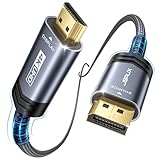
- 【Stronger Version】UNI DIRECTIONAL ONLY, NOT BIDIRECTIONAL: This DisplayPort to HDMI cable works only from a DisplayPort source device to an HDMI display. It does not support HDMI source to DisplayPort monitor use. Please confirm your device ports before purchase.
- 【CLEAR VIDEO FOR WORK AND DAILY DISPLAY】:Supports up to 4K at 30Hz, 2K at 60Hz, and 1080P at 120Hz under supported conditions, helping deliver clear video for office work, presentations, home display, and everyday viewing. Please confirm your source device and display setup support the required resolution.
- 【MADE FOR COMMON DP TO HDMI SETUPS】Ideal for connecting a computer, laptop, or graphics card with DisplayPort output to an HDMI monitor, TV, or projector. Before purchase, please confirm that your source device has a DisplayPort output and your display uses HDMI input to avoid compatibility issues caused by incorrect port type.
- 【EASY TO CHECK WHEN THERE IS NO SIGNAL】If no image appears after connection, please check whether the DisplayPort end is connected to the source device, whether the HDMI end is connected to the display, whether the display is switched to the correct HDMI input source, and whether the output resolution is within the supported range.
- 【10FT CABLE WITH DURABLE NYLON DESIGN】The 10FT cable length gives you more flexibility for desk setups, meeting rooms, home offices, and entertainment spaces. Built with a durable nylon exterior for daily use, it helps provide a more reliable and tidy connection experience in common DP to HDMI display setups.
6. Reset the graphics driver without restarting Windows
Press Windows + Ctrl + Shift + B. Windows resets the graphics driver; the screens may go black briefly and you may hear a short beep. This shortcut does not reinstall the driver or repair a defective cable, but it can recover a graphics stack that stopped responding after sleep, a resolution change, or connecting the second display.
Windows Errors? Fix Them Before They Spread
Repair common Windows errors and clear accumulated junk for a smoother, more stable PC - no reinstall needed.Free scan · no reinstallCrashes, No Sound, or Screen Glitches?
Random freezes, missing sound and display glitches usually trace back to one bad driver. Find and replace yours safely.Free scan · under a minuteAfter the screen returns, repeat the Windows + P and Detect steps. If the display appears only after this reset, note whether the problem returns after sleep or a reboot; that pattern points toward driver or firmware behavior rather than a permanently dead panel.
7. Update, roll back, or reinstall the display driver
Open Start, type Device Manager, and open it. Expand Display adapters, right-click the graphics device, and choose Properties to see the driver version and date.
- Install available updates. In Settings > Update & Security > Windows Update, select Check for updates. If Windows 10 offers View optional updates, inspect the driver section and install a display driver only when it matches your hardware. Restart when prompted.
- Roll back a recent change. In Device Manager, open the adapter’s Properties > Driver tab and select Roll Back Driver if the button is available. This is the appropriate test when the second monitor stopped working immediately after a driver update. The rollback option is unavailable when Windows has no previous driver package.
- Reinstall a damaged driver. Save your work, return to the adapter in Device Manager, select Uninstall device, and restart Windows. Windows will attempt to load a basic display driver. If detection remains broken, install the current driver supplied by the computer maker or by the GPU manufacturer—Intel, AMD, or NVIDIA—using the exact model. Windows Central notes that a manufacturer’s package can be newer than the version delivered through Windows Update: driver troubleshooting guidance for Windows 10.
Do not install a driver meant for a different GPU or laptop model. On systems with integrated and discrete graphics, the physical output may be controlled by only one of them; use the manufacturer’s documentation to identify which adapter drives each socket.
8. Confirm that the hardware can drive two displays
Not every graphics adapter supports more than one monitor, and a dock or USB display adapter can impose a lower limit than the computer itself. Check the specifications for the GPU, laptop, dock, and adapter for maximum display count, supported resolution, and supported refresh rate. Both screens must be connected to outputs driven by a GPU that supports two active displays; plugging one panel into a motherboard socket and the other into a separate graphics card can fail on systems whose firmware disables integrated graphics when a discrete card is installed.
Rank #4

- Top Technology--8K@60HZ: This 8K Ultra-High Speed 2.1 HDMI Cable uses the most cutting-edge technology, which is compatible with 8K@60HZ,4K@240HZ and 4K@120HZ clearly displays every particle, and accurately processes every signal source.
- Upgrade Revolution: Highwings Ultra High Speed HDMI Cable 2.1 8K supports 48Gbps (6GB/s) which can will no longer be stuck or dropped frames when watching video. It is also backward compatible with HDMI 2.0b/2.0a/1.4/1.3/1.2/1.1 versions.
- For Game Enthusiasts: This 8K Ultra High Speed HDMI Cable 2.1 can achieve a super smooth picture of 4K@120HZ. Its latest game mode supports variable refresh rate, maximizes the value of the graphics card and CPU to obtain a smoother and more detailed picture.
- Reinforced high-quality materials: This 8K HDMI Cord uses Highwings' most popular classic style. The tail's anti-bending design has been upgraded to make it more durable. The military grade tensile nylon material also greatly extends its life.
- The ultimate perfectionist: Highwings every parts of the cable has been put through rigorous the performance tests in the laboratory. After we've combined every flawless part into a perfect 8K cable and it can be presented to you.
For a USB-C connection, verify that the port supports video output and that the dock or adapter supports the monitor’s signal. For a high-resolution or high-refresh-rate panel, temporarily choose a lower resolution or refresh rate in Settings > System > Display > Advanced display as a diagnostic. If the monitor appears at a lower setting, the path is functioning but its bandwidth or capability is being exceeded at the original setting.
Use isolation tests to identify the failing part
Change one variable at a time and record the result. The following matrix turns common observations into the next action.
| Test result | Most likely area | Next action |
|---|---|---|
| The monitor works with another computer, but never appears on this PC | This PC’s output, GPU, dock, or driver | Connect directly to another supported output, reset the driver, then update or roll it back. |
| Another monitor works on the same port and cable | Original monitor, its input, or its cable | Choose the correct input, test a known-good cable, and try the original monitor on another computer. |
| The second monitor works when the dock is removed | Dock, dongle, adapter, power, or bandwidth limit | Check the accessory’s display-count and resolution specifications and update its firmware if the maker provides one. |
| Neither monitor works from one graphics output | That port, cable, or GPU output | Try another output and cable; if every output fails, inspect the GPU and driver path. |
| The monitor shows “No signal” but Windows lists it | Input selection, cable, adapter, or output signal | Select the matching monitor input, reseat both ends, and test a direct connection. |
| Detection fails only after a driver update | New driver package or settings migration | Use Device Manager’s Roll Back Driver, then test before installing another version. |
Connection paths: direct versus docked
| Path | Advantages | Limits to verify | Best diagnostic use |
|---|---|---|---|
| Direct HDMI, DisplayPort, or video-capable USB-C | Fewest components and no dock bandwidth sharing | Available ports, GPU display count, cable capability | Baseline test for every setup |
| Dock with two monitor outputs | One connection can carry displays, USB, network, and power | Dock model’s maximum displays, resolution, refresh rate, power, and host-port support | Reconnect only after direct output works |
| Dongle or single-display adapter | Can add a connector when the computer lacks the needed socket | Adapter chipset, driver, bandwidth, and whether it supports a second active display | Test against the adapter’s stated limits |
| Splitter | Duplicates one signal to multiple panels | Usually mirrors rather than extends; output resolution follows the weakest link | Not a solution when independent extended desktops are required |
Common situations and the right branch
The monitor says “No signal” immediately
Start at the monitor’s input menu, then bypass the dock and reseat the cable. A “No signal” message means the panel has power but is not receiving a usable signal; pressing Detect before proving the physical path will not create one. Test a different cable and output, and confirm that the selected output belongs to the GPU that supports the second display.
The monitor appears in Settings but remains black
Select the numbered display in Settings > System > Display, make sure Extend desktop to this display is selected, and check its resolution and refresh rate. A setting beyond the monitor or adapter’s capability can leave the panel blank even though Windows has enumerated it. Temporarily choose a conservative resolution and refresh rate, apply the change, and increase them only after the picture is stable.
The problem began after Windows Update or a graphics update
Use the graphics reset shortcut first. If the failure persists and the timing matches a driver update, use Device Manager > Display adapters > Properties > Driver > Roll Back Driver. If rollback is unavailable, uninstall and reinstall the correct package from the GPU or computer manufacturer. Do not stack several driver installers without testing between them; otherwise you lose the timing clue that identifies the responsible version.
Best Value
- IMPORTANT: This cable is not USB-A compatible. Signal direction is one-way only: DisplayPort (computer) → HDMI (display)
- IN THE BOX: DisplayPort to HDMI 10-foot display cable
- COMPATIBILITY: Connects a DisplayPort-enabled computer to an HDMI display; does not support LVDS signal sources such as audio/video players; NOT compatible with a USB port
- PERFORMANCE: Supports uncompressed digital audio channels (7.1, 5.1, or 2) and video resolutions up to 1920x1200 and 1080p (Full HD)
- USES: Transmits audio and video from computer to HD display; great for showing movies on a big-screen HDTV, presenting work on a projector, or configuring a second monitor or mirrored displays
The second screen works after a reboot but disappears after sleep
Check the cable and input first, then reset the graphics driver when the failure occurs. Test the computer with the dock removed and install any applicable display, chipset, or dock updates from the computer maker. If only the docked path fails after sleep, continue using the direct connection as a workaround while checking the dock’s documented display and power limits.
A laptop has HDMI plus USB-C, but only one screen works
Verify that the USB-C socket supports DisplayPort video output; not every USB-C port does. Check whether the laptop’s GPU supports two active displays and whether the chosen dock or adapter counts as one display or uses a special driver. Testing HDMI and USB-C separately, then testing both directly without a dock, identifies whether the limitation is the laptop, the adapter, or the accessory.
When replacement hardware is justified
Buy a cable only after a known-good cable changes the result or the original cable shows physical damage. Match HDMI to HDMI, DisplayPort to DisplayPort, or a documented USB-C video connection; an adapter must support the signal in both directions. A new dock, GPU, or monitor is a later escalation, justified when the current component fails the isolation tests or its specifications do not include two displays at the required resolution and refresh rate.
Recommended Free Tools
If the monitor works on another computer but no supported output on this PC detects it, the remaining suspects are the PC’s GPU, port wiring, firmware, or driver. If another monitor works on the same port, focus on the original monitor, cable, and input instead of replacing the graphics card. This evidence-based split keeps the diagnostic cost low: reseating and Detect are free, a replacement cable is a low-cost test, and a new dock, GPU, or monitor should come only after the capability and connection checks.
Windows 10 support and longer-term planning
Microsoft states that support for Windows 10 ended on October 14, 2025 on its current multi-monitor support page. That end-of-support date does not change the connection sequence above, but it does affect security updates and upgrade planning. If the computer supports a newer Windows release, evaluate that migration separately from the immediate monitor diagnosis; if it cannot, keep a record of the working driver and hardware combination and understand that future compatibility fixes may be limited. The current Microsoft guidance is available at How to use multiple monitors in Windows.
For the immediate fault, stop when the second display is listed, shows a picture, and remains stable after a restart and a sleep-wake cycle. If it still fails, the isolation results—direct versus docked connection, each cable and port tested, driver version, and whether the monitor works elsewhere—are the information a repair shop or hardware manufacturer needs to identify the remaining fault.
Quick Recap
As an optional shortcut after the manual checks, Outbyte Driver Updater can scan more than 100 devices for outdated, corrupted, or missing drivers, show the current and recommended versions, install official drivers, and provide driver backup, restore, and scheduled scans. It runs on Windows 11, 10, 8, and 7 and offers a two-day free trial without a credit card before a subscription; results vary, and no utility repairs every hardware or display problem.
What’s actually slowing this PC down?
Pick the symptom - the matching free tool is one click away.
Product prices and availability are accurate as of the date/time indicated and are subject to change. Any price and availability information displayed on Amazon at the time of purchase will apply.

