Recommended Free Tools
The fastest way to find scholarships you can actually use is to treat your background as a set of search clues, then verify every sponsor’s rules one by one. Start with your school and state resources, add community, employer and interest-based searches, and keep only awards whose location, enrollment, program, financial and document requirements you can meet. This guide uses U.S. guidance from Federal Student Aid; students elsewhere should use their national, regional and institutional sources.
A surname, race or ethnicity, hometown, family circumstance or intended major can point you toward a search term, but none of those details automatically qualifies you. The sponsor decides eligibility, and a current application page—not a search snippet—controls.



As an Amazon Associate I earn from qualifying purchases.
What “matching your background” really means
A good match is not simply a scholarship whose title mentions you. It is an opportunity for which you satisfy every stated condition and can submit the required evidence by the deadline. Sponsors may limit an award by one detail or by several details at once.
Quick wins for a faster PC:
Clear out junk files and repair common Windows errorsFree Scan →Scan for outdated or missing drivers - takes under a minuteDriver Scan →- Place: residence, county, state, school district, high school, college or the location where you plan to study.
- Education: current grade or college level, enrollment status, eligible school type, degree or certificate program and sometimes a particular field of study.
- Academic or career interests: a major, occupation, activity, talent or professional goal.
- Affiliation: membership in a community, religious, professional, civic, cultural or interest-based organization.
- Family or service connection: an employer relationship, military-family circumstance or another specifically defined connection.
- Financial circumstances: financial need or information drawn from the Free Application for Federal Student Aid (FAFSA), when the sponsor uses it.
- Required proof: a transcript, recommendation, essay, enrollment confirmation, affiliation verification or other document named in the rules.
Use these categories to generate searches and questions, not to assume an award is yours. Federal Student Aid puts the rule plainly: “Different scholarships have different eligibility requirements, so check and make sure you meet all the requirements for a scholarship before you apply.”
#1 Best Overall
Build a search profile before opening listings
Write a one-page profile in your notes or spreadsheet. It prevents vague searches and makes it easier to recognize a legitimate fit when you find one.
Record your location and school status
Note where you live, where you attend school, the school type, your expected graduation or completion date and where you expect to enroll next. Include county or city when a local award could use that boundary. A scholarship restricted to residents of one state or graduates of one high school is different from a national award with no geographic limit.
Describe your education and intended path
List your current level, intended degree or credential, possible major and career interests. Add activities, skills or projects that an organization connected to that field might recognize. Keep uncertain plans marked as possibilities until an award’s rules specify what counts as an eligible program.
Free tools Windows power users keep installed
One-click scans. No signup required.
List affiliations and family connections
Include organizations you or your family genuinely belong to, an employer connection, military-family circumstances and community or religious involvement. Do not stretch a relationship to fit a label. If a rule says “member,” determine whether it means current membership, a parent’s membership, a particular chapter or another definition.
Note financial and application circumstances
Record whether you expect to complete FAFSA, whether you may need a recommendation, and which documents you already have. Financial need is defined by each sponsor; do not substitute a general income assumption for the sponsor’s wording.
Race and ethnicity require particular care. Federal Student Aid explains that the FAFSA’s race and ethnicity responses are collected for research purposes and do not affect federal student-aid eligibility or calculations. A private scholarship provider may set separate criteria, so read that provider’s definition and documentation rules rather than treating a FAFSA demographic answer as a matching result.
Search several channels instead of relying on one database
Federal Student Aid recommends a broad search. Use the channels below, then ask the relevant office or organization when a condition is unclear.
What’s actually slowing this PC down?
Pick the symptom - the matching free tool is one click away.
| Channel | What to look for | Useful next action |
|---|---|---|
| College or career-school financial aid office | Awards limited to students at that institution, institutional funds and campus-specific deadlines | Ask which scholarships require admission, enrollment, FAFSA information or a separate campus form. |
| High school counselor’s office | Local awards, counselor-managed nominations and opportunities for current seniors | Request the current list and confirm whether the counselor must submit or certify anything. |
| State higher-education agency | State grants and scholarships, residency rules and state deadlines | Read the state’s current eligibility page and note whether FAFSA is part of the process. |
| Community and religious organizations | Geographic, membership, service or congregation-based awards | Ask the sponsoring chapter or office what “member,” “resident” or “community” means for that award. |
| Local businesses and community foundations | Employer, neighborhood, school-district or local-service awards | Check the foundation or business’s own application instructions and award year. |
| Your employer or a parent’s employer | Employee-dependent scholarships and workplace education benefits | Contact human resources or the benefits office for the current rules and internal deadline. |
| Organizations connected to your interests | Professional, civic, cultural, hobby, academic or career-related awards | Search the organization’s official site and verify whether participation or membership is required. |
| U.S. Department of Labor’s free scholarship search tool | A broader starting point for discovering opportunities | Use results as leads, then verify each award with the sponsor before preparing an application. |
Save the sponsor’s official page for every serious lead. A third-party listing can be old, incomplete or missing a restriction that changes your eligibility.
Verify eligibility before investing application time
Use a separate record for each scholarship. Copy the sponsor’s wording accurately, then mark the requirement as confirmed only after you have checked the current official instructions.
Capture the complete rule set
- Sponsor and award year: identify who funds the award and which entering or academic year it covers.
- Eligible student: record grade or college level, enrollment status, citizenship or residency language and any age or graduation condition.
- Eligible school or program: note institution type, approved program, major or vocational path and whether acceptance or enrollment must already be established.
- Location: record the exact state, county, city, school or chapter boundary.
- Background or affiliation: copy the sponsor’s definition rather than reducing it to a broad identity label.
- Financial rule: determine whether the sponsor asks for financial-need information, FAFSA data or a separate form.
- Documents: list essays, transcripts, recommendation letters, enrollment proof and any verification form.
- Deadline: record the date, time and time zone when supplied, plus whether the deadline is for the applicant or a recommender.
- Renewal: note whether the award can continue and what grades, credits, enrollment or reapplication conditions apply.
- Application route: use the sponsor’s own portal, form or instructions, and note any required nomination.
Test the hard-stop requirements first
Check conditions that can disqualify you before drafting an essay: wrong state, school, program, class year, enrollment status, affiliation or deadline. Then evaluate softer fit such as interests or the story you could tell. This order keeps you from spending hours on an attractive award you cannot legally receive under its rules.
Ask when wording is ambiguous
Contact the financial aid office, counselor or sponsoring organization with a specific question. Ask whether your school or program qualifies, what a residency or membership term means, whether a parent’s employer connection counts, and which document proves the condition. Keep the answer with your scholarship record and recheck the page before submission.
Understand exactly how FAFSA fits
FAFSA is sometimes relevant to scholarships, but it is not a universal scholarship application or background-matching service. Federal Student Aid states: “Some states and schools use information from the FAFSA® form to determine your eligibility for their grants, scholarships, and loans.”
Use the correct aid year and deadline
The 2026–27 FAFSA form is available as of the current guidance, but federal, state and school deadlines are different. Check the aid year named by the scholarship and complete FAFSA early enough for the applicable state or institution. Completing FAFSA does not replace a sponsor’s separate scholarship application, essay, recommendation or transcript submission unless the sponsor explicitly says it does.
Separate federal-aid rules from private-scholarship rules
Federal student aid generally has its own eligibility framework, including citizenship or eligible-noncitizen status and enrollment in an eligible program. Federal Student Aid also says there is no overall income cutoff for federal aid. Those points do not define every private scholarship: a private sponsor can impose different residency, income, affiliation, academic or documentation rules.
Know the distinction for undocumented and DACA students
Federal Student Aid says undocumented students, including DACA recipients, are not eligible for federal student aid. It also explains that they may still be eligible for state, school or private scholarships. Check each state, institution and sponsor directly; do not treat federal-aid ineligibility as a blanket denial of every scholarship.
Do not read demographic questions as award matching
FAFSA demographic questions and a private sponsor’s eligibility criteria serve different purposes. The federal form’s race and ethnicity responses do not alter federal aid eligibility or calculations. A private provider may ask for demographic information under its own rules, so rely on that provider’s definition and required proof.
Prepare a reusable application file
Preparing common materials once lets you tailor each application without starting from zero. Federal Student Aid recommends beginning early because documents and recommendations take time.
Collect the materials most often requested
- A current transcript or other recent academic record.
- An essay response that answers the sponsor’s actual prompt.
- At least one recommendation letter when required.
- FAFSA information when the sponsor, state or school uses it.
- Proof of enrollment, admission, residency, affiliation or another specific condition when required.
Keep a clean master résumé or activity list for reference, but follow the sponsor’s requested format and length. Do not submit extra personal information merely because you have it.
Build a deadline tracker
- Create one row per scholarship and enter the sponsor, award year, official application route and deadline.
- Add a column for every required document, including the person responsible for a recommendation.
- Set an internal date several days before the sponsor’s deadline so you have time to correct an upload or missing signature.
- Mark each item as planned, requested, drafted, submitted or confirmed.
- After submitting, save the confirmation or receipt and record any follow-up date.
A paper scholarship planner or deadline notebook is optional. It can support the same tracking system, but there is no evidence that buying one increases the chance of receiving an award.
PC Slower Than It Used to Be?
A free scan shows the junk files, broken settings and background clutter dragging Windows down - then fixes them in one click.Free scan · Windows 10 & 11Outdated Drivers Are Slowing You Down
One free scan finds every outdated or missing driver and matches the right update for your exact hardware.Free scan · exact hardware matchPrioritize opportunities by fit, value and effort
Federal guidance emphasizes understanding requirements and timing; it does not prescribe a government scoring formula. You can still make a transparent personal comparison after hard eligibility checks.
Best Value
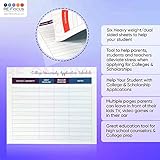
- Two-Sided. One side allows you to track College/University Application deadlines. The other side tracks Scholarships.
- Colorful. Each side uses a different color pallet in order to be easily distinguishable.
- Sturdy paper stock.
- 6 pack. There are six two-sided sheets per pack.
- Measures 11.5 x 9.5 inches.
| Criterion | Question to answer |
|---|---|
| Eligibility fit | Can you document every mandatory condition? |
| Award amount | How much funding does the sponsor offer for the stated award period? |
| Renewal | Can it continue, and what performance or enrollment conditions apply? |
| Eligible expenses | Which education costs may the funds cover under the sponsor’s rules? |
| Application effort | How much writing, coordination and document preparation is required? |
| Deadline risk | Can you obtain every document and submit through the required route on time? |
Rank a fully documented, realistic fit above a larger award whose requirements you cannot meet. Do not assume that applying to a fixed number of scholarships guarantees success; Federal Student Aid cautions that receiving an award is never guaranteed.
Use this application workflow for each confirmed match
- Open the sponsor’s current page. Confirm the award year, deadline, eligibility text and official application route.
- Mark every requirement. Separate hard-stop conditions from documents you can still obtain.
- Resolve questions. Contact the named office or sponsor and save the answer with your notes.
- Request recommendations early. Give recommenders the prompt, deadline, submission method and a concise résumé or activity list.
- Draft to the prompt. Connect your experience to the sponsor’s stated purpose without claiming a background qualifies you automatically.
- Assemble evidence. Use the requested transcript, FAFSA information, enrollment proof and affiliation documents; protect personal information and follow the portal’s file instructions.
- Review for rule compliance. Check word limits, file types, signatures, required fields and the applicant or recommender deadline.
- Submit through the official route. Keep a confirmation, receipt or screenshot and update your tracker.
- Monitor follow-up. Watch for requests for clarification, notification dates, renewal instructions or school financial-aid-office action.
How common background questions change your search
“Can I find awards based on where I live?”
Yes, location is a productive search dimension. Try your state, county, city, school district and local community-foundation channels. Verify the sponsor’s exact residency period and whether you must attend an in-state institution.
“Can my family background qualify me?”
Possibly, if a sponsor defines a family, employer, military or organizational connection that you can document. A broad family description is not enough; read the sponsor’s definition and ask what proof it accepts.
“Can my major or activity lead to an award?”
Interest-based organizations and professional groups often organize searches around fields, careers, activities or service. Confirm that your intended program and enrollment stage match the award’s wording.
“Does a demographic identity guarantee eligibility?”
No. A demographic label may be one condition among several, and the sponsor decides how it is defined. FAFSA demographic answers do not change federal-aid calculations, while private sponsors may use separate criteria.
“What if federal aid is unavailable to me?”
Check state, institutional, community, employer and private sources individually. Federal Student Aid’s guidance for undocumented and DACA students illustrates why federal-aid status and scholarship eligibility must be evaluated separately.
Common mistakes and practical fixes
- Trusting a search-result snippet: open the sponsor’s current page and copy the complete rule set.
- Applying because the title sounds familiar: test location, school, program, affiliation, documents and deadline before drafting.
- Assuming FAFSA is always required—or never relevant: check the state, school and sponsor instructions for the correct aid year.
- Confusing demographic questions with eligibility: distinguish FAFSA’s research-use demographic responses from a private provider’s criteria.
- Missing a recommender’s deadline: track that submission separately from your own form and request the letter early.
- Ignoring renewal language: record continuing enrollment, grade or credit requirements before comparing the award’s value.
- Submitting through an unofficial route: use the sponsor’s named portal or instructions and retain confirmation.
- Believing an application guarantees funding: treat every award as competitive and make no promise to yourself about the outcome.
Make the search sustainable
Review your profile when your school, program, residence, employer connection or financial circumstances change. Remove opportunities whose deadlines have passed, but retain notes on recurring sponsors so you can check the next award year. Before every submission, return to the sponsor’s official page, confirm the current rules and deadline, and make sure your evidence supports each requirement.
The Tool Desk
Outbyte Driver Updater FREEFix the driver behind crashes, sound loss and screen glitchesFind Drivers →Outbyte PC Repair FREEClear out junk files and repair common Windows errorsFree Scan →The practical answer to “What scholarships can I get based on my background?” is therefore a documented list of sponsor-defined matches—not a single demographic search result. Search broadly, verify narrowly, use FAFSA where the relevant state or school requires it, and apply only when you can meet every stated condition.
Quick Recap
Product prices and availability are accurate as of the date/time indicated and are subject to change. Any price and availability information displayed on Amazon at the time of purchase will apply.

