Quick wins for a faster PC:
Scan for outdated or missing drivers - takes under a minuteDriver Scan →Clear out junk files and repair common Windows errorsFree Scan →Fix the driver behind crashes, sound loss and screen glitchesFind Drivers →Start by identifying both connectors: the port on your phone and the plug on the accessory. A USB-C accessory can often plug directly into a USB-C phone, while a USB-A accessory usually needs a USB-C OTG adapter. Earlier iPhones use Lightning and need a Lightning-compatible cable or adapter. A matching shape is only the first check: the phone, cable and accessory must also support the function you need, such as storage, audio, video or data transfer.
When a device is not recognized, check the adapter, cable capability, storage format, available power and whether the phone is unlocked. The steps below cover common USB drives, hard disks, wired earbuds, card readers and computer connections on current iPhone and Android phones.
As an Amazon Associate I earn from qualifying purchases.
Check compatibility before connecting anything
USB accessories vary in connector, protocol, speed and power requirements. Use this checklist before buying an adapter or repeatedly reconnecting a device.
The Tool Desk
Outbyte Driver Updater FREEFix the driver behind crashes, sound loss and screen glitchesFind Drivers →Outbyte PC Repair FREEClear out junk files and repair common Windows errorsFree Scan →| Check | What to determine | Why it matters |
|---|---|---|
| Phone port | USB-C or Lightning | Determines which cable or adapter can physically connect. |
| Accessory plug | USB-C, USB-A, Lightning, USB Micro-B or a memory card | Determines the connector bridge you need. |
| Function | Storage, audio, display, data transfer or charging | A connector adapter cannot add a protocol the phone does not support. |
| Power demand | Bus-powered device or device with its own supply | Large hard drives and some hubs may draw more power than the phone can provide. |
| Cable capability | Charging only, USB 2 data or USB 3 data | A cable can charge normally while failing to transfer data or limiting speed. |
| Software and lock state | Android 7.0 or later for Google’s USB-storage workflow; an unlocked iPhone for accessory access | The operating system and security settings control whether the device appears. |
USB-C iPhones and Lightning iPhones
iPhone 15 and later use USB-C. Earlier iPhone models use Lightning. On a USB-C iPhone, Apple recommends a USB-C cable with USB-C connectors at both ends for a compatible USB-C accessory. To connect a USB-A car port or USB-A peripheral, use a compliant USB-C-to-USB-A cable or a USB-C OTG adapter, depending on the device.
#1 Best Overall
![JSAUX USB C to USB 3.0 Adapter [2 Pack], USB C Male to USB Female OTG Cable Adapter Compatible with MacBook Pro/Air, iPhone 18 Pro Max/iPhone Duo/Air/17/16/15 Series, Samsung Galaxy S26/S25/S24/S23](https://m.media-amazon.com/images/I/41Q9tgu65+L._SL160_.jpg)
- USB OTG(On The Go): Plug in and use computer peripherals, such as flash drive, keyboard, hub, mouse and more, makes your USB C devices compatible with USB drives and any other USB devices that support OTG. Not compatible with video output.
- USB 3.0 Super Speed Transfer: Full USB 3.0 super speed data transfer up to 5Gbps, 10x faster than USB 2.0; Transfer files, HD movies and songs to your USB C devices in seconds
- Nylon Tangle-free Design: Tangle-free nylon braided design, premium nylon braided cable adds additional durability and tangle free
- Aluminum Body: Made out of sturdy aluminum alloy, innovative engineering ensures durability and a long life span
- What you get: We provide this 2 USB C adapters. If you have any questions,we will resolve your issue within 24 hours; Compatible with all USB C devices, Compatible with iPhone 18 Pro, iPhone 18 Pro Max, iPhone Duo, Samsung Galaxy S26/S25/S24/S23, MacBook Pro/Air, LG G6 G5 V20 and more.
Existing Lightning accessories can remain usable with a USB-C iPhone through Apple’s USB-C to Lightning Adapter. Apple identifies that adapter as supporting power, data and audio, but the connected accessory still has to be compatible with the phone and the intended task.
Why “it fits” is not enough
USB-C is a connector standard, not a promise that every port supports every feature. A phone may accept a plug yet lack support for a particular audio, video, storage or data protocol. Google, for example, says its Pixel USB-C digital earbuds require both a USB-C port and USB-C digital-audio support. Check the phone manufacturer’s specifications when the accessory’s function is not explicitly documented.
Understand the adapter labels
An OTG adapter is useful when a phone with USB-C must host a USB-A peripheral such as a flash drive, keyboard or card reader. “OTG” describes the host connection; it does not certify that every accessory will work. A hub may add several ports, but each connected device still shares the phone’s available power and data bandwidth. A simple charging adapter or cable may have the right plugs while omitting the data wiring.
Do these 3 things before closing this tab:
1Scan for outdated or missing drivers - takes under a minute2Repair Windows errors before they cause bigger problems3Fix the driver behind crashes, sound loss and screen glitchesFor a USB-C car outlet, choose a compliant USB-C-to-USB-A cable if the outlet is USB-A. For a USB-C accessory, a direct USB-C cable is generally the simplest path. If the accessory uses Lightning and the phone uses USB-C, Apple’s USB-C to Lightning Adapter is the named bridge. Always verify whether the intended operation is charging, syncing, audio or storage before purchasing.
Connect a USB drive or other storage to Android
Google’s documented USB-storage workflow applies to Android 7.0 (Nougat) and later and uses Files by Google. A USB-C phone can usually accept a USB-C drive directly. A USB-A flash drive needs a USB-C OTG adapter (often called a USB-OTG adapter) unless the drive already includes a USB-C plug.
- Connect the drive to the phone. For a USB-A drive, attach it to the USB-C OTG adapter first, then plug the adapter into the phone.
- Wait for the USB available notification.
- Tap the notification to open Files by Google.
- Select the connected drive and tap Allow when Android requests permission.
- Open the drive under Storage devices to browse, copy, move or delete files.
- When finished, use the system’s eject or unmount control if it is offered before physically removing the drive.
If no notification appears, disconnect and reconnect the drive, verify that the phone is running Android 7.0 or newer, and try a different OTG adapter or cable. A charging-only cable will not provide the data connection required for file access. If the drive has an activity light but Files still shows nothing, the light only proves that it is receiving some power; it does not prove that Android has mounted its storage.
Rank #2

- What You Get: We provide 2 JXMOX USB C (Male) to USB 3.0 (Female) adapter. During the use of our products, if you have any questions or dissatisfaction, please contact our customer support team, we will serve you wholeheartedly
- Data Sync And Charge: By supporting USB 3.0 and OTG, this adapter allows USB-C equipped smartphones and tablets to read from removable media as the host, offering data transfer speeds of up to 5 Gbps between connected devices. It also supports up to 2.4 Amps of power output for charging your devices
- Reversible Design: Smaller, smarter and more convenient! Low-profile connector with a reversible design simplifies the connection; Plug and unplug easily without checking for the connector orientation
- Compatible With All: This USB C to USB adapter is compatible with ANY laptop, tablet, or smartphone with a USB Type-C port. The USB-C to USB Adapter lets you connect standard USB accessories and cables to a USB-C or Thunderbolt 4/3 device such as MacBook Pro 2019 2018 2017 2016, MacBook Air 2020 2019 2018, iPad Pro 2020 2018, iPad Air 4, iPhone 16 16 Plus 16 Pro 16 Pro Max, iPhone 15 15 Plus 15 Pro 15 Pro Max, Chromebook, Pixelbook, Microsoft Surface Go, Samsung Galaxy S23 S22 S21 S20 Ultra 10 9 8 Plus, Note 20 10 Ultra 9 8 Plus
- Convert USB-A Devices: Use the adapter to connect any USB-A peripheral (flash drives, keyboards, mice) that you have on hand to your new USB-C enabled devices. The reinforced USB Type-C connector features a symmetrical design which allows it to be easily connected on the first try
Using other Android USB peripherals
Keyboards, mice, game controllers, card readers and other peripherals follow the same connector and OTG principle, but support is accessory- and model-specific. An adapter changes USB-A to USB-C; it does not guarantee that the phone supplies enough power or recognizes the peripheral’s protocol. If a device has a companion app or requires drivers, confirm Android support before purchase.
For a card reader, insert the card only after the reader is connected if the manufacturer’s instructions require it, then look for the reader in Files or the accessory’s app. A multiport hub can be convenient, but disconnect other devices while diagnosing a problem so that power draw and competing connections do not obscure the cause.
Connect external storage to an iPhone
Use the adapter that matches the iPhone’s port and the storage device. Apple lists the Lightning to USB Camera Adapter, Lightning to USB 3 Camera Adapter, USB-C to SD Card Camera Reader and Lightning to SD Card Camera Reader as possible ways to attach external storage. After connecting, use the Files app or another app that supports the device.
USB-C iPhone procedure
- Unlock the iPhone.
- Connect a USB-C flash drive, card reader or compatible enclosure directly, or connect a USB-A device through a suitable USB-C adapter or hub.
- Open the Files app and tap Browse.
- Look under Locations for the connected drive or card.
- Tap the device to view files, then copy or move items as needed.
Lightning iPhone procedure
- Unlock the iPhone and attach the Lightning to USB Camera Adapter, Lightning to USB 3 Camera Adapter or Lightning to SD Card Camera Reader.
- Plug the storage device into the adapter.
- For a drive that needs more power, connect a USB power adapter to the Lightning to USB 3 Camera Adapter’s power input.
- Open Files, tap Browse, and select the storage device under Locations.
Required drive format and partition layout
Apple says an external storage device must have exactly one data partition and use one of these formats: APFS, encrypted APFS, macOS Extended (HFS+), exFAT (FAT64), FAT32 or FAT. If the drive uses another filesystem, has multiple partitions or is damaged, the iPhone may not show it even when the connector and adapter are correct.
That requirement applies to the storage device itself, not merely to the adapter. Back up files before repartitioning or reformatting, because those operations erase existing content. A drive formatted for another purpose may therefore need to be prepared on a computer before it can be used with the iPhone.
Power for external hard drives
Portable hard disks often need more power than an iPhone can provide through a simple adapter. With a USB-C iPhone, Apple describes using a powered USB hub for an unpowered external drive. With a Lightning iPhone, use the Lightning to USB 3 Camera Adapter connected to a USB power adapter. A drive with its own power supply is another way to avoid an under-power condition.
Rank #3
![USB C to USB Adapter [2 Pack],Type-C OTG Cable Type C Male to USB A Female Usb to Usbc-c Adapter Compatible with Macbook Pro/Air iPad Pro 2022 2021 2020, Galaxy S23 S22 Ultra Note 10 S9 S8 (Black)](https://m.media-amazon.com/images/I/31xINmpcvYL._SL160_.jpg)
- 【Durable and Reliable】Type-C Adapter shell is made of high-quality material, which is used to dissipate the heat generated during charging and data transmission. It can be used daily and can withstand strong tension.
- 【Super Speed Transfer】Full USB 2.0 ultra high speed data transfer up to 480MB / s, transfer files, HD movies and songs to usb-c devices in seconds. Every detail is guaranteed to ensure the fast transfer of high-definition digital audio and high-definition video signals.
- 【Plug & play 】Plug in and use computer peripherals, such as flash drive, keyboard, hub, mouse and more, makes your USB-C devices compatible with USB drives.
- 【Wide Compatibility】This is a flexible and durable usb-c to usb adapter. Compatible with all USB C devices, Compatible with Samsung Galaxy Note8 S9/S9 Plus S8/S8 Plus, Compatible with New Macbook Pro,LG G6 G5 V20 and other USB Type-C devices.
- 【Customer Service】If anything is wrong or you are not satisfied, please contact us and we will resolve the issue.
Symptoms of inadequate power include a drive appearing briefly, clicking or spinning up and then disappearing, or repeated mount failures. Add power before assuming that the filesystem or phone is defective. Avoid relying on an unstable connection for important transfers.
Connect USB-C wired audio
Do not assume that every USB-C phone accepts every USB-C headset. Digital USB-C earbuds require digital-audio support on the phone’s USB-C port. Some phones require USB-C audio to be enabled in settings, and some may not support phone calls through a particular headset.
- Confirm in the phone’s specifications that the USB-C port supports digital audio.
- Plug the digital earbuds directly into the phone, or use an adapter explicitly designed for digital USB-C audio.
- Play audio and select the USB headset as the output if the phone does not switch automatically.
- Test a call separately; music playback does not prove that microphone or call support is available.
An analog 3.5 mm headset connected through a passive USB-C-to-3.5 mm adapter is a different case: the phone must support analog audio accessory mode, or the adapter must contain its own digital-to-analog converter. Check the adapter and phone documentation rather than relying on the plug’s shape.
What’s actually slowing this PC down?
Pick the symptom - the matching free tool is one click away.
Understand cables, speed and charging limits
Cables that look identical can have very different wiring. A cable may provide charging but no file transfer, or USB 2 data when the accessory can use USB 3. Apple’s supplied USB-C cable supports charging and USB 2 speeds. A USB 3 device therefore needs a compatible USB 3 cable to reach USB 3 performance.
Apple specifies data rates of up to 10 Gbit/s for listed iPhone Pro models when used with an optional compliant USB 3 cable. That figure does not apply to every iPhone, cable or accessory. The slowest component in the chain—the phone port, adapter, cable, hub or drive—sets the practical limit.
Apple also states that iPhone 15 and later can charge certain small USB Power Delivery devices at up to 4.5 watts. This is a limited output for suitable small devices, not a general rating for powering every USB accessory. A hub, hard disk or other high-draw product may still need a separate supply.
Rank #4
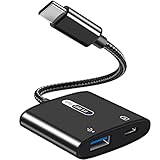
- [OTG Function and Charging]: This USB C OTG Adapter with Power features a USB C 60W Charging Port and a USBA 2.0 Female Port, allowing you to transfer data and charge your device simultaneously-all from a single USB-C output. Stay powered and data connected without compromise
- [USB On-The-Go(OTG) Connectivity & 480Mbps Transfer Speed]: Expand the functionality of your USB-C device. This OTG adapter instantly connects it to a wide range of USB-A peripherals-from usb flash drives and keyboards to mice and hubs-enabling super-speed data transfer at up to 480Mbps. Enjoy seamless compatibility with all devices that support USB OTG
- [Wide Compatibility]: This 2-in-1 USB-C to USB 2.0 OTG Adapter works with a wide range of USB-C devices, including: Smartphones--iPhone 17 series/16 series/15 series, Samsung Galaxy S25/25+/25 Ultra/S24/S24+/S24 Ultra/S23/S23+/S23 Ultra/S23FE/S10/S9, Google Pixel 9/8/7/6 and more. Tablets--iPad Pro, iPad Air 6/5/4, iPad 10, Samsung Galaxy Tab series. Laptops & More-- Surface Book/Book 2, Google Chromecast with Google TV, PixelBook, Raspberry Pi 4 and others. NOTE: Not compatible with Amazon Fire HD tablets
- [60W PD Fast Charging]: Experience powerful 60W Power Delivery(PD) charging for laptops/tablets/smartphones, alongside efficient Quick Charge(QC) support for phones and USB A peripherals-all while transferring data. Enjoy fast, stable power up to 20V/3A for all your latest USB-C devices
- [Premium Material]: Crafted with a flexible TPE casing and sturdy shell, this OTG adapter is both durable and lightweight. Feature corrosion-resistant gold-plated connectors for enhanced signal stability and longevity, its compact, integrated design weighs just 13g-perfect for effortless portability where you go
Connect an Android phone to a computer for file transfer
For a USB connection between an Android phone and a Windows computer, use a data-capable cable and unlock the phone.
Recommended Free Tools
- Connect the phone to the computer.
- Unlock the phone’s screen.
- Swipe down and tap the Charging this device via USB notification.
- Choose File Transfer.
- Open the phone in the computer’s file browser and copy files.
- In Windows, eject the phone from the system before unplugging the cable.
If the USB notification offers only charging, try another cable: not all USB cables transfer files. Also try another computer port and remove hubs while troubleshooting. Keep the phone unlocked while changing the USB mode so the permission control is visible.
Unlocking and wired-accessory security on iPhone
Apple generally requires an iPhone to be unlocked before it communicates with a USB or Thunderbolt accessory or a computer. Storage accessories always require unlocking before use. If an accessory is not recognized, disconnect it, unlock the phone and reconnect it.
On supported software, review Settings > Privacy & Security > Wired Accessories. The choices available can vary by connector and iPhone model. A restrictive setting can prevent a newly connected accessory from communicating until the phone is unlocked or permission is granted. This security behavior is separate from filesystem compatibility and cannot be fixed by buying a different connector alone.
Independent reader supportYour contribution helps us test, update, and keep practical guides available for everyone.Troubleshoot a USB accessory that is not recognized
The plug fits, but nothing happens
- Confirm that the phone supports the accessory’s specific function, not just its connector.
- Replace the adapter with one intended for data or OTG rather than charging-only use.
- Unlock the phone and reconnect.
- Test the accessory on a known-compatible device to separate a phone problem from a failed accessory.
- Remove extra hubs or adapters temporarily and test the shortest direct connection available.
Android does not show a USB drive
- Reconnect the drive and wait for the USB available notification.
- Open Files by Google and grant access when prompted.
- Verify Android 7.0 or later.
- Try a different OTG adapter, cable or drive.
- Check whether the drive works on a computer; a failed or unreadable drive will not become usable through OTG.
iPhone does not show external storage
- Unlock and reconnect the iPhone.
- Check that the drive has one data partition.
- Confirm that its filesystem is APFS, encrypted APFS, HFS+, exFAT, FAT32 or FAT.
- Use the correct Lightning or USB-C adapter.
- Supply additional power if the device is a hard disk or another high-draw accessory.
- Look in Files under Browse and Locations, rather than expecting a separate home-screen icon.
A hard drive repeatedly disconnects
Intermittent mounting usually indicates insufficient power, a poor cable or a failing drive. Use the drive’s own power supply, a powered USB hub with a USB-C iPhone, or the powered Lightning to USB 3 Camera Adapter with a Lightning iPhone. Replace the cable and test the disk on another device before trusting it with important data.
Free tools Windows power users keep installed
One-click scans. No signup required.
The cable charges but will not transfer data
Replace it with a known data cable. Apple’s included USB-C cable is limited to USB 2 speeds, while USB 3 accessories require a USB 3-capable cable. On Android, select File Transfer in the USB notification instead of leaving the connection in charging mode.
Best Value

- 【High-Speed Transfer】The upgraded USB-C to USB 3.0 adapter enables high-speed data transfer, allowing you to transfer 5GB of data in seconds. It can also charge your phone (USB-C to USB-A).
- 【Durable and Stylish】Made of premium scratch-resistant aluminum, the adapter complements USB-C devices well and withstands daily use. It features two mini LED indicators to show successful connections.
- 【Universal Compatibility】Just plug it in to convert most male USB-C ports into female USB-A ports. It's compatible with various USB-C devices such as external drives, laptops, tablets, USB storage, hard drives, data cables, card readers, microphones, etc.(NOTE: When reading external data through this adapter, ensure that the connected USB storage device is functioning properly and that the cable used supports the USB 3.0.This adapter does not support audio or video functions, nor does it support in-vehicle data transfer.)
- 【Compact and Easy to Use】It’s plug-and-play; no drivers are needed. Its compact, lightweight design makes it highly portable. You can also sync or charge your phone with this USB-C to USB adapter.
- 【Superior Connectors】The male USB-C to female USB-A 3.0 connectors are highly durable, lasting up to 10,000 plug-and-unplug cycles.
Choose the right adapter or hub
| Your situation | Typical solution | Important limitation |
|---|---|---|
| USB-A accessory with a USB-C phone | USB-C OTG adapter or USB-C hub | Connector conversion does not guarantee protocol support or adequate power. |
| Lightning accessory with a USB-C iPhone | USB-C to Lightning Adapter | Check the accessory’s power, data and audio compatibility. |
| USB-A storage with a Lightning iPhone | Lightning to USB Camera Adapter or Lightning to USB 3 Camera Adapter | High-power drives may need the USB 3 adapter connected to a power adapter. |
| Unpowered hard drive with a USB-C iPhone | Powered USB hub | The hub must support the drive and the iPhone’s required data mode. |
| USB-C digital earbuds | Direct USB-C connection or a digital-audio adapter | The phone must support USB-C digital audio; call support can vary. |
| USB 3 storage on iPhone | USB 3-capable cable and compatible port or adapter | A USB 2 cable reduces the connection to USB 2 speeds. |
A reliable connection routine
- Read the phone and accessory specifications for the required port and function.
- Match the connectors with a direct cable or an OTG, Lightning or USB-C adapter.
- Use a data-rated cable when storage, audio or file transfer is involved.
- Connect the accessory while the phone is unlocked.
- Accept Android’s USB-storage permission or select the appropriate USB mode on a computer.
- For iPhone storage, check Files, the filesystem and the one-partition requirement.
- Add powered hardware when a hard drive or hub cannot stay connected.
- Eject or unmount storage before removal whenever the operating system offers that control.
Frequently Asked Questions
Do I need an OTG adapter for my phone?
You need one when the phone has USB-C and the accessory has USB-A, unless the accessory already includes a USB-C plug. Choose an adapter intended for data or OTG; a charging-only adapter may not work. The phone must still support the accessory’s function.
Why does my phone charge a USB device but not recognize it?
Charging proves only that power is passing through. Try a data-capable cable or OTG adapter, unlock the phone, and confirm that the phone supports the accessory’s protocol. On Android, select File Transfer for a computer connection; on iPhone, check Files, the drive format and partition layout.
How do I connect a USB drive to an Android phone?
Connect a USB-C drive directly or attach a USB-A drive through a USB-C OTG adapter. On Android 7.0 or later, tap the USB available notification, open Files by Google, select the drive and tap Allow.
How do I connect a USB drive to an iPhone?
Use a direct USB-C connection on a compatible USB-C iPhone, or the appropriate Lightning camera adapter on an older iPhone. Unlock the phone, open Files and look under Locations. The drive needs one data partition and a supported format such as exFAT, FAT32, FAT, APFS or HFS+.
Why will my external hard drive not stay connected to an iPhone?
The drive may need more power than the phone can supply. Use its own power supply, a powered USB hub with a USB-C iPhone, or a Lightning to USB 3 Camera Adapter connected to a USB power adapter on a Lightning iPhone.
Will every USB-C headset work with an Android phone or iPhone?
No. USB-C earbuds need digital-audio support, and call or microphone support can vary. Check the phone specifications and the headset documentation instead of relying on the connector shape.
What speed will a USB accessory reach?
The slowest phone port, adapter, cable, hub or accessory determines the practical speed. Apple’s included USB-C cable supports USB 2 speeds; listed iPhone Pro models can reach up to 10 Gbit/s with an optional compliant USB 3 cable.
Windows Errors? Fix Them Before They Spread
Repair common Windows errors and clear accumulated junk for a smoother, more stable PC - no reinstall needed.Free scan · no reinstallCrashes, No Sound, or Screen Glitches?
Random freezes, missing sound and display glitches usually trace back to one bad driver. Find and replace yours safely.Free scan · under a minuteWhy must I unlock an iPhone before using a USB accessory?
Apple generally blocks communication with USB or Thunderbolt accessories until the iPhone is unlocked, and storage accessories always require unlocking. If needed, review Settings > Privacy & Security > Wired Accessories.
The Bottom Line
Match the phone port, accessory plug, supported function, cable data rating and power needs before connecting. Use an OTG adapter for USB-A accessories on USB-C Android phones, the appropriate Lightning or USB-C storage adapter on iPhone, and unlock the phone before granting access. If storage fails, check Android’s permission workflow or the iPhone’s one-partition and filesystem requirements; if a hard drive drops out, add power.
Quick Recap
Product prices and availability are accurate as of the date/time indicated and are subject to change. Any price and availability information displayed on Amazon at the time of purchase will apply.

