AI-generated network changes should be treated as proposals, not authorization. Put every proposal through configuration change control: limit what the agent can see and do, compare its intended state with an approved baseline, run deterministic policy and security checks, test before production, obtain the approval required for the change risk, and block execution until that approval is recorded. Then capture the proposal, decision, implementation result, and observed outcome in an audit trail, with a recovery procedure suited to the actual devices and topology.
This design follows the intent of NIST configuration-management and DevSecOps guidance while leaving risk thresholds and tooling to each organization. A guardrail can constrain an agent’s behavior, but it is not a substitute for authorization enforced at the execution boundary.
As an Amazon Associate I earn from qualifying purchases.
What guardrails and approval workflows do
An AI network agent can suggest an access-list edit, route change, firewall rule, load-balancer setting, or switch configuration in seconds. Speed does not make the suggestion safe or authorized. A useful design separates four decisions that are often incorrectly collapsed into one:
- Scope: Which configuration items, environments, accounts, and operating windows may the agent affect?
- Validity: Does the proposed state satisfy syntax, dependency, security, and policy checks?
- Authorization: Has the accountable person or group approved this exact proposal?
- Execution and outcome: Was the approved change applied through a restricted interface, and did the network reach the intended state?
Guardrails are controls around the agent and its tools. They can constrain prompts, data access, destinations, commands, and operating conditions. Approval workflow is the controlled path that turns a reviewed proposal into an authorized change. The execution gateway must enforce that path; merely displaying an approval button in a user interface is not a control if the agent can call a device API directly.
#1 Best Overall

- SonicWall TZ270W Appliance Only - No Service Subscription (02-SSC-2823) - Combines enterprise-grade firewalling with integrated 802.11ac Wave 2 Wi-Fi to deliver secure wired and wireless connectivity in one compact device for small offices and clinics.
- Blocks zero-day threats and ransomware with Capture ATP sandboxing enhanced by RTDMI, plus IPS and anti-malware scanning for layered protection.
- Eliminates the need for separate access points in smaller spaces thanks to built-in high-speed wireless that is simple to deploy and manage.
- Supports VPN, SD-WAN, and TLS 1.3 decryption to secure hybrid cloud access and remote workers while maintaining usability and performance.
- Delivers gigabit performance with up to 750,000 concurrent connections to handle growth in users, devices, and SaaS applications.
Start with configuration change control
NIST’s configuration-management guidance treats firewalls, routers, gateways, switches, and other network components as configuration items. Before enabling an agent, document what is controlled, how security impact is assessed, who may initiate and approve changes, and how activity is monitored. The framework is a baseline, not a universal policy, so map it to your organization’s regulatory, availability, and operational requirements.
Define controlled items and boundaries
- Inventory device classes, controllers, cloud networking objects, and configuration repositories.
- Identify production, staging, laboratory, and out-of-band management environments.
- Specify which attributes are in scope, such as interface state, routing, address objects, security rules, quality-of-service, and authentication settings.
- Exclude safety-critical or unsupported operations until a separate control design exists.
- Record dependencies, maintenance windows, and communication requirements for each class of change.
Assign ownership and identities
Give the agent a distinct identity and least-privilege credentials. Define the initiating identity, technical reviewer, business or service owner, and final approver. The identity that proposes a change should not automatically be able to approve and execute it. Use workflow automation, logical access controls, and change windows to restrict the path, as suggested by NIST configuration-management guidance.
A reference architecture for safe AI changes
A practical implementation has separate components, even if one platform hosts several of them:
- Agent and context layer: Reads approved inventories, baselines, topology data, and runbooks. It cannot write to devices.
- Proposal service: Converts the agent’s output into a versioned change record with a target state and validation plan.
- Policy and scope engine: Performs deterministic checks against authorization, prohibited targets, baseline rules, and local safety constraints.
- Validation environment: Runs syntax, dependency, security, and behavioral tests in a lab, simulator, or staged environment where feasible.
- Approval service: Routes the exact proposal and evidence to the designated approver, records the decision, and handles expiry and escalation.
- Execution gateway: Accepts only an approved proposal identifier, uses a restricted automation identity, and records the actual commands or API operations.
- Observation and evidence layer: Captures implementation status, telemetry, drift, alerts, notifications, and recovery actions.
NIST’s DevSecOps model states that AI-generated outputs should pass established peer review, security validation, testing, and approval. It also says AI-generated corrective actions should not modify software, configurations, or system state without review and approval through established DevSecOps processes. Human experts remain responsible for governance, approval, and mission outcomes; AI can accelerate analysis and execution inside those controls.
Step-by-step workflow
1. Establish scope, ownership, and escalation rules
Write a policy that answers, in operational terms, what the agent may propose and what it may execute. Include permitted targets, authorized initiating identities, approved interfaces, maintenance windows, mandatory approvers, and conditions that force escalation. Examples of escalation conditions include a production-wide route change, a rule that exposes a sensitive service, an identity or authentication change, a proposal that cannot be tested, or uncertainty about dependencies.
Keep these rules outside the model’s discretion. A prompt that says do no harm is not an enforceable restriction. The policy engine and execution gateway should reject requests that fall outside the recorded scope.
2. Require a structured, reviewable proposal
Do not let the agent submit arbitrary device commands as its change request. Require a structured record that is attributable and versioned. At minimum, capture:
- Unique change identifier and proposal version.
- Target devices, services, accounts, and environments.
- Current observed state and the approved baseline revision.
- Intended state, exact configuration objects, and dependencies.
- Business or operational rationale.
- Predicted impact, affected traffic, and blast radius.
- Policy checks to be run and their results.
- Test environment, test cases, and validation evidence.
- Implementation window, execution identity, and operator on call.
- Recovery method, prerequisites, and success criteria.
Hash or otherwise version the proposal and its evidence. If a material field changes after review, create a new version and invalidate the earlier approval.
3. Run deterministic policy and scope checks
Before a human sees an approval request, evaluate the proposal against machine-enforced rules. Check that every target is authorized, the requested operation is permitted for that device class, the change is within the maintenance window, required ownership fields are present, and the intended state does not violate security or segmentation policy. Compare the proposed configuration with the approved baseline and identify unexpected deletions, broadening of access, or dependency conflicts.
Reject or escalate proposals that exceed scope, fail validation, or cannot be assessed with adequate confidence. Do not rely on the model’s statement that an action is safe. NIST requires security-impact consideration, testing, validation, and controlled access, but does not mandate a particular policy-engine product.
Rank #2
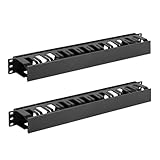
- Space-saving: This server rack cable management is made of plastic, lightweight,easy to assemble and disassemble,can save space and manage cables
- Muti-access: Rack mount cable management has 12 slots and 2 back accesses to organize and distinguish countless cables separately
- User-friendly Design: Removable Top Cover makes this 1u cable management easy to add or remove bundled cables
- Easy to use:This rack mount cable management is easy to install,with instructions or videos for reference;Accessories including 12-24 Cage nut and Screw×8,10-32 Screw×8,you can choose according to the actual installation
- Widely Applicable: Rack cable management is suitable for 19in wide AV/IT/Data/Audio racks and server cabinets in home office, studio and other workplaces
4. Validate before production
Run syntax and semantic checks first, then test behavior in a representative laboratory, simulator, or staged environment where the network permits it. Test cases should cover intended connectivity, denied connectivity, routing convergence, redundancy, logging, and interactions with dependent services. Record the test inputs, software or firmware versions, topology assumptions, results, and unresolved limitations.
What’s actually slowing this PC down?
Pick the symptom - the matching free tool is one click away.
NIST IR 8011 describes testing, validating, and documenting changes before operational implementation. Its concrete workflow examples come from software vulnerability management, so apply the mechanics to network changes without treating that publication as a network-specific standard. The DevSecOps reference model adds peer review and security validation for AI-generated outputs.
5. Route approval according to risk
Organizations should define their own tiers using local impact and risk analysis. The following model is an implementation example, not a universal NIST threshold:
| Tier | Typical characteristics | Required decision | Execution condition |
|---|---|---|---|
| Preapproved | Reversible, narrowly scoped, well-tested action on an approved target with no security-boundary change. | Recorded policy match; designated owner may review exceptions. | Automation may proceed only through the approved workflow and within the window. |
| Standard review | Change affects a service or segment, has measurable user impact, or introduces dependency risk. | Explicit technical or service-owner approval on the exact proposal. | Execution gateway verifies the approval identifier and unchanged proposal hash. |
| High impact | Broad routing, perimeter, identity, segmentation, or production availability consequences. | Explicit approval from the designated authority, with security and operations review as required. | Scheduled implementation, active monitoring, and confirmed recovery readiness. |
| Uncertain or exceptional | Novel action, incomplete evidence, failed tests, unsupported platform, or unclear blast radius. | Escalation; no implicit approval. | Blocked until the uncertainty is resolved and a new decision is recorded. |
Risk should reflect potential operational and security impact, reversibility and recovery time, confidence in preproduction validation, execution privileges, and uncertainty. NIST’s Generative AI Profile calls for human-AI oversight roles and risk-proportionate evaluation but does not prescribe universal thresholds.
6. Enforce the approval gate
NIST IR 8011 describes automated documentation, approval notifications, overdue-decision flags, blocking until designated approval, implementation records, and completion notifications. Implement those behaviors directly:
The Tool Desk
Outbyte PC Repair FREEClear out junk files and repair common Windows errorsFree Scan →Outbyte Driver Updater FREEScan for outdated or missing drivers - takes under a minuteDriver Scan →- Create an approval request that references the immutable proposal version and validation evidence.
- Notify the designated approver and start a documented decision timer.
- Record approve, reject, request-changes, and expire outcomes with identity and timestamp.
- Make the execution gateway query the approval service before every implementation.
- Compare the approved proposal hash with the proposal being executed.
- Block execution when approval is absent, expired, rejected, or associated with a different version.
- Escalate overdue decisions to a named backup; never treat a timeout as approval.
A user-interface status is not enough. The agent should receive an execution token or equivalent authorization only after the gate succeeds, and that token should be scoped to the approved targets, operations, and time window.
7. Execute narrowly and record the result
Use a restricted automation interface rather than broad administrator credentials. Limit the session to the approved objects and commands, and prevent the agent from substituting an unreviewed command when an operation fails. Capture the actual request, device response, start and end times, partial failures, and completion status. Notify the responsible staff when implementation starts and ends.
After execution, compare observed state with the intended state. A successful API response does not prove that traffic behavior, redundancy, or security policy is correct. Check telemetry, reachability, route tables, rule counters, error rates, and relevant alerts for the environment.
8. Monitor and recover
Define post-change observation windows and success criteria before approval. Watch for unexpected side effects and automatically alert the on-call team when thresholds are breached. Keep the approved configuration and the prior known-good state available to the recovery process.
Recovery must match the platform, topology, and failure modes. A rollback of an AI guardrail configuration is not necessarily a rollback of a changed firewall or router. The available guidance supports versioned guardrails and rollback as a general pattern, but it does not provide a universal device-level recovery recipe. Rehearse the actual procedure under controlled conditions, including loss of management access and partial application.
Rank #3

- What You Will Get: 20pcs of self adhesive hook and loop cable ties in black color, Each cable organizer is 1.13 x 3.55 in/2.88 x 9 cm, suitable to meet your various cable management on or under desk needs
- Strong Adhesive Backing: Designed with strong adhesive backing, they cord holders are easy to use. They can be firmly adhered and keep the cable tidy for a long time, which increases its reliability
- Reliable Quality: Made of premium nylon material, these cable straps have excellent insulation and wear resistant, which can support for a long time
- Reusable and Adjustable: You can adjust the adhesive appliance cord organizer according to your different cable management needs. Reusable and practical, help you to organize the messy cables and keep them neat and orderly
- Wide Application: These self-adhesive hook and loop cable ties for organizing cords suitable for home, office, computer room, kitchen, studio, game competition, workshop and so on
What the audit record should contain
Retain one linked record from proposal through outcome. A useful minimum schema is:
| Record area | Evidence to retain |
|---|---|
| Proposal | Agent identity, initiating user, prompt or task context where policy permits, proposal version, target, intended state, rationale, and baseline revision. |
| Policy | Rules evaluated, scope decision, security-impact result, exceptions, and policy-engine version. |
| Validation | Environment and topology assumptions, test cases, tool versions, outputs, reviewer comments, and unresolved limitations. |
| Approval | Required tier, approver identity, decision, timestamp, expiration, escalation history, and approved proposal hash. |
| Implementation | Execution identity, gateway authorization, actual commands or API operations, device responses, timestamps, and partial-failure details. |
| Outcome | Completion notification, observed state, monitoring data, incidents, recovery actions, and final disposition. |
Protect these records from alteration, restrict access to authorized staff, and retain them according to your security and compliance requirements. Monitoring change activity is part of NIST configuration-management guidance.
Choosing an approval model
Three broad patterns are common. Compare them using the same decision axes rather than choosing by convenience.
Do these 3 things before closing this tab:
1Scan for outdated or missing drivers - takes under a minute2Repair Windows errors before they cause bigger problems3Fix the driver behind crashes, sound loss and screen glitches| Model | Strength | Risk or cost | Best fit |
|---|---|---|---|
| Direct human approval | Clear accountability for each change. | Can delay routine work and overload reviewers. | High-impact, novel, or poorly reversible changes. |
| Preapproved automation | Fast and consistent for narrowly defined operations. | Can hide an overly broad rule if scope and tests are weak. | Repetitive, reversible actions with strong validation and fixed targets. |
| Risk-tiered approval | Balances speed with oversight by routing only consequential work to people. | Requires careful classification, policy maintenance, and escalation design. | Mixed environments with meaningful variation in blast radius. |
Evaluate each model against potential operational and security impact; reversibility and recovery time; confidence and completeness of preproduction validation; scope and privileges of the execution identity; reviewer workload and timeout behavior; and the quality of the audit trail. AWS guidance warns that routing every action to a human can create fatigue and rubber-stamping. That warning supports risk-proportionate review, not removal of review where consequences warrant it.
Independent reader supportYour contribution helps us test, update, and keep practical guides available for everyone.Keep AI guardrails separate from network policy enforcement
An agent guardrail may restrict tool calls, destinations, data handling, or conversational behavior. The network still needs enforceable authorization and policy checks at the point where a change would be applied. Treat the two as complementary controls:
- AI guardrail: Limits what the agent is allowed to propose or attempt.
- Change policy: Determines whether the proposed state is permitted for the target and environment.
- Approval gate: Determines whether the accountable authority has authorized this exact version.
- Execution control: Ensures only the approved operation can reach the device or controller.
Microsoft Foundry’s documented Network control governs a hosted agent’s outbound connections. It is an egress control for that hosted agent, not a general approval system for changes to routers or firewalls. Do not mistake network connectivity restrictions for change authorization.
Common failure modes and fixes
The agent can write directly to production
Cause: Broad credentials or a device API exposed as an unrestricted tool.
Free tools Windows power users keep installed
One-click scans. No signup required.
Fix: Remove direct write access, route proposals through the proposal service, and require a scoped execution token issued only after approval.
Approval covers a moving target
Cause: The agent edits the request after approval or resolves a failure with a different command.
Fix: Version and hash the proposal. Invalidate approval on any material change and require a new validation and decision.
Rank #4

- Compact and Efficient Design: The FortiGate 40F is designed for small to mid-sized businesses and enterprise branch offices, featuring a compact, fanless desktop form factor that ensures quiet operation and minimizes space usage.
- Robust Connectivity Options: Equipped with 5 GE RJ45 ports, including 1 WAN port and 4 internal ports, this model provides essential connectivity and flexibility for various network configurations in a small-scale environment.
- High-Performance Security: Offers up to 1 Gbps IPS throughput and 600 Mbps threat protection throughput, using Fortinet’s purpose-built security processor technology to deliver industry-leading performance and protection for SSL encrypted traffic.
- Advanced Threat Protection: Integrated with Fortinet’s AI-powered FortiGuard Labs, the FortiGate 40F offers comprehensive cybersecurity, identifying and mitigating both known and unknown threats to maintain robust security across your network.
- Simplified Management and Deployment: Features a user-friendly management console that provides comprehensive network automation and visibility, coupled with Zero Touch Integration with Fortinet’s Security Fabric for easy deployment.
Tests pass but production behavior fails
Cause: The lab did not represent topology, firmware, traffic, dependencies, or failure conditions.
Quick wins for a faster PC:
Repair Windows errors before they cause bigger problemsFix Now →Scan for outdated or missing drivers - takes under a minuteDriver Scan →Fix: Record test assumptions, improve representative staging, add negative and dependency tests, and require an explicit risk decision when representative testing is impossible.
Reviewers approve everything without reading
Cause: Every trivial action produces an interruption, or the request lacks concise impact evidence.
Fix: Use risk tiers, preapprove tightly bounded reversible actions, summarize blast radius and test results, and measure overdue and rubber-stamp indicators. Do not lower the tier merely to improve throughput.
A timeout silently becomes approval
Cause: Workflow defaults or an automation script interpret no response as consent.
Recommended Free Tools
Fix: Make timeout a blocked or escalated state. Require an explicit decision from the designated authority.
Rollback is theoretical
Cause: The plan names a previous configuration but does not account for management loss, stateful sessions, dependency order, or partial application.
Fix: Define device-specific recovery steps, prerequisites, access paths, verification checks, and ownership. Rehearse them under controlled conditions.
Operational checklist
- Every target and operation is in an inventoried scope.
- The agent uses a separate least-privilege identity and cannot bypass the workflow.
- The proposal states intended state, baseline, dependencies, impact, tests, and recovery.
- Deterministic policy checks run before approval.
- Validation evidence identifies its environment and limitations.
- Approval is tied to an immutable proposal version and expires appropriately.
- The execution gateway blocks missing, stale, rejected, or mismatched approvals.
- Timeouts escalate or block; they never approve silently.
- Actual implementation actions and device responses are recorded.
- Post-change observations compare intended and observed state.
- Recovery is platform-specific, tested, and available to the on-call team.
- Audit records and monitoring data are protected and retained.
How to improve the workflow over time
Review completed changes for policy misses, unexpected impact, reviewer workload, and recovery performance. Tighten scopes when a control proves too broad, improve tests where production differs from staging, and revise risk tiers when local incident data changes the assessment. Keep guardrail and policy definitions versioned so an investigation can reconstruct which controls were active at the time.
Crashes, No Sound, or Screen Glitches?
Random freezes, missing sound and display glitches usually trace back to one bad driver. Find and replace yours safely.Free scan · under a minuteWindows Errors? Fix Them Before They Spread
Repair common Windows errors and clear accumulated junk for a smoother, more stable PC - no reinstall needed.Free scan · no reinstallThe objective is not to eliminate human judgment or to make every action manual. It is to make the agent’s authority explicit, evidence-based, proportionate to risk, and technically impossible to exceed.
Quick Recap
Product prices and availability are accurate as of the date/time indicated and are subject to change. Any price and availability information displayed on Amazon at the time of purchase will apply.

