The right walking shoe is the one that matches your foot’s length, width, toe-box shape and depth, then provides the hold and sole behaviour your usual route requires. Start with fit rather than the number printed on the tongue: sizes vary between brands and styles, and the larger foot determines the pair you should buy.
Try both shoes with your walking socks, preferably later in the day, and walk in them before committing. A comfortable shoe should not require a painful break-in period. City pavements, park paths, grass, hills and uneven trails can each justify a different level of structure, cushioning and weather protection.
As an Amazon Associate I earn from qualifying purchases.
What a properly fitted walking shoe should do
A walking shoe should hold your heel and midfoot securely while allowing your toes to spread and your foot to lengthen naturally as you walk. It should not pinch, rub, slip or force your toes to grip the shoe. The fit must be judged on both feet, because one is often slightly larger or shaped differently from the other.
Fit has four separate dimensions:
- Length: clearance in front of the longest toe, which may not be the big toe.
- Width: room across the ball of the foot and around the little-toe side.
- Toe-box shape and depth: an outline and vertical space that do not press on or crowd the toes.
- Volume and security: enough upper material for your foot and a fastening system that holds the heel and midfoot without pressure.
A longer shoe is not a reliable solution to a narrow width. It can let the foot slide forward, leaving the heel loose while the original pressure remains. Compare width and depth independently from length.
#1 Best Overall
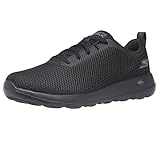
- MAXIMUM COMFORT AND SUPPORT: Advanced Goga Max cushioned insole technology provides superior comfort for running shoes for men, perfect for extended wear
- BREATHABLE DESIGN: Nearly seamless air mesh upper construction in these mens running shoes ensures optimal ventilation and comfort
- RESPONSIVE CUSHIONING: Lightweight 5GEN cushioning technology in midsole and outsole delivers enhanced response and support for sneakers for men
- EASY CARE MAINTENANCE: Machine washable design keeps your athletic shoes looking fresh with minimal effort
- FLEXIBLE PERFORMANCE: Flexible rubber outsole with 1.5-inch heel height provides reliable traction and stability for daily activities
The American Academy of Orthopaedic Surgeons (AAOS) advises leaving approximately 1/2 inch between the longest toe and the shoe tip. Guy’s and St Thomas’ NHS Foundation Trust describes about 1 cm as ideal clearance. These are practical rules of thumb, not a guarantee; the foot should have that space without sliding forward. See AAOS guidance on finding the right shoe fit and the trust’s shoe-pain guidance.
Assess your foot before you shop
Find the longest toe
Stand normally rather than sitting and identify the toe that reaches furthest forward. On some feet it is the second toe. Judge clearance from that toe to the end of the insole or upper, not automatically from the big toe.
Check the forefoot outline
Look at the widest part of your foot around the ball and little-toe joint. If your toes touch each other or the sides of a shoe, seek a broader or more foot-shaped toe box. A round or square front can provide useful room without adding unnecessary length.
Outdated Drivers Are Slowing You Down
One free scan finds every outdated or missing driver and matches the right update for your exact hardware.Free scan · exact hardware matchWindows Errors? Fix Them Before They Spread
Repair common Windows errors and clear accumulated junk for a smoother, more stable PC - no reinstall needed.Free scan · no reinstallConsider vertical space
Width and depth are different problems. Toes that press into the top of the upper, clawed toes, or a prominent joint may need extra vertical depth. A shoe can be wide enough across the sole yet still rub the top of the toes. If you use a prescribed insole, allow room for its thickness as well as your foot.
Rank #2

- Exceptional Cushioning: These women’s walking shoes are well-cushioned. The thick EVA midsole provides a cloud-like feel, absorbing shock and reducing impact on joints, making these women’s sports shoes ideal for daily walks and workouts.
- Breathable & Lightweight: No more sweaty feet and discomfort after long walks. The mesh upper of these women’s running shoes allows for great airflow, keeping feet cool and dry even during intense activities.
- Confident & Stable: Designed for walking and running, these women’s workout shoes feature a slip-resistant rubber outsole that enhances traction and grip on wet pavements and gym floors.
- Stylish & Protective: These women’s gym shoes are comfortable for everyday wear but also perform well for training. The added 3M reflective strip on the upper enhances visibility during nighttime walks.
- For Everyday Activities: The minimalist design makes these women’s athletic sneakers easy to pair with workout clothes and casual outfits. Whether for walking, jogging, running errands, or gym workouts, these women’s trainers keep your feet feeling fresh and supported.
Notice heel and midfoot volume
A roomy forefoot is not helpful if the heel lifts on every step. Look for a shape that follows your heel and a closure that can adjust the midfoot. Laces provide incremental adjustment; hook-and-loop straps can be useful when bending to tie shoes is difficult.
Use this fitting sequence in a shop
- Go at the right time. Shop in the afternoon or early evening if your feet enlarge during the day. The Royal College of Podiatry notes that feet can expand by as much as half a shoe size. AAOS reports swelling of up to 8% over the day; that figure is an approximate guideline, not a reason to buy an oversized shoe. Read the college’s walking-footwear advice.
- Bring the socks you will actually walk in. Sock thickness changes the available width and depth. Wear the pair intended for your normal routes, including any moisture-wicking walking socks you routinely use.
- Try several constructions and sizes. Put on four or five pairs if possible, as the Royal College of Podiatry recommends, and compare each for a minute or two while walking. Include different brands and styles rather than assuming one label’s size will transfer to another.
- Put both shoes on and fasten them normally. Stand, walk, turn and use stairs if available. Do not judge a shoe while it is loose or only on one foot.
- Check the longest-toe gap. Aim for comfortable clearance of roughly 1/2 inch (AAOS) or about 1 cm (Guy’s and St Thomas’), without the foot sliding toward the front.
- Check the forefoot separately. Spread your toes and roll through a step. There should be no side pressure, seam rubbing or need to curl the toes to create space.
- Check depth and the upper. Move your toes up and down. The upper should not press on them, and an insole should not make the shoe tight across the instep.
- Test heel hold. Walk briskly and up a slope if the shop permits. Minor movement is normal, but repeated lifting, slipping or rubbing means the shape or fastening is wrong.
- Walk long enough to notice pressure. A shoe that feels fine for a few steps can reveal a hot spot after several minutes. Discomfort is information; do not assume it will disappear after a painful break-in.
The Australian Podiatry Association also recommends checking that footwear stays secure and protects the foot. Its footwear advice is useful when ordinary sizing does not explain pressure or instability.
Compare the features that affect comfort
| Feature | What to check | Why it matters |
|---|---|---|
| Length | Clearance from the longest toe; no forward sliding | Protects toes while allowing the foot to lengthen during walking |
| Width and toe shape | Room across the ball; round, square or foot-shaped front that does not squeeze | Reduces side pressure and crowding |
| Depth | Vertical room for toes, prominent joints and any prescribed insole | Prevents rubbing on the top of the toes or instep |
| Closure and heel hold | Laces or straps that secure the midfoot and heel without pinching | Stops the foot sliding and avoids toe gripping |
| Sole and flex | Stable through the arch, with flex near the ball of the foot | Supports a natural roll-through without an overly floppy middle |
| Routine and terrain | Construction suited to pavements, paths, grass, hills or uneven trails | Matches traction, protection and structure to where you walk |
| Comfort | No pinching, rubbing, slipping or painful break-in | Immediate comfort is a better buying signal than a size label |
These checks reflect recommendations from the AAOS, the Royal College of Podiatry and Guy’s and St Thomas’ NHS Foundation Trust’s athletic-footwear guidance.
Choose by foot shape
Wide forefoot or toes crowded at the sides
Compare wide widths and broader toe-box outlines. Inspect the sole as well as the upper: a wide-looking fabric upper cannot compensate if the outsole tapers sharply under the little toe. Keep the correct length; adding length to gain width can create heel movement.
Rank #3

- ABZORB HEEL CUSHIONING - ABZORB heel crash pad absorbs impact on every step, paired with a molded PU insert for underfoot comfort that lasts from morning to night
- SUEDE LEATHER UPPER - Sturdy suede upper provides supportive structure and a classic look that breaks in nicely over time for a personalized fit
- DUAL DENSITY COLLAR - Dual density collar foam supports the ankle and helps maintain stability during workouts, walks, and all-day wear
- PHANTOM LINER INTERIOR - Phantom Liner construction features minimal interior seaming to reduce irritation and create a smooth, comfortable fit against the foot
- LIGHTWEIGHT EVA FOAM - EVA foam midsole with an internal shank adds lightweight cushioning and midfoot stability for versatile daily comfort
Toes pressing on the top
Prioritise depth. A wider size may leave the top pressure unchanged, while a deeper model can accommodate the toes and an insole. Check that the tongue and lacing do not create a hard pressure line over the instep.
Narrow heel with a fuller forefoot
Look for a shoe whose heel counter follows your heel and whose laces or straps can tighten the midfoot independently of the forefoot. If tightening makes the forefoot painful, the shoe’s shape is mismatched rather than simply insufficiently fastened.
Flat feet or pronation concerns
Some athletic shoes include pronation-control features, but there is no universal arch category that prescribes one shoe for everyone. Guy’s and St Thomas’ NHS Foundation Trust notes that athletic-shoe selection can be complicated and recommends footwear suitable for most people, with orthoses used when needed. Choose the shoe that is comfortable, secure and appropriate to your activity; ask a clinician to assess persistent symptoms instead of trying to correct gait from an arch label alone.
Free tools Windows power users keep installed
One-click scans. No signup required.
High-volume feet or swelling
Prioritise adjustable closures and sufficient depth. Fit at the time of day when your feet are largest, and leave enough room for the socks you will wear. A shoe that is comfortable only early in the morning is not a successful all-day fit.
Rank #4

- ABZORB HEEL CUSHIONING - IMEVA midsole with ABZORB heel pad absorbs impact and provides added cushioning for all-day comfort during training and everyday wear
- SUEDE LEATHER UPPER - Quality suede upper delivers a classic, durable look with supportive structure that molds comfortably to your foot over time
- LACE-UP CLOSURE - Traditional lace-up design allows you to adjust the fit for maximum comfort and a secure feel during workouts and daily activities
- CUSHIONED FOOTBED - Lightly cushioned footbed provides an extra layer of soft comfort underfoot, keeping you supported through long days on your feet
- DURABLE OUTSOLE - Sturdy outsole construction offers reliable traction and long-lasting durability on gym floors, sidewalks, and everyday surfaces
Match the shoe to your daily routine
| Where and how you walk | Useful characteristics |
|---|---|
| City streets and paved paths | Stable trainers with cushioning you find comfortable, a secure heel and a sole that flexes at the ball |
| Grass, parkland and mixed paths | More protection and structure than a minimal street shoe, with traction suited to changing surfaces |
| Uneven trails and hills | A stiffer, more structured walking shoe or boot; tread and upper protection become more important |
| Wet or exposed routes | Weather-resistant construction when useful, balanced against the breathability you need |
Trainers are generally suitable for urban walking and ordinary paths. Uneven trails, grass and hills can justify a stiffer, more structured shoe or boot. Waterproofing may help in wet conditions, while breathable materials can be preferable in warm weather; neither feature fixes an incorrect fit.
Match the shoe to your real routine rather than an occasional adventure. If most of your steps are on pavement but you sometimes visit a trail, a comfortable city shoe may be the sensible daily pair, with more structured footwear reserved for the rougher route.
Independent reader supportYour contribution helps us test, update, and keep practical guides available for everyone.Understand sole flex, cushioning and structure
Flex at the right place
Guidance from Guy’s and St Thomas’ NHS Foundation Trust says athletic footwear should resist bending through the arch and flex at the ball of the foot. Hold the shoe and test it: it should not fold easily in the middle, yet it should bend where your toes naturally push off. This is a functional check, not a ranking of one sole design over another.
Quick wins for a faster PC:
Fix the driver behind crashes, sound loss and screen glitchesFind Drivers →Clear out junk files and repair common Windows errorsFree Scan →Scan for outdated or missing drivers - takes under a minuteDriver Scan →Use cushioning as a comfort decision
Cushioning changes how a shoe feels on hard surfaces, but the available evidence here does not establish that a particular cushioning amount prevents injury for every walker. Choose the level that feels stable and comfortable for your distance and surface, then verify that added foam has not reduced heel hold or usable toe room.
Best Value

- HANDS-FREE CONVENIENCE: Step in and go with these innovative mens slip on shoes featuring Heel Pillow technology for secure fit and easy entry
- SUPERIOR COMFORT: Air-Cooled Memory Foam insole and ULTRA GO cushioning deliver responsive comfort for slip on sneakers men will love
- BREATHABLE DESIGN: Lightweight mesh upper with subtle sheen finish provides ventilation and style for these mens slip on sneakers
- FLEXIBLE PERFORMANCE: Multi-surface traction with Flex Pillars offers stability and flexibility for various activities
- EASY CARE: Machine washable design keeps your slip on shoes for men looking fresh with minimal maintenance
Balance structure with natural movement
A trail-oriented shoe can protect against uneven ground but may feel unnecessarily stiff on smooth pavements. Conversely, a very flexible trainer may offer little protection on rocks, roots or steep grass. Let the route determine the compromise.
When a medical condition changes the fitting rules
Arthritis, deformity, diabetes, reduced sensation, circulation problems and prescribed orthoses can change what counts as a safe fit. Extra width or depth may be necessary, and a shoe that feels acceptable may still create unnoticed pressure when sensation is reduced.
- Seek a podiatrist or foot-care professional if ordinary shoes cannot accommodate your foot shape.
- Arrange individual advice for persistent pain, rubbing, pressure marks, blisters or skin damage.
- Do not ignore a new wound, colour change, swelling or loss of sensation, particularly with diabetes or circulation problems.
- Take prescribed orthoses to the fitting and test them inside the shoe; the insole must not lift your foot into the upper.
Footwear can support comfort and protection, but it is not a guaranteed treatment for pain or a substitute for assessment. The Australian Podiatry Association’s guidance and the NHS trust’s advice for reducing foot pain both emphasise individual fit.
What’s actually slowing this PC down?
Pick the symptom - the matching free tool is one click away.
Buying online without losing the fit test
- Measure or trace both feet while standing, but treat the result as a starting point because printed size charts differ.
- Read the specific model’s width, depth and insole information where supplied; do not assume a brand’s standard width applies to every style.
- Order the size that accommodates the larger foot and use the socks and orthoses planned for walking.
- Walk indoors on a clean floor soon after delivery. Check toe clearance, forefoot pressure, depth, heel hold and flex before removing tags or exposing the sole.
- Keep the packaging and follow the retailer’s return conditions. A return window is useful only if you test the shoes indoors first.
Online fitting cannot replace walking in both shoes. If the heel slips, the toes press, or a seam creates a hot spot, return the pair rather than hoping a painful fit will break in.
Troubleshoot common fit problems
| Symptom | Likely mismatch | What to try |
|---|---|---|
| Toes hit the front on descents | Insufficient length or poor heel hold | Recheck longest-toe clearance and fastening; do not simply size up if the heel already slips |
| Little toe is squeezed | Outsole or toe box too narrow | Compare a broader outline or wide width at the same usable length |
| Toes rub the upper | Insufficient depth | Try a deeper toe box and check insole thickness |
| Heel lifts | Heel shape or closure does not match your foot | Try another last, adjust laces or straps, and walk on an incline |
| Arch or midfoot feels unstable | Shoe bends through the middle or lacks secure fastening | Test a shoe that resists arch bending and holds the midfoot without pressure |
| Hot spot or blister appears | Rubbing, seam pressure, moisture or movement | Stop using the pair, reassess fit and socks, and do not rely on break-in |
A final pre-purchase checklist
- Did you try both shoes with your actual walking socks?
- Did you shop when your feet are likely to be largest?
- Is there comfortable space in front of the longest toe without sliding?
- Are width and toe-box shape adequate across the ball and little-toe side?
- Is there enough vertical depth for your toes, joints and insole?
- Does the fastening secure the heel and midfoot without pinching?
- Does the shoe resist bending at the arch and flex at the ball?
- Is the sole and upper appropriate for your regular surface and weather?
- Can you walk indoors without rubbing, pressure or toe gripping?
- Do a foot condition, reduced sensation or orthosis require professional fitting?
The practical choice is the pair that passes every one of these checks for your actual routes. Labels such as “walking,” “wide” or “support” are starting points; your foot’s shape, your fastening adjustment and the surfaces you cover determine whether the shoe works.
Quick Recap
Product prices and availability are accurate as of the date/time indicated and are subject to change. Any price and availability information displayed on Amazon at the time of purchase will apply.

