Choose a cloud GPU by starting with the workload—not the provider’s family name. Define whether you are training, fine-tuning or serving a model; estimate weight, optimizer, activation and KV-cache memory; set latency or throughput targets; then select an exact GPU model and count that fit those constraints. Compare the complete host (vCPUs, system RAM, storage, network and interconnect), verify regional capacity and software compatibility, and calculate total cost. A GPU-hour price by itself is not a buying decision.
What you are actually buying
A cloud GPU instance combines an accelerator with a virtual machine and a data path. The accelerator performs tensor and graphics operations, while host CPUs feed it data, system memory holds input pipelines and checkpoints, storage supplies datasets, and networking connects distributed workers or remote storage. Two instances advertised under similar family names can therefore behave very differently.
As an Amazon Associate I earn from qualifying purchases.
Cloud providers publish families as a starting point, not as a universal performance ladder. Confirm the exact GPU generation, memory per GPU, number of GPUs, host memory, vCPU allocation, local SSD, network bandwidth and interconnect for the machine size you intend to rent. A single-GPU inference server and an eight-GPU training node have different bottlenecks even when their family labels look related.
Step 1: Write a workload specification before comparing machines
Record these values for the job you need to run. If a value is unknown, measure a small representative workload before committing to a long reservation.
#1 Best Overall

- 【Up Link & Down Link】Up link: Oculink 4i(PCIE4.0x4), Down Link: PCIEx16(PCIE4.0x4). Only Support Oculink.
- 【Power Supply】This DEG1 supports ATX and SFX standard power supplies, which provides flexible power supply solutions for mini chassis.
- 【Oculink Interfaces】Please kindly note the OCulink interface does not support hot plugging, and the machine needs to be turned off first.
- 【Follow-start Function】The follow-start function is only compatible with MINISFORUM Mini PCs, it requires the use of original wires.
- Note: The GPU is not included.
- Phase: pre-training, fine-tuning, batch inference, interactive inference, rendering, simulation or another accelerated task.
- Model and data: parameter count, sequence or image size, batch size, number of simultaneous requests and dataset size.
- Precision: FP32, FP16, BF16, INT8, 4-bit or mixed precision.
- Service target: maximum response latency, tokens or samples per second, daily volume and acceptable queue time.
- Scale: one GPU, several GPUs in one host, or multiple hosts.
- Reliability: whether a job can restart from a checkpoint, and how much interruption is acceptable.
- Software: framework, CUDA and driver requirements, container runtime, orchestration and any enterprise AI software license.
This profile prevents a common error: choosing the largest available accelerator for a small model whose real limit is CPU preprocessing, storage throughput or an application with low utilization.
Training and fine-tuning
Training needs memory for weights, gradients, optimizer state and activations. Distributed training also needs fast GPU-to-GPU and host-to-host communication. A configuration that runs inference comfortably may fail during training because optimizer and activation memory are substantially larger.
Inference and serving
Inference sizing is driven by model weights, the key-value cache for active sequences, batch size and latency target. A single GPU can be preferable when it meets the target: it avoids communication overhead and simplifies operations. Throughput-oriented services may batch requests across multiple GPUs, but that trade-off must be measured against latency.
The Tool Desk
Outbyte Driver Updater FREEFix the driver behind crashes, sound loss and screen glitchesFind Drivers →Outbyte PC Repair FREERepair Windows errors before they cause bigger problemsFix Now →Rendering, simulation and video
Graphics-intensive work can favor a workstation-class or graphics-optimized family rather than a training-focused accelerator. Google Cloud positions its G4 series, using RTX PRO 6000 Blackwell Server Edition GPUs, for graphics, simulation, video transcoding, virtual desktops and some single-host inference and tuning workloads. That positioning is a use-case guide, not a claim that G4 is faster for every AI model.
Step 2: Estimate GPU memory instead of guessing
GPU memory is usually the first hard limit. Start with a conservative model of what must remain resident:
- Weights: parameter count multiplied by bytes per parameter (approximately 4 for FP32, 2 for FP16 or BF16, 1 for INT8 and about 0.5 for 4-bit weights, before metadata and packing overhead).
- Gradients: required for training and often stored at the training precision or a separate precision.
- Optimizer state: methods such as Adam keep additional moment estimates, so training memory can be several times the weight footprint.
- Activations: affected by sequence length, image resolution, batch size and model architecture; activation checkpointing can trade compute for memory.
- KV cache: important for transformer inference and grows with context length and concurrent sequences.
- Runtime overhead: CUDA allocations, kernels, communication buffers and framework fragmentation.
Leave headroom rather than selecting a card that is exactly equal to the arithmetic estimate. Quantization, offloading and sharding can reduce GPU demand, but they add complexity and may change latency. Measure peak allocated memory during a representative batch, then choose a machine with operational margin.
Rank #2

- Package Include: OCuLink SFF-8612 Female to PCIe x16 Enclosure Dock, and SFF-8611 Male to Male Cable 50cm/19.7inch (Note: The GPU and Power Supply are not included)
- Advantage of the dock: Our enclosue detachable design on both ends for improved portability and easy storage. PCB board with 10μ gold-plated contacts ensure superior conductivity and reduce oxidation/rust-related resistance that may cause system crashes or BSOD. Multi-status LED indicators provide clear visual feedback for real-time device monitoring. Transfer Speed: PCIe 4.0 x4 (64Gbps )
- SFF-8611 Male to Male Cable: Ultra-thin & flexible design (0.5mm thickness) with premium aesthetics, eliminating port damage risks from rigid traditional OCuLink cables. Flat cable architecture with full-coverage shielding and advanced EMI materials to minimize interference and performance degradation
- Compatible Graphics Cards: Compatible with graphics cards of various sizes like RTX 4090, AMD RX 7900 XTX etc., no need to worry about graphics card length restrictions. 🔺Compatible Power Supply: Compatible with standard ATX power supply ONLY, dual screw mounting (top & bottom) for PSU stability
- Note: The OCulink interface does not support hot plugging, and the computer needs to be turned off to unplug the cable.
When one GPU is enough
Use one GPU when the model and target batch fit in memory, the required throughput is met, and the input pipeline can keep the device busy. Single-GPU deployments usually have the simplest checkpointing, scheduling and failure recovery.
When to use multiple GPUs
Use multiple GPUs when memory cannot fit on one device, when measured throughput justifies data parallelism, or when a training framework requires tensor or pipeline parallelism. Check whether the GPUs share a host and what interconnect is provided. Splitting a job across hosts introduces network synchronization and can erase the benefit of additional accelerators if bandwidth or latency is insufficient.
Step 3: Match the workload to provider families
Provider guidance is useful for creating a shortlist, but it is not an independent ranking. Confirm the exact machine configuration and test your code.
| Workload need | Documented starting point | How to interpret it |
|---|---|---|
| Generative or complex model training | Azure ND family; NC as an alternative | Azure describes ND as its preferred infrastructure family for these training classes. Compare actual GPU memory, count and interconnect for the selected size. |
| Generative or complex inference | Azure NC or ND families | Choose between single-host simplicity and larger configurations based on latency and throughput measurements. |
| Small models | Azure CPU families may be sufficient | Do not pay for a GPU when CPU inference meets the target. |
| Large-scale training or serving | Google Cloud A3 with H100 options | A3 sizes range from one to eight GPUs. Networking capacity differs by size, so record it with the GPU count. |
| Fine-tuning and inference | Google Cloud A2 with A100 GPUs | Validate memory and framework support for your exact A2 shape. |
| Graphics, simulation, transcoding and virtual desktops | Google Cloud G4 with RTX PRO 6000 Blackwell Server Edition | Its published positioning emphasizes graphics-heavy and some single-host AI workloads. |
| Latest accelerated AWS instances | P6 and P5 families | Use the current instance specification pages to verify GPU model, memory, networking, capacity and price before comparing. |
Google Cloud’s current accelerator-optimized documentation also lists A4X Max, A4X and A4 alongside A3, A2, G4 and G2. Availability, bundled resources and consumption options differ by series; family names alone do not establish equivalent performance.
Step 4: Compare the host and data path
For each candidate, create a row in a comparison sheet with the following fields:
| Category | Record | Why it matters |
|---|---|---|
| Accelerator | Exact model and generation; memory per GPU; GPU count | Determines fit, parallelism and likely software support. |
| CPU and RAM | vCPU count, architecture and system memory | Feeds data loaders, tokenization, preprocessing and orchestration. |
| Storage | Local SSD, attached volume type, capacity and throughput | Controls dataset staging, checkpoint time and restart speed. |
| Networking | Advertised bandwidth, intra-host interconnect and cross-host topology | Synchronization and remote data access can dominate distributed jobs. |
| Placement | Region, zone and whether all GPUs are on one host | Affects latency to data, availability and multi-host design. |
| Operations | Images, drivers, orchestration, monitoring and support | Reduces setup time and prevents incompatible software stacks. |
Google’s A3 H100 sizes illustrate the point: configurations run from one to eight GPUs and have materially different stated networking capacities. Record those differences instead of treating “A3” as one specification.
Rank #3
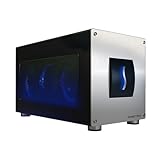
- Astounding Performance: Unlock near-desktop GPU power with your Thunderbolt 5 Windows 11 laptop. Breakaway Box 850 T5 delivers 80 Gbps of bi-directional bandwidth, ensuring blazing-fast performance for GPU-accelerated workflows. Accelerates Thunderbolt 4 and Most USB4 Windows 11 Computers, too. Intel Thunderbolt Certified.
- Supports Triple Wide GPU Cards NVIDIA GeForce RX50, 40, and 30 Series; AMD Radeon RX 9000, 7000, and 6000 Series.
- 850W power supply supports the power requirements of today’s and tomorrow’s power-hungry GPU cards. And large built-in, variable-speed, temperature-controlled fan quietly and effectively cools whatever card you install.
- Editing, rendering, color grading, animation, and visual effects run significantly faster with GPU acceleration. And Supercharge AI-driven applications with massively increased processing power and efficiency.
- Built-in Thunderbolt 5 Dock for Additional Connectivity Includes one Thunderbolt 5 peripheral port, three 10 Gbps USB Type A ports, plus a 5 Gigabit Ethernet (RJ45) port for super-fast wired network connectivity.
Step 5: Verify images, drivers and framework compatibility
A theoretically suitable GPU can be unusable if the image and driver stack do not support your framework. Pin the CUDA, cuDNN, driver and framework versions in your environment, and test the same container or lockfile on the intended machine.
Preconfigured image paths
- AWS: its Deep Learning AMI is documented as the simplest starting point for current GPU instances. Confirm the image’s included framework and driver versions before production use.
- Azure: GPU-enabled Data Science Virtual Machine images include common tools, NVIDIA drivers, CUDA Toolkit and cuDNN. Verify that the image version matches your project requirements.
NVIDIA AI Enterprise supports deployment across multiple clouds, but a standard GPU instance does not necessarily include that license. Check the supported configuration and current licensing terms before adding it to a production design.
Step 6: Check region, quota and capacity before designing around a GPU
GPU availability is regional and zonal. Google Cloud states that GPU prices vary by region and that devices are available only in some zones. Specific machine families can require reservations or alternate provisioning paths.
PC Slower Than It Used to Be?
A free scan shows the junk files, broken settings and background clutter dragging Windows down - then fixes them in one click.Free scan · Windows 10 & 11Crashes, No Sound, or Screen Glitches?
Random freezes, missing sound and display glitches usually trace back to one bad driver. Find and replace yours safely.Free scan · under a minute- Choose the region closest to your data and users, subject to compliance requirements.
- Check that the exact GPU and machine size are offered in the target zone.
- Request or verify GPU quota for the required count; approval does not guarantee capacity.
- Check reservation requirements and current on-demand capacity.
- Keep a second region, machine family or GPU generation as a fallback.
Do this before building a distributed topology. A design that depends on eight identical GPUs in one zone can be blocked by capacity even when smaller shapes are available elsewhere.
Step 7: Calculate total cost, not just GPU price
Cloud GPU billing normally combines the accelerator with the VM or machine type. Add storage, snapshots, network egress, image or software licenses, orchestration and idle time. Google Cloud’s pricing guidance explicitly says an attached GPU is added to the machine-type cost, and its GPU price list excludes disk, image, networking and VM instance charges.
Published Google Cloud examples
Google Cloud’s GPU pricing page listed the following figures in 2026. They are USD per GPU-hour examples, not a universal quote; recheck region, currency, machine configuration and current date before purchase.
Rank #4

- USB4 V2 (TBT5 compatible) and OCuLink Dual Mode: Dual-link interfaces support transfer speeds up to 80Gbps (TB5) and 64Gbps (OCuLink). A dedicated hardware switch allows for instant switching between all-in-one docking mode and pure GPU performance mode.
- Integrated M.2 NVMe Storage: A built-in M.2 2280 slot allows direct storage of AI models and project files on the dock. Maintains synchronized workspace and GPU performance when switching between different host devices.
- Universal Power and Graphics Card Compatibility: Supports standard ATX and SFX power supplies and is compatible with a variety of desktop graphics cards. Modular design ensures easy upgrades to power and computing power.
- Enhanced Signal Stability: Built-in re-drive signal booster stabilizes PCIe data transfer. Minimizes latency and connection interruptions during high-bandwidth tasks such as LLM inference or 8K rendering.
- Single-Cable Desktop Workflow: A single TB5 cable handles data transfer, display, and laptop charging. It features automatic power-on and can synchronize with the host computer, providing a seamless plug-and-play desktop experience.
| GPU | Displayed on-demand price per GPU-hour | Commitment pricing |
|---|---|---|
| T4 | $0.35 | One- and three-year prices were listed; amount depends on the page’s current region and term. |
| P4 | $0.60 | One- and three-year prices were listed; amount not stated here. |
| V100 | $2.48 | One- and three-year prices were listed; amount not stated here. |
| P100 | $1.46 | One- and three-year prices were listed; amount not stated here. |
Use the provider calculator to combine the GPU with the selected VM, storage and network. A cheaper GPU can cost more for the completed job if it takes longer, requires more instances, or causes expensive idle periods.
What’s actually slowing this PC down?
Pick the symptom - the matching free tool is one click away.
On-demand, commitments and interruptible capacity
- On-demand: simplest for experiments and uncertain usage, but usually the least discounted option.
- Committed use: can reduce rates when demand is predictable; verify the term, eligible machine types and regional constraints before signing.
- Spot or similar interruptible capacity: Google Cloud describes dynamic Spot prices and discounts of 60–91% off corresponding on-demand prices for most machine types and GPUs, while noting smaller discounts for some resources. Prices can change as often as every 30 days, and capacity is interruptible.
Google Cloud documentation describes a 30-second reclaim notice for Spot. Azure likewise warns that Spot capacity may be reclaimed at any time and recommends checkpointing for interruption-tolerant work. Use these options for fault-tolerant batch training, queued inference or other jobs that can resume; do not place an uncheckpointed, latency-critical service on reclaimable capacity.
Independent reader supportYour contribution helps us test, update, and keep practical guides available for everyone.Step 8: Benchmark the complete workload
After filtering by memory, availability and software, run the same representative workload on each finalist. Keep model version, input data, precision, batch size, software image and stopping criteria identical.
Record:
- Completed tokens, samples or frames per second.
- Time to a fixed training milestone or time to serve a fixed request set.
- Peak GPU memory and utilization, plus CPU, RAM, storage and network utilization.
- Startup and data-loading time.
- Total billed cost for the measured run, including non-GPU charges.
- Failure, retry and checkpoint recovery behavior.
No controlled cross-provider AI benchmark establishes that one provider or GPU is categorically faster or cheaper. Treat your measured workload as the decision evidence, and preserve the benchmark script so a price or software change can be retested.
Common buying mistakes and fixes
Choosing by family name
Symptom: an “A3,” “NC” or “P-series” label is treated as a performance guarantee.
Fix: compare exact GPU model, memory, count, host resources and interconnect.
Free tools Windows power users keep installed
One-click scans. No signup required.
Fitting weights but not training state
Symptom: inference works, but training fails with out-of-memory errors.
Fix: budget gradients, optimizer states, activations and runtime headroom; then test the real batch and sequence length.
Best Value

- Compatibility: Compatible with most NVIDIA/AMD graphics cards up to ≤205mm (≤8.07”) in length, ≤150mm (≤5.91”) in height, and ≤55mm (≤2.17”) in width. Support Windows 10/11, Linux
- This complete kit includes everything you need:a GPU Enclosure Box ,240W external power supply, Thunderbolt 4 cable, 8-pin PCIe power cable, and a custom carrying case. Simply connect one cable to your device and instantly boost your graphics power for editing, rendering, or gaming
- Application: Compatible with NUC/laptop/handheld game console with Thunderbolt 4/3 USB4 interface. Note that The Type-C port is not applicable if it does not support Thunderbolt 3/4 or USB4 protocols. And package does not contain the graphics card
- Multiple Interfaces: Features one Thunderbolt port with PD 85W charging, one Thunderbolt port with PD 15W charging, and one DP port.Supports PCIe 3.0 x16 data transfer mode
- Compact & Durable Design:Featuring a lightweight yet robust anodized aluminum shell, this enclosure combines portability with premium protection. Complete with a custom carrying case, it delivers desktop-grade graphics performance wherever you go
Ignoring the input pipeline
Symptom: GPU utilization is low while CPU, storage or network utilization is high.
Fix: increase host resources, stage data locally, improve preprocessing or select a shape with a faster data path.
Assuming quota equals capacity
Symptom: a quota-approved request cannot launch in the chosen zone.
Fix: check live capacity, reservations and alternate zones or families before deployment.
Comparing GPU-hour prices only
Symptom: the nominally inexpensive accelerator produces a higher completed-job bill.
Fix: multiply the full instance rate by measured runtime and add storage, network, licensing and retry costs.
Quick wins for a faster PC:
Scan for outdated or missing drivers - takes under a minuteDriver Scan →Clear out junk files and repair common Windows errorsFree Scan →Using interruptible capacity without recovery
Symptom: a reclaim restarts hours of work.
Fix: checkpoint frequently, persist checkpoints outside the instance, automate resume and keep an on-demand fallback.
Practical decision patterns
Small model, modest request volume
Benchmark a CPU instance first. If it meets latency and throughput, it avoids GPU cost and quota constraints. Move to a single GPU only when measurements show a clear benefit.
Fine-tuning a medium model
Estimate training memory with optimizer and activation overhead, select a GPU with margin, and compare one-GPU versus multi-GPU scaling. A2 A100 configurations are a documented Google Cloud starting point for fine-tuning and inference; verify the exact shape and availability.
Large generative training run
Shortlist high-memory, multi-GPU configurations such as Google Cloud A3 H100 sizes or Azure ND options, then inspect interconnect and networking. Plan checkpoint storage, distributed orchestration and quota well before the run.
Interactive inference with strict latency
Favor predictable on-demand capacity in a region close to users. Test concurrency, context length and tail latency, not only average tokens per second. Keep enough memory for KV cache and traffic bursts.
Fault-tolerant batch training
Use Spot or another interruptible option only after checkpoint and resume automation works. Compare the discounted rate with expected restart time and the cost of maintaining a fallback capacity path.
Quick Recap
A final pre-purchase checklist
- Workload phase, model size, precision, batch or concurrency and target throughput are written down.
- Peak memory includes weights, gradients, optimizer state, activations, KV cache and runtime margin.
- Exact GPU model, generation, memory and count are recorded.
- vCPU, system RAM, storage throughput, network bandwidth and interconnect match the data path.
- Region, zone, quota, reservation and live capacity have been checked.
- Driver, CUDA, cuDNN, framework, container and licensing requirements are verified.
- Total cost includes VM, GPU, storage, network, software, idle time and interruption recovery.
- A representative benchmark measures performance and completed-work cost on each finalist.
- Checkpointing and a fallback plan exist before using reclaimable capacity.
Product prices and availability are accurate as of the date/time indicated and are subject to change. Any price and availability information displayed on Amazon at the time of purchase will apply.

