The Tool Desk
Outbyte PC Repair FREERepair Windows errors before they cause bigger problemsFix Now →Outbyte Driver Updater FREEScan for outdated or missing drivers - takes under a minuteDriver Scan →Do not treat a citation badge or a polished AI answer as proof. Treat every citation as a lead: isolate the claim, open the linked source, verify the exact wording in context, and judge whether that source is authoritative, current and applicable to your situation. For important decisions, confirm the result with an original record, an independent authority or a qualified professional.
What a trustworthy citation must establish
An AI search answer can contain a working link and still be unreliable. A citation is useful only when it supports the specific statement beside it and comes from a source that is suitable for that subject. Check four separate properties rather than looking for one overall trust score.


As an Amazon Associate I earn from qualifying purchases.
Citation precision
Precision asks: of the citations shown, how many actually support the claims they accompany? A page can mention the same topic while failing to support the answer’s number, cause, recommendation or level of certainty. For example, a news article saying that a medicine is being studied does not support an AI sentence saying the medicine is proven to work.
Crashes, No Sound, or Screen Glitches?
Random freezes, missing sound and display glitches usually trace back to one bad driver. Find and replace yours safely.Free scan · under a minuteWindows Errors? Fix Them Before They Spread
Repair common Windows errors and clear accumulated junk for a smoother, more stable PC - no reinstall needed.Free scan · no reinstallCitation recall
Recall asks: of the factual statements that need evidence, how many have citations? An answer may include several well-supported sentences and then add an uncited date, statistic or causal explanation. Audit the whole response, not only the links that look convincing.
#1 Best Overall
Source reliability
Reliability concerns the source itself: who produced it, what expertise it has, whether it presents evidence, and whether it is an appropriate authority for this question. Reliability is different from citation matching. A source can accurately support a sentence that is nevertheless false because the source is mistaken, limited or reporting an outdated finding.
Freshness and scope
A source also has to fit the answer’s time, place and subject. Check publication or update date, jurisdiction, population, product version, study period and any eligibility conditions. A current rule for one country may be irrelevant to a reader elsewhere; an old software manual may describe a menu that no longer exists.
A claim-by-claim verification workflow
Use this sequence whenever an AI answer affects money, health, law, safety, civic choices, employment, security or a technical decision that is hard to reverse.
Recommended Free Tools
- Split the answer into atomic claims. Mark statements that assert a fact, number, date, trend, cause, comparison or recommendation. Keep one proposition per line. A sentence such as “The policy began in 2022, covers renters and reduces fees” contains at least three claims.
- Prioritize consequential and changeable claims. Check legal requirements, medical advice, financial figures, emergency information, deadlines, prices, security instructions and version-specific behavior first. A colorful description or general background can wait.
- Open the citation attached to each claim. Confirm that the link works and lands on the page the answer describes. The OpenAI Help Center warns that search results and citations can be “incomplete, outdated, or incorrect,” and advises opening the sources to check their support. A link that redirects to a home page, paywall or unrelated article has not verified anything.
- Locate the underlying passage. Use the page’s find function for names, dates and distinctive phrases, then read several paragraphs around the match. Check footnotes, tables, methods, definitions, exceptions and the author’s conclusion. Do not accept a snippet or a sentence fragment stripped from its qualification.
- Compare wording, scope and certainty. Ask whether the source establishes the same subject, quantity, population, time period and confidence level. “May be associated with” does not support “causes.” “In a survey of 500 adults” does not support a claim about an entire country. “A proposal would” does not mean “the law requires.”
- Record unsupported statements. Give every important claim a status such as supported, partly supported, contradicted, unclear or uncited. This prevents a few impressive references from masking unsupported connective prose.
- Assess the source for this exact question. Identify the author or issuing body, its relevant expertise, the source type and whether it points to original evidence. A regulator is generally the right starting point for a rule it administers; an original study is the primary record of its own results; a manufacturer’s documentation is the primary source for the behavior of its product.
- Check date, geography and version. Compare the source’s publication and update dates with how quickly the fact changes. Verify country or state, population, language, software release, device model and study dates. If any of these do not match the answer, narrow or reject the claim.
- Cross-check high-impact or disputed points. Find an independent authoritative source or the original record. Five pages that copy one press release count as one information trail, not five independent confirmations.
- Set the answer’s confidence to the evidence. Retain only the certainty the sources warrant. If evidence is weak, stale, contradictory or tangential, label the claim unverified and continue to primary sources. For a consequential decision, consult the relevant professional or authority rather than using the AI summary as the final basis.
How to inspect a source beyond its domain name
Identify who is accountable
Look for a named author, an organization with a clear mandate, editorial contact information and a date. “About” pages can reveal whether a site is a government agency, university, professional body, company, advocacy group or anonymous publication. Accountability does not guarantee accuracy, but its absence is a warning when the claim is important.
Match expertise to the claim
Authority is subject-specific. A hospital may be authoritative for patient guidance but not for tax law; a tax authority may explain filing rules but not diagnose an illness. Check whether the author has the qualifications, role or direct access needed to make the statement. Treat a famous or highly ranked site as a clue, not as automatic proof.
Prefer primary records when they are available
Primary material includes statutes and regulator notices, court decisions, official statistics, original research papers, technical standards, product documentation and direct statements from the organization responsible for an event. Secondary reporting can be valuable for explanation, but trace consequential claims back to the record it summarizes. Read the methods and limitations of a study rather than relying on a headline about it.
Inspect evidence and incentives
Reliable pages distinguish observed results from interpretation, define terms, describe methods and disclose conflicts or sponsorship. A sales page, campaign material or advocacy article may accurately state its position while presenting selective evidence. Ask what the publisher gains if you accept the claim and whether independent evidence reaches the same conclusion.
Do these 3 things before closing this tab:
1Fix the driver behind crashes, sound loss and screen glitches2Repair Windows errors before they cause bigger problems3Scan for outdated or missing drivers - takes under a minuteDo not confuse popularity with trust
Google Search Help says its systems use many factors to determine content quality and describes expertise, authoritativeness and trustworthiness as signals. It also explains that search engines use clues rather than human understanding and that quality-rater scores are not directly used in ranking algorithms. A prominent result can therefore be a useful lead without being proof that the page is correct for your question.
Check context, not just a matching phrase
AI systems often compress a long page into a confident sentence. Context checking catches the most common distortions.
- Definitions: Verify what terms such as “user,” “case,” “effective,” “risk” or “average” mean in the source.
- Denominators: Check whether a percentage uses all participants, only respondents, or a selected subgroup.
- Conditions: Look for “under laboratory conditions,” “for eligible applicants,” “when configured,” or other limits.
- Exceptions: Read footnotes and exclusions that may reverse how the statement applies to you.
- Uncertainty: Preserve confidence intervals, ranges, preliminary status and causal limitations.
- Time frame: Distinguish a one-time observation, a forecast, a recurring benefit and a rule that has since expired.
Participants in a 2025 FAccT qualitative study recommended inspecting full source context to detect misattribution and asking systems to disclose useful source context. Treat that as practical guidance: the surrounding paragraphs often matter more than the highlighted sentence.
Rank #3
Find what the answer failed to cite
Start a second pass with the links hidden. Read each sentence and ask, “What would I need to verify this?” Mark uncited numbers, dates, causal explanations, rankings, safety claims and recommendations. Then check whether a nearby citation really covers them. This is a recall audit; it catches unsupported additions that a precision-only check misses.
Watch for “bridge” sentences. An answer may cite a study showing an association, then add an uncited statement that the intervention will work for you. It may cite an official announcement and infer a deadline, eligibility rule or cost that the announcement never states. Treat every inference as a separate claim requiring its own evidence.
When sources disagree
Do not resolve a conflict by counting links or choosing the result that sounds most certain. Compare the sources on the same five axes.
| Axis | Questions to ask |
|---|---|
| Direct support | Which source actually establishes the precise claim rather than merely mentioning the topic? |
| Expertise and authority | Which author or institution has the relevant mandate, qualifications or first-hand access? |
| Date and scope | Which source matches the applicable jurisdiction, population, version and time period? |
| Primary status | Is one source the original record while the other is a summary, commentary or repost? |
| Independence | Were the sources produced independently, or do they repeat the same release or database? |
Explain the disagreement in those terms. A newer secondary article may be useful for context, while an older but still controlling statute determines the legal rule. A preliminary study can conflict with a later systematic review because the evidence base changed. If no source clearly fits, report the uncertainty instead of inventing a universal trust score.
What published audits say about AI citations
The 2023 generative-search evaluation
Liu, Zhang and Liang defined verifiability as claims being fully supported by inline citations and citations supporting their associated statements. In their evaluation corpus, Bing Chat, NeevaAI, Perplexity and YouChat averaged 51.5% of generated sentences fully supported by citations, while 74.5% of citations supported their associated sentence. These are historical, study-specific measurements from the systems and methods examined at that time—not current rates for every platform or a prediction about an individual answer.
The same paper reported an inverse correlation between perceived utility and citation precision (r = −0.96) in that evaluation. It does not show that usefulness causes bad citations or establish a general law. Its practical lesson is narrower: fluent, helpful-seeming answers still require claim-level verification.
Qualitative findings from 2025
The FAccT 2025 study gathered participant concerns and recommendations rather than a platform-wide accuracy rate. Participants emphasized relevant citations, full-context checks for misattribution, disclosure of source context, attention to source type and expertise, and a clear distinction between sourced material and content whose origin is unclear. Use these recommendations as a checklist, not as a prevalence estimate.
A 2026 Google AI Overviews case study
A 2026 paper in the Proceedings of Machine Learning Research examined retrieval and citation together in a Google AI Overviews case study using “Your Money or Your Life” queries drawn from MS MARCO. It reported that AI-generated documents were cited more often than human-authored documents after controlling for retrieval rank, with the difference driven primarily by non-retrieved citations. That result is bounded to the stated dataset, query class and platform. It is a reason to inspect provenance—how a cited passage entered the answer—not evidence that every AI search engine favors AI-written pages.
Independent reader supportYour contribution helps us test, update, and keep practical guides available for everyone.Special handling for high-stakes topics
Health and safety
Check the issuing medical or public-health authority, the population studied, dosage or emergency conditions and the date. Do not turn a general explanation into a diagnosis or treatment plan. If symptoms are urgent, follow emergency guidance and contact a qualified clinician; an AI citation is not a substitute for care.
Quick wins for a faster PC:
Scan for outdated or missing drivers - takes under a minuteDriver Scan →Repair Windows errors before they cause bigger problemsFix Now →Fix the driver behind crashes, sound loss and screen glitchesFind Drivers →Law and civic information
Verify the controlling jurisdiction, effective date, amendments, definitions and exceptions in the official statute, regulation, court decision or election authority notice. A national summary may not apply to a state, province or municipality, and a proposed bill is not an enforceable rule.
Best Value
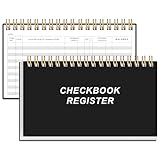
- MANAGE EASILY - This checkbook registers will help you track and manage your personal finances, savings, debts, and bills for your bank account. Use the account track notebook to keep your budget in balance, and develop good bookkeeping habits to meet your financial goals.
- UNIQUE DESIGN - This check registers total 65 sheets/130 pages contains: offer clear pages with 17 lines each, making it easy to track account withdrawals; The bold layout and spacious rows and columns (0.32 in wide) provide a comfortable writing experience, an annual overview (calendar from 2025-2026), yearly goals page, 8 pages (lined) for notes, lists, goals, etc, that helping you easily manage your balance, precisely budget, and work towards your financial goals; It's a convenient tool for achieving financial success
- A6 SIZE/POCKET SIZE - The transaction registers size of 3.75" x 6.75". Check registers for personal checkbook. Just the perfectly size to fit in your wallet, purse or laptop case. Without taking up your space and always helping you keep track of your finances.
- SUPERIOR QUALITY - This transaction registers with 100gsm thick paper to reduce ink leakage, erase fraying and shade issues. Sturdy and flexible PP cover to protect the inner pages well. Strong metal and lay-flat twin-wire binding, Planner with inner pocket to store loose items, like tickets, cards etc and elastic closure to protect your finance planner.
- THE PERFECT GIFT - Use check register book for your personal or business finances, give it to your friends, colleagues as a gift for Birthday| Easter|Children's Day|Halloween|Thanksgiving|Christmas|Back to school and New Year's Day.
Finance
Check the regulator, filing, prospectus or contract, along with fees, dates, eligibility and assumptions. Distinguish historical performance from a guarantee. For a decision involving substantial money, obtain advice from an appropriately qualified professional.
Security and privacy
Prefer current vendor documentation, security advisories and standards-body material. Confirm the affected version, attack preconditions, patch status and mitigation steps. Do not run a command copied from an uncited answer on a production system until you understand what it changes and have a recovery plan.
A compact worksheet you can reuse
Copy the answer into a note and create one row for each important claim.
| Claim | Source passage | Precision | Authority and scope | Date/version | Independent check | Decision |
|---|---|---|---|---|---|---|
| Write the claim in your own words. | Quote or describe the exact supporting passage. | Supported, partial, contradicted or not found. | Author, source type, jurisdiction and population. | Publication/update date and applicable version. | Original record or independent authority. | Use, qualify, replace or discard. |
Keeping the claim separate from your verdict prevents a citation’s reputation from substituting for evidence. Save copies or stable references when a page is likely to change, and record the access date for fast-moving information.
Common citation failures and the fix
| Failure pattern | Why it misleads | Fix |
|---|---|---|
| A citation mentions the subject but not the claim. | Topical relevance is mistaken for proof. | Locate a passage that establishes the exact wording, number and scope. |
| One citation is placed after several claims. | Readers assume every clause is supported. | Split the sentence and cite each material proposition. |
| A snippet is treated as the source. | Search snippets omit qualifications and can be stale. | Open the page and read the surrounding context. |
| Many pages repeat one original report. | Duplication looks like independent corroboration. | Trace the chain to the primary record and find a genuinely independent check. |
| Old information is presented as current. | Rules, prices, threats and software behavior change. | Check update date, effective date and version; seek a current authority. |
| Confidence exceeds evidence. | “Proves,” “will” or “always” can overstate a limited study. | Match language to the source’s uncertainty and limitations. |
| Ranking is used as a trust certificate. | Search systems use signals and can return a relevant but wrong page. | Assess author, evidence, scope and independence yourself. |
Example: auditing a numerical claim
Suppose an AI answer says, “The program saves households 30% each year,” with a link to an evaluation. First, isolate the number, the unit (households or spending), the period (one year or a trial), and the population. Open the evaluation and find the table or result from which 30% came. Check whether it is an average, a median, a modeled estimate or a result for a selected subgroup. Read the limitations to see whether savings were measured against a control group and whether they persisted.
Next, inspect the publisher and funding disclosure. Compare the result with the program’s official data or an independent evaluation. If the source reports “up to 30% in a pilot,” the AI sentence is too broad; rewrite it with the pilot’s population, dates and qualification. If no passage contains 30%, mark the claim unsupported even if the page discusses savings extensively.
When to stop relying on the AI answer
Discard or replace an answer when its key links fail, sources are anonymous or outside their expertise, dates or jurisdictions do not match, passages contradict the wording, important claims have no citations, or independent authoritative evidence disagrees. A transparent answer that says “I could not verify this” is more useful than a confident paragraph built on mismatched links.
Use the AI response as an index to documents you can inspect. The final judgment should rest on the evidence those documents contain, the authority that issued it and its fit to your circumstances—not on citation count, search position or fluent prose.
Quick Recap
Product prices and availability are accurate as of the date/time indicated and are subject to change. Any price and availability information displayed on Amazon at the time of purchase will apply.

