To check whether a third-party zoom will work, identify the exact camera body, the lens’s complete model and mount variant, and whether the lens is native or adapted. Then use the lens maker’s compatibility chart for that exact combination. A lens can physically attach while still lacking autofocus, aperture control, stabilization, reliable metadata, firmware support or teleconverter compatibility.
Do not make a purchase decision from the camera brand, a familiar-looking mount label or a seller’s statement that a lens “fits.” Compatibility is a model-and-mount question, followed by a separate check of every function you need.
As an Amazon Associate I earn from qualifying purchases.
What lens compatibility actually means
“Compatible” can describe several different outcomes. The most basic is mechanical fit: the lens locks onto the body without damaging either mount. That is only the first test. A useful buying decision also asks whether the camera and lens can communicate and whether the resulting combination supports your work.
- Mechanical fit: the mount dimensions, locking mechanism and flange distance are appropriate.
- Exposure control: the camera can set or receive aperture information electronically, if the lens depends on electronic control.
- Autofocus: single-shot focus, continuous focus, tracking and any focus-area modes you rely on operate as expected.
- Stabilization: optical, in-body or coordinated stabilization behaves as documented for that combination.
- Communication and metadata: focal length, aperture, focus distance and other lens data are transmitted correctly when required.
- Firmware and accessories: the lens has a supported update path and works with approved teleconverters or other accessories.
- Sensor coverage: the lens covers the camera’s sensor in the intended mode rather than forcing an unexpected crop or leaving dark corners.
A manufacturer compatibility list is therefore evidence that a particular combination was checked, not a universal guarantee. Tamron states that its chart reflects a “General operation check” and that “It is not guaranteed for all function and performance.” Treat that limitation as part of the result, not as fine print to ignore.
#1 Best Overall

- Standard Mount Adapter allows EF/EF-S lens compatibility with EOS RP, EOS R, EOS R6, and EOS R5 Cameras
- Exterior design matched to EF lenses
- Dust- and water-resistant
- Metal mount on both Lens and camera sides provides rugged flexibility
Start with the exact camera and lens identities
Record the camera body, not just the brand
Read the model name from the camera body, its information screen or its settings menu. Write down the complete designation, including letters or regional suffixes. Also record whether it is a DSLR or mirrorless body and whether its sensor is full-frame or APS-C. Two bodies from the same manufacturer can use different mounts or have different electronic support.
Do not substitute a similar model when searching a compatibility database. If the list names one body and yours is a later or regional variant, treat the difference as unresolved until the manufacturer confirms it.
Record the lens’s complete model and mount variant
Third-party zooms that look identical may be sold in several mounts or in versions intended for different sensor formats. Capture the exact model name, focal-length range, maximum-aperture designation and mount marking from the lens, box or serial-number label. A listing that says only “for Canon” or “for Nikon” is incomplete information; you need the actual mount variant.
Quick wins for a faster PC:
Scan for outdated or missing drivers - takes under a minuteDriver Scan →Clear out junk files and repair common Windows errorsFree Scan →Also note the lens generation and approximate age. A discontinued or end-of-life lens may predate a newer camera body. Tamron warns that performance is not guaranteed when an end-of-life lens is used with cameras released later, even when the physical mount appears correct.
Understand the mount and sensor-format labels
Native mount versus adapted mount
A native lens is made for the body’s mount and normally provides the most direct path to the manufacturer’s supported functions. An adapted lens uses an intermediary adapter to bridge two mounts. The adapter direction matters: a DSLR lens adapted to a mirrorless body is a different compatibility question from a mirrorless lens adapted to another system.
Rank #2

- Compatibility: EF-EOS M mount adapter compatible for Canon EF and EF-S mount lenses and EOS-M (EF-M mount) mirrorless cameras, such as EOS M M2 M3 M5 M6 M10 M50 M100.
- AF Function & Aperture Control: fast auto-focus(AF) speed; inbuilt aperture motor and an electronic contact; actual aperture of lens can be controlled directly from the camera side; data of shutter, aperture and ISO indicated on camera screen.
- Built-in IS(Image Stabilizer): built-in image stabilizer, making focus more accurate and better helping you take clear pictures; please set your camera APS-C Size Capture to 'off' if you get your lenses to full frame function.
- EXIF Signal Transmission: use gold-plated needle/PIN to transmit signal, dramatically enhancing its transmission performance; metal electronic contact ensure high quality signal transmission.
- Fashionable Design: designed with 1/4 screws at the bottom, which can be mounted on tripod or other support platform; detachable support tripod; very convenient to use this lens control ring.
Brand matching is not the rule. Tamron’s FAQ states: "YES, you can use a different brand lens on different brand cameras, but you must make sure that the lens is manufactured with the compatible mount to the camera model that you are using (or by using the appropriate lens adapter)." This is the lens manufacturer’s guidance, not a promise that every third-party combination will retain every feature.
Sensor coverage and crop behavior
Check the lens family’s sensor designation against the body. Tamron describes Di III lenses as compatible with full-frame and APS-C mirrorless systems, while Di III-A lenses are intended for APS-C mirrorless cameras. In Tamron’s example, a Sony E Di III-A lens mounted on a full-frame Sony mirrorless body produces an APS-C crop. The camera may still make an image, but the field of view and recorded resolution differ from full-frame operation.
The Tool Desk
Outbyte Driver Updater FREEScan for outdated or missing drivers - takes under a minuteDriver Scan →Outbyte PC Repair FREEClear out junk files and repair common Windows errorsFree Scan →Do not assume that a lens marked for APS-C automatically gives full-frame coverage, or that a full-frame lens has identical behavior on an APS-C body. Confirm the maker’s description for the exact model and check whether the body automatically enters a crop mode or allows you to choose one.
Use the manufacturer’s compatibility resource in the right order
- Open the lens maker’s official compatibility chart or database. Search by the exact lens model and mount variant, then locate the exact camera body. A general product page or a retailer’s filter is not a substitute for the maker’s compatibility record.
- Read the status and notes, not only the check mark. Look for wording about general operation, restricted functions, firmware requirements, crop modes or specific combinations. A checked combination can still have limitations.
- Check the chart’s date and product status. Tamron’s chart reports a last update of August 27, 2026. That is a page-update date, not a performance statistic and not proof that every newly released body was tested.
- Look for the lens generation. If the chart distinguishes current and end-of-life products, select the exact generation you plan to buy. Do not infer support for an older version from a newer revision with a similar name.
- Save the relevant notes before ordering. Record the body, lens mount, listed restrictions and any required firmware version. Product pages and databases can change, and a saved note prevents a later mix-up between similar models.
If the camera is absent from the chart, do not treat that absence as approval. Tamron directs users to its distributor for unlisted camera models. Sigma’s compatibility material likewise directs users to service or support when further details are needed.
Evaluate an adapter as a separate product
Confirm the exact mount pairing
An adapter is not a universal converter. It must be designed for the lens mount on one side and the camera mount on the other, with the correct direction. For example, Tamron says its Di DSLR lenses in Canon EF/EF-S and Nikon F mounts can work with newer Canon RF and Nikon Z mirrorless bodies when used with the appropriate manufacturer adapter. That example does not establish support for every lens brand, every adapter or every feature.
Rank #3

- This adapter allows Nikon F-Mount Lens to fit on Sony NEX E-Mount Mirrorless Digital Cameras, extending the usefulness of your favorite Lens.
- The adapter allows TTL (Through-The-Lens) metering, and when using a lens with the adapter, the camera body should be set to either manual exposure or aperture priority mode.
- Automatic diaphragm, auto-focusing, or any other functions will not operated with using this adapter
- There is no electrical contacts in the adapter ring. Exposure and focus has to be adjusted manually.
- If Nikon lens does not have a manual Aperture Control ring, it will stop down to its smallest f/stop by default.
Use the manufacturer’s named pairing, such as an EF-to-RF or F-mount-to-Z adapter, only after confirming that your actual lens model and body are included. A mechanically similar adapter can have different electronics, tolerances or firmware behavior.
Recommended Free Tools
Check what the adapter preserves
Read the adapter documentation alongside the lens chart. Confirm whether it passes electronic aperture commands, autofocus signals, stabilization data and lens metadata. Some adapted combinations may permit manual focus and image capture but not continuous autofocus, tracking, automatic aperture control or coordinated stabilization.
Also check the physical clearance and operating restrictions stated for the specific adapter. A lens that attaches safely can still have limitations with focus range, camera modes or accessory use. Never assume that an adapter’s ability to mount a lens means the lens maker has approved the combination.
Check each function you actually need
| Function | What to verify | Why it can change the buying decision |
|---|---|---|
| Autofocus | Whether autofocus is supported on the exact body, including continuous AF and tracking if required. | A lens may capture photographs while losing the focus modes needed for moving subjects. |
| Aperture control | Whether the camera can command the lens aperture electronically, including the intended exposure modes. | Without electronic control, you may be limited to manual aperture operation or a fixed setting. |
| Stabilization | Whether optical stabilization, in-body stabilization or a coordinated mode is supported. | The lens and body may stabilize independently, or a combined mode may be unavailable. |
| Communication and metadata | Whether focal length, aperture, focus information and other lens data are transmitted accurately. | Incorrect or missing data can affect image records, stabilization behavior and post-processing. |
| Firmware updates | Which device performs updates, whether the lens requires a dock or service, and whether the current firmware supports your body. | An older lens may need a specific update, while an end-of-life model may have no guaranteed support for a later camera. |
| Teleconverters and accessories | Whether the exact lens, mount and body are listed for the accessory. | Accessory support is combination-specific; a supported lens does not automatically support every teleconverter. |
| Sensor mode | Whether the body records full-frame or APS-C coverage and how crop mode is applied. | Crop behavior changes field of view, resolution and sometimes the camera’s operating choices. |
Mark a feature as “confirmed,” “restricted,” or “not stated” in your notes. “Not stated” is not the same as “works.” If a feature is essential and the maker does not document it, seek confirmation before paying.
Teleconverter and accessory compatibility needs its own check
Teleconverters are especially easy to misjudge because their compatibility depends on the exact lens and mount, not merely on the camera system. Tamron lists designated lens-and-camera combinations for its teleconverters and states that other combinations are not supported.
What’s actually slowing this PC down?
Pick the symptom - the matching free tool is one click away.
Rank #4

- 【Widely Compatible EF-EOS R Lens Adapter】EF EOS R1 lens adapter ring allows: Fits Canon EF and EF-S lenses for Canon EOS R series mirrorless cameras including the EOS R, RP, R3, R5, R6, R6 Mark II, R7, R8, R10, R50 and R100.
- 【Full-featured Design】Maintains autofocus, image stabilization, and transmits EXIF data from compatible EF lenses to R mount cameras.
- 【Integrated Image Stabilization】IS Function:EF-EOS R1 converter inbuilt image stabilizer, effectively eliminating image ghosting and blurring. The in-lens stabilization from EF lenses with the feature continues to function when mounted with the adapter.
- 【Robust Autofocus Performance】AF Function:On-sensor Dual Pixel CMOS AF allows lenses to focus quickly and smoothly just like on EF mount SLR cameras. The adapter ring use gold-plated pure copper PINs to transmit signal, greatly enhancing its conductivity and transmission performance and the image quality is not affected by the adapter.
- 【Sturdy Constructionand Durable】Full metal body & brass mounting plates provide durability and ensure lenses stay securely attached during shooting for stability and reliability.built-in tripod mount (removable), designed with 1/4 screws at the bottom, which can be mounted on tripod or other supporting platform.
- Identify the teleconverter model and mount.
- Find the exact zoom model in the lens maker’s teleconverter compatibility list.
- Confirm that the camera body is also included, especially if autofocus or electronic aperture is important.
- Read notes about focal-length, aperture or focus restrictions before assuming normal operation.
If the accessory list does not name your combination, do not infer support from a lens with a similar focal range or from a different mount version.
Compare two candidate zooms without hiding the compatibility differences
When two third-party zooms are under consideration, compare the complete body-and-lens combinations rather than comparing product names in isolation.
| Comparison axis | Questions to answer for each candidate |
|---|---|
| Mount path | Is the lens native to the body, or does it require an adapter? If adapted, is the exact direction and adapter pairing approved? |
| Sensor coverage | Does it cover the body’s sensor, and will the camera enter APS-C crop mode? |
| Electronic functions | Are autofocus, tracking, aperture control, stabilization and metadata all documented for this body? |
| Firmware and age | Is the lens current, end-of-life or dependent on a firmware update? Who can perform that update? |
| Accessory support | Are the intended teleconverter and other accessories listed for this exact lens, mount and body? |
| Uncertainty | Which required feature is merely unstated rather than confirmed? |
A universal winner cannot be named without the camera body and candidate lens models. A native lens with fewer theoretical specifications may be the safer choice if the adapted alternative leaves autofocus, stabilization or firmware support unresolved.
Independent reader supportYour contribution helps us test, update, and keep practical guides available for everyone.Common mistakes and how to recover from them
“It has the same camera-brand name”
Camera-brand matching does not prove mount compatibility. Recheck the body’s mount and the lens’s mount variant, then search the manufacturer’s chart by exact model.
“The lens locks on, so everything works”
Mechanical attachment proves only the first layer. Test or verify each required electronic function and look for the chart’s limitations statement.
Best Value
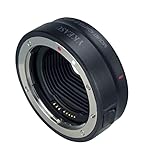
- 【Compatibility】Compatible with Canon EF/EF-S lenses to Canon EOS R RP R5 R6 R7 R10 Mirrorless Digital Camera
- 【IS Stabilization & EXIF Signal Transmitting】Built-in IS stability, making focus more accurate and clear; The design of gold plated PIN has excellent signal transmission performance
- 【AF Function & Aperture Control】Fast auto-focusing speed; Actual aperture of the lens can be controlled directly from the camera side. Meanwhile, Datas of Shutter, aperture and ISO are displayed on camera
- 【Weather Sealing】Dust and water- resistant
- 【Construction】Metal mount on both Lens and camera sides provides rugged flexibility
“A similar camera is listed”
Do not transfer approval from a related body. Camera firmware, mount electronics and sensor behavior can differ. Ask the manufacturer or authorized distributor about the exact unlisted model.
“An adapter is just a passive ring”
Some adapters carry electronic signals and have their own compatibility requirements. Confirm the named adapter, lens generation and body before purchase, and treat retained functions as a separate question.
“The lens is current, so an old body is covered”
Compatibility works in both directions. A new lens may not have been checked with an older body, and an end-of-life lens may not have guaranteed performance with a later camera. Use the chart entry for the exact pair.
“The teleconverter fits the lens mount”
Physical fit does not establish optical or electronic support. Consult the designated combination list; unsupported pairings should be treated as unsupported.
A pre-purchase checklist
- Camera body model copied exactly from the body or settings screen.
- DSLR or mirrorless type recorded.
- Full-frame or APS-C sensor format recorded.
- Complete lens model, generation and mount variant recorded.
- Native or adapted mounting path identified.
- Exact body-and-lens pair found in the manufacturer’s compatibility resource, or manufacturer confirmation obtained.
- Autofocus and tracking checked separately from mechanical fit.
- Electronic aperture control checked.
- Optical, in-body and coordinated stabilization behavior checked.
- Metadata and camera-to-lens communication checked.
- Firmware version and update method checked, especially for older or end-of-life lenses.
- Teleconverter and other required accessory combinations checked.
- Sensor coverage and any APS-C crop behavior understood.
- Every unresolved feature documented before payment.
When to contact the manufacturer
Contact the lens maker, camera maker or authorized distributor when the body is absent from the list, the lens is end-of-life, the chart shows a restriction, firmware information is unclear or a required feature is not stated. Provide the exact body model, lens model and mount variant, adapter model if applicable, current firmware versions and the function you need.
Ask a precise question such as whether continuous autofocus works on the named body with the named lens and adapter, rather than asking whether the lens is “compatible.” A precise question produces a useful answer and leaves less room for a seller or support representative to interpret “compatible” as mechanical fit only.
Bottom line: verify the complete combination
Before buying a third-party zoom, verify the exact camera body, exact lens mount variant and complete native-or-adapted path in the lens maker’s compatibility resource. Then check autofocus, aperture, stabilization, metadata, firmware, sensor coverage and teleconverter support one by one. If the model is missing, restricted or end-of-life, obtain confirmation from the manufacturer or distributor instead of inferring support from a similar camera or a mount that happens to attach.
Crashes, No Sound, or Screen Glitches?
Random freezes, missing sound and display glitches usually trace back to one bad driver. Find and replace yours safely.Free scan · under a minutePC Slower Than It Used to Be?
A free scan shows the junk files, broken settings and background clutter dragging Windows down - then fixes them in one click.Free scan · Windows 10 & 11Quick Recap
Product prices and availability are accurate as of the date/time indicated and are subject to change. Any price and availability information displayed on Amazon at the time of purchase will apply.

