Recommended Free Tools
Optogenetic therapy tries to restore some light sensitivity in people whose inherited retinal disease has destroyed their photoreceptors. A gene-delivery step gives surviving retinal cells instructions to make a light-sensitive protein, called an opsin, so those cells can respond to light themselves. It bypasses the dead photoreceptors. It does not regrow them, and it does not recreate normal sight.
Human results exist, but they come from a single case report, small open-label work, company-announced trial data and interim dose-escalation results. As of October 2026, the sources cited here do not establish that any optogenetic therapy for inherited blindness is approved or commercially available. This article explains the mechanism, how the leading programs differ, and what each reported result does and does not show.
As an Amazon Associate I earn from qualifying purchases.
The problem optogenetics is trying to solve
In inherited retinal diseases such as retinitis pigmentosa, the light-detecting photoreceptors (rods and cones) degenerate. Many of the neurons behind them often survive for a long time. These include bipolar cells and retinal ganglion cells, which carry signals to the brain through the optic nerve. In late-stage disease the eye still has this wiring, but nothing at the front end converts light into an electrical signal.
Most gene therapies for inherited retinal disease fix or replace one faulty gene. That only works for people with that specific mutation and only while enough photoreceptors remain. Optogenetics takes a different route. It does not try to repair the original defect. It gives a different, surviving cell type a new job.
#1 Best Overall

- Enhanced Daily Accessibility: You will receive 250 tactile silicone bump dots provide essential low vision aids. Perfect for marking keyboards, appliances, and switches, they empower independent living through intuitive touch identification.
- Premium Material: Crafted from soft-yet-durable silicone, our braille stickers offer long-lasting comfort and reliable adhesion. The smooth texture ensures gentle tactile feedback without skin irritation for sensitive users.
- Versatile Adhesive Solution: Featuring strong self-adhesive backing, these vision impairment stickers install instantly on smooth surfaces. Simply peel-and-stick for permanent tactile markers that won't slip or lose grip over time.
- Customizable Identification: With 5 size variations and multiple shapes, these high-contrast tactile dots allow personalized organization. Color-coded options improve recognition for partial sight users.
- Thoughtful Assistive Gift: An ideal practical present for blind friends or aging relatives. Covering all household marking needs while promoting safety and independence for low vision individuals.
How the approach works, step by step
- Choose a target cell. The therapy aims at a retinal neuron that survives after photoreceptor loss. Different programs choose different cells, such as retinal ganglion cells or bipolar cells.
- Deliver the gene. In the programs described here, the genetic instructions for an opsin are given by a single injection into the eye. For GS030 and for Nanoscope’s four-patient study this is an intravitreal injection, into the gel-filled cavity in front of the retina.
- The cells make the opsin. Treated cells start producing a light-sensitive protein. Light striking it changes the cell’s electrical activity, much as a photoreceptor would.
- Light activates the treated cells. Depending on the design, the light comes either from a wearable device that projects a pattern onto the retina or from ordinary ambient light.
- The remaining retinal circuitry carries the signal. Activated cells pass signals toward the brain through the pathways that are still intact. The patient then has to learn to interpret what they perceive. In the GS030 case, training with the goggles was part of the process.
The result is a different kind of vision from natural sight. The treated cells were not built for this job, and the signal they send differs from what a healthy retina produces. That is why reported results are usually measured as detecting light, locating objects, discriminating shapes or improving chart acuity, not as “normal vision.”
Three programs, three different designs
Optogenetic programs are not interchangeable. They target different cells, use different light-activation strategies and have been tested in very different ways.
| Program | Target and approach | External device? | Evidence reported so far |
|---|---|---|---|
| GS030 (GenSight Biologics) | Intravitreal gene therapy expressing the opsin ChrimsonR in retinal ganglion cells | Yes: goggles that project light onto the treated retina | One late-stage retinitis pigmentosa patient, published as a Nature Medicine case report (described in GenSight’s 2021 announcement) |
| MCO-010 (Nanoscope Therapeutics) | Targets retinal bipolar cells; designed to be activated by ambient light | Designed for ambient-light activation | Company-announced Phase 2b RESTORE results (2024); company announcement of a four-patient open-label study (2025) |
| RV-001 (Restore Vision) | GPCR-based approach intended to work without external devices | Intended not to need one | Interim, company-issued results from an ongoing Phase 1/2 dose-escalation trial in Japan (May 2026) |
Vectors and some other design details are not stated in the sources cited here, so they are left out rather than guessed.
What’s actually slowing this PC down?
Pick the symptom - the matching free tool is one click away.
What the human evidence shows
GS030: a single proof-of-concept case
The Nature Medicine case report described one person with late-stage retinitis pigmentosa. After the injection and a period of training with the goggles, he could perceive, locate, count and touch objects using the treated eye with the goggles. The report says he could not do these tasks without them. The details here come from GenSight’s 2021 announcement summarizing the paper.
Rank #2
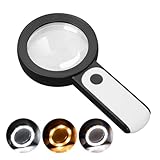
- HIGH POWER MAGNIFICATION: This magnifying glass provide Optical high magnification, allowing users with low vision to read text, no matter the size.
- ULTRA BRIGHT 18 LED WITH 3 MODES: The built-in energy-saving 18 LED lights provides extra luminance to ensure an overall better reading experience even at night or dark places. The stepless dimmable 3 lighting modes (cold, warm and mixed) can be switched based on different light condition, which can reduces visual fatigue, which is very useful for people with macular degeneration or far-sightedness/feyopia.
- EASY TO USE: Comes completely assembled, just requires 3x AAA batteries (not included). Easy to operate with a simple ON / OFF button switch, making it perfect for the elderly or those requiring an intuitive magnification system.
- LARGE LENS(Diameter 3.15"): Magnifies without optical distortion. Optimal to enhance reading and viewing very fine details in books, newspapers, magazines, photographs, maps, electronics, miniatures, jewelry, pill bottles, medications, hobbies, models, and crafts of all kinds.
- PERFECT GIFT FOR THE ELDERLY: Great magnifier for seniors, Most elderly have difficulty reading the small print on coupons, prescription,medical bottle.clear magnifier with light also a great choice for those who have low or impaired vision of most types.
GenSight co-founder Dr. Botond Roska, founding director of the Institute of Molecular and Clinical Ophthalmology Basel, said at the time: “We have worked on optogenetic therapy in the lab for 16 years and now seeing the proof of concept in a patient is a unique experience.” That describes a proof of concept in one person. It is not evidence that the approach restores ordinary vision broadly.
MCO-010: a four-patient study and the RESTORE trial
Nanoscope’s 2025 announcement describes a separate investigator-initiated, open-label study of four blind retinitis pigmentosa patients with ABCA4 variants. Each received a single intravitreal injection. The company reported improvements in visual acuity, shape discrimination and mobility over the 52-week study period. With four participants and no blinded control group, this is early-stage evidence.
In the announcement, Dr. Vinit B. Mahajan of Stanford University, a co-corresponding author, called the study “a pivotal milestone in the treatment of inherited retinal degenerations, demonstrating that optogenetics can successfully restore vision in blind patients, regardless of their genetic mutation.” That is the author’s own characterization, published by the company that makes the therapy, not an independent consensus. It does illustrate the main appeal of the approach: it is designed to work whatever the underlying mutation.
Nanoscope’s March 2024 top-line announcement for the Phase 2b RESTORE trial gave mean changes in best-corrected visual acuity (BCVA) from baseline. In logMAR units, a negative change is an improvement, and 0.1 logMAR is roughly one line on an eye chart. The company described a modified intent-to-treat analysis of 18 treated participants and 9 controls who received a sham procedure.
Rank #3

- 【High Power Magnification】This 5.0 inch portable magnifier reading aids provide 2X-32X zoom magnification, the unit has been an absolute lifesaver for who has macular degeneration. With this unit you can shop the grocery store, read restaurant menus, plus magazines and books.
- 【Simplified Buttons, Easy to Use】The low vision aids with the simplified buttons is more suitable for the operation of elderly or amblyopic children. There are no redundant buttons, which can meet the daily reading needs. Capabiities of memorizing the habits of users before the shutdown. Don't need to adjust every time.
- 【Eyes Don't Get Tired Easily】HD color LCD screen featuring 800*480 high resolution and the professional image processing DSP, restore colors and details truly. The vision aid does not deform when magnifying fonts, suit for long time reading, also can connect it to a television and computer by include cable to provide greater and clearer visual effects.
- 【Ergonomic Design Handle and Bracket】Integrated design of handle and bracket, the back of the digital magnifier with a foldable bracket on the handle, it can be laid on the page at an angle so you don't need to hunch over the top to read the text. The handle also can be installed according to the habit of left and right hands.
- 【Wide Range of Applications】The reading aids with multiple color modes for choose, meet the needs for different people, especially for the visually impaired, low vision, color blindness and amblyopia, letting eyes get a great visual experience. It's a great for who need it.
| Group | Mean BCVA change, week 52 | Mean BCVA change, week 76 |
|---|---|---|
| High dose | −0.337 logMAR (p=0.0209) | −0.539 logMAR (p=0.0014) |
| Low dose | −0.382 logMAR (p=0.0290) | −0.374 logMAR (p=0.0652) |
| Sham control | −0.050 logMAR | −0.078 logMAR |
The low-dose group’s week-76 result did not reach statistical significance in that announcement. These figures come from a company top-line release, not a full peer-reviewed trial report, so the analysis methods and safety data have not been independently reviewed in the sources cited here.
RV-001: early interim data from Japan
Restore Vision’s May 2026 release reported results out to 168 days from an ongoing Phase 1/2 dose-escalation trial in Japan. It covered six participants across low- and high-dose cohorts. In the high-dose cohort, all three participants moved from no light perception to light perception or better within a month. One low-dose participant did so at about three months. One high-dose patient had chart-based acuity measured with the Berkeley Rudimentary Vision Test. The company states that the findings are interim and the study is still in progress.
Going from no light perception to light perception is a meaningful step for the person involved. But it is far from functional reading or navigation vision. Six participants and a company-issued interim release do not establish efficacy.
Why the results cannot be lined up against each other
No head-to-head comparison exists. The programs differ in target cell, device requirement, trial design, participant numbers, outcome tests and follow-up length. When you read any new result, check these points:
Rank #4
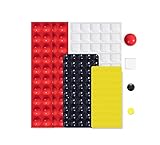
- TACTILE IDENTIFICATION:A boon for individuals with visual impairments such as low vision, glaucoma, blindness, and macular degeneration! This tactile marking solution brings accessibility to everyday items, be it keyboards, phones, electronic controls, buttons, or switches – all effortlessly identifiable through touch.
- DIVERSE SHAPES AND SIZES:Meet various identification needs! We offer three shapes – hemisphere, cylinder, and square, ranging from 0.2 to 0.4 inches. Whether you seek a subtle or robust tactile experience, we've got you covered.
- HIGH CONTRAST COLORS:Yellow, red, black, and white – 4 vivid color choices providing optimal recognition for users with low vision.
- USER-FRIENDLY DESIGN:Simple and convenient! Crafted from high-quality silicone material .
- HIGH COST-EFFECTIVENESS:Each set includes up to 165 markers, offering a one-time purchase for long-term use, making your life more convenient and economical.
- Which retinal cell was targeted, and which opsin or vector was used?
- Were goggles or another device required to see the benefit?
- Was there a sham or other control group, or was the study open-label?
- How many people were treated, and what was their disease stage?
- Which outcome was measured: light perception, a chart score, shape discrimination or real-world mobility?
- How long were participants followed, and what safety findings were reported?
- Does the source come from a peer-reviewed paper or a company announcement?
Not the same thing: the PRIMA implant
PRIMA is often mentioned alongside optogenetics in vision-restoration news, but it is not a gene therapy. It is a surgically implanted subretinal photovoltaic array, used with glasses that project near-infrared light. The peer-reviewed PRIMAvera study, reported in the New England Journal of Medicine in 2025, concerned geographic atrophy from age-related macular degeneration, not inherited blindness. The authors reported that 26 of 32 participants assessed at 12 months (81%) had a clinically meaningful improvement in visual acuity from baseline. That figure belongs to a different device and a different disease. It says nothing about the efficacy of optogenetics.
Availability and what to expect
The sources cited here include company announcements of trials and development plans. Those cannot confirm a present-day regulatory decision, so this article does not describe any optogenetic therapy for inherited blindness as approved, available or a cure. Anyone considering these treatments should check current information from regulators and from the trial registry entries, and should discuss options with a retinal specialist or genetic counselor.
The studies described above focused on people with advanced vision loss, such as late-stage retinitis pigmentosa or no light perception. Eligibility rules differ by trial. A result in one disease stage or one program should not be assumed to apply to other inherited retinal conditions or to other therapies.
The Tool Desk
Outbyte Driver Updater FREEScan for outdated or missing drivers - takes under a minuteDriver Scan →Outbyte PC Repair FREEClear out junk files and repair common Windows errorsFree Scan →Quick Recap
Product prices and availability are accurate as of the date/time indicated and are subject to change. Any price and availability information displayed on Amazon at the time of purchase will apply.

