Mosasaurs were predatory marine reptiles, but fossils do not show that every species—or even every hunt—relied on ambush. Their meals, teeth, skulls and rare bite traces point instead to varied ways of finding and handling prey. Ambush is a plausible tactic, not a universal behavior established by the fossil record.
How can scientists tell how mosasaurs hunted?
A fossil rarely preserves the hunt itself. Instead, paleontologists piece together behavior from different kinds of evidence: prey remains found in a predator’s stomach region, the shape and mechanics of teeth and jaws, and damage left on potential prey. Each answers a different question. Gut contents can show what one animal ate; anatomy can suggest what it was equipped to handle; a bite trace may preserve part of an attack. None, on its own, records a complete chase from detection to capture.
As an Amazon Associate I earn from qualifying purchases.
That distinction matters when discussing ambush. A powerful skull or a tooth mark on a shell does not reveal whether the mosasaur waited concealed, charged from below, pursued its target, or used some other approach. The evidence supports predation and varied feeding adaptations much more directly than it supports any one hunting sequence.
Recommended Free Tools
What did mosasaurs eat?
Rare fossil meals show that mosasaurs consumed a broad range of animals, including fish, squid and octopus relatives, seabirds, turtles, plesiosaurs and other mosasaurs. The Smithsonian explains why such records are uncommon: an animal had to die soon after eating, be buried before scavenging and decay erased the remains, and later be discovered in an accessible deposit. A stomach fossil is therefore an unusually informative snapshot, not a typical sample of a species’ diet.
#1 Best Overall
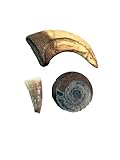
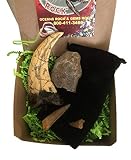
- Three-Item Fossil Set – Includes one Velociraptor claw replica, one Mosasaur tooth (B-grade), and one genuine small ammonite fossil
- Educational and Collectible – A great hands-on way to explore prehistoric life and paleontology
- Genuine Fossils Included – Both the Mosasaur tooth and ammonite are real fossil specimens
- Realistic Replica Claw – Velociraptor claw cast features high quality texture and curvature
- Ready for Display or Teaching – Great for collectors, educators, or science-themed gifts
A clear case of one mosasaur eating another
A specimen of Prognathodon kianda from Angola, an animal that lived about 72 million years ago, preserves at least three mosasaur skulls in its stomach region. The Smithsonian identifies them as a “Platecarpus” ptychodon, a juvenile Mosasaurus, and a juvenile Prognathodon kianda. The last is evidence that this individual consumed a member of its own species: cannibalism occurred in this case.
The specimen does not tell us how often cannibalism occurred, whether it was deliberate predation or opportunistic feeding, or what the animal’s usual meals were. Those conclusions would require a broader record than one remarkable gut association can provide. The careful answer to “Did mosasaurs eat other mosasaurs?” is yes, at least some did; how common that behavior was remains unknown.
What do teeth reveal about feeding?
Mosasaur teeth were not all built for the same job. Comparing tooth shape with likely mechanical function suggests a spectrum of prey handling: conical teeth could snag or hold fish, blunt or rounded teeth could crush shells, and blade-like or serrated teeth could cut larger prey. These are anatomical and biomechanical inferences, not observations of a living mosasaur feeding. They also caution against treating all mosasaurs as ecologically interchangeable.
Rank #2
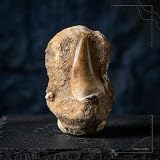
- Paleontological‑Grade Precision Replica – This is a high‑quality replica of a prehistoric Mosasaur tooth. We meticulously recreate the natural curvature, enamel texture, and sharpness, paired with a realistic matrix base that captures the authentic look of ancient marine fossils. Ideal for beginner collectors and educational displays.
- Natural Matrix & Unique Aesthetics – Each tooth is set in a naturally textured matrix with its own distinct shape and layering. The rough, raw stone contrasts beautifully with the refined tooth, offering a visually striking piece that sparks curiosity and appreciation for natural history.
- Versatile Display Options – Use it as an elegant desktop ornament on your shelf, desk, or office to add a touch of prehistoric mystery, or attach the built‑in magnet to your fridge for a fun and conversation‑starting daily accent. Two ways to enjoy the same remarkable fossil replica.
- Complete Gift Set – The package includes a premium gift box, a vintage‑style informational card, and a soft hemp collection bag. Every detail, from unboxing to final display, is carefully designed to deliver a memorable and high‑quality experience.
- A Thoughtful, One‑of‑a‑Kind Gift – Surprise the curious minds and adventure lovers in your life with something truly different. This replica combines science, art, and history – it is not just a decoration, but a tangible piece of a prehistoric world that can be held, admired, and shared.
| Example | Evidence | Likely feeding role | What the evidence does not establish |
|---|---|---|---|
| Globidens phosphaticus | Tooth form, as described by the Smithsonian | Crushing shellfish or other hard-shelled prey | The full menu or the precise method of capture |
| Prognathodon kianda | Teeth suited to tearing larger prey, alongside stomach-region remains in a notable specimen | Handling larger animals, including other mosasaurs in the documented case | That every individual ate the same prey or hunted in the same way |
| Carinodens | Limited jaw and tooth fossils, compared with living analogues and a mechanical jaw model | Crushing small molluscs and arthropods | A complete diet or proof that hard-shelled prey made up all of it |
What a jaw model can—and cannot—show
Carinodens is known, in A.S. Schulp’s 2005 account in the Netherlands Journal of Geosciences, from two dentary fragments and just over a dozen isolated teeth. Schulp compared its teeth and jaw with living analogues and tested a mechanical jaw model with a force gauge. The study inferred that it could crush small molluscs and arthropods, while allowing that its diet may not have been limited to hard-shelled prey.
This is useful evidence about capacity, not a feeding experiment on a living animal. A model can help evaluate whether a jaw-and-tooth arrangement could apply force in a particular way. It cannot identify every food item an extinct species ate, establish how it approached prey, or prove that it used the same tactic in every encounter.
Could mosasaur skulls handle large prey?
Mosasaur skull anatomy offers another clue about feeding capacity. Natural History Museum curator Dr Marc Jones describes the quadrate, a bone in the jaw joint, as unusually mobile: “They also have a bone known as the quadrate that’s very mobile, just like snakes, which allows different parts of the mosasaur skull to move independently to consume larger prey.” This flexibility may have helped a mosasaur manage prey larger than its mouth could simply bite and swallow as a rigid unit.
Rank #3

- Genuine Mosasaur Tooth – Each tooth measures approximately 2 inches long and 1 inch wide, some of the largest we’ve offered in our 26 years in business.
- Museum-Grade Specimens – Similar specimens sell for $50 or more at major museum shops.
- Authenticity Guaranteed – Each tooth comes with a Certificate of Authenticity, documenting its age, origin, and legal excavation.
- BONUS TOOTH INCLUDED – Order today and we’ll include an additional 1-inch genuine Mosasaur tooth absolutely FREE (a $20 value). Perfect for display or gifting.
- Extremely Limited Quantity – Only 40 teeth available. Once they’re gone… they’re gone.
That anatomical comparison helps explain how feeding could work after a capture; it does not identify the capture method. A mobile skull is compatible with more than one hunting style. It cannot show whether an animal ambushed a target, followed it, or seized an opportunity after encountering it.
Outdated Drivers Are Slowing You Down
One free scan finds every outdated or missing driver and matches the right update for your exact hardware.Free scan · exact hardware matchWindows Errors? Fix Them Before They Spread
Repair common Windows errors and clear accumulated junk for a smoother, more stable PC - no reinstall needed.Free scan · no reinstallWhat can bite marks on ammonites tell us?
Some fossil ammonite shells preserve damage that may record predator attacks. A 2024 paper in Cretaceous Research describes a damaged lower Turonian ammonite from the Czech Republic and names the trace fossil Nihilichnus quadripertitus. From the injury’s shape and spacing, the arrangement of tooth rows, and the animals known from the region, the authors identify a mosasauroid as the likely attacker while leaving uncertainty about the exact animal.
The authors consider a possible attack from below, directed toward the ammonite’s soft tissues. They also discuss whether repeated attacks on the chambered shell might have reduced buoyancy before a final attack. These are interpretations of one trace, not a recording of a confirmed sequence. The paper explicitly cautions that such traces are too rare to justify generalizing the strategy; more than one kind of attack may have occurred.
Rank #4

- 【Detailed Mosasaurus Skeleton Replica】Build a realistic Mosasaurus marine reptile fossil skeleton with 191 pieces, featuring streamlined body, fin limbs, and movable joints, capturing the iconic look of the ancient ocean predator.
- 【Museum Display-Ready Design】Includes a brown display base with mechanical movement knob, transparent supports, and a Mosasaurus nameplate, perfect for showcasing your model as a unique piece of prehistoric decor in your home or office.
- 【STEM Learning & Imaginative Play】This building kit combines assembly fun with marine paleontology knowledge, helping kids aged 8+ learn about prehistoric ocean life while developing fine motor skills and logical thinking through hands-on building.
- 【Safe & Easy-to-Assemble Blocks】Made of high-quality, non-toxic ABS plastic, the pieces are smooth, burr-free, and compatible with standard building blocks. Clear instructions guide you through every step, suitable for kids and adult hobbyists.
- 【Unique Gift for Dinosaur & Ocean Lovers】A special gift for anyone who loves dinosaurs, marine life, or model building. It’s a great way to spark curiosity about prehistoric creatures and provide hours of screen-free entertainment.
Why a hole in a shell is not automatically a mosasaur bite
Some punctures once attributed to mosasaur attacks have been disputed as possible limpet home scars. National Geographic’s account of the debate describes the alternative that limpets grazing on shells produced some pits. Later analyses argued that features such as variation in punctures, missing body chambers, healed injuries and patterns consistent with tooth rows fit predation in at least some specimens. The interpretation is contested at the level of particular examples, so a perforated shell should not be treated as a confirmed mosasaur kill without considering its surrounding evidence.
Experiments with modern nautilus shells have also raised questions about how well robotic jaws reproduce attacks on fossil ammonites. The shell and the experimental setup are not the extinct predator and prey themselves. Such work can test whether a proposed mechanism is plausible, but it does not turn every similar-looking mark into proof of the same attacker or behavior.
Do these 3 things before closing this tab:
1Fix the driver behind crashes, sound loss and screen glitches2Clear out junk files and repair common Windows errors3Scan for outdated or missing drivers - takes under a minuteNational Geographic reports that researchers examined more than 150 Placenticeras shells from Alberta in work associated with Tsujita and Westermann’s 2001 study. That is a sample of shells studied in a particular context, not a population-wide measure of mosasaur attacks. The broader lesson is to assess each trace by its pattern, damage and preservation rather than assigning an attacker from the presence of a hole alone.
Independent reader supportYour contribution helps us test, update, and keep practical guides available for everyone.Were mosasaurs ambush predators?
They may have used ambush attacks, but the fossil evidence does not establish ambush as the defining strategy of mosasaurs. A study of preserved Ectenosaurus skin notes a traditional view that mosasaurs could make short bursts during brief ambush pursuits. That work focuses on integument and hydrodynamic adaptation; it is not direct evidence of a universal hunting behavior.
The ammonite trace adds a possible attack scenario, but its authors warn against extrapolating from a rare trace. The gut contents show successful feeding without preserving the approach, while teeth and skulls indicate how prey might have been held, crushed, cut or managed. Together, these lines of evidence make predation clear and behavioral variety plausible. They do not preserve enough hunts to decide how often any mosasaur waited in ambush rather than pursuing prey or taking advantage of an encounter.
How strong is each kind of evidence?
| Evidence | Best-supported conclusion | Main limit |
|---|---|---|
| Stomach-region prey remains | A particular animal consumed the identified prey, when the association is reliable | Rare specimens cannot establish a species-wide or population-wide diet |
| Teeth and jaw anatomy | Likely prey handling capabilities, such as grasping, crushing or slicing | Function is inferred; capacity does not prove a complete diet or hunting sequence |
| Mechanical jaw model | A proposed mechanical function can be tested against a physical model | It is not an experiment on a living mosasaur and cannot recreate behavior in full |
| Bite or injury traces | A specimen may preserve an attack, and some patterns may identify a likely predator | Damage can have alternative causes; a single trace rarely reveals the entire attack |
For the question “How did mosasaurs hunt?”, the most defensible answer is therefore a set of possibilities, not a single script. Different teeth point to different ways of processing prey, gut contents document particular meals, and a small number of traces offer clues to attacks. Ambush may have been one option among varied tactics, but the fossils cannot show that all mosasaurs used it or establish how frequently they did.
Quick Recap
Product prices and availability are accurate as of the date/time indicated and are subject to change. Any price and availability information displayed on Amazon at the time of purchase will apply.

