What’s actually slowing this PC down?
Pick the symptom - the matching free tool is one click away.
Dinosaur eggs become fossils when some part of an egg survives burial and geological alteration long enough to be incorporated into rock. The surviving evidence may be a calcified shell, an impression where the shell dissolved, an embryo, or chemically altered residue from a membrane. No single pathway preserves every egg, and the evidence does not automatically identify the dinosaur that laid it.
After discovery, museum teams begin a separate process: documenting the specimen, removing surrounding rock carefully, stabilizing fragile material and storing it so researchers can examine it without destroying information. Geological fossilization and museum conservation solve different problems.
As an Amazon Associate I earn from qualifying purchases.
What a fossil dinosaur egg can preserve
“Dinosaur egg” describes a fossil association, not one guaranteed material. Preservation is uneven because the shell, contents and surrounding sediment respond differently to burial and later chemical and physical change. A specimen can preserve several kinds of evidence at once, or only a trace of the original egg.
Calcified eggshell
Many recognizable egg fossils retain calcareous shell. The shell’s shape, thickness, pore pattern and microscopic structure can be examined as biological features, although later alteration may obscure or modify them. Researchers compare these features with other fossil eggs and, cautiously, with living animals.
#1 Best Overall
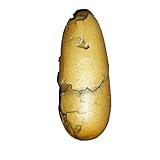
- Realistic oviraptor dinosaur egg cast
- Approximately 6" long
- Great addition to prehistoric fossil collections or as a gift for paleontology lovers
Impressions in sedimentary rock
An egg can leave a three-dimensional or partial impression even when the original shell is gone. Sediment surrounding the egg records its outline and, in favorable cases, surface texture. An impression can establish that an egg-shaped object occupied a particular position, but it may provide less chemical or microscopic information than surviving shell.
Embryos and internal anatomy
Rare eggs preserve embryos. Their bones can reveal developmental stage and posture, and an embryo may provide anatomical evidence that helps connect an egg to a dinosaur group. Such finds are exceptional: embryos that would help identify the parent are rarer than eggs themselves.
Soft-shell membrane residues
Hard shell is not the only possible evidence. A 2023 study of examined Protoceratops and Mussaurus eggs reported chemically altered residues interpreted as remnants of eggshell membrane. The researchers found a diffuse halo around embryos, examined it with petrographic microscopy and high-resolution in-situ Raman microspectroscopy, and compared the chemical results with eggshell data from living animals. Their conclusion was that the studied eggs had been soft-shelled and non-biomineralized. That result applies to the specimens analyzed; it does not show that all dinosaur eggs were soft-shelled.
How an egg becomes a fossil
The broad sequence can be described, but the exact geochemical route differs from site to site. The available evidence does not establish one universal mineralization recipe or a single set of environmental conditions that preserves every component. Scientists therefore reconstruct preservation from the specimen and its surrounding rock rather than assuming a standard pathway.
- An egg is laid and deposited. Its position, orientation and relation to other eggs may later become evidence of a nest or clutch. Disturbance by weather, water, animals or sediment can move or break it before burial.
- Burial isolates part of the egg. Sediment covers the shell or an egg-shaped cavity. Rapid, stable burial can protect geometry, but the record is incomplete and many eggs are destroyed or scattered before they are deeply buried.
- Sediment hardens around the remains. As surrounding sediment becomes rock, it can hold a shell in place or preserve a mold after shell material is lost. Compaction may flatten or distort an egg, so apparent shape must be checked against the surrounding geology.
- Burial chemistry changes the evidence. Fluids and minerals can alter original shell, embryo bone or membrane residues. Some original biological signals survive; others are replaced, dissolved or overprinted. This is why researchers distinguish original biology from diagenetic alteration.
- Different components survive unevenly. One fossil may retain shell but no embryo; another may preserve an impression and a faint chemical trace. Low-density embryonic bone can become difficult to distinguish from nearby sediment even when an embryo is present.
- Erosion exposes the fossil. Geological uplift and erosion eventually bring fossil-bearing rock near the surface. Field teams then excavate the specimen, usually keeping it supported in a block and protecting it for transport.
This sequence explains why two eggs from the same locality can carry very different records. It also explains why a visually complete egg may provide less biological information than a fragment containing a diagnostic microscopic structure or chemical residue.
Rank #2

- THE ULTIMATE STEM PARTY PACK (24 SETS IN 1) – Make your child’s birthday legendary! This jumbo kit contains 24 individually wrapped dino eggs, each with its own chiseling tool and learning card. It acts as a perfect social catalyst for classroom activities, playdates, or distinct party favors that keep a whole group of kids engaged and quiet for hours.
- DISCOVER, LEARN & MATCH – We turn simple digging into a hands-on archaeological science lesson. After digging out the dinosaur, you can use a magnifying glass to observe the details of the dinosaur and combine it with the card to determine the name of the dinosaur. Each card reveals the dinosaur's history and characteristics, fostering a love for paleontology and biology while training fine motor skills and patience.
- INCLUDES EXCLUSIVE "MESS-FREE" MAT – Say goodbye to dusty tables. Unlike other kits, our set includes a specially designed excavation mat (Styled like an old newspaper, the content is a report about dinosaurs) to catch all the debris and plaster dust. Parents love the easy cleanup—simply fold up the mat and toss the dust, keeping your home spotless after the fun.(You can soak the dinosaur eggs in water for 5-10 minutes before digging to make it easier.)
- MYSTERY DINOSAUR EGGS – With dig tools,fell like a real paleontologist excavating up unique toy dinosaurs. Fun to guess which dinosaur you are digging by the dug up body parts, eg. a leg, part of the head etc.The excitement of not knowing which dino is inside the egg adds a thrilling "blind box" element that kids adore.
- PREMIUM QUALITY & SAFETY FIRST – Designed for the US market, our excavation bricks are made from non-toxic, odorless plaster that is safe for children. Packaged in a vibrant, gift-ready display box, it’s the ideal choice for Christmas, Easter Egg Hunts, science projects, and grand rewards. 100% satisfaction guaranteed.
How scientists read the surviving evidence
Researchers combine physical form, microscopy, chemistry, imaging and geological context. Each method answers a different question and has a different uncertainty.
| Evidence that survives | Methods used | What it can support | Important uncertainty |
|---|---|---|---|
| Calcified shell | Surface examination, sectioning and microscopy | Egg morphology, shell architecture and comparison with egg types | Fossilization may alter or erase original structures; egg type is not automatically a dinosaur species |
| Impression in rock | Three-dimensional mapping and study of surrounding sediment | Egg shape, position and possible arrangement in a clutch | Compaction, erosion and movement can distort the original form |
| Embryo or embryonic bone | Micro-CT, high-powered X-ray and synchrotron imaging | Developmental stage, posture and internal anatomy | Low-density bone may have nearly the same density as surrounding material |
| Membrane or other chemical residue | Petrographic microscopy, Raman microspectroscopy and comparative chemistry | Evidence about original shell biology, including possible soft shells | Researchers must separate original molecules or minerals from products of alteration |
| Nest or clutch arrangement | Field mapping, sedimentary context and comparison among eggs | Hypotheses about nesting, colony formation and reproductive behavior | Later disturbance and alternative explanations can produce similar patterns |
Why an egg rarely identifies its parent dinosaur
Egg fossils have their own classification system based on shell and egg morphology. That system does not map neatly onto the taxonomy used for dinosaur skeletons. A nearby skeleton is not proof that the animal laid the eggs, and even an egg with a distinctive shell may not be assignable to a particular dinosaur genus.
Do these 3 things before closing this tab:
1Clear out junk files and repair common Windows errors2Scan for outdated or missing drivers - takes under a minute3Repair Windows errors before they cause bigger problemsThe strongest link would usually come from an embryo whose anatomy can be compared with known dinosaur skeletons. Such associations are rare. In many cases, scientists can describe an egg type, its age and its geological setting while leaving the parent taxon unresolved. This is not a failure of identification; it is a statement about what the evidence can support.
What nests can—and cannot—show
Eggs found together, especially in repeated arrangements, can support hypotheses about nesting behavior. Orientation, spacing, sediment layers and the presence of multiple clutches may suggest that a site was reused or that many animals nested in one area. But the arrangement must be tested against transport, collapse, erosion and other geological explanations.
Timing is another uncertainty. Eggs in one layer may not have been laid simultaneously, and eggs in nearby layers may represent separate nesting events. Parentage and behavior are therefore presented as hypotheses rather than automatic conclusions. As Becky Lakin, a PhD student studying parental care evolution in dinosaurs, told the Natural History Museum, “Finding an active nest is very rare.”
Rank #3
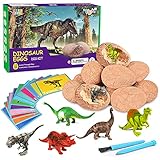
- Dino Eggs Kit: Discover 12 unique dinosaurs.With dig tools,feel like a real paleontologist excavating up unique toy dinosaurs.
- Knowledge Cards: Includes 12 dinosaur cards, each describing the history of a different dinosaur. After digging up a dino, match up the appropriate card to your dinosaur and learn more about it.
- 2 ways: Dig it up directly or put dinosaur eggs in water before digging,will be easier to dig up.A great learning and interaction toy for boys and girls.It fosters a love for science and paleontology in a fun and exciting way.
- 12 x Dinosaur Eggs (with a unique dinosaur toy in each), 12 x Chisel,12 x Brushes, 12 x Knowledge Cards.The best choice for kids, Easter gift, Birthday gift or Christmas gift.
- Perfect Easter Eggs Gift: Color packing box.A fun and educational gift for all ages. It fosters a love for science and paleontology in a fun and exciting way.
Imaging embryos without opening the egg
Physical preparation is not always the first way to investigate an egg. Micro-computed tomography (micro-CT) and synchrotron X-ray imaging can produce internal reconstructions while the specimen remains intact. Researchers can inspect the orientation of bones, estimate developmental stage and plan any later preparation around the most informative areas.
Quick wins for a faster PC:
Scan for outdated or missing drivers - takes under a minuteDriver Scan →Clear out junk files and repair common Windows errorsFree Scan →A Natural History Museum report describes Massospondylus eggs discovered in South Africa in 1976 and later examined with high-powered X-ray imaging and synchrotron scanning. The embryos’ bones were poorly ossified and had a density similar to the surrounding material, which made them difficult to distinguish. Imaging and reconstruction nevertheless revealed developmental details that would have been difficult to obtain by simply breaking open the eggs.
Imaging has limits. A scan can show a density contrast without identifying a bone with certainty, and reconstruction depends on the quality of the data and the geological material around the embryo. Scientists may combine several imaging modes with physical observations rather than treating one scan as definitive.
Two studies that illustrate the range of preservation
Soft-shell evidence in Protoceratops and Mussaurus
The 2023 soft-shell study examined embryo-containing fossils, including a clutch of at least 12 Protoceratops eggs. Six embryos in that material preserve nearly complete skeletons, according to the American Museum of Natural History release. The study’s key evidence was not a visibly intact membrane but a chemically altered halo detected around embryos. Microscopy, Raman analysis and comparison with living eggs supported the interpretation of non-biomineralized, soft-shelled eggs for the specimens studied.
This example shows why fossil interpretation requires more than visual inspection. A shell that appears absent may have left a chemical signal, while a chemical signal must still be tested against possible alteration during burial.
The Tool Desk
Outbyte Driver Updater FREEFix the driver behind crashes, sound loss and screen glitchesFind Drivers →Outbyte PC Repair FREERepair Windows errors before they cause bigger problemsFix Now →Rank #4

- JUMBO-SIZED DIG BRICK - At over 6" tall, this giant dinosaur egg dig brick is our largest ever! Using the included dig tools, kids can unearth the dino figurines inside just like a professional paleontologist would do!
- EXCAVATE 12 DINOS - Inside the jumbo egg are 12 dinosaur figurines, including favorites like velociraptor, stegosaurus, brachiosaurus, and more! It's the perfect start to a collection for any kid interested in dinosaurs.
- REPLICA T. REX TOOTH - Also included inside the dig brick is a replica T. Rex tooth! At 3" long and molded from a real T. Rex tooth fossil, it's a high-quality, stunningly accurate specimen kids will love adding to their new dinosaur collection.
- IDENTIFY & LEARN ABOUT EACH DINO - As kids uncover the dinosaur figures inside the egg, the included Learning Guide will help them identify each one. It also includes fascinating facts including their diet, where and when they lived, and more!
- AWARD-WINNING PRODUCTS - Blue Marble, winner of the Toy Association's prestigious Toy of the Year Award, proudly develops products that foster education, imagination, and creativity, with a U.S. support team to ensure a stellar experience!
The Lameta Formation assemblage in India
A 2023 Natural History Museum account of research in the Late Cretaceous Lameta Formation of central India reports 256 eggs grouped into six egg types. Researchers described one unusual specimen as a possible ovum-in-ovo egg and interpreted the broader assemblage as potentially indicating a nesting colony.
Those interpretations remain qualified. Other explanations cannot be ruled out, and further work is needed to determine whether different nests were made at the same time. The assemblage also demonstrates the parentage problem: even when eggs occur in apparent nests, linking an egg type to one dinosaur taxon is often difficult because embryos are uncommon.
Independent reader supportYour contribution helps us test, update, and keep practical guides available for everyone.What happens after excavation: museum preparation
Geological fossilization ends before museum conservation begins. Once excavated, an egg may be transported inside a supported block, commonly protected by a plaster jacket. The jacket and surrounding matrix are removed in a laboratory using mechanical or chemical methods selected for the specimen’s condition. Preparation is conservation work, not cosmetic cleaning.
1. Document the field context
Teams record the egg’s position, orientation, associated eggs, sediment and any visible fractures before removing material. Context can be as scientifically important as the exposed surface, so preparation should not erase it.
2. Remove the jacket and excess matrix
Preparators open the protective block and reduce surrounding rock gradually. They choose tools and, where appropriate, chemical methods according to the contrast between fossil and matrix. Force that is safe for a robust rock may shatter a thin shell or embryo-bearing area.
Best Value

- DISCOVER 12 UNIQUE DINOSAUR FIGURES: Each dino egg hides a different dinosaur toy, keeping the excitement alive through multiple digs and encouraging teamwork during group play. It's absolutely a novel toy for kids.
- READY-TO-GIFT ADVENTURE: Beautifully packaged in a gift-ready box, this all-inclusive set makes the perfect surprise for Easter baskets, birthdays, Christmas stockings, or dinosaur-themed parties.
- PERFECT FOR GROUP ACTIVITIES: Ideal for Easter egg hunts, classroom projects, party favors, or family game nights—designed to engage multiple kids ages 3–12 in shared excitement.
- SPARK STEM CURIOSITY & SKILLS: Enhances fine motor control, hand-eye coordination, and creative problem-solving while introducing concepts in paleontology through interactive play.
- MESS-FREE HANDS-ON FUN: Simply soak each egg for 3–5 minutes, then let kids safely excavate using the included chisel and brush. Easy cleanup when played on a tray or table.
3. Stabilize fragile areas
Cracks, loose fragments and powdering surfaces may need consolidation or repair. The aim is to keep original material in place and make the specimen safe to handle, scan and display. Any repair should remain distinguishable from the fossil itself in documentation.
4. Coordinate preparation with imaging
Scanning can reveal where an embryo, membrane residue or delicate shell structure lies. A museum may scan before exposing a surface, then remove only enough matrix to answer a specific question. This reduces the risk of destroying hidden evidence.
5. Store and monitor the specimen
After preparation, the egg or egg-bearing block needs stable support, appropriate storage and records of every intervention. Storage planning is part of preservation because vibration, mishandling or unsuitable conditions can damage a specimen long after excavation.
Outdated Drivers Are Slowing You Down
One free scan finds every outdated or missing driver and matches the right update for your exact hardware.Free scan · exact hardware matchPC Slower Than It Used to Be?
A free scan shows the junk files, broken settings and background clutter dragging Windows down - then fixes them in one click.Free scan · Windows 10 & 11These procedures require trained personnel and institutional equipment. A private attempt to chip matrix from a fossil egg can permanently destroy shell microstructure, impressions or embryo material, so preparation should not be treated as a do-it-yourself project.
How to evaluate a claim about a fossil egg
- Ask what physically survives. Is the claim based on shell, an impression, an embryo, or chemical residue?
- Check the method. Surface morphology, microscopy, spectroscopy and CT each reveal different evidence.
- Separate observation from interpretation. “Eggs occur in one layer” is an observation; “this was a colony nesting site” is a hypothesis.
- Look for a parent link. A nearby skeleton or a named egg type does not by itself establish which dinosaur laid it.
- Read the qualification. Diagenetic alteration, low image contrast and alternative explanations are normal parts of the scientific assessment.
- Keep specimen-specific numbers specific. The figures of 256 eggs, six egg types, a clutch of at least 12 eggs or six nearly complete embryos describe particular studies, not dinosaur eggs generally.
What fossil eggs can reveal
When evidence survives and is interpreted cautiously, fossil eggs contribute to several fields at once. Shell and membrane studies address reproductive biology and the evolution of egg construction. Embryos provide snapshots of skeletal development before hatching. Egg arrangements and sedimentary context allow researchers to test ideas about nesting, repeated use of sites and possible parental behavior.
The record is necessarily incomplete. Fossilization can remove the very structures that would identify a parent or reveal behavior, and museum preparation cannot restore information that was never preserved. The most reliable conclusions are therefore layered: a specimen may establish that an egg existed in a particular rock layer, preserve a measurable shell or embryo feature, and support a behavioral hypothesis without proving every step of the animal’s reproductive history.
Quick Recap
Product prices and availability are accurate as of the date/time indicated and are subject to change. Any price and availability information displayed on Amazon at the time of purchase will apply.
Free tools Windows power users keep installed
One-click scans. No signup required.

